


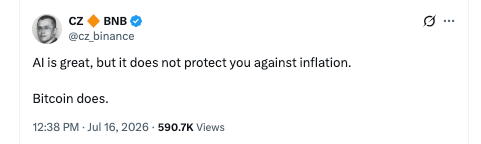
Binance founder Changpeng Zhao, widely known as CZ, has recently ignited a fresh debate within the financial and technological spheres by drawing a stark contrast between the capabilities of Artificial Intelligence (AI) and Bitcoin in addressing the persistent issue of inflation. While acknowledging the transformative potential of AI across various sectors, Zhao posited that it is Bitcoin, with its inherent design as a decentralized monetary system, that possesses the fundamental attributes to serve as a robust hedge against the erosive effects of inflation. This assertion, made through a public statement on X (formerly Twitter), has resonated with cryptocurrency advocates and sparked discourse among economists and industry observers.
The genesis of this comparison lies in the burgeoning influence of both AI and digital assets on the global economy. AI, a field experiencing exponential growth and investment, necessitates substantial infrastructure development, including massive data centers, advanced semiconductor manufacturing, and significant energy consumption. These demands, as highlighted by recent reports, are inadvertently contributing to inflationary pressures. Conversely, Bitcoin, since its inception in 2009, has been positioned by many as a digital store of value, designed with a fixed supply cap that proponents argue makes it inherently resistant to inflation. Zhao’s statement, therefore, frames this as a fundamental divergence in their utility when confronting economic headwinds.
The Inflationary Impact of the AI Boom
The rapid advancement and widespread adoption of Artificial Intelligence have undeniably begun to reshape the economic landscape. This technological revolution, while promising unprecedented productivity gains and innovations, is not without its immediate economic consequences. A significant driver of these consequences is the sheer scale of investment required to fuel the AI ecosystem. According to a report by Goldman Sachs, the burgeoning demand for AI-related hardware and infrastructure has become a noticeable contributor to rising consumer prices. This influx of capital is not merely theoretical; it translates into tangible increased costs for essential components such as high-performance computing chips, memory modules, and the extensive energy grids needed to power these operations.
Goldman Sachs’ analysis specifically pointed to the United States as a market experiencing a pronounced effect from these AI-driven economic shifts. The investment bank’s findings indicated that the surge in AI-related expenditures added approximately 20 basis points to the annual core Personal Consumption Expenditures (PCE) inflation rate. More concerning for policymakers, this trend has the potential to double by the end of 2026, underscoring the immediate inflationary pressures associated with the AI boom. This phenomenon creates a paradoxical situation where a technology aimed at optimizing efficiency and potentially reducing long-term costs is, in its nascent stages, contributing to short-term economic strain for consumers.
While the long-term outlook for AI in the economy is often viewed through a deflationary lens—as automation and improved efficiency could theoretically lower production costs and labor expenses—the immediate future presents a different picture. The energy-intensive nature of AI, coupled with the substantial capital expenditures required for its infrastructure, suggests that the inflationary pressures may persist or even intensify before the anticipated deflationary benefits materialize. This temporal lag in economic impact is a critical consideration for central banks and economic planners navigating the current inflationary environment.
Bitcoin: A Proven Inflation Hedge?
In stark contrast to the current inflationary implications of the AI surge, Bitcoin has, for a considerable period, been championed as a digital asset capable of acting as a hedge against inflation. While its proponents often acknowledge its inherent volatility and susceptibility to speculative price swings, historical data suggests a pattern of resilience and significant long-term returns. This resilience, they argue, positions it as a viable alternative to traditional inflation hedges.
A compelling illustration of Bitcoin’s historical performance comes from examining the decade between 2015 and 2025. During this period, Bitcoin experienced a remarkable surge of approximately 38,000%. This extraordinary growth trajectory not only outpaced traditional assets like gold and the stock market but also demonstrated its ability to maintain its value even after accounting for inflation. This performance, critics often contend, has stalled in more recent years, with Bitcoin struggling to maintain parity with other asset classes. However, proponents counter that its fundamental characteristics—namely its scarcity, enforced by a predetermined supply cap of 21 million coins, and its peer-to-peer, borderless transactional utility—continue to provide a valuable hedge against currency debasement and economic uncertainty.
Zhao’s consistent emphasis on Bitcoin, often singling it out from the broader cryptocurrency market, stems from this perceived long-term prowess. He frequently distinguishes Bitcoin from other digital assets, many of which have exhibited less predictable performance and are viewed with skepticism by seasoned investors. The argument is that while the altcoin market is often characterized by speculative bubbles and fleeting trends, Bitcoin’s established network effect, its decentralized nature, and its narrative as a digital store of value confer upon it a unique and enduring position in the financial ecosystem.
The Divergent Paths: AI vs. Bitcoin in Economic Stability
The core of CZ’s argument lies in the fundamental difference between a technological innovation and a monetary system. AI is a tool, a sophisticated set of algorithms and computational power designed to augment human capabilities and drive efficiency. Its economic impact, while potentially vast, is largely contingent on its application, the infrastructure it requires, and the resulting changes in production and consumption. The current inflationary pressures are a direct consequence of the capital and energy demands of building and deploying this technology.
Bitcoin, on the other hand, is designed as a decentralized, peer-to-peer electronic cash system, and increasingly, as a store of value. Its scarcity is an intrinsic feature, not an emergent property of its development. The fixed supply of Bitcoin means that its purchasing power is, in theory, less susceptible to dilution through increased issuance, a common mechanism by which fiat currencies can lose value over time due to inflation. This inherent characteristic, coupled with its global accessibility and resistance to censorship, forms the basis of its appeal as an inflation hedge.
Historical Context and Market Reactions
The discourse surrounding Bitcoin’s role as an inflation hedge is not new. Since the global financial crisis of 2008 and the subsequent quantitative easing policies implemented by central banks worldwide, investors and economists have been actively seeking alternative assets to preserve wealth. Gold has historically served this purpose, but Bitcoin emerged in the post-crisis era, offering a digital, portable, and mathematically secured alternative.
Early adopters and proponents of Bitcoin, including prominent figures in the tech and finance industries, began to articulate this narrative of "digital gold" around the mid-2010s. As inflation concerns periodically resurfaced, particularly during periods of economic stimulus or supply chain disruptions, the price of Bitcoin has often seen increased attention and speculative buying. For instance, during the COVID-19 pandemic and the subsequent massive stimulus packages, Bitcoin experienced a significant bull run, with many attributing its rise, in part, to its perceived role as a hedge against currency devaluation.
However, the volatility of Bitcoin remains a significant point of contention for skeptics. Critics often highlight instances of sharp price declines, which can erode capital rapidly, making it a risky proposition for investors seeking stability. The market capitalization of Bitcoin, while substantial, is still considerably smaller than that of traditional assets like gold or global equities, making it more susceptible to large price swings driven by sentiment, regulatory news, and macroeconomic shifts.
Expert Opinions and Broader Implications
The comparison drawn by CZ resonates with a segment of the financial community that views Bitcoin as a critical component of a diversified investment portfolio, particularly in an environment characterized by rising inflation and geopolitical uncertainty. Analysts at firms like JPMorgan have, at times, acknowledged Bitcoin’s potential as a store of value, even while expressing caution about its volatility.
Conversely, traditional economists often remain skeptical, emphasizing the speculative nature of Bitcoin and its lack of intrinsic value in the same way a company’s earnings or a commodity’s industrial use is understood. They point to the absence of a central bank or government backing, and the reliance on market sentiment and adoption for its value. The debate often boils down to whether Bitcoin is a nascent technological innovation with long-term potential or a speculative asset with limited fundamental value.
The implications of CZ’s statement extend beyond the immediate debate on inflation. It underscores the growing recognition of digital assets as legitimate financial instruments, capable of challenging traditional paradigms. As institutions and sophisticated investors continue to explore and allocate capital to cryptocurrencies, the narrative surrounding their utility, particularly in relation to macroeconomic challenges, gains further traction.
The future trajectory of both AI and Bitcoin will undoubtedly be closely watched. AI is poised to continue its integration into virtually every facet of life and commerce, promising unprecedented advancements. Its economic footprint, including its impact on inflation, will be a subject of ongoing analysis and policy adjustment. Bitcoin, meanwhile, will continue to navigate its path as a digital asset, with its value proposition as a store of value and hedge against inflation being tested by market dynamics, regulatory developments, and the evolving global economic landscape. Zhao’s assertion, therefore, serves as a timely reminder that while technological progress is paramount, the fundamental principles of monetary stability and value preservation remain critical concerns for individuals and economies alike. The choice between embracing a potentially inflationary technological advancement and a deflationary digital asset, as CZ suggests, may become an increasingly pertinent consideration for investors navigating the complexities of the 21st-century economy.














