


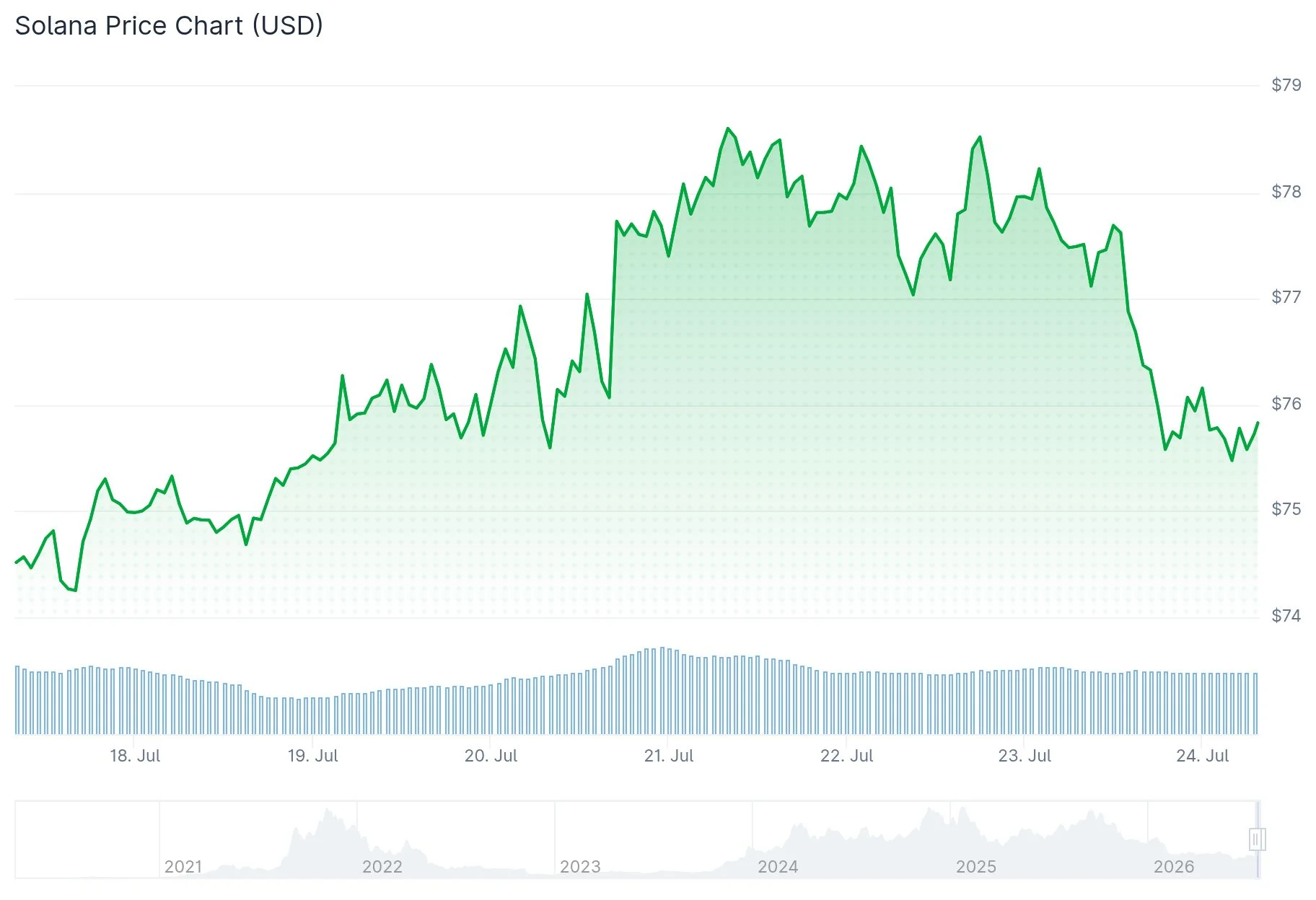
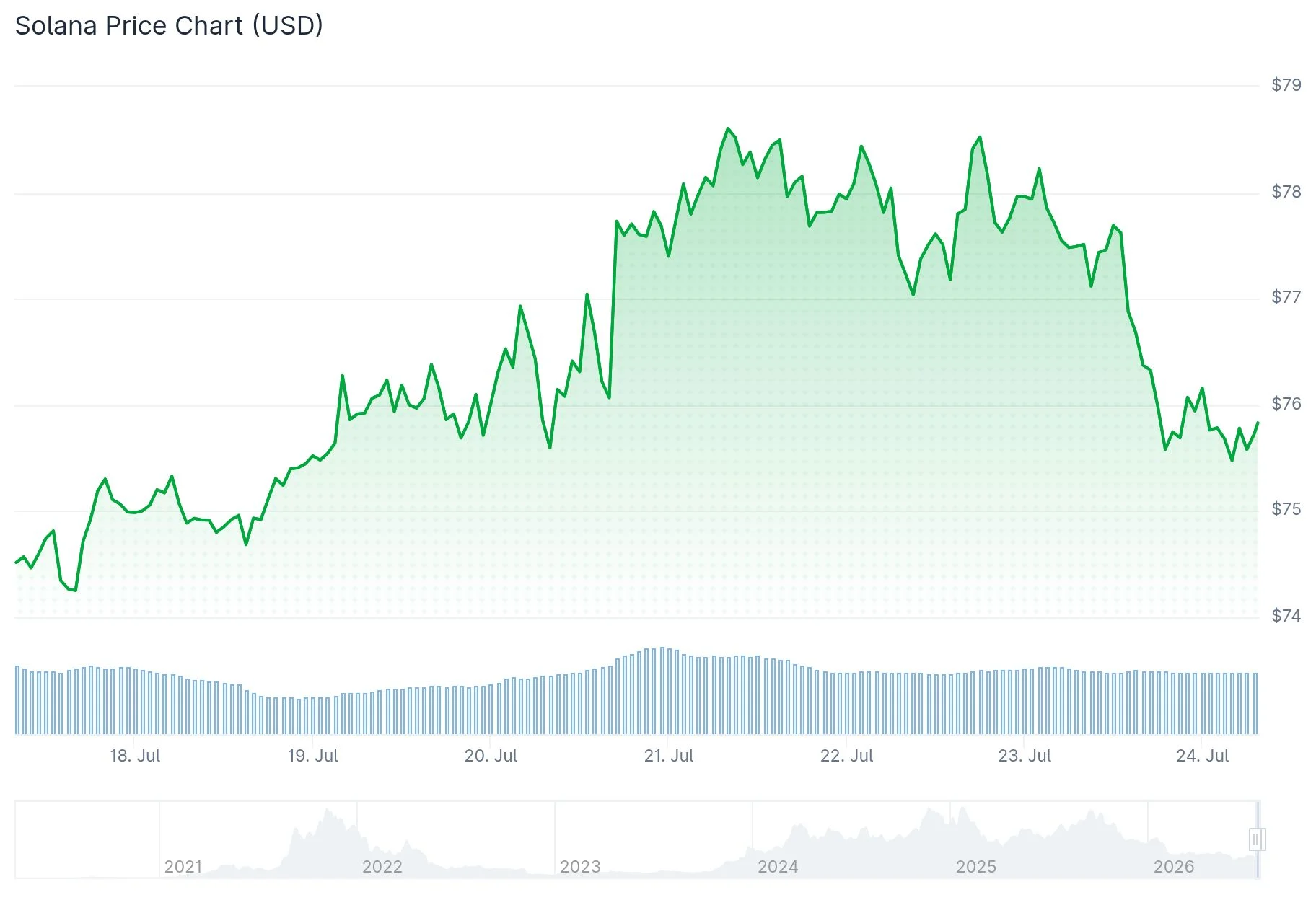
Solana, the high-performance blockchain, has distinguished itself as the premier performer among the top five cryptocurrencies by market capitalization over the past 30 days, recording an impressive 12% surge. This robust upward trajectory has propelled the digital asset, SOL, to trade around the $77 mark, underpinned by a substantial daily trading volume of $1.61 billion, signaling renewed investor confidence and significant market activity. This stellar performance positions Solana at the forefront of the digital asset landscape, particularly as the broader cryptocurrency market exhibits signs of consolidation after a period of rapid advance.
Solana’s Ascent in a Consolidating Market
Over the preceding month, while many established cryptocurrencies navigated a volatile landscape, Solana’s native token, SOL, demonstrated remarkable resilience and growth, securing its position as the strongest performer within its peer group of top-tier digital assets. The 12% gain is particularly noteworthy when viewed against a backdrop where other major cryptocurrencies like Ethereum, Binance Coin (BNB), Ripple (XRP), and Cardano (ADA) have shown more modest gains or even slight pullbacks. This outperformance underscores a growing conviction in Solana’s technological capabilities and its burgeoning ecosystem.
The current trading price of approximately $77 per SOL represents a critical juncture for the asset. While below its all-time highs, it signifies a strong recovery from earlier lows and a stable foundation for potential further growth. The daily trading activity, totaling $1.61 billion, is indicative of healthy liquidity and sustained investor interest, allowing for efficient price discovery and execution of large-scale trades. However, a closer examination of transaction volumes reveals a nuanced picture. Following a four-day consecutive upward price movement, daily transaction volumes experienced a modest decline from $2.2 billion down to $1.7 billion. This decrease, while not alarming, suggests that the market may be taking a pause, with some profit-taking occurring after the recent rally. Such consolidation phases are a natural part of market cycles, often preceding the next directional move, and are closely monitored by technical analysts for signs of trend continuation or reversal.
Institutional Capital Flows and ETF Dynamics
A significant driver behind Solana’s recent momentum has been the notable shift in institutional capital flows. This week, Solana-focused exchange-traded funds (ETFs) transitioned into positive territory, attracting approximately $7.2 million in fresh investment. This influx of capital into SOL-based investment products is a powerful indicator of increasing institutional appetite for Solana, moving beyond the traditional Bitcoin and Ethereum offerings. The emergence of specialized crypto ETFs, designed to provide regulated access to digital assets without direct ownership, has been a game-changer for institutional adoption. These products simplify investment, offering familiar structures for fund managers, pension funds, and wealth advisors.
Leading this charge was the Bitwise Solana Staking ETF (BSOL), which alone garnered $5.83 million on July 21. This performance marked BSOL’s strongest single-day inflow in a fortnight, highlighting a concentrated burst of institutional interest in a product that not only offers exposure to SOL’s price but also potentially yields staking rewards, an attractive feature for long-term investors. The ability to earn passive income through staking within a regulated ETF structure adds an additional layer of appeal, distinguishing Solana ETFs from many other passive crypto investment vehicles.
However, the subsequent trading session witnessed outflows totaling $1.27 million, representing approximately 25% of the previous day’s inflows. This type of short-term fluctuation is typical in the volatile cryptocurrency market and can be attributed to various factors, including short-term profit-taking, rebalancing by institutional portfolios, or reactions to broader market news. Despite this minor retracement, the overall trend for July remains overwhelmingly positive, with net inflows reaching nearly $12 million. This figure stands in stark contrast to June, which saw a net exodus of $786,000 from Solana ETFs, underscoring a significant reversal in sentiment and a renewed commitment from institutional investors.
While July’s performance is a strong positive, it represents an 86% decrease compared to the robust inflows witnessed in May, when Solana ETFs attracted a staggering $115 million. During that period, SOL was valued around the $80 mark, indicating that institutional interest can be highly sensitive to price action and broader market conditions. The fluctuations in monthly inflows highlight the evolving nature of institutional engagement, often characterized by periods of aggressive accumulation followed by consolidation or profit-taking.
Crucially, Solana and Hyperliquid ETF products collectively represent nearly 80% of the non-Bitcoin and non-Ethereum ETF trading volume. This dominance signifies Solana’s leadership in the nascent altcoin ETF market, demonstrating its appeal as a diversified asset choice for institutions looking beyond the two largest cryptocurrencies. Furthermore, the aggregate assets under management (AUM) for Solana ETFs are nearing the significant $1 billion milestone. Reaching this threshold would solidify Solana’s standing as a major institutional asset class, attracting further capital and cementing its position as a key player in the regulated crypto investment space. This milestone would also likely enhance its visibility and legitimacy within traditional financial circles.
A Deeper Look into Solana’s On-Chain Resurgence
Beyond price action and institutional flows, a profound revitalization is evident in Solana’s underlying network activity. One of the most compelling indicators of this resurgence is the dramatic comeback of previously inactive wallet addresses within Solana’s decentralized exchange (DEX) ecosystem. During the past week, approximately 62,000 such addresses returned to active participation, a monumental increase from fewer than 20,000 in the preceding period. This represents a remarkable 400% surge in returning participants and marks the highest count recorded in more than twelve months. This surge in dormant addresses reactivating signals renewed user engagement, potentially driven by new decentralized applications (dApps), ecosystem developments, or improved network performance following past challenges. It suggests a broadening user base and a deeper level of participation, which are vital for the long-term health and decentralization of the network.
Complementing this, the stablecoin reserves on Solana’s network have reached a fresh record high of $17 billion, according to data from DeFi Llama. This substantial increase in stablecoin holdings is a critical metric for several reasons. It indicates a significant amount of liquidity within the Solana ecosystem, suggesting that users are either holding capital on the network for future transactions, engaging in extensive DeFi activities such as lending, borrowing, and yield farming, or leveraging Solana for high-speed, low-cost transfers. High stablecoin reserves often precede increased trading activity or new investment into native tokens and dApps, as users convert stablecoins into other assets.
However, amidst these overwhelmingly positive on-chain metrics, one area shows lagging performance: application fee generation. Data suggests that fees generated by applications on Solana continue to languish at levels not seen in two years. This apparent contradiction—high user engagement and stablecoin reserves but low fees—could be attributed to Solana’s inherently low transaction costs, which are a core tenet of its design. While beneficial for users, it means that even a high volume of transactions may not translate into significant fee revenue for the network itself or its validators. It could also suggest a shift in the types of dApps gaining traction, perhaps favoring those with minimal fee structures, or a focus on activities like NFT trading or gaming that might have different fee models compared to traditional DeFi protocols. Nevertheless, the combination of returning users and record stablecoin reserves paints a picture of a network teeming with potential energy, poised for future growth and innovation.
Expert Market Projections and Technical Indicators
Prominent digital asset analysts are closely monitoring Solana’s trajectory, with many offering optimistic outlooks. Michaël van de Poppe, a respected figure in the crypto analysis community, recently shared on X (formerly Twitter) that SOL is "holding the range low," implying strong foundational support. Van de Poppe forecasted that it’s "just a matter of time" before the cryptocurrency accelerates toward the $120 threshold, identifying the $75 zone as a crucial support foundation for SOL. His analysis suggests that current price levels represent a consolidation phase before a significant upward breakout, contingent on maintaining key support.
From a technical analysis perspective, several indicators support a potentially bullish scenario for Solana. A significant moving average crossover has recently materialized, with the shorter-term moving average climbing above its longer-term counterpart. This configuration, often referred to as a "golden cross" when applied to longer timeframes, is typically monitored by market participants as a strong signal for potential trend reversals from bearish to bullish, indicating strengthening momentum. Furthermore, the Relative Strength Index (RSI), a momentum oscillator, is positioned above the midpoint of 50. An RSI above 50 generally indicates that buying pressure is stronger than selling pressure, signaling strengthening buyer interest and upward price momentum.
For Solana to definitively shift its market structure from bearish to bullish, it must establish a sustained close above the $97.89 level. Trading consistently beneath this threshold maintains the technically bearish pattern, despite recent gains. Should Solana successfully pierce through the immediate $78 resistance barrier, market analysts are targeting the $90-$95 zone as the subsequent objective. This zone is particularly significant as the 200-day exponential moving average (EMA) is currently positioned there, often acting as a strong dynamic resistance or support level. A sustained advance beyond $97 could then realistically propel prices into the $120-$130 territory, aligning with expert predictions and reinforcing a strong bullish reversal. These technical thresholds provide critical markers for traders and investors to gauge the asset’s short-to-medium-term price action and potential.
Macroeconomic Factors and Broader Market Sentiment
While Solana’s individual performance metrics are robust, the broader macroeconomic landscape and overall cryptocurrency market sentiment continue to exert influence. The Crypto Fear and Greed Index, a composite measure of market sentiment, currently registers at 39, hovering near the "Neutral" sentiment zone. This indicates that while extreme fear has subsided, there isn’t yet widespread "greed" or irrational exuberance, suggesting a cautious but not overly pessimistic market. A neutral sentiment can often precede significant price movements as conviction builds, but it also reflects underlying uncertainties.
One of the primary macroeconomic concerns for risk assets, including cryptocurrencies, is the stance of central banks. More than half of the analysts monitored by FedWatch anticipate a 25 basis point Federal Reserve rate increase by September. Historically, interest rate hikes by central banks tend to constrain upside potential for alternative cryptocurrencies in the immediate term. Higher interest rates typically increase the cost of capital, making riskier assets less attractive compared to safer, yield-bearing investments. This macro headwind could act as a ceiling for altcoin rallies, including Solana’s, even if its fundamental and technical indicators are strong. Investors will be closely watching the Fed’s decisions and forward guidance for clues on market direction. The interplay between Solana’s intrinsic strengths and these external macroeconomic pressures will define its trajectory in the coming months.
Solana’s Strategic Position and Future Outlook
Solana’s recent performance underscores its strategic importance within the blockchain ecosystem. Known for its high transaction throughput, low fees, and rapid finality, Solana continues to attract developers and users seeking scalable solutions for dApps, NFTs, and DeFi. Despite past challenges, including network outages, its core technology and vibrant community have demonstrated remarkable resilience. The recent surge in returning inactive wallets and record stablecoin reserves are strong indicators that the network’s utility and appeal are growing, driving organic user adoption.
The significant institutional interest, evidenced by rising ETF inflows and AUM nearing $1 billion, further legitimizes Solana as a serious contender in the digital asset investment space. This institutional backing is crucial for long-term price stability and market recognition. As the crypto market matures, the ability of an asset to attract regulated capital becomes a key differentiator. Solana’s success in capturing a dominant share of non-Bitcoin/Ethereum ETF volume highlights its distinct value proposition for institutional portfolios seeking diversification.
Looking ahead, Solana is positioned at a fascinating juncture. While macroeconomic headwinds and potential Federal Reserve actions could temper immediate upside, the underlying fundamentals of the network, coupled with strong technical indicators and expert projections, paint a compelling picture. The ongoing development of its ecosystem, continuous improvements in network stability, and its competitive advantages in speed and cost will likely continue to attract innovation and investment. For investors, the critical price thresholds of $78, $97.89, and the ambitious $120-$130 targets will serve as key benchmarks to monitor Solana’s journey toward potentially establishing new market highs and cementing its role as a foundational blockchain for the future of decentralized finance and web3. The coming months will be crucial in determining whether Solana can sustain its impressive momentum and navigate the broader market challenges to achieve its full potential.














