



The cryptocurrency market is currently witnessing a pivotal transition as Bitcoin, the world’s largest digital asset by market capitalization, faces significant technical hurdles that may pave the way for a broader altcoin resurgence. Recent data and market analysis from industry observers, including Justcryptopays and Binance Research, indicate that Bitcoin’s failure to sustain its momentum above critical psychological and technical thresholds is prompting a strategic rotation of capital. As the market enters the opening stages of 2026, the digital asset landscape is characterized by a delicate balance between Bitcoin’s cooling dominance and the emerging strength of alternative cryptocurrencies, commonly referred to as altcoins.
For much of the preceding year, Bitcoin acted as the primary vacuum for institutional and retail capital, bolstered by the maturation of spot Exchange-Traded Funds (ETFs) and its status as a digital "safe haven" amid global macroeconomic uncertainty. However, the technical narrative has shifted. Bitcoin recently broke below a long-standing diagonal trendline that had supported its upward trajectory throughout the latter half of 2025. This breach is more than a mere price fluctuation; it represents a potential exhaustion of the "Bitcoin-only" narrative that dominated the previous cycle. As Bitcoin struggles to reclaim the $90,000 level—currently oscillating around $90,525 with intermittent dips—investors are increasingly looking toward high-beta assets to achieve superior returns.
The Mechanics of Capital Rotation and Market Sentiment
The concept of "Alt-Season" is a cyclical phenomenon in the cryptocurrency market where capital flows from Bitcoin into Ethereum and subsequently into mid-cap and small-cap assets. This rotation typically occurs when Bitcoin enters a period of consolidation or mild retracement after a significant rally. When Bitcoin’s price volatility stabilizes or its dominance index (BTC.D) begins to decline, traders often perceive a lower risk-to-reward ratio in the flagship asset and seek opportunities in the altcoin sector.
Market analyst Justcryptopays notes that the recent break below the key trendline is a primary signal of this shifting dynamic. Historically, when Bitcoin loses a major support level, it often leads to a "sideways" market for the benchmark asset. During these periods of range-bound trading, the liquidity that was previously concentrated in Bitcoin begins to permeate the rest of the ecosystem. This liquidity "trickle-down" effect is currently being observed in major assets such as Ethereum (ETH), Solana (SOL), Cardano (ADA), and XRP, all of which have shown signs of decoupling from Bitcoin’s immediate price action.
Historical Context: Shaking Off the Bearish Momentum of 2025
To understand the significance of the current market structure, one must examine the performance of the crypto market throughout 2025. The previous year was characterized by a grueling bearish sentiment for many altcoins, even as Bitcoin reached new heights. While Bitcoin benefited from institutional inflows, many decentralized finance (DeFi) and Web3 tokens struggled with regulatory clarity and a lack of retail engagement.

The "altcoin winter" of 2025 saw many projects lose 50% to 80% of their value against Bitcoin pairs. This prolonged period of underperformance has created a "coiled spring" effect. As 2026 begins, the valuation of many altcoins relative to Bitcoin is at multi-year lows, making them attractive to value investors. The challenge for bulls in the current quarter is to overcome the overhead resistance established during the 2025 sell-offs. Breaking these long-term bearish trends is essential for confirming that the current rally is a sustainable trend rather than a short-lived "dead cat bounce."
Technical Indicators: The $90,000 Threshold and the 21-Day Moving Average
Technical analysis remains at the forefront of the current market transition. Bitcoin’s struggle at the $90,000 mark is a significant psychological hurdle. In financial markets, round numbers often act as "magnets" for buy and sell orders. The inability of Bitcoin to turn $90,000 into a firm support level suggests that the market is currently lacking the necessary "buy-side" pressure to push toward the six-figure territory.
While Bitcoin wavers, specific altcoins are flashing bullish signals. For instance, Chainlink (LINK) recently broke above its 21-day Moving Average (MA), a common indicator used by swing traders to identify short-term trend reversals. When major utility tokens like LINK begin to outperform their moving averages, it often serves as a leading indicator for the rest of the altcoin market. Similarly, Ethereum has shown resilience, holding key support levels even as Bitcoin faced selling pressure. The Ethereum-to-Bitcoin (ETH/BTC) ratio, a critical metric for gauging altcoin health, has begun to show signs of a bottoming formation, suggesting that the "smart money" is positioning for an ETH-led recovery.
The Role of Solana, XRP, and Emerging Ecosystems
The potential altcoin resurgence is not limited to Ethereum. Solana (SOL) continues to capture significant market share due to its high throughput and growing ecosystem of decentralized applications (dApps). Solana’s ability to maintain its price levels during Bitcoin’s volatility has made it a favorite among institutional traders looking for an alternative to the more established Layer 1 protocols.
Furthermore, XRP and Cardano (ADA) have seen renewed interest as regulatory environments in various jurisdictions become more defined. The legal clarity surrounding XRP, in particular, has allowed it to act as a bellwether for the "old guard" of altcoins. If these established assets can sustain a breakout, it typically provides the confidence necessary for capital to flow into more speculative segments of the market, such as memecoins and emerging DeFi protocols. Memecoins, while highly volatile, often serve as a gauge for retail participation. A surge in memecoin trading volume is frequently the final stage of a full-blown alt-season, indicating that retail "FOMO" (Fear Of Missing Out) has returned to the market.
Institutional Response and Infrastructure Growth
The institutional landscape in 2026 differs significantly from previous cycles. The infrastructure for altcoin investment has matured, with more custodial services and regulated platforms offering a wider array of digital assets. Binance Research highlights that the professionalization of the market has led to more sophisticated capital rotation. Instead of haphazardly buying any available token, institutional investors are focusing on projects with tangible utility, revenue-generating models, and robust developer activity.
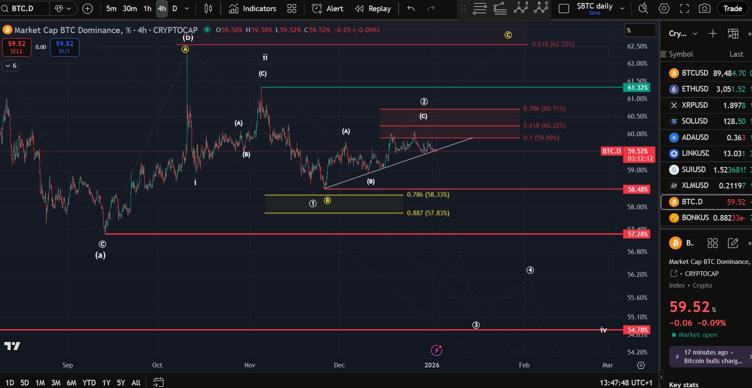
Statements from various hedge fund managers and crypto-native investment firms suggest a "wait and see" approach regarding Bitcoin’s $90,000 level. However, many have already begun diversifying their portfolios. The logic is simple: if Bitcoin is entering a period of diminishing returns due to its massive market cap, the percentage gains available in mid-cap altcoins represent a more efficient use of capital. This institutional shift is reflected in the rising "Total 3" market cap—a metric that tracks the total market capitalization of all cryptocurrencies excluding Bitcoin and Ethereum.
Broader Implications for the Digital Asset Economy
A shift toward a more balanced market has profound implications for the entire digital asset economy. A Bitcoin-dominated market is often seen as a "one-trick pony" by traditional financial analysts. However, a thriving altcoin ecosystem demonstrates the diversity and utility of blockchain technology beyond just a store of value.
- Innovation Incentive: A rally in altcoins provides the necessary funding for startups and developers. When token prices rise, project treasuries expand, allowing for more aggressive research and development in fields like Zero-Knowledge proofs, cross-chain interoperability, and decentralized physical infrastructure networks (DePIN).
- Market Maturity: A market that can sustain multiple concurrent rallies across different sectors (e.g., AI tokens, Gaming, and DeFi) is a sign of a maturing asset class. It suggests that investors are performing fundamental analysis rather than just following Bitcoin’s lead.
- Volatility Management: While altcoins are traditionally more volatile, a diversified market can actually provide better risk-adjusted returns for sophisticated traders. The ability to hedge Bitcoin positions with altcoin longs—or vice versa—allows for more complex and robust trading strategies.
Timeline of Expected Market Movements
As the first quarter of 2026 progresses, the market will likely follow a specific chronology of events. The first phase is the current "Testing Phase," where Bitcoin attempts to reclaim and hold the $90,000 support. If Bitcoin fails and enters a consolidation range between $85,000 and $90,000, the second phase—the "Altcoin Awakening"—will likely accelerate.
During this second phase, expect to see Ethereum lead the charge, followed closely by high-performance Layer 1s like Solana. By the mid-point of the year, if the macroeconomic environment remains favorable—specifically regarding interest rate decisions by the Federal Reserve and global liquidity cycles—the market could enter the third phase: a "Full-Scale Alt-Season." This phase is characterized by widespread gains across nearly all sectors of the crypto market, often decoupled from Bitcoin’s price action.
Conclusion and Strategic Outlook
The break in Bitcoin’s trendline and its struggle at $90,000 are not necessarily bearish signs for the industry at large; rather, they are indicators of a healthy market evolution. For the cryptocurrency sector to reach its next stage of growth, it must move beyond its reliance on a single asset. The data provided by Binance Research and the observations from technical analysts suggest that the "Altcoin Rally" is not just a possibility but a logical progression of the current market cycle.
Investors and traders are advised to remain vigilant. While the prospects for altcoins are brightening, the "bearish momentum of 2025" still casts a long shadow. Strategic positioning in assets with strong fundamentals, high liquidity, and clear technical breakouts—such as those moving above their 21-day and 200-day moving averages—will be the key to navigating the coming months. As capital continues to rotate, the digital asset market is poised for a more balanced and potentially more lucrative era, where the "benchmark" Bitcoin shares the spotlight with a diverse array of innovative protocols and tokens.














