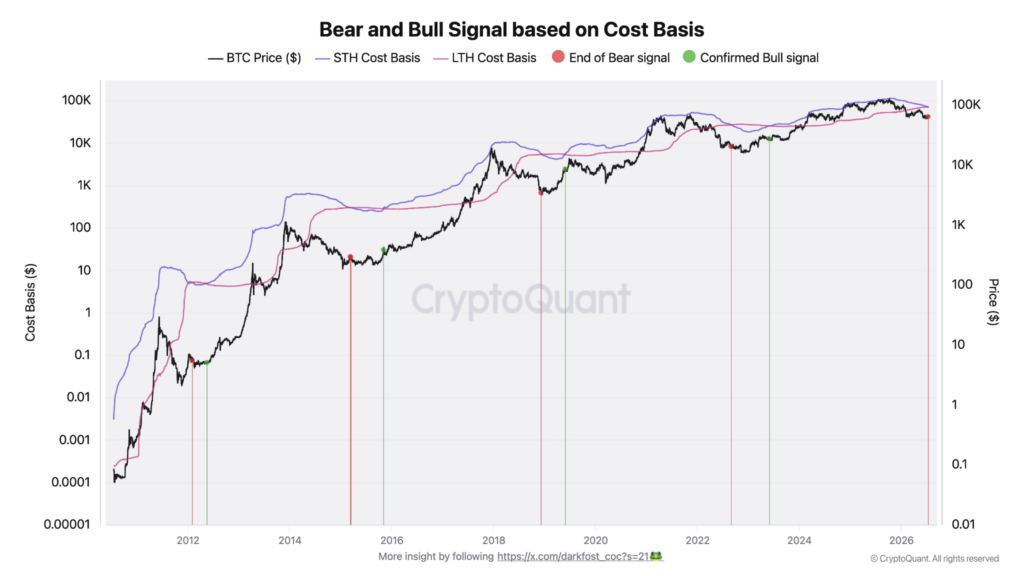
On-chain indicators are flashing signals that the protracted nine-month bear market for Bitcoin may be entering its terminal phase, potentially paving the way for a recovery. Popular crypto analyst Darkfost recently highlighted a significant on-chain development: a downward crossover of the cost basis between Short-Term Holders (STH) and Long-Term Holders (LTH). This crucial signal, confirmed over a three-day period, suggests a fundamental shift in market dynamics that has historically preceded the end of bear cycles.
The concept of cost basis, particularly when segmented between short-term and long-term holders, offers a granular view into investor behavior and market sentiment. Short-Term Holders are typically defined as those who have held their Bitcoin for less than 155 days, while Long-Term Holders have possessed their assets for longer. The cost basis represents the average price at which these groups acquired their holdings. When the cost basis of STHs falls below that of LTHs, it implies that newer market participants are entering the ecosystem at progressively lower prices, effectively diluting the average purchase price of the overall holder base. This downward pressure on the STH cost basis is often interpreted as a sign of capitulation among recent buyers, who are forced to sell at a loss, and a potential precursor to a market bottom.
Darkfost’s analysis, shared via a detailed tweet, emphasized the reliability of this specific indicator. "The end-of-bear-market signal has just flashed," he stated, elaborating that "This signal is defined by the downward crossover of the STH/LTH cost basis (with a 3-day confirmation window to validate the signal)." This confirmation period is critical, as it filters out short-lived fluctuations and provides greater confidence in the trend’s sustainability.
The Shift in Holder Cost Basis
The accompanying graph provided by Darkfost visually depicts this significant shift. It illustrates a dramatic decline in the STH cost basis, which has reportedly fallen from a peak of approximately $112,500 down to $69,000. This substantial decrease signifies that a large segment of recent Bitcoin buyers have incurred significant losses, leading them to divest their holdings. Consequently, the average acquisition price for this cohort has been substantially reduced.
The crossover event, where the STH cost basis dips below the LTH cost basis, is particularly noteworthy. Historically, this has marked a pivotal moment in Bitcoin’s market cycles. The current scenario suggests that the market is approaching a point where the cost of acquiring Bitcoin for new entrants is becoming more attractive, potentially drawing in opportunistic investors. The potential for the STH cost basis to dip even further below the LTH cost basis in the coming months adds to the narrative of a potential market bottom being formed.
Historical Context and Market Cycles
Bitcoin’s price action has historically been characterized by cyclical behavior, often linked to the halving events, which occur approximately every four years. These events reduce the rate at which new Bitcoins are created, impacting supply and potentially driving prices upward. The preceding bull runs have typically seen sharp price increases followed by prolonged bear markets, during which prices can decline by 70-80% or more from their all-time highs.

The current bear market, which has persisted for approximately nine months, follows a period of significant growth that saw Bitcoin reach all-time highs in late 2021. The subsequent downturn has been attributed to a confluence of factors, including macroeconomic headwinds such as rising inflation and interest rates, regulatory scrutiny, and the collapse of several prominent crypto firms. This prolonged period of price decline has tested the resolve of many investors, leading to capitulation events that are now being reflected in the STH cost basis.
The STH/LTH cost basis crossover has been a reliable indicator in previous market cycles. For instance, during the 2018-2019 bear market, a similar crossover preceded the eventual bottom. The confirmation of this signal in the current environment suggests that the market may be mirroring these historical patterns, indicating that the most severe phase of the downturn might be behind us.
Implications for Investment Strategies
The prevailing market conditions, characterized by a potentially bottoming bear market, create fertile ground for strategic investment approaches like Dollar Cost Averaging (DCA). DCA involves investing a fixed amount of money at regular intervals, regardless of the asset’s price. This strategy helps to mitigate the risk of buying at a market peak and can be particularly effective during periods of high volatility or when an asset is believed to be undervalued.
As the STH cost basis falls and overlaps with the LTH cost basis, it suggests that the average entry price for new investors is becoming more favorable. This can encourage more systematic buying strategies, as investors may feel more confident entering the market knowing that the risk of immediate, substantial losses is decreasing. However, it is important to note that the signal indicates the beginning of the end of the bear market, not its immediate conclusion. The recovery phase can still be gradual and subject to volatility.
The Path Forward: Divergence and Confirmation
While the current overlap in STH and LTH cost bases signals the terminal phase of the bear market, a definitive confirmation of a bull market’s onset will likely come with a subsequent upward crossover. This means that as prices begin to recover, new buyers (STHs) will start accumulating at higher prices, causing their cost basis to rise above that of the long-term holders.
This future divergence is a key event to watch for. However, there is no fixed timeline for its occurrence. Market analysts suggest it could take several months, or potentially even over a year, for this upward crossover to materialize and be confirmed. The duration will depend on various factors, including broader economic conditions, regulatory developments, and institutional adoption of Bitcoin.
Despite the uncertainty in timing, the current signal underscores Bitcoin’s maturation as an asset class. While some market observers have questioned the persistence of the traditional four-year market cycles, particularly in light of recent events, the cyclical investor behavior associated with Bitcoin appears to be enduring. The ability of these on-chain metrics to provide insights into investor psychology and market structure suggests that, for now, these historical patterns remain relevant.
Expert Perspectives and Market Sentiment
The analysis by Darkfost is indicative of a growing sentiment among some on-chain analysts that a market bottom is forming. These analysts often rely on a suite of on-chain metrics, including holder accumulation and distribution patterns, exchange flows, and network activity, to gauge the health of the Bitcoin market. The STH/LTH cost basis crossover is considered one of the more robust indicators due to its direct link to investor behavior and profitability.
However, it is crucial to acknowledge that not all market participants share this optimistic outlook. Some analysts and investors remain cautious, arguing that further price declines may be necessary before a definitive bottom can be established. They point to lingering macroeconomic uncertainties and the potential for unforeseen "black swan" events within the crypto space. The current low for Bitcoin in this cycle has been around the $58,500 mark, and opinions are divided on whether this level will hold or if further downside is imminent.
The divergence in opinions highlights the inherent volatility and speculative nature of the cryptocurrency market. While on-chain data provides valuable insights, it is not a foolproof predictor of future price movements. Investor sentiment, global economic conditions, and regulatory decisions all play significant roles in shaping market outcomes.
Broader Impact and Future Outlook
The potential end of a prolonged bear market for Bitcoin carries significant implications not only for the cryptocurrency itself but also for the broader digital asset ecosystem. A sustained recovery in Bitcoin’s price often has a ripple effect, boosting the confidence of investors in other cryptocurrencies and potentially attracting new capital into the market.
Furthermore, the maturation of Bitcoin’s market cycles, as suggested by the enduring relevance of metrics like the STH/LTH cost basis, indicates a growing understanding of its economic principles and investor behavior. This increasing predictability, even within cyclical frameworks, can contribute to greater institutional interest and adoption.
The coming months will be critical in observing whether the current on-chain signals translate into a sustained upward trend. The confirmation of an upward STH/LTH cost basis crossover will be the ultimate validation of a new bull market. Until then, investors are likely to remain vigilant, closely monitoring price action, on-chain data, and macroeconomic developments to navigate this potentially pivotal moment in Bitcoin’s history. The ongoing debate about the relevance of the four-year cycle versus uncharted territory will continue, but for now, the data suggests a familiar pattern of recovery may be unfolding.