


Arthur Hayes, the co-founder of BitMEX and a prominent figure in the cryptocurrency space, has significantly increased his holdings of Ethereum (ETH), acquiring an additional 1,290 ETH valued at approximately $2.5 million. This substantial purchase, executed using funds transferred to the institutional trading firms Cumberland and FalconX three days prior, underscores a notable accumulation trend by a high-profile investor as Ethereum approaches a pivotal technical resistance level. The acquisition has intensified market scrutiny on Ethereum’s immediate price trajectory, particularly as it trades just below the critical $1,900 threshold, a price zone widely regarded by analysts as determinative for its next directional movement. Market participants are now keenly observing whether a surge in buying pressure can propel ETH above this formidable resistance, potentially clearing the path towards the psychological $2,000 mark and beyond.
Arthur Hayes: A Key Figure and His Market Influence
Arthur Hayes is not merely an investor but a widely recognized thought leader and influential voice within the cryptocurrency ecosystem. As the co-founder and former CEO of BitMEX, one of the earliest and largest cryptocurrency derivatives exchanges, Hayes possesses an intimate understanding of market mechanics, liquidity flows, and institutional trading strategies. His public commentary, often shared through his blog and interviews, frequently offers deep insights into macroeconomic trends, regulatory shifts, and their potential impact on digital assets. Consequently, his personal investment actions, particularly large-scale accumulations of specific cryptocurrencies, are closely watched by both retail and institutional investors. Such moves are often interpreted as strong signals of conviction regarding the asset’s future prospects, especially when they occur at critical junctures in the market. Hayes’s consistent accumulation of Ethereum suggests a long-term bullish outlook, reinforcing a narrative of increasing institutional confidence in the second-largest cryptocurrency by market capitalization. This latest purchase is not an isolated incident but rather a continuation of a pattern, highlighting a sustained belief in Ethereum’s fundamental value and growth potential despite broader market volatility.
The Anatomy of a Major Ethereum Acquisition
The on-chain data tracking Hayes’s transaction provides valuable transparency into the mechanics of institutional-grade cryptocurrency purchases. The transfer of funds to Cumberland and FalconX, both well-established over-the-counter (OTC) trading desks catering to high-net-worth individuals and institutions, indicates a preference for executing large orders without significantly impacting public exchange order books. This method helps mitigate slippage and allows for more discreet accumulation, which is a common practice among "whale" investors seeking to build substantial positions. The $2.5 million valuation of the 1,290 ETH acquired places this transaction firmly in the category of significant capital deployment, signaling a strategic move rather than speculative day trading. The timing, just days after funds were moved, suggests a pre-planned execution designed to capitalize on specific market conditions or technical levels. This methodical approach underlines the strategic intent behind Hayes’s ongoing accumulation strategy for Ethereum.
Ethereum’s Technical Crossroads: The $1,900 Hurdle

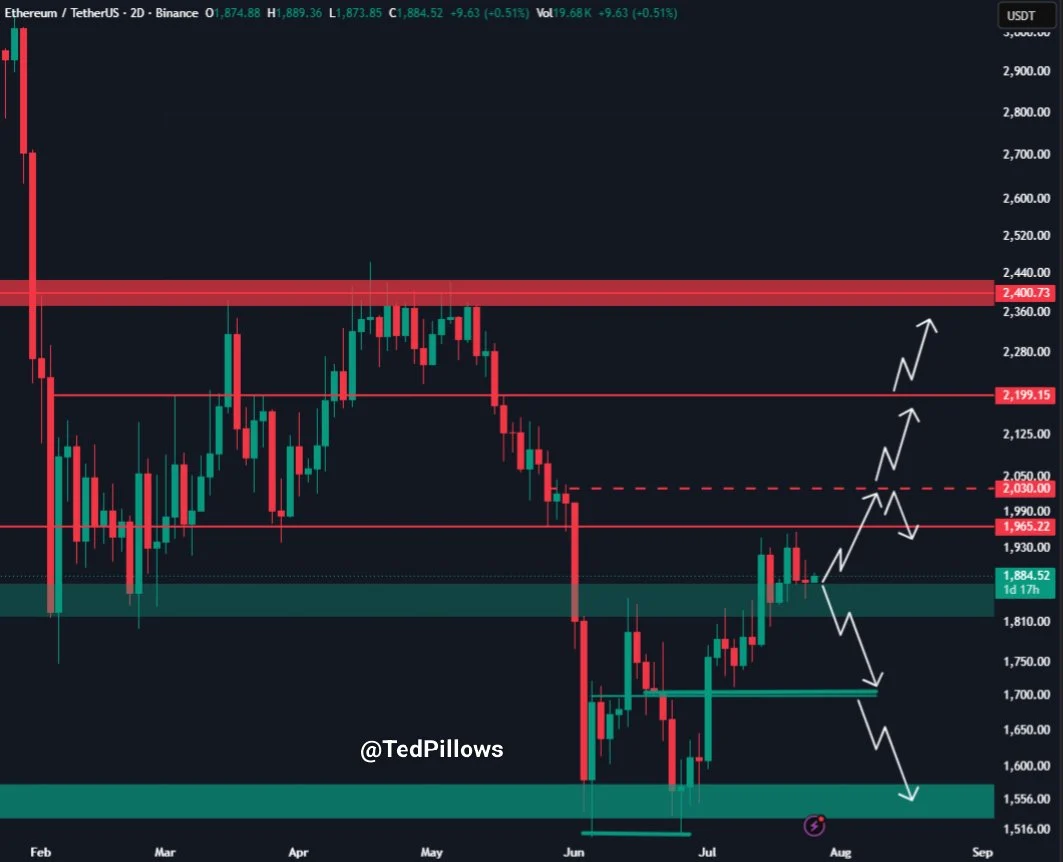
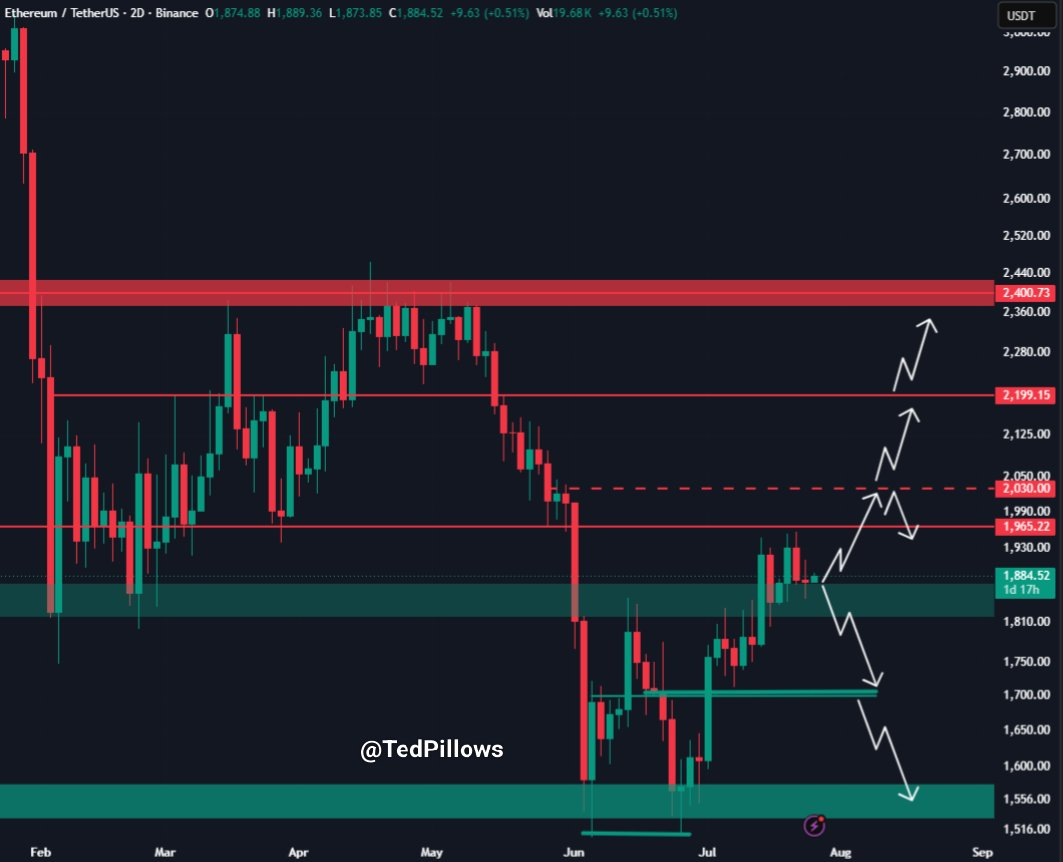
The current price action of Ethereum places it at a critical technical juncture, with the $1,900 level acting as a formidable resistance. A review of the accompanying 2-day ETH/USDT chart (Source: X, Ted Pillows) illustrates Ethereum’s steady recovery from its June lows, characterized by a series of higher lows throughout July. However, this upward momentum has consistently encountered selling pressure around the $1,900 zone, where previous rallies have stalled.
Technical analysis, a discipline focused on identifying patterns and trends in market data, suggests that overcoming key resistance levels is crucial for an asset to sustain an uptrend. For Ethereum, a decisive breach above $1,900 would not only signify a victory over persistent selling but also imply a shift in market sentiment. According to market analyst Ted Pillows, reclaiming and establishing support above $1,900 could act as a catalyst, potentially triggering a near-term surge toward the $2,000 mark. A successful breakout beyond this psychological barrier would then set the stage for further advancement, with the next significant resistance anticipated around the $2,200 region, before Ethereum could challenge the broader supply zone near $2,400. These levels represent areas where a high concentration of previous selling activity occurred, and breaking them would indicate renewed bullish strength.
Conversely, the failure to surmount the $1,900 resistance and, more critically, to hold current support levels, could expose Ethereum to a renewed downside trajectory. A rejection at this level might lead to a decline toward the $1,700 support, a level that has historically offered some stability. Should selling pressure intensify, a deeper correction could see Ethereum revisiting the $1,550 support zone, which represents a more significant area of historical demand. The outcome of this contest between buyers and sellers at the $1,900 level will likely dictate Ethereum’s price action in the coming weeks, making it a focal point for traders and investors alike.
On-Chain Data: Illuminating Investor Sentiment and Flow
The transparency inherent in blockchain technology allows for unprecedented insight into market dynamics, particularly through on-chain data analysis. Beyond simply tracking transactions, on-chain metrics offer a glimpse into investor behavior, accumulation trends, and network health. Hayes’s transfer of funds to Cumberland and FalconX for his ETH purchase exemplifies how large, strategic accumulations are often executed. These OTC desks facilitate private, large-volume transactions that bypass public exchanges, preventing immediate price impact and offering better execution for significant orders. This method is preferred by institutional players and high-net-worth individuals for its efficiency and discretion.
The sustained accumulation by figures like Hayes, identifiable through on-chain tracking, often correlates with broader "whale" activity. Whale transactions, characterized by their large size, can act as leading indicators, suggesting that informed investors are positioning themselves for anticipated market movements. When multiple large entities begin accumulating an asset, it can signal an underlying confidence in its long-term value, potentially preceding significant price appreciation. Furthermore, monitoring the flow of ETH to and from exchanges can provide additional insights. A net outflow of ETH from exchanges, for instance, often indicates that investors are moving their assets into cold storage or staking protocols, reducing immediate selling pressure and signaling a hold strategy. Conversely, a net inflow might suggest an intent to sell. The current environment, marked by high-profile accumulation, suggests a prevailing sentiment of long-term holding among key players.
Beyond Price: Robust Network Activity Underpins Ethereum’s Value
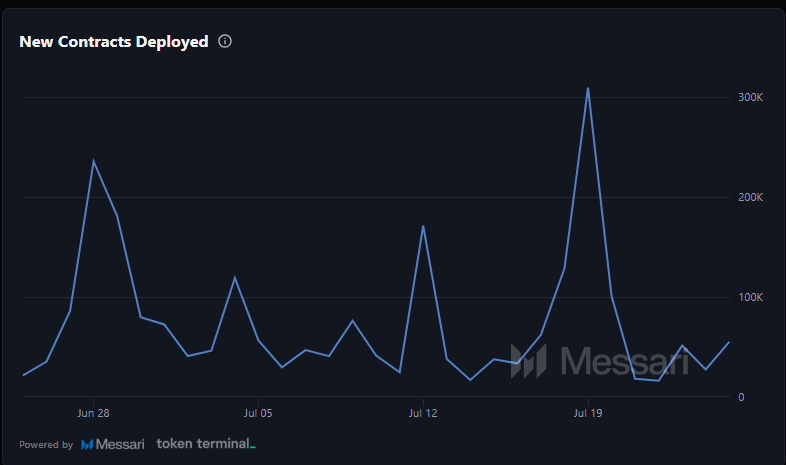
While price action and technical levels capture immediate attention, the underlying health and utility of a blockchain network are crucial for its long-term viability. Ethereum’s ecosystem continues to demonstrate robust activity, reflecting sustained developer confidence and innovation. The Messari data on new smart contract deployments, as depicted in the accompanying chart (Source: Messari), provides compelling evidence of this vitality. Throughout July, Ethereum witnessed several significant spikes in new smart contract creations, with one surge exceeding 300,000 new contracts deployed.
Smart contracts are the foundational building blocks of decentralized applications (dApps), powering everything from decentralized finance (DeFi) protocols to non-fungible tokens (NFTs) and various Web3 initiatives. Consistent deployment activity, even amidst market volatility, signifies that developers are actively building, innovating, and expanding the functional capabilities of the Ethereum network. This ongoing development is a strong indicator of ecosystem growth, irrespective of short-term price fluctuations.
Beyond smart contract deployments, other network metrics further corroborate Ethereum’s robust health. Daily active users, transaction volumes, and the total value locked (TVL) in DeFi protocols on Ethereum all contribute to a comprehensive picture of its utility. While specific figures fluctuate, a sustained baseline of these metrics underscores the network’s continued relevance and adoption. The "Merge" upgrade in September 2022, transitioning Ethereum from a proof-of-work to a proof-of-stake consensus mechanism, significantly enhanced its energy efficiency and laid the groundwork for future scalability improvements. This was followed by the "Shanghai" upgrade in April 2023, which enabled staked ETH withdrawals, further maturing the staking ecosystem. These foundational improvements continue to attract both capital and talent, bolstering Ethereum’s position as the leading smart contract platform. The combination of strong developer participation and ongoing technological advancements paints a picture of an ecosystem that is not only resilient but also poised for continued evolution and expansion.
Ethereum’s Evolving Ecosystem: A Magnet for Capital and Innovation
Ethereum’s foundational role in the broader Web3 movement cannot be overstated. It serves as the backbone for the vast majority of decentralized finance (DeFi) applications, where users can lend, borrow, trade, and earn interest without traditional intermediaries. The network also dominates the non-fungible token (NFT) market, hosting some of the most prominent digital art and collectible projects. This extensive utility, combined with its established developer community and robust security, makes Ethereum an attractive proposition for both individual and institutional investors.
The ongoing accumulation by high-profile individuals like Arthur Hayes is not an isolated phenomenon but rather reflects a broader trend of increasing institutional interest in Ethereum. Beyond direct token purchases, institutions are exploring various avenues for exposure, including Ethereum Exchange-Traded Products (ETPs) and futures contracts. The anticipation of a spot Ethereum ETF in markets like the United States, following the potential approval of Bitcoin ETFs, could further open the floodgates for institutional capital, integrating Ethereum more deeply into traditional financial systems. This institutional validation is crucial for the long-term maturation and stability of the asset.
Moreover, the continuous advancements within Ethereum’s scaling roadmap, including Layer 2 solutions like Optimism, Arbitrum, and zkSync, are addressing previous concerns regarding network congestion and high transaction fees. These solutions are expanding Ethereum’s capacity, making it more accessible and efficient for a wider range of applications and users. The synergy between a thriving developer ecosystem, ongoing technological improvements, and growing institutional acceptance positions Ethereum as a critical asset in the evolving digital economy.
Market Psychology and the Influence of High-Profile Investors
The actions of influential figures like Arthur Hayes carry significant weight in the cryptocurrency market. Often referred to as "whale watching," observing the movements of large investors can provide insights into potential market shifts. When a well-known and respected figure publicly or demonstrably accumulates a significant amount of an asset, it can instill confidence among other investors, potentially triggering a cascade of buying activity. This "signaling effect" is particularly potent in a market often driven by sentiment and narrative.
The confluence of Hayes’s accumulation with Ethereum testing a crucial technical resistance level creates a powerful narrative. It suggests that major players believe in Ethereum’s ability to overcome these technical hurdles and embark on a new upward trajectory. This can sway undecided investors, encouraging them to enter or increase their positions, thereby contributing to the very buying pressure needed to break resistance. Conversely, if a high-profile investor were to liquidate a significant portion of their holdings, it could trigger fear and selling pressure. This interplay between technical analysis, fundamental strength, and market psychology is a defining characteristic of cryptocurrency markets, where narratives can often amplify price movements.
The Road Ahead: Scenarios for Ethereum’s Immediate Future
The coming days and weeks are poised to be critical for Ethereum’s price action. The immediate focus remains on the $1,900 resistance level. For bullish momentum to strengthen and for Hayes’s accumulation to be validated in the short term, Ethereum must decisively break above $1,900 and establish it as a new support level. A sustained move above this threshold would likely encourage further buying, shifting market sentiment positively after months of consolidation and range-bound trading. Such a breakout would open the door for a retest of the $2,000 psychological barrier, followed by potential targets at $2,200 and ultimately $2,400, as outlined by technical analysts.
Conversely, a sustained rejection below the $1,900 resistance would likely keep Ethereum trading within its current range, increasing the probability of another test of lower support levels, particularly $1,700 and potentially $1,550. Such a scenario would reinforce the perception of a market lacking the necessary conviction for a significant upward move, prolonging the period of accumulation or even leading to further downside if broader market conditions deteriorate.
For now, the strategic accumulation of Ethereum by Arthur Hayes, coupled with an improving technical structure and consistently robust network activity, places ETH at a pivotal juncture. The market is keenly awaiting whether buying pressure can convert the $1,900 resistance into a foundational support, thereby extending its recovery towards its next major price objectives and reaffirming its position as a leading force in the digital asset landscape. The outcome of this immediate technical battle will provide significant clues regarding Ethereum’s short-to-medium-term trajectory.














