PI Network (PI) has demonstrated a notable recovery, reclaiming the $0.13 price level as buying interest returns to the market. This resurgence follows a period of decline, with the digital asset now holding firm above this critical support. Technical indicators suggest a potential shift in momentum, though traders remain cautious due to low trading volumes, which could temper the sustainability of any upward trend.
PI Network Price Analysis: Key Levels and Market Sentiment
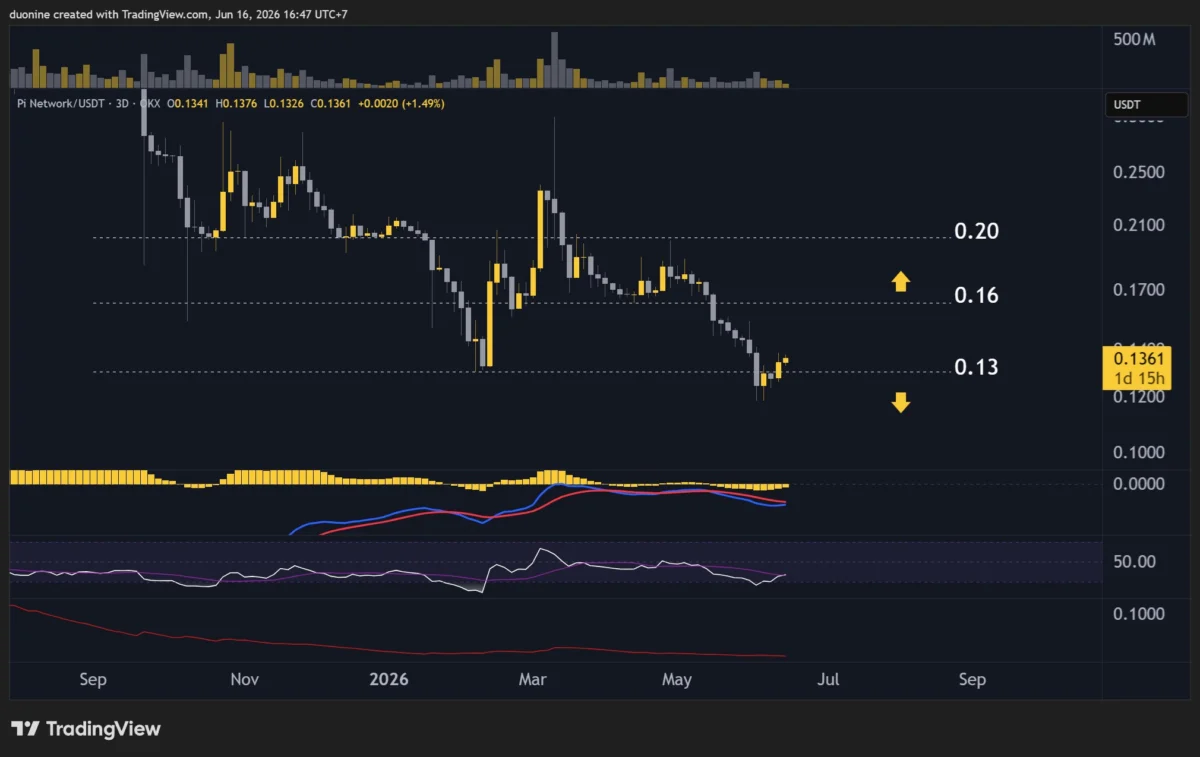
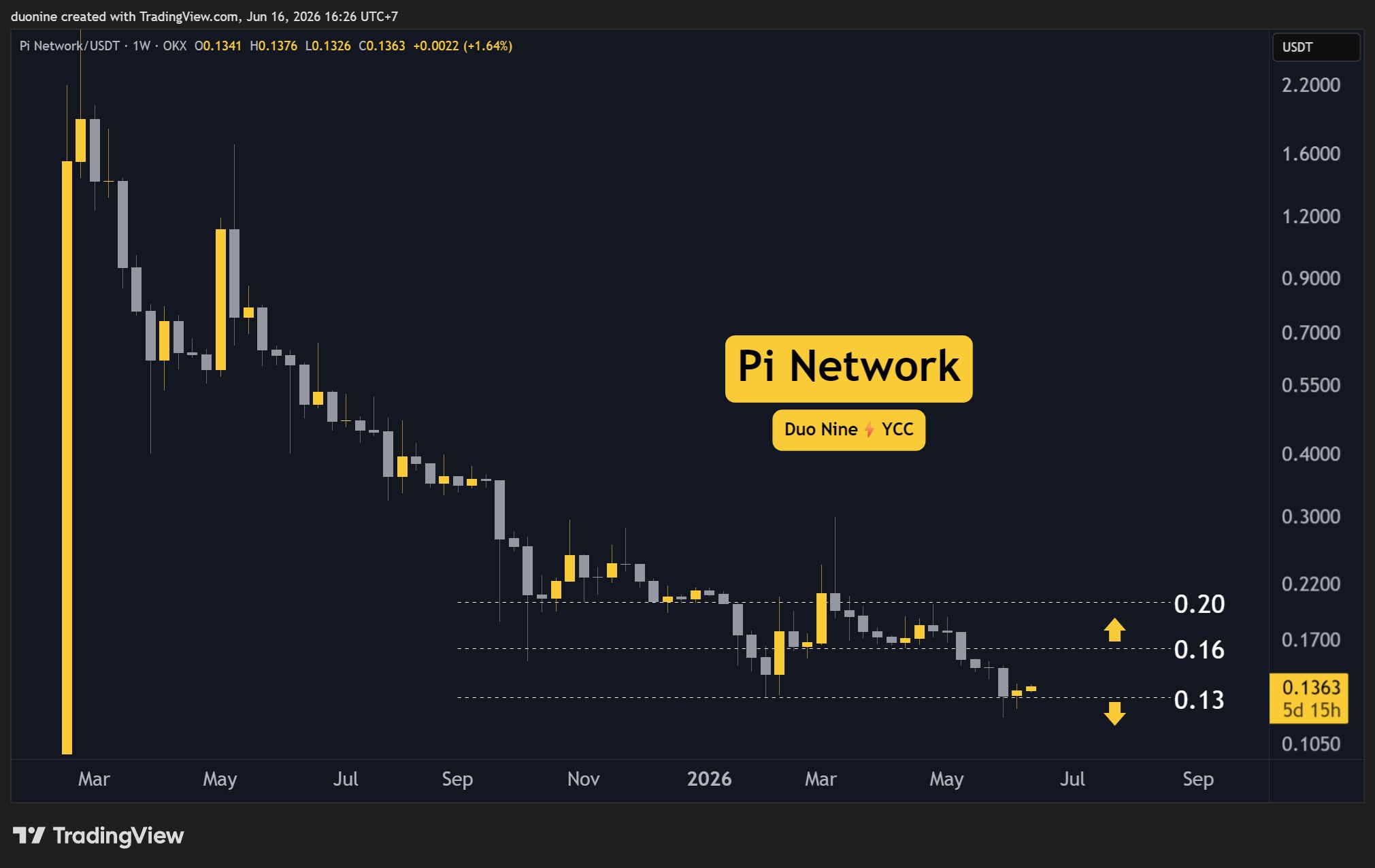
At the time of reporting, PI Network was trading above the $0.13 mark, a level identified as a crucial support zone. The ability of buyers to maintain this floor is paramount for any further bullish sentiment to take hold. A sustained presence above $0.13 is interpreted as a positive sign, indicating that the asset may have found a local bottom after a protracted downtrend.
However, the underlying market dynamics present a mixed picture. While the price action on daily charts suggests a potential reversal—evidenced by a higher low on the Relative Strength Index (RSI) compared to a lower low in price, a pattern known as bullish divergence—the volume of trades remains a significant concern. This divergence typically signals that selling pressure might be waning, and a potential trend reversal is on the horizon. For this bullish outlook to gain stronger validation, PI Network would need to decisively break through key resistance levels at $0.16 and subsequently at $0.20.
Identifying a Local Bottom Amidst Volatility
The recent price action for PI Network suggests that the asset may have established a temporary floor at $0.13. This level has acted as a significant psychological and technical barrier, and its successful defense by buyers is a key indicator of potential price stabilization. Historically, cryptocurrencies often experience periods of consolidation after sharp declines, and the $0.13 mark appears to be serving as such a consolidation point for PI.
The concept of "bullish divergence" is a critical element in this analysis. It occurs when an asset’s price makes lower lows, but its momentum indicator (like the RSI) makes higher lows. This disparity suggests that the downward momentum is weakening, and the underlying buying pressure may be increasing, even if not yet reflected in significant price gains. For PI Network, this pattern is a signal that the prevailing downtrend might be nearing its end. However, traders and analysts emphasize that this divergence is a preliminary indicator and requires confirmation through further price action and increased trading activity.
The Crucial Role of Trading Volume
Despite the positive signals from price action and momentum indicators, the trading volume accompanying PI Network’s recent recovery remains notably subdued. This low volume is a point of contention among market observers, as it suggests a lack of strong conviction from buyers. In a market where volume is sparse, even modest buying pressure can temporarily inflate prices, potentially leading to a "bull trap." A bull trap is a scenario where an asset’s price rises temporarily, luring in new buyers, only to reverse sharply downwards as sellers reassert control, leaving the recent buyers with losses.
For PI Network’s current uptrend to be considered sustainable and robust, an accompanying increase in buy volume is essential. Such an increase would validate the return of investor confidence and provide the necessary fuel for breaking through resistance levels. Without this confirmation, the risk of a price reversal and a return to lower levels remains elevated. The current low volume environment means that any significant selling pressure could quickly overwhelm the nascent buying interest, undoing the recent gains.
Understanding the Implications of Low Volume
The current trading volume for PI Network can be characterized as declining, even as the price attempts to move higher. This is an atypical scenario in a healthy uptrend, which is usually supported by expanding volume. The low volume suggests that the buying interest might be limited to a small group of traders or is driven by speculative short-term plays rather than broad-based accumulation.
This situation poses a significant challenge for PI Network. If the price were to continue its ascent on such low volume, it would be vulnerable to rapid corrections. A strong move upwards typically requires a broad participation of market players, which is reflected in high trading volumes. The absence of this broad participation raises questions about the underlying strength of the current recovery. Analysts often look for a confluence of factors—including price momentum, positive divergence in technical indicators, and robust trading volume—to confirm a genuine trend reversal. In PI Network’s case, the volume component remains a significant missing piece.
Momentum Indicators Signal a Bullish Bias
In contrast to the concerns surrounding trading volume, other technical indicators, particularly the daily Moving Average Convergence Divergence (MACD), are painting a more optimistic picture for PI Network. The MACD, a widely followed momentum indicator, has turned bullish. This positive shift has been observed since PI Network successfully reclaimed the $0.13 level and managed to sustain its position above it.
The bullish bias from the MACD suggests that the upward momentum is building. Analysts anticipate that this momentum could carry the price of PI Network towards the immediate resistance level at $0.16. This initial target is considered a significant hurdle, and its breach would be a crucial step in confirming a more sustained recovery.
The Path to $0.20 and Beyond
The trajectory for PI Network’s price, as suggested by the bullish MACD, points towards a potential retest of the $0.16 resistance. Successfully overcoming this level would be a significant psychological victory for buyers and could pave the way for further upward movement towards the next major resistance point at $0.20.
The critical question for investors and traders is whether buyers can muster enough strength and conviction to break through these resistance levels. If PI Network experiences a rejection at the $0.16 mark, it is highly probable that sellers will re-enter the market. Such a scenario could lead to a rapid decline in price, potentially pushing PI Network back down to its established support level of $0.13 in short order. The interplay between buyer accumulation and seller activity at these key price points will be crucial in determining the short-to-medium term direction of PI Network.
Background and Context of PI Network
The PI Network project, launched with the aim of making cryptocurrency mining accessible to everyday users through mobile devices, has garnered a substantial community of participants since its inception. The project’s core proposition revolves around a free mining mechanism that allows users to accumulate PI tokens simply by checking in daily via a mobile application. This approach has led to a vast user base, though the token has yet to be listed on major cryptocurrency exchanges for public trading, and its actual market value has been a subject of speculation and debate.
The development roadmap of PI Network has often been characterized by its gradual approach, with a focus on building out its ecosystem and utility before a full public launch. This has led to periods of anticipation and uncertainty among its community members regarding the token’s future listing and price discovery. The current price indications, often seen on over-the-counter (OTC) markets or through unofficial channels, do not represent a fully established market valuation.
Timeline of PI Network’s Development and Price Activity
While PI Network’s journey has been ongoing for several years, its price dynamics have largely been confined to internal assessments and informal trading. The initial phase of the project involved extensive development and community building, with users mining PI tokens without an immediate market value.
As the project progressed, discussions and unofficial listings on certain platforms began to emerge, leading to fluctuating price indications. The period leading up to the current analysis saw PI Network experience a notable price correction, bringing its perceived value down to the $0.13 level. This decline occurred against a backdrop of broader cryptocurrency market volatility and specific project-related developments or market sentiment shifts. The subsequent recovery to $0.13 marks a significant point in this recent price history, suggesting a potential turning point in its short-term trajectory.
Broader Implications and Future Outlook
The recent price action of PI Network, while showing signs of a potential recovery, underscores the inherent volatility and speculative nature of many digital assets, particularly those in their developmental stages. The ability of PI Network to sustain its reclaim of the $0.13 level and break through subsequent resistance points will be closely watched by its large community.
The project’s future success hinges not only on its technical development and ecosystem growth but also on its eventual integration into the broader cryptocurrency market. A successful listing on reputable exchanges, coupled with demonstrable utility and adoption of the PI token, would be critical for establishing a stable and verifiable market price. Until then, price movements will likely remain subject to speculation, technical analysis based on unofficial pricing, and the sentiment of its dedicated user base.
The current technical indicators, such as the bullish divergence on the RSI and the bullish turn in the MACD, provide a degree of optimism. However, the persistent low trading volume serves as a cautionary flag. Market participants will be looking for a substantial increase in buyer participation and a decisive break above key resistance levels to confirm a more robust and sustainable upward trend for PI Network. The coming weeks will likely be crucial in determining whether this reclaimed support at $0.13 can serve as a springboard for further price appreciation or if the asset will retrace its steps. The broader implications for PI Network’s community and its path towards wider market recognition will be significantly influenced by these short-term price developments.