The cryptocurrency market has entered a period of intense structural reassessment as BNB, the native utility token of the BNB Chain ecosystem, continues to solidify its position as the world’s fourth-largest digital asset by market capitalization. Following a decisive performance in May where BNB successfully reclaimed its ranking above XRP, the focus of the investment community has shifted from short-term volatility to long-term valuation ceilings. A comprehensive new analysis of the asset’s trajectory suggests that while a return to previous all-time highs and a move toward the $2,000 to $3,000 range remains within the realm of mathematical probability, the more hyperbolic price targets of $10,000 to $20,000 would require a fundamental transformation of the global financial landscape.
As of the current market cycle, BNB maintains a market capitalization of approximately $80.6 billion. This valuation places it in an elite bracket of "mega-cap" cryptocurrencies, trailing only behind Bitcoin (BTC), Ethereum (ETH), and the leading stablecoin, Tether (USDT). The token’s previous peak performance, which saw prices reach approximately $1,370, represented a total market valuation of nearly $185 billion. This historical context provides a baseline for understanding the scale of growth required to reach the ambitious milestones currently being discussed by retail traders and institutional analysts alike.
The Mathematical Constraints of a Trillion-Dollar Valuation
The discourse surrounding BNB’s potential to reach a five-figure price point is often detached from the underlying mathematics of market capitalization. According to Crypto Patel, a prominent market analyst whose recent breakdown has gained significant traction on social media, the path to a $10,000 BNB is inextricably linked to the asset’s supply dynamics. BNB operates under a rigorous "burn" protocol, which involves the permanent removal of tokens from circulation through both a real-time burning mechanism (BEP-95) and quarterly scheduled events. The ultimate goal of this program is to reduce the total supply of BNB to 100 million tokens.
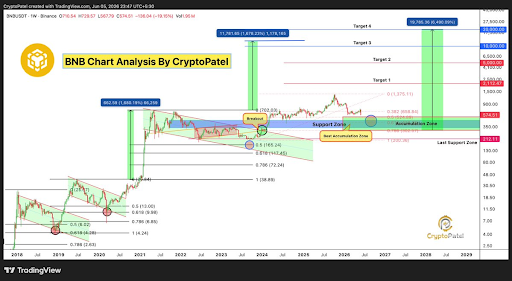
Under the assumption that the 100-million-token supply target is achieved, a price of $10,000 per BNB would result in a total market capitalization of $1 trillion. To put this figure into perspective, a $1 trillion valuation is roughly equivalent to the current market dominance of Bitcoin. For BNB to reach this level, it would essentially need to capture a portion of the global store-of-value market that is currently reserved for the industry’s "digital gold."

The analysis becomes even more stark when evaluating the $20,000 price target. At a $20,000 valuation per token, the BNB ecosystem would be worth $2 trillion. This figure exceeds the total valuation of the entire cryptocurrency market during several periods of its history. As Patel noted in his assessment, any near-term projection suggesting a $20,000 price target is likely based on speculative marketing rather than sober financial analysis. Such a valuation would require a global crypto market cap likely exceeding $10 trillion to $15 trillion, a scenario that implies massive institutional adoption and the integration of blockchain technology into the core of global sovereign finance.
Chronology of Market Movements: From XRP to Ethereum
The recent ascent of BNB is characterized by its resilience against other major "altcoins." In mid-May, BNB underwent a significant price rally that allowed it to overtake XRP in the global rankings. This shift was not merely a temporary fluctuation but rather a reflection of the diverging utility cases between the two assets. While XRP remains entangled in various regulatory and cross-border payment narratives, BNB has benefited from the massive transactional volume of the Binance exchange and the burgeoning DeFi (Decentralized Finance) and RWA (Real World Asset) sectors on the BNB Chain.
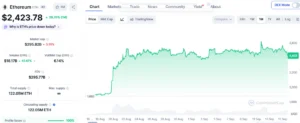
Since flipping XRP, the gap between the two assets has widened, leading many to ask if the "flippening" of Ethereum is the next logical step. Currently, the distance between BNB and Ethereum remains substantial. Based on static market figures, BNB would need to trade at approximately $1,500 per token to match Ethereum’s valuation (calculated at $203 billion for the purpose of this specific comparison). While $1,500 is within striking distance of BNB’s historical peak, the reality of market dynamics suggests that Ethereum would not remain stagnant. In a bullish environment where BNB rises to record levels, Ethereum—the primary layer-one smart contract platform—would likely experience a simultaneous upward trajectory, maintaining the valuation gap.
The Binance Concentration Risk and Ecosystem Dependencies
A critical component of any BNB price analysis is the inherent relationship between the token and the Binance exchange. Unlike Bitcoin, which is decentralized and lacks a single point of failure, or Ethereum, which has a diverse array of stakeholders and developers, BNB’s value proposition is heavily concentrated within the Binance ecosystem.
Analysts have identified this as "Binance concentration risk." Almost every major driver of BNB’s value—including the burn mechanism, the utility of exchange fee discounts, the launchpad for new projects, and institutional custody solutions—runs through or is adjacent to the Binance brand. This creates a high-beta relationship with the exchange’s regulatory and operational health.

In recent years, Binance has faced significant scrutiny from global regulators, including a high-profile settlement with the U.S. Department of Justice (DOJ) and the transition of leadership from founder Changpeng "CZ" Zhao to Richard Teng. While the exchange has demonstrated remarkable resilience and a commitment to compliance under its new leadership, any future legal or operational hurdles for Binance would inevitably exert downward pressure on BNB. Conversely, the continued expansion of Binance into new markets and its maintenance of the highest liquidity in the crypto space serve as the primary fundamental tailwinds for the token.
Supporting Data: Burn Mechanisms and RWA Integration
The fundamental bull case for BNB is supported by two primary pillars: deflationary pressure and expanding utility. The BNB Auto-Burn mechanism is designed to be independent of the Binance centralized exchange, using a formula that calculates the amount to be burned based on the BNB price and the number of blocks produced on the BNB Chain during the quarter. This transparency is intended to provide investors with a predictable model for supply reduction.
Furthermore, the BNB Chain has seen a surge in the integration of Real World Assets (RWAs). Recent data indicates that the total value of RWAs on the chain has hit a milestone of $3 billion. This includes tokenized versions of traditional financial instruments, such as treasury bills, real estate, and commodities. By providing a low-cost, high-speed environment for RWA transactions, the BNB Chain is positioning itself as a vital infrastructure provider for the next wave of institutional blockchain adoption. This utility transcends the "exchange token" label and places BNB in direct competition with other smart-contract platforms for a share of the burgeoning tokenization market.
Chronology of Projections: The 2029 Horizon
While $10,000 or $20,000 may seem unrealistic in the current 2024–2025 market cycle, analysts like Crypto Patel do not rule these figures out for the distant future. The analytical charts presented suggest a multi-year trajectory that accounts for the cyclical nature of the crypto market, typically dictated by Bitcoin’s four-year halving schedule.
The timeline for a potential $20,000 BNB is projected for 2029 at the earliest. This five-year outlook assumes several key factors:
- Continued Deflation: The successful reduction of circulating supply toward the 100 million mark.
- Institutional Adoption: The approval and success of BNB-based exchange-traded products (ETPs) or ETFs, similar to those seen for Bitcoin and Ethereum.
- Global Market Expansion: A significant increase in the total cryptocurrency market cap, driven by global inflation and the devaluation of fiat currencies.
- Technological Superiority: The ability of the BNB Chain to maintain its edge in transaction throughput and cost-efficiency against competitors like Solana and Ethereum’s Layer-2 solutions.
Impact and Implications for Investors
The implications of this analysis are twofold. For the conservative investor, the data suggests that BNB remains a robust "blue-chip" asset within the crypto space, with a realistic path toward doubling or tripling its previous all-time high as it challenges Ethereum’s dominance. The $2,000 to $3,000 range is viewed not as a fantasy, but as a target achievable through standard market growth and the continued execution of the BNB Chain’s roadmap.
For the speculative investor, the analysis serves as a cautionary note against "outlier" price targets. The mathematical reality of a $1 trillion or $2 trillion market cap for a single utility token requires a level of market maturity that does not yet exist. Investors are encouraged to monitor the "Binance concentration" factor and the progress of the chain’s decentralization efforts as key indicators of long-term stability.
In conclusion, BNB has successfully navigated the turbulent waters of 2023 and early 2024, proving its staying power by reclaiming its position over XRP. While the journey toward $10,000 remains a long-term mathematical challenge dependent on massive global shifts, the asset’s current trajectory confirms its status as a cornerstone of the digital asset economy. Whether it can eventually bridge the gap with Ethereum will depend on its ability to evolve beyond its exchange-centric roots and become the preferred infrastructure for the tokenized future of global finance.