The rapid evolution of artificial intelligence is fundamentally altering the landscape of digital privacy, creating unprecedented capabilities for financial surveillance on public, transparent blockchains. According to a recent analysis by Grayscale Research, the integration of AI tools into blockchain forensics is significantly increasing the risk of de-anonymization for users of traditional digital assets like Bitcoin. By leveraging machine learning algorithms to correlate vast amounts of on-chain transaction data with off-chain information—such as social media activity, IP addresses, and exchange KYC (Know Your Customer) records—AI is making it increasingly difficult for individuals to maintain financial confidentiality. This technological shift marks a critical turning point in the digital asset industry, prompting a reassessment of privacy-preserving technologies as a necessary safeguard against pervasive monitoring.
The Evolution of Privacy Concerns: A Three-Wave Perspective
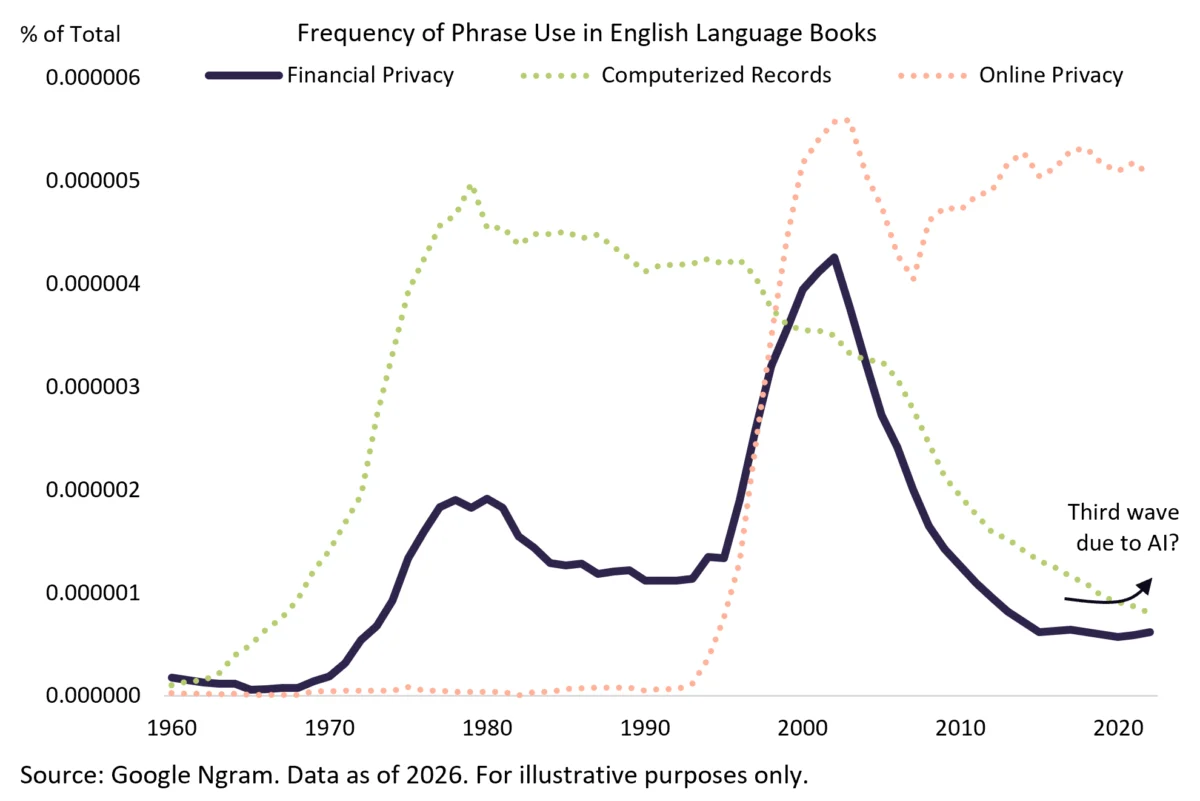
Grayscale Research contextualizes the current threat within a broader historical framework, identifying three distinct "waves" of privacy concerns triggered by technological advancements. Each wave has necessitated a new set of solutions to protect individual autonomy in an increasingly digitized world.
The first wave emerged in the 1970s with the initial digitization of financial records. As banks and financial institutions moved away from paper-based ledgers toward computer systems, the efficiency of record-keeping increased, but so did the potential for centralized surveillance. This era saw the introduction of early data protection regulations as governments and citizens began to grapple with the implications of automated data processing.
The second wave arrived in the 1990s with the commercialization of the internet. The rise of the World Wide Web brought about the democratization of information but also introduced new vectors for tracking consumer behavior and personal communications. The response to this wave included the development of encryption protocols like SSL/TLS and the eventual implementation of comprehensive data privacy laws, such as the General Data Protection Regulation (GDPR) in the European Union.
We are now entering the third wave, driven by the convergence of blockchain technology and artificial intelligence. While blockchains provide a decentralized alternative to traditional finance, their inherent transparency is becoming a vulnerability in the age of AI. Grayscale argues that the ability of AI to process and synthesize data at scale means that "anonymity through obscurity" is no longer a viable defense on public ledgers.
The Vulnerability of Transparent Ledgers to AI Forensics
Bitcoin, the world’s first and most prominent cryptocurrency, operates on a public ledger where every transaction is visible to anyone with an internet connection. While the Bitcoin white paper originally suggested that privacy could be maintained by keeping public keys anonymous, the reality has proven more complex. In the current ecosystem, sophisticated blockchain analytics firms utilize AI to "label" addresses—associating a string of alphanumeric characters with a real-world identity.
AI models are particularly adept at pattern recognition. They can analyze the timing of transactions, the specific amounts being sent, and the frequency of interactions between certain wallets to build a "digital fingerprint" of a user. When this on-chain data is cross-referenced with data leaked from web trackers, cookies, or centralized exchange databases, the veil of pseudonymity is often lifted. This capability heightens the risk of financial surveillance not only by state actors but also by malicious third parties who can use de-anonymized data for targeted attacks, phishing, or competitive intelligence.
Zcash as a Technological Countermeasure
In response to these mounting surveillance risks, Grayscale Research highlights Zcash (ZEC) as a potential solution for users prioritizing financial privacy. Unlike Bitcoin, which is transparent by default, Zcash was built with the specific goal of providing a "shielded" environment for value transfer.
Zcash utilizes a sophisticated form of cryptography known as Zero-Knowledge Succinct Non-Interactive Arguments of Knowledge, or ZK-SNARKs. This technology allows a user to prove that a transaction is valid—meaning they have the funds and the authority to send them—without revealing any of the underlying data, such as the sender’s address, the receiver’s address, or the transaction amount.
Zach Pandl, Grayscale’s Head of Research, emphasizes that Zcash functions more like physical cash than a traditional digital ledger. In a physical cash transaction, the exchange occurs privately between two parties without a permanent, public record of the participants’ identities. Pandl suggests that as AI-driven surveillance becomes more pervasive, the privacy features of Zcash could transition from a niche preference to a "must-have" requirement for a broad spectrum of digital asset users.

"We expect AI to create new threats to financial privacy, and to motivate a search for new solutions," Pandl stated. "Zcash, a Bitcoin-like digital currency with additional privacy features, may be one of those solutions. Shielded Zcash transactions, using the power of zero-knowledge cryptography, hide both transacting addresses and the amount being transferred."
Technical Analysis of Shielded Transactions
The efficacy of Zcash lies in its dual-address system: transparent addresses (t-addresses) and shielded addresses (z-addresses). While t-addresses function similarly to Bitcoin, z-addresses leverage the "shielded pool" to break the linkable trail of transactions.
When a user moves funds from a transparent address to a shielded address, the transaction is visible, but once the funds are within the shielded pool, their subsequent movements are mathematically obscured from public view. This structure provides a "privacy set"—the larger the pool of shielded transactions, the harder it is for any analytical tool, AI-driven or otherwise, to discern individual patterns.
Recent upgrades to the Zcash network, such as the "Halo" abstraction, have further refined this process by removing the need for a "trusted setup," a historical point of contention in cryptographic circles. This makes the network more decentralized and the privacy guarantees more robust against advanced computational threats.
Market Context and Data Points
At the time of Grayscale’s analysis, Zcash (ZEC) was reported to be trading at $826.25. While the asset has faced significant volatility and regulatory scrutiny in various jurisdictions—leading to delistings from some centralized exchanges due to Anti-Money Laundering (AML) concerns—the fundamental demand for privacy remains a potent market driver.
The broader "Privacy Coin" sector has often been at odds with global regulators. However, proponents argue that financial privacy is a fundamental human right, essential for preventing discrimination, protecting political dissidents, and ensuring personal safety. The Grayscale report suggests that the "AI era" may force a shift in the regulatory narrative, as the risks of total financial transparency become more apparent to the general public and institutional investors alike.
Broader Implications for the Digital Asset Ecosystem
The warning from Grayscale Research extends beyond Zcash and Bitcoin, touching on the future of the entire decentralized finance (DeFi) ecosystem. If AI can easily de-anonymize users on transparent chains, the "permissionless" nature of these networks could be compromised. Users might find themselves blacklisted or targeted based on their transaction history, leading to a fragmented and less inclusive financial system.
This has led to a surge in interest in "Zero-Knowledge" (ZK) technology across the board. Ethereum, for instance, is increasingly looking toward ZK-rollups as a primary scaling solution that also offers enhanced privacy benefits. The integration of ZK-proofs at the protocol level is becoming a major theme for blockchain developers seeking to future-proof their networks against the analytical power of AI.
Furthermore, the rise of AI-driven surveillance is likely to catalyze the development of "privacy-by-design" applications. From private messaging to decentralized identity solutions, the goal is to ensure that personal data is never exposed on-chain in the first place. The Grayscale report serves as a call to action for the industry to prioritize these technologies before the window for effective privacy closes.
Conclusion: The Path Forward
The intersection of AI and blockchain technology presents a paradox. While AI can improve blockchain efficiency, security, and accessibility, it also provides the tools for unprecedented levels of financial monitoring. Grayscale Research’s analysis underscores the urgency of this challenge, positioning assets like Zcash not just as alternative currencies, but as essential tools for preserving individual liberty in a digital age.
As AI continues to advance, the "third wave" of privacy concerns will likely intensify. The ability of the crypto industry to integrate robust privacy protections—whether through shielded transactions, zero-knowledge proofs, or other cryptographic innovations—will determine the extent to which digital assets can fulfill their promise of being a truly private and decentralized alternative to the traditional financial system. For investors and users, the "privacy imperative" highlighted by Grayscale is no longer a theoretical debate but a practical necessity in a world where every digital footprint is being tracked, analyzed, and categorized by intelligent machines.