
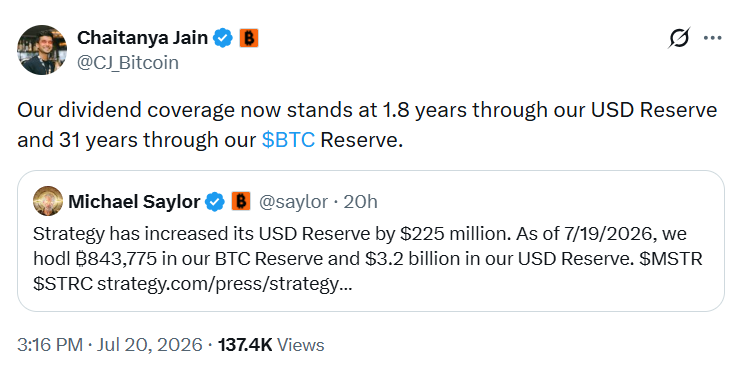
Strategy, a prominent entity in the financial landscape, has once again captured the attention of investors and analysts with a significant disclosure regarding its substantial Bitcoin holdings. The company’s corporate treasurer, Chaitanya Jain, revealed that its Bitcoin treasury could potentially cover approximately 31 years of shareholder dividend payments. This revelation starkly contrasts with the protection offered by its traditional cash reserves, which would only suffice for about 1.8 years of such obligations. This strategic pivot towards digital assets underscores a profound shift in how companies are managing their treasuries and securing long-term financial stability.
The announcement arrives amidst a period of heightened interest in Bitcoin’s role as a corporate reserve asset. As the cryptocurrency continues to demonstrate its potential for significant appreciation, companies that have embraced it are seeing their balance sheets transformed. Strategy, under the leadership of its founder Michael Saylor, has been at the forefront of this movement, consistently increasing its Bitcoin allocation. This latest update not only reaffirms their commitment to this digital asset strategy but also provides tangible evidence of its growing impact on the company’s financial architecture.
Strategic Financial Planning: Bitcoin as a Long-Term Dividend Payer
The core of Strategy’s latest announcement lies in the comparative analysis of its treasury assets. Chaitanya Jain’s statement highlights a critical point: the longevity of dividend coverage provided by Bitcoin versus U.S. dollars. While the company’s cash reserves offer a relatively short-term buffer for dividend payments, its Bitcoin holdings present a significantly more robust and extended financial cushion. This suggests a strategic re-evaluation of risk management and capital allocation, where Bitcoin is increasingly viewed not just as an investment but as a foundational element of its long-term financial sustainability.
This assertion is particularly significant for preferred stockholders and the broader investment community. The ability of Bitcoin reserves to back dividend payments for over three decades implies a degree of financial security that transcends typical market cycles. It signals that Strategy is not merely holding Bitcoin speculatively but has integrated it into its financial planning with a view towards consistent shareholder returns, even in the face of economic uncertainties.

Michael Saylor Confirms Massive Bitcoin Holdings: The World’s Largest Corporate Holder
Further solidifying Strategy’s position as a digital asset pioneer, founder Michael Saylor confirmed the company’s holdings as of July 19th. Strategy maintained its status as the world’s largest corporate Bitcoin holder, possessing 843,775 Bitcoin. This figure represents a substantial allocation of capital, underscoring the company’s conviction in Bitcoin’s long-term value proposition. Notably, during the latest reporting period, Strategy did not engage in any Bitcoin buying or selling. Instead, the company focused on bolstering its liquidity through its at-the-market (ATM) common stock program.
This approach signifies a deliberate strategy to leverage equity markets for immediate capital needs while preserving its significant Bitcoin holdings for long-term appreciation and financial backing. The lack of trading activity in its Bitcoin reserves suggests a "hodl" strategy, where the company aims to benefit from the potential price appreciation of Bitcoin over extended periods, rather than engaging in short-term trading.
Capital Infusion Through Equity Markets: Strengthening Liquidity and Financial Flexibility
Between July 13th and July 19th, Strategy successfully generated approximately $263.5 million through the sale of its Class A common shares. These proceeds were instrumental in increasing the company’s U.S. dollar reserve to an estimated $3.225 billion. This injection of capital serves multiple strategic purposes: it enhances the company’s liquidity, provides a buffer for preferred stock dividend payments, and ensures the servicing of interest obligations on outstanding debt. The added financial flexibility allows Strategy to navigate market conditions with greater confidence and pursue its long-term objectives without undue pressure.
The reliance on equity markets for capital generation, while simultaneously holding a vast Bitcoin treasury, highlights a dual-pronged financial strategy. This approach allows Strategy to access traditional funding mechanisms for operational needs and short-term obligations, while its Bitcoin holdings serve as a long-term strategic asset, potentially appreciating in value and reinforcing its overall financial standing.
The Mechanics of Strategy’s Treasury: Cost Basis and Capital Raising Capacity
Strategy’s significant Bitcoin holdings were accumulated at an average acquisition cost of $75,476 per Bitcoin, with the total investment approximating $63.69 billion. This cost basis provides context for the current market value of its holdings, especially when considering Bitcoin’s recent price surges. The company’s commitment to preserving these long-term cryptocurrency assets, rather than actively trading them, is a key aspect of its financial model. This strategy is further supported by its ongoing capital-raising efforts.
Regulatory filings indicate that Strategy retains substantial capacity under its common stock ATM program, with approximately $23.5 billion remaining. This significant headroom allows the company to raise additional capital efficiently should market conditions or strategic opportunities necessitate it. This financial flexibility is crucial for a company that has made such a substantial bet on a nascent asset class like Bitcoin.
Investor Perspectives: Analyzing Strategy’s Preferred Stock and Digital Asset Integration
The unique financial structure employed by Strategy has also drawn the attention of various market participants, particularly concerning its preferred stock. Credit investor Khing Oei offered a perspective that suggests the market may be undervaluing Strategy’s STRC preferred shares. Oei argues that a primary focus on current yield might be overlooking the longer-term cash generation potential inherent in these securities. He proposes that preferred shares should be analyzed more akin to traditional bonds, with an emphasis on the issuer’s ability to meet its obligations over an extended period.
Oei’s analysis posits that Strategy’s capacity to support dividend payments for decades, bolstered by its Bitcoin holdings, lends considerable long-term value to its preferred securities. Furthermore, he suggests that any upward movement in Bitcoin’s price could further enhance Strategy’s financial position, potentially leading to a re-evaluation and improvement in the valuation of its preferred securities over time. This perspective highlights the interconnectedness of Strategy’s traditional financial instruments and its innovative digital asset strategy.
Broader Implications: A New Paradigm for Corporate Treasuries
Strategy’s approach signifies a potential shift in the broader corporate treasury landscape. By integrating a significant allocation of Bitcoin into its balance sheet, the company is demonstrating a proactive strategy to hedge against traditional financial risks and tap into the potential growth of digital assets. This move is particularly impactful in an environment where traditional fiat currencies can be subject to inflationary pressures and monetary policy shifts.
The success of Strategy’s model could encourage other corporations to explore similar allocations, potentially leading to increased institutional adoption of Bitcoin and other cryptocurrencies. However, this unconventional treasury model also presents its own set of challenges and requires continuous scrutiny from investors. The long-term viability of this strategy will depend on several factors, including the continued price appreciation of Bitcoin, the company’s ability to manage its equity financing effectively, and the evolving regulatory landscape surrounding digital assets.

As Strategy continues to expand its capital-raising programs without reducing its Bitcoin exposure, the market will be keenly observing whether its innovative treasury model can consistently deliver both balance sheet stability and sustained shareholder value. The company’s bold embrace of Bitcoin positions it as a key case study in the evolving intersection of traditional finance and the burgeoning digital asset economy.
At the time of reporting, Bitcoin (BTC) was trading at approximately $64,880, reflecting a modest gain of 0.45% over the preceding 24 hours. This price action, while not directly tied to Strategy’s internal disclosures, contributes to the broader market sentiment that underpins the valuation of its substantial digital asset holdings.