The recent shutdown notice from AscendEX, like many before it in the volatile cryptocurrency market, provides a stark reminder of the inherent risks associated with centralized exchanges and offers a crucial template for discerning the early warning signs of an impending collapse. These official communications often masquerade as routine compliance updates, citing broad "regulatory considerations" or "market conditions," yet they invariably lead to a point where the platform can no longer guarantee user withdrawals, a critical juncture that typically follows weeks of underlying distress. The case of AscendEX, with its well-documented timeline and public data points, serves not merely as an obituary for another failed exchange but as an invaluable educational tool for users to proactively safeguard their assets from similar fates.
The Official Narrative: AscendEX’s Notice and Its Unspoken Truths
The starting point for understanding AscendEX’s unraveling is the company’s own official communication to its account holders, issued in the weeks leading up to the crisis. This notice, a primary source of information, declared that AscendEX would cease operations effective July 1, 2026. The stated justifications included "regulatory developments," specifically mentioning the European Union’s Markets in Crypto-Assets Regulation (MiCA), under which the exchange acknowledged it held no authorization. This was coupled with broader references to "regulatory, financial, and operational considerations," a common refrain used by exchanges navigating difficult periods.
MiCA, a landmark regulatory framework designed to create a comprehensive legal regime for crypto-assets within the EU, began its phased implementation in 2024, with full effect anticipated by December 2024. Its introduction mandated stringent licensing requirements, operational standards, and consumer protection measures for crypto-asset service providers (CASPs) operating within the bloc. For an exchange like AscendEX, which operated globally but likely served EU users, securing MiCA authorization would have necessitated significant investment in compliance, robust internal controls, and often, a re-evaluation of its business model to meet the demanding regulatory landscape. While genuine regulatory non-compliance can certainly lead to an exchange’s closure, the timing and the subsequent actions by AscendEX suggested that MiCA was potentially serving as a convenient, albeit plausible, explanation for deeper, more existential financial troubles.
From the specified date of July 1, 2026, AscendEX users were informed they could no longer open new accounts, deposit assets, engage in trading or swapping, stake, lend, or participate in referral or promotional campaigns. Account access was explicitly narrowed to "offboarding functions," including withdrawal requests, KYC updates, and transaction exports. This initial notice, while concerning, still offered a semblance of controlled wind-down. However, the true gravity of the situation became undeniably clear on July 6, when a follow-up communication revealed that every withdrawal request would henceforth be subjected to manual review, and automated withdrawals were paused entirely.
Buried within this critical update was a sentence that signaled the profound depth of AscendEX’s predicament: "Withdrawals may be delayed, or may not be processed during the review period. The timing or amount of withdrawals cannot be guaranteed at this time." This language, meticulously crafted by legal counsel, transcended mere hedging. It served as a stark, written admission by the exchange that it could neither promise to return users’ funds nor confirm the extent of the assets it actually held. This phrase, far from reassuring, pointed directly to a severe liquidity crisis, suggesting the exchange was grappling with fundamental solvency issues.
Further cementing this interpretation, AscendEX later conceded in the same notice that its collapse was precipitated by the failure of an "agreed strategic transaction." The counterparty, the exchange stated, simply "didn’t perform." This single line provided more genuine insight into the crisis than all the preceding references to MiCA. A licensing gap, while a significant bureaucratic hurdle, is fundamentally a regulatory problem that can often be addressed or mitigated with strategic adjustments. The failure of a critical strategic transaction, particularly one upon which the exchange’s continued operations evidently relied, points unequivocally to a solvency crisis – a critical shortage of deployable capital – that was merely cloaked in the guise of regulatory compliance. This admission shifted the narrative from a perceived regulatory-driven exit to a clear financial collapse, highlighting the distinction between operational challenges and outright insolvency.
The Unfolding Timeline: A Chronicle of Distress
The journey towards AscendEX’s public collapse was not instantaneous but a series of escalating events, visible to vigilant observers long before the official notices arrived. Understanding this chronology is key to developing an early warning system.
May 2026: The First Cracks Emerge – Vague Trading Halts
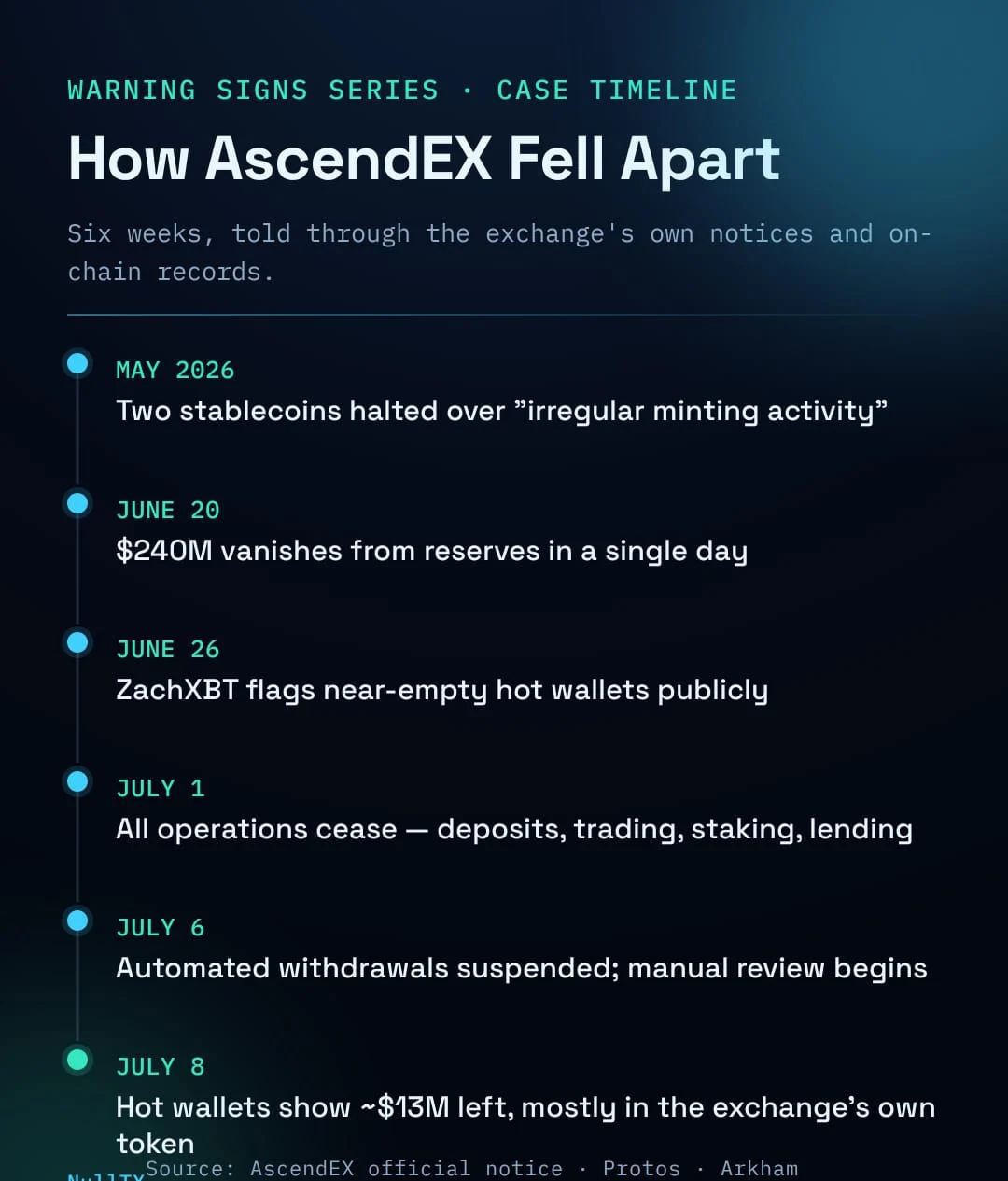
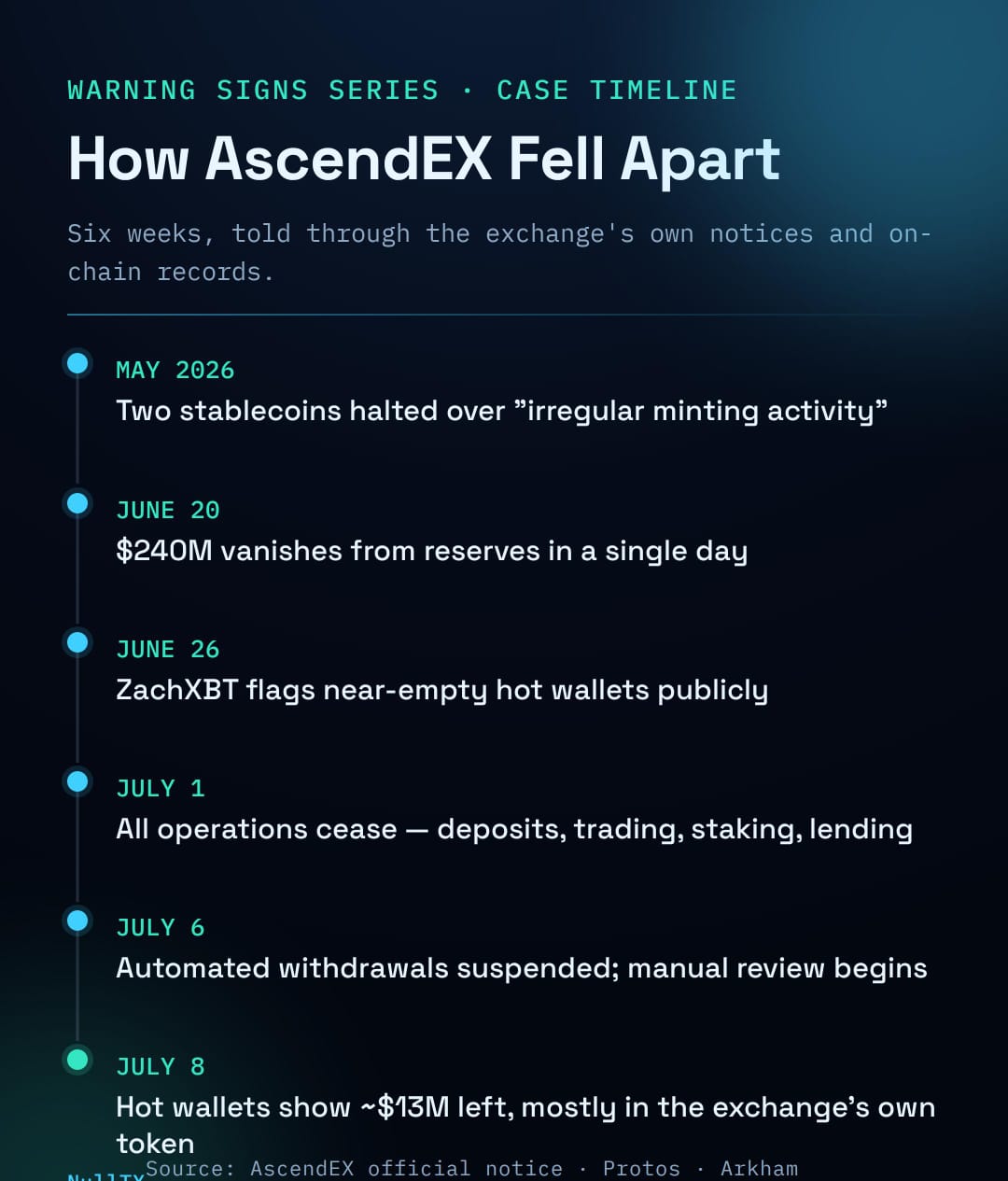
Weeks before any public mention of withdrawal issues or regulatory pressure, AscendEX initiated a trading halt on two stablecoins. The explanation provided was vague, attributing the halt to "irregular token minting activity tied to a security incident." On its own, such an announcement might appear as routine exchange housekeeping; freezing assets for security reasons is a common practice in the crypto space, and many such incidents are indeed benign and quickly resolved. However, when viewed retrospectively against the backdrop of the subsequent collapse, this event serves as the crucial first domino. A halt explained with nebulous, security-flavored language, particularly one involving stablecoins which are supposed to maintain a stable peg, warrants careful attention. While not immediately damning, it should be filed away as a potential precursor to deeper issues, to be revisited if other red flags appear. The lesson here is not that every trading halt signals collapse, but that such events, especially when accompanied by opaque explanations, should trigger heightened user vigilance.
Late May – Early June 2026: Subtle Shifts in Liquidity Management
While difficult to pinpoint with exact dates without direct user testimony, the general pattern observed in failing exchanges is a subtle but discernible shift in how deposits and withdrawals are handled. A company facing financial distress prioritizes incoming capital over outgoing. This can manifest as:
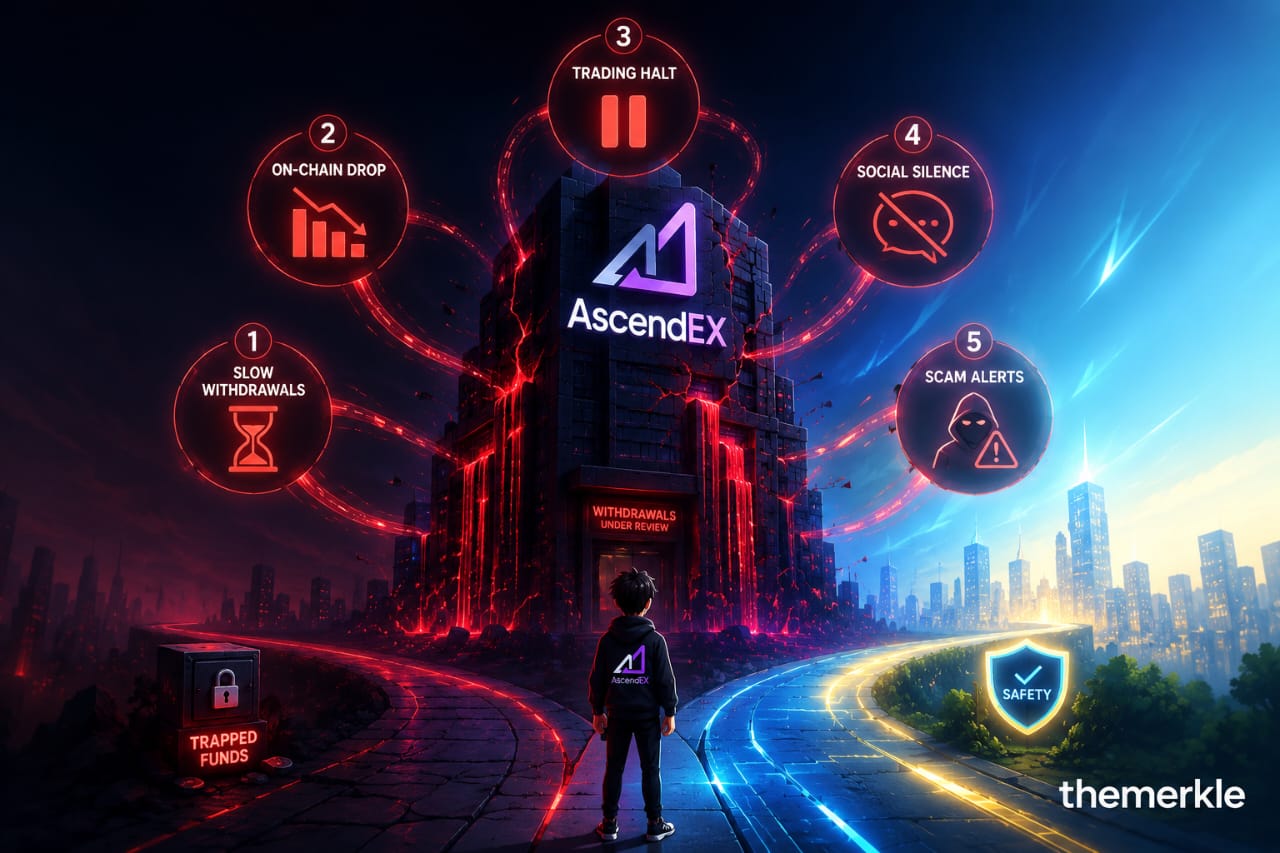
- Slowing Withdrawals: Automated withdrawals might become less frequent, or processing times might subtly extend beyond advertised norms. Users might report delays in forums or social media.
- Continued Deposit Promotion: Despite internal struggles, the exchange continues to actively promote deposits, perhaps through aggressive marketing campaigns, bonuses, or new listing announcements, attempting to shore up liquidity.
- Customer Support Changes: A degradation in the responsiveness or helpfulness of customer support regarding withdrawal inquiries can also be an early indicator.
These subtle changes, when observed in isolation, might be dismissed as minor technical glitches. However, when combined with other emerging signs, they contribute to a broader picture of an exchange struggling with liquidity.
June 20, 2026: On-Chain Data Screams for Attention
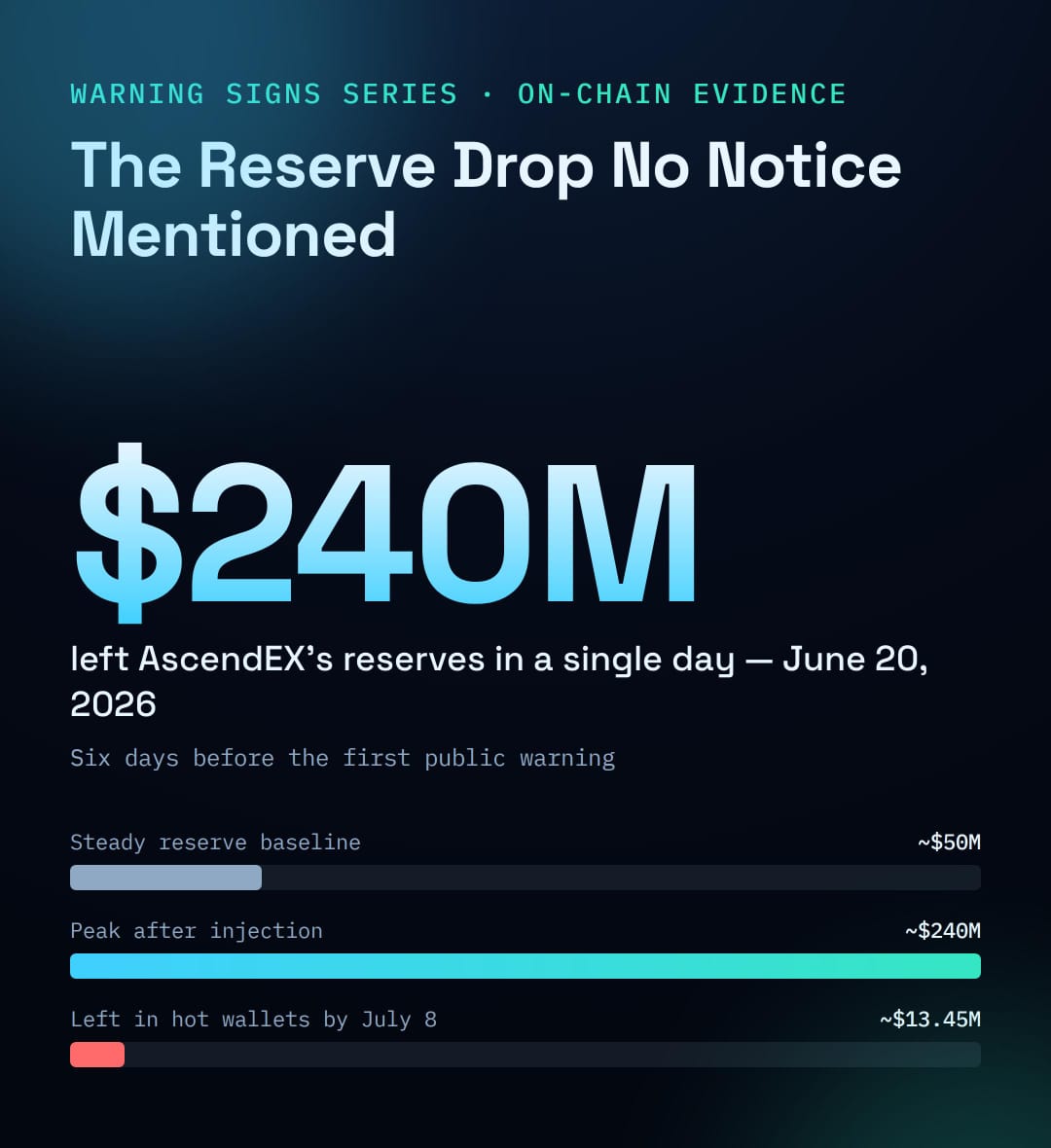
Official notices are inherently reactive; they tell users what a company wants them to know, often when it is already too late for meaningful action. In contrast, on-chain data offers an unfiltered, real-time ledger of an exchange’s financial health. On June 20, 2026, over a week before AscendEX’s official shutdown notice, independent researchers at Protos uncovered alarming shifts in the exchange’s reserve records. Their analysis revealed a precipitous drop of over $240 million in AscendEX’s total balance. This sudden and massive outflow occurred less than two months after a liquidity injection of roughly the same size, which had briefly inflated the exchange’s reserves from a steady baseline of approximately $50 million. This pattern – a large, temporary balance that appears just long enough to project an image of stability, only to vanish within weeks – is a critical red flag. It suggests either a failed attempt to recapitalize, a strategic but ultimately unsuccessful movement of funds, or an orchestrated effort to temporarily boost reported assets.
July 1, 2026: The Official Shutdown Notice
AscendEX publicly announces its cessation of operations, citing regulatory and financial reasons, and restricting most user activities. This is the first official confirmation of the exchange’s severe difficulties.
July 2, 2026: The Silence Descends
Following the initial warnings and official notices, a critical indicator of deepening crisis emerged: the company went silent. Prominent on-chain investigator ZachXBT reported that AscendEX’s official X (formerly Twitter) account had been inactive for nine consecutive days since his initial public warnings. Simultaneously, a major affected user disclosed that repeated attempts to contact AscendEX co-founder George Cao had gone unanswered. A functioning company, even one facing significant challenges, typically maintains communication with its user base, however uncomfortable the message may be. This was evident in AscendEX’s initial, albeit hedged, notice. However, a company that retreats into silence on its primary public communication channels is rarely managing a mere PR problem; it is more likely grappling with an internal crisis for which it has no approved language, or one that its legal counsel advises against putting into writing. This radio silence signals a profound internal breakdown and loss of control over the public narrative.
July 6, 2026: The Withdrawal Freeze
The "second shoe drops" as AscendEX announces that all withdrawal requests will be subject to manual review, effectively halting automated withdrawals and explicitly stating that withdrawal timing and amounts cannot be guaranteed. This is the definitive moment confirming a liquidity crisis.
July 8, 2026: Illiquid Reserves Exposed
Further investigation by ZachXBT, utilizing data from Arkham Intelligence, painted an even starker picture of AscendEX’s financial state. As of July 8, addresses labeled as belonging to AscendEX held approximately $13.45 million in crypto assets. Crucially, more than $12 million of this total was concentrated in the exchange’s own native token, ASD, and a partner project’s UNITE token. Neither of these assets possessed sufficient liquidity to fund withdrawals at any meaningful scale. An exchange that is genuinely solvent does not rely on its own illiquid tokens as primary collateral for customer funds. This practice, reminiscent of the FTX collapse where FTT tokens formed a significant portion of Alameda Research’s balance sheet, is a catastrophic red flag. It indicates a critical lack of diversified, liquid assets necessary to meet customer redemption demands, revealing the depth of the insolvency.
The Broader Ecosystem: Scammers Capitalize on Distress
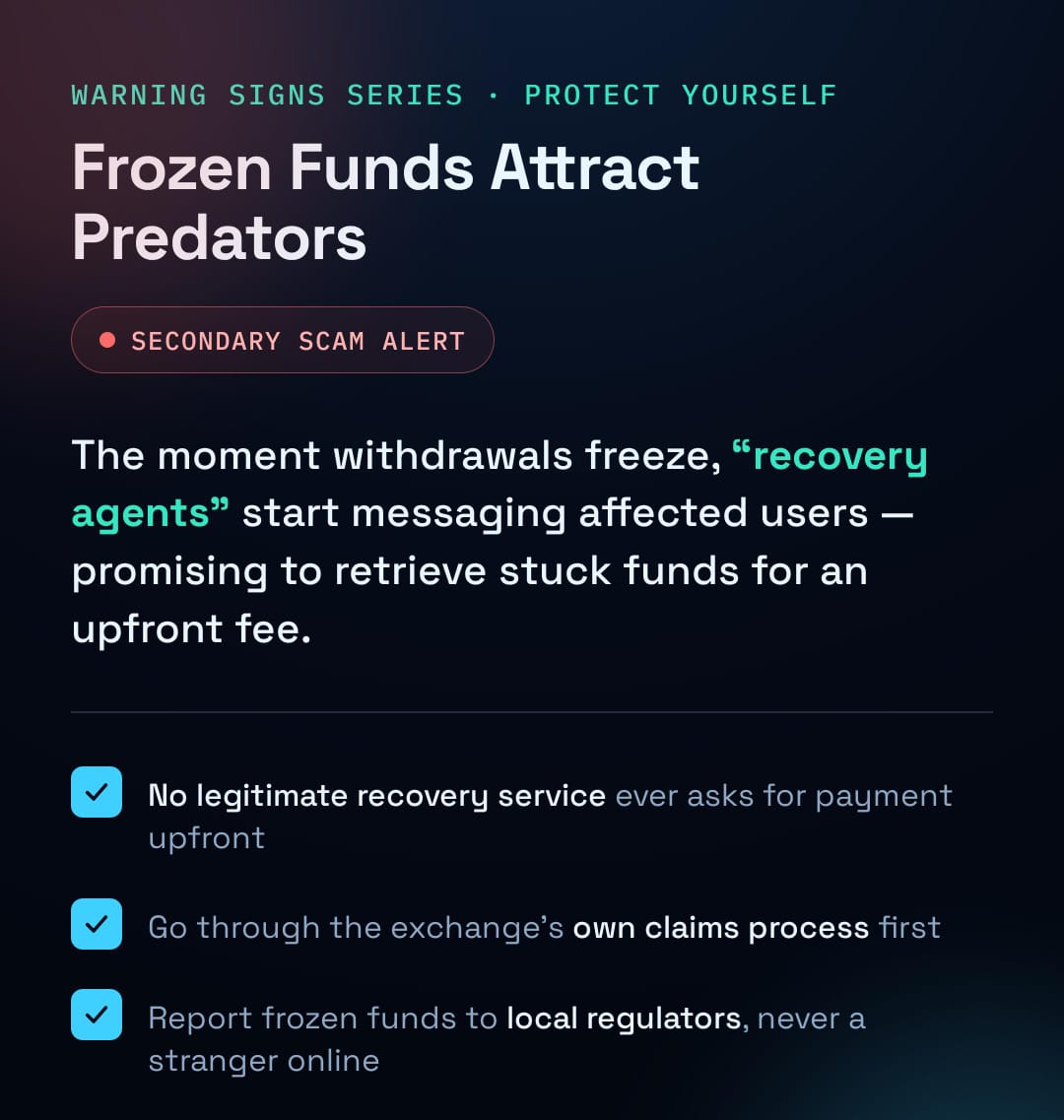
The final, but equally important, pattern observed around collapsing exchanges is not directly related to the exchange’s internal operations but rather to the external environment it fosters. Once withdrawal delays and asset freezes become public knowledge, a secondary wave of exploitation inevitably begins: the proliferation of recovery scammers. These opportunistic actors approach users with stuck funds, promising to retrieve their frozen assets for an upfront fee. This is a well-established scam, preying on the anxiety and desperation of individuals who are already vulnerable and seeking any semblance of a solution.
If funds are indeed frozen at a collapsing exchange, the legitimate avenues for recourse are limited and often arduous: engaging with the exchange’s official claims process (if one exists), contacting local financial regulators, or, in more severe cases, pursuing legal action through law enforcement. The critical takeaway is that legitimate recovery paths never involve a stranger who reaches out promising a shortcut in exchange for an upfront payment. Users must exercise extreme caution and skepticism when approached by such "recovery services," as they are designed to extract additional funds from already distressed victims.
Putting the Pieces Together: A Universal Collapse Sequence
The specifics of AscendEX’s downfall, when stripped of their unique details, reveal a recurring sequence that has characterized nearly every centralized exchange failure in the history of cryptocurrency:
- Subtle Operational Slowdowns: Early, often imperceptible, delays in withdrawal processing or uncharacteristic technical glitches begin to surface.
- Vague Communication and Security Alerts: Official communications become increasingly opaque, sometimes citing "security incidents" or "system upgrades" to explain operational disruptions or trading halts, without providing sufficient detail.
- On-Chain Data Discrepancies: Independent analysis of blockchain data reveals significant outflows, declining reserves, or a disproportionate holding of illiquid, native tokens in the exchange’s wallets.
- Escalating Withdrawal Restrictions: Initial delays escalate to manual reviews, then partial freezes, and finally, outright cessation of withdrawals.
- Corporate Silence: The exchange’s official communication channels go dark, and key personnel become unresponsive, signaling an internal crisis and a reluctance to face the public.
- Scammer Influx: A surge of "asset recovery" scams emerges, targeting affected users.
None of these signs, in isolation, is definitively damning. Healthy exchanges can experience temporary trading halts, social media accounts can go quiet for legitimate reasons, and even minor withdrawal delays can occur due to peak network congestion. However, when two or three of these indicators align within a compressed timeframe – a matter of weeks or even days – it transcends mere noise. It becomes a discernible pattern, the unmistakable shape of a centralized exchange undergoing a slow-motion wind-down. The users who successfully retrieve their funds are almost invariably those who recognize and act upon these early warnings, rather than those who wait for the formal, often belated, official notice of collapse.
The AscendEX case underscores the imperative for greater transparency within the centralized crypto exchange ecosystem. While the industry has seen calls for widespread "Proof-of-Reserves" audits since events like the FTX collapse, the implementation remains inconsistent and often lacks true third-party verification. The ability of an exchange to manipulate its balance sheet or to rely on its own illiquid tokens to back customer deposits highlights a fundamental flaw in the current trust model. As regulatory frameworks like MiCA mature and exert more pressure, exchanges will be forced to adhere to higher standards of financial integrity and operational transparency. However, until such regulations are globally uniform and rigorously enforced, individual users remain the primary line of defense for their own assets, requiring a proactive and critical approach to monitoring the health of the platforms they entrust with their funds.
This ongoing pattern of quiet collapses, masked by bureaucratic language and revealed by diligent on-chain analysis and social signals, serves as a crucial lesson for the entire cryptocurrency ecosystem. It reinforces the need for continuous vigilance, the importance of independent data verification, and the understanding that in the decentralized world of crypto, the ultimate responsibility for asset security often rests with the individual. The AscendEX incident, therefore, is not just a story of another exchange’s failure but a vital playbook for fostering greater user empowerment and resilience in a market still prone to dramatic and often opaque downturns.
Disclosure: This is not trading or investment advice. Always do your research before buying any cryptocurrency or investing in any services.