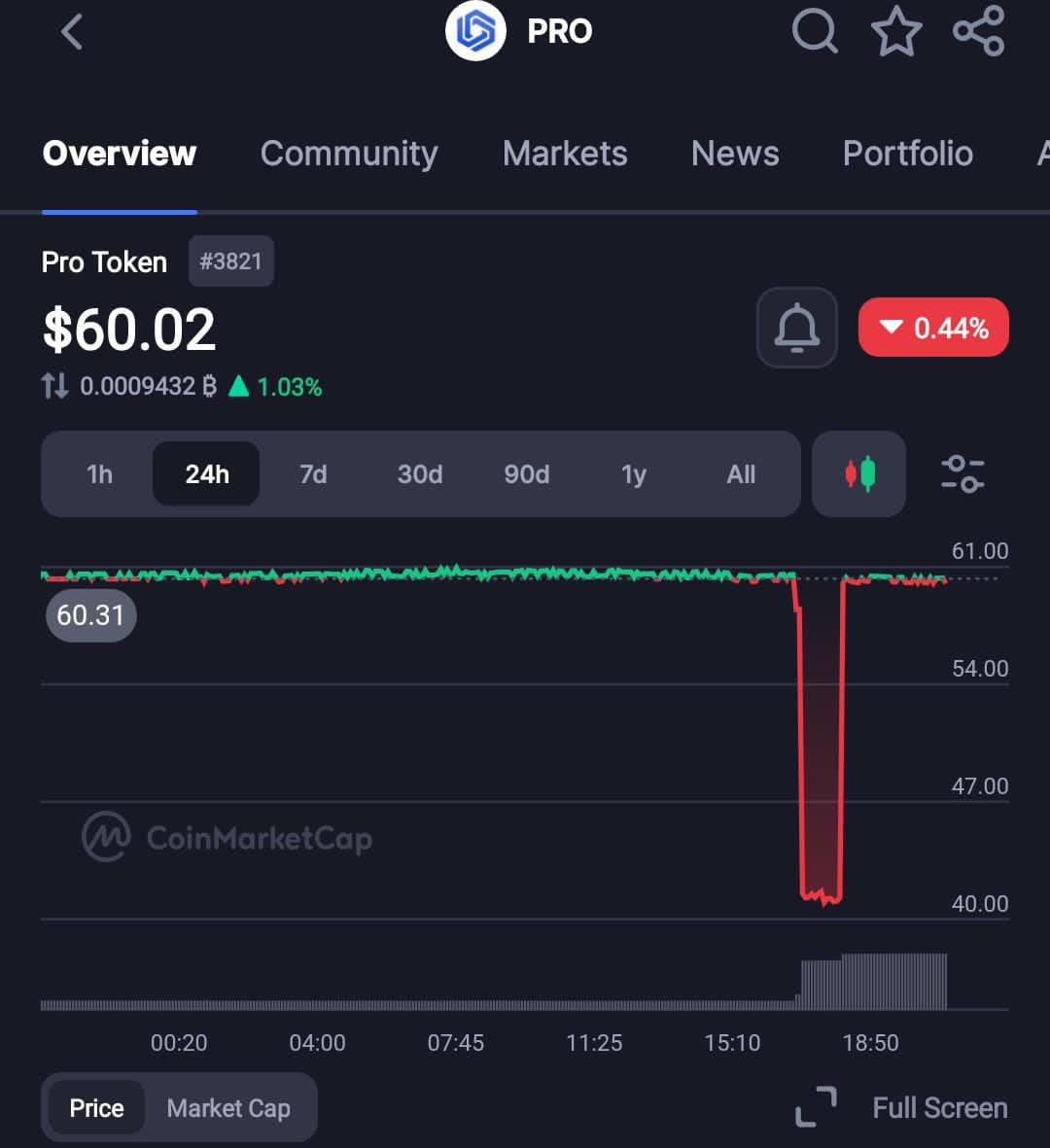
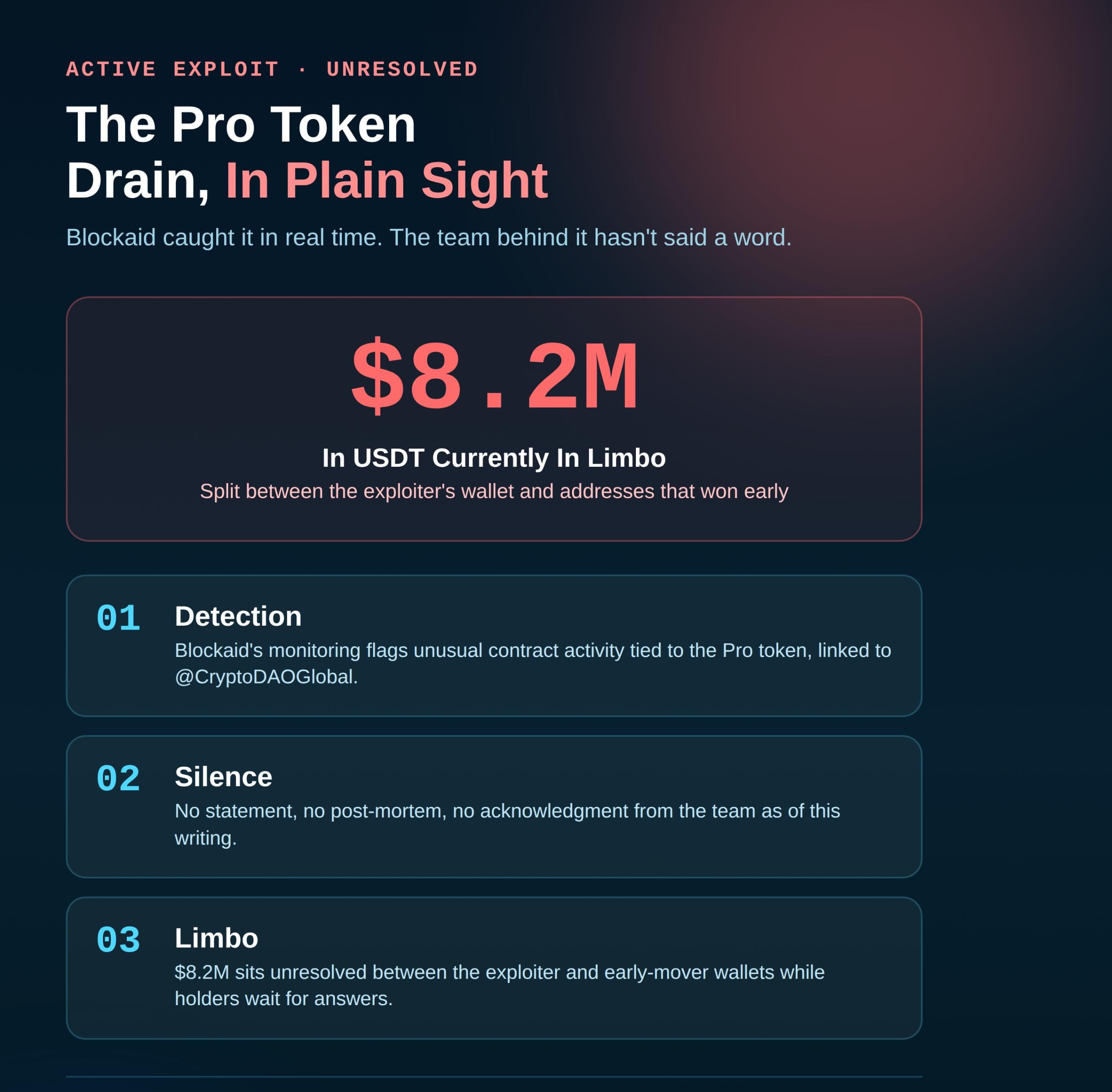
The cryptocurrency market is once again grappling with the fallout of a significant exploit, as the Pro token, linked to the CryptoDAO Global project, experienced a substantial drain of approximately $8.2 million in USDT. The incident, detected in real-time by blockchain security firm Blockaid, casts a stark spotlight on the escalating crisis in onchain security, particularly exacerbated by the project team’s conspicuous silence in the immediate aftermath. This event unfolds amidst what has been recorded as the worst six months for onchain security in the industry’s history, with Blockaid’s recent report revealing a disturbing surge in successful attacks and a critical shift in the vulnerabilities being exploited. For Pro token holders, the anxiety is palpable, characterized by incessant chart refreshes and desperate searches for any official communication, while the alleged exploiter remains in possession of the stolen funds.
The Pro Token Exploit: A Detailed Account of Funds Drained
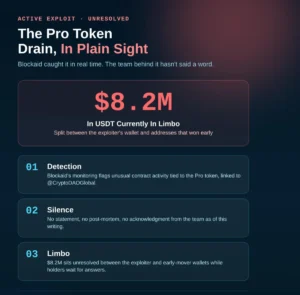
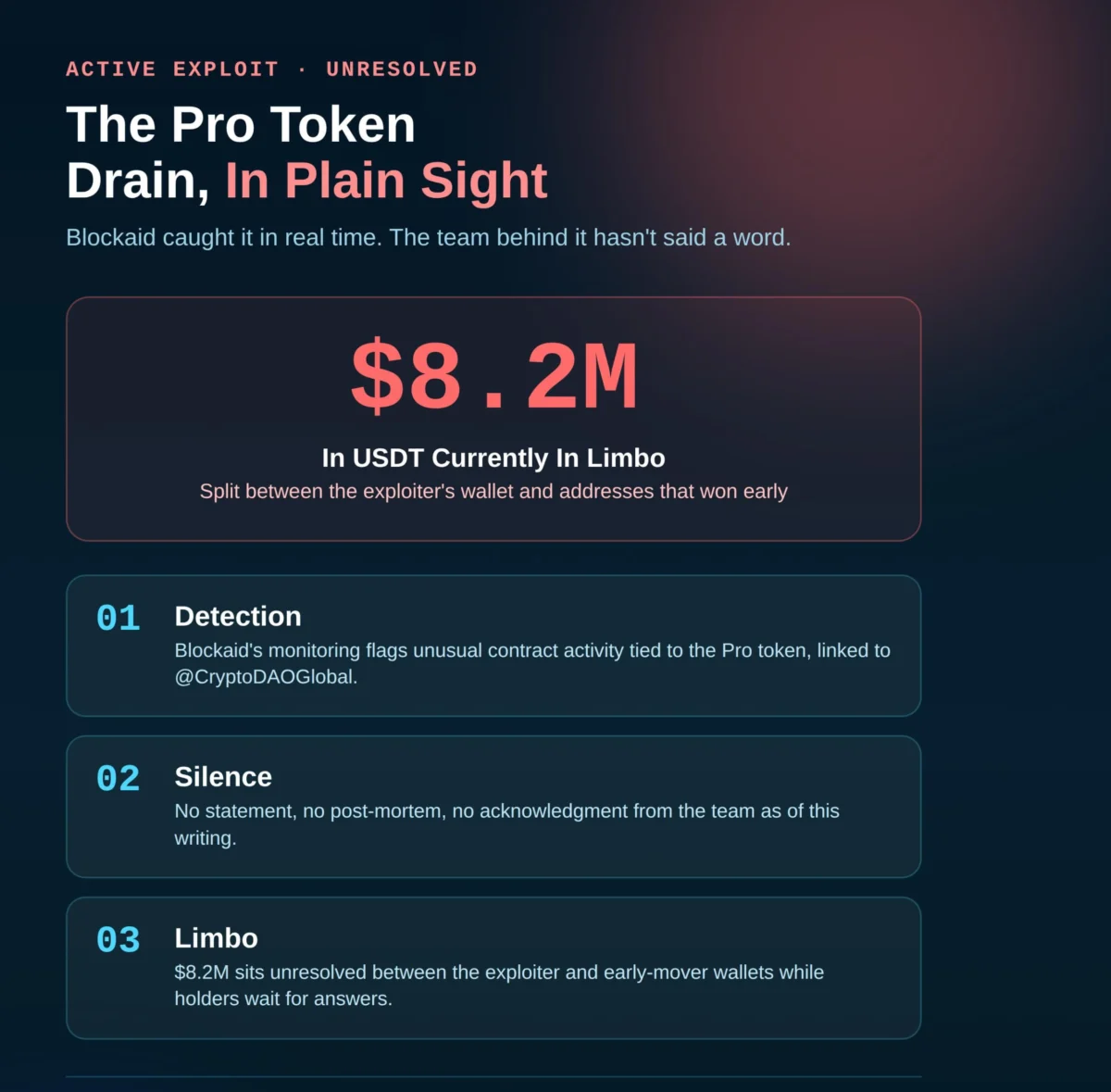
On a recent date in 2026, Blockaid’s sophisticated exploit detection systems flagged an active and ongoing attack targeting the Pro token. The incident quickly escalated, leading to the siphoning of roughly $8.2 million worth of Tether (USDT). According to Blockaid’s real-time monitoring, these funds are currently distributed between the primary exploiter’s wallet and a cluster of associated addresses. These additional addresses appear to have benefited from the chaos, potentially through front-running the exploit transaction or strategically positioning themselves to capitalize on the market instability that invariably follows such an event. The precision and speed with which these operations unfolded underscore the increasingly sophisticated nature of crypto attacks. The Pro token is understood to be associated with the entity operating under the social media handle @CryptoDAOGlobal, a detail that further links the project to the unfolding crisis.
CryptoDAO Global’s Silence: A Growing Concern for Holders and Industry Observers
Perhaps as troubling as the exploit itself is the complete lack of official communication from the CryptoDAO Global team. As of the latest updates, there has been no public statement, no post-mortem analysis, and not even a basic acknowledgment that a significant security breach has occurred. This prolonged silence has left Pro token holders in a state of extreme frustration and uncertainty. In an industry where transparency and rapid response are paramount, particularly during crises, this reticence is widely perceived as a significant red flag. Security researchers have noted a concerning pattern throughout 2026: project teams are increasingly learning about major exploits not from their internal security protocols, but from public alerts issued by independent security firms. This disjunction between external detection and internal awareness highlights severe operational deficiencies and exacerbates the trust deficit between projects and their communities. For investors, this scenario reinforces the critical need for projects to prioritize robust communication channels and incident response plans.
Blockaid’s Role in Real-Time Detection and the Unfolding Narrative

Blockaid has distinguished itself as a frontrunner in real-time onchain security detection. The firm’s monitoring systems are designed to constantly scan for unusual contract behavior, anomalous minting patterns, and suspicious fund movements, often catching illicit activities within minutes or even seconds of the first transaction. The Pro token exploit serves as another testament to Blockaid’s capabilities, having been flagged by their systems almost immediately. This proactive detection is vital in an ecosystem where every second counts, potentially limiting the scope of damage or providing crucial data for subsequent investigations. Blockaid’s track record in 2026 includes successfully identifying a range of exploits, from complex bridge vulnerabilities to governance takeovers, often before the broader crypto community or even the affected projects themselves become aware. In the case of the Pro token, Blockaid’s public alert effectively served as the primary source of information regarding the incident, further emphasizing the accountability gap within the decentralized finance (DeFi) space.
A Bleak First Half: Onchain Crime Reaches Unprecedented Levels in 2026
The Pro token incident is not an isolated event but rather a stark microcosm of a much larger, grim picture for the cryptocurrency industry in the first half of 2026. Blockaid’s comprehensive research arm has verified an alarming 212 separate security incidents during this period alone. This volume represents an astounding 3.4 times increase compared to all recorded incidents across the entirety of 2025, signaling an unprecedented acceleration in the frequency and audacity of attacks.
The total verified losses for H1 2026 have soared to approximately $1.1 billion. Major blockchain networks such as Ethereum and Solana bore the brunt of these damages, accounting for a significant portion of the stolen funds. To contextualize this escalating threat, an industry that once measured major exploits in dozens per year is now experiencing a comparable count roughly every few weeks. This relentless barrage of security breaches has created an environment of heightened anxiety and fatigue among long-term crypto holders, validating the widespread sentiment that exploit alerts have become a near-constant fixture on social media feeds and news aggregators. The data undeniably confirms that this feeling is not mere overreaction but an accurate reflection of the deteriorating security landscape.
Beyond Code: Operational Security Failures as the Primary Attack Vector
One of the most critical revelations from Blockaid’s H1 2026 report challenges a long-held assumption within the crypto security paradigm. The report conclusively demonstrates that a staggering 74% of all funds stolen during this period did not originate from smart contract bugs, which have historically been the primary focus of security audits and developer scrutiny. Instead, the overwhelming majority of losses stemmed from fundamental operational security (OpSec) failures.
These OpSec vulnerabilities encompass a range of insidious attack vectors, including:
- Compromised Private Keys: The direct theft or unauthorized access to the cryptographic keys that control digital assets. This can occur through phishing, malware, or insider threats.
- Hijacked Signer Infrastructure: Gaining control over the systems or devices used to authorize transactions, such as multi-signature wallets or oracle networks. This often involves sophisticated social engineering or direct system breaches.
- Social Engineering: Manipulating individuals, particularly project insiders, into performing actions that compromise security, such as approving malicious transactions or revealing sensitive information. This can involve impersonation, baiting, or pretexting.
- Insider Threats: Malicious actions or negligence by individuals with legitimate access to a project’s systems or funds.
This paradigm shift profoundly alters how projects and investors must approach security. Code audits, once considered the gold standard and the finish line for security assurances, are increasingly proving insufficient. While essential for identifying vulnerabilities within the code itself, they offer little protection against the "human element" and process-related weaknesses that now constitute the most significant attack surface. The costly failures are occurring "around the code"—within the human teams, the internal processes, and the infrastructure that holds the keys to the digital assets. This necessitates a radical re-evaluation for anyone considering investment in a crypto project. A "clean audit badge" on a landing page provides increasingly less insight into the true security posture, as it fails to address whether a team member’s laptop is compromised, a multi-signature wallet is improperly configured, or a Slack workspace has been infiltrated.
The DPRK Connection: A Dominant Force in Crypto Theft
Further drilling into the attribution data from H1 2026, Blockaid’s research points to a highly concentrated source of malicious activity. North Korea-linked operators are identified as being responsible for an astonishing 55% of all losses recorded during this period. This statistic aligns with separate reports from other leading blockchain security firms, which have consistently highlighted the significant scale and sophistication of Pyongyang’s state-sponsored crypto theft operations.
These are not opportunistic, "smash-and-grab" hacks. The patterns observed by researchers describe patient, methodical, and long-term campaigns designed to infiltrate and compromise targets over extended periods. Common tactics include:
- Fake Job Offers: Malicious actors pose as recruiters or hiring managers, offering lucrative positions to developers or key personnel, often embedding malware in "application materials" or during "technical interviews."
- Impersonated Venture Capital Outreach: Attackers create elaborate fake identities to impersonate reputable venture capital firms or investors, engaging with project teams to gain trust and eventually compromise their systems.
- Infiltration of Trusted Infrastructure: Gaining long-term access to critical project infrastructure, such as development environments, communication channels, or deployment pipelines, months before initiating any fund movements.
The implications of this sophisticated methodology are deeply unsettling. It suggests that a project team behind a token might unknowingly have a compromised individual on staff, or a backdoored system, for months before any overt signs of an attack manifest. This underscores the need for continuous, proactive threat hunting and robust internal security protocols that go far beyond superficial checks.
Anticipating the Next Wave: Blockaid’s Forecast for H2 2026
The forward-looking aspects of Blockaid’s research offer invaluable insights for anyone involved in building or investing in the crypto space. The firm’s team has identified a set of newer attack vectors that they anticipate will scale significantly through the second half of 2026. While these patterns have appeared in isolated incidents so far, they have not yet evolved into widespread industry trends. Given the rapid transition of operational compromises and infrastructure targeting from niche concerns to the dominant source of stolen funds in H1, Blockaid’s forecast carries substantial weight.
The core lesson from the first half of 2026 is clear: the next wave of losses will likely not mirror the last. This mandates a proactive and adaptive approach to security, requiring projects and investors to ask more nuanced and critical questions. The focus must shift beyond the traditional "was the code audited?" to more fundamental inquiries such as: "Who holds the keys to critical systems?" and "How would I, as an investor or community member, even know if the control over those keys changed or was compromised?" This necessitates a deeper dive into project governance, team structure, internal security policies, and the transparency mechanisms in place for reporting such changes.
The Unresolved Pro Token Exploit: A Microcosm of Industry Challenges
As of this writing, the Pro token exploit remains active and unresolved. The $8.2 million in USDT continues to reside in limbo, held by the exploiter and associated winning addresses, while CryptoDAO Global persists in its silence. This individual case study serves as a potent illustration of a much larger, systemic issue plaguing the cryptocurrency industry: an undeniable tendency to prioritize rapid innovation and development over robust security measures. The threat landscape is not static; it is dynamic and intelligent, constantly evolving to exploit the very gaps created by this accelerated pace of development.
The continued silence from CryptoDAO Global is not merely an oversight; it actively erodes investor confidence and perpetuates an accountability vacuum that the industry can ill afford. For every holder of a cryptocurrency, this ongoing saga is a critical reminder: vigilance is paramount. The next time a project team goes quiet after a token’s chart begins a precipitous decline, it is not an overreaction to be concerned. It is a prudent response to an industry that, despite its revolutionary potential, continues to grapple with foundational security and transparency challenges. The future resilience of the crypto ecosystem hinges on its ability to learn from these costly lessons, moving beyond superficial security assurances to cultivate a culture of comprehensive operational integrity and unwavering transparency.