The cryptocurrency market has witnessed a dramatic downturn for PI Network (PI) this week, with its value plummeting by a staggering 40% amidst a significant sell-off that has driven the token to consecutive all-time lows. Despite this precipitous decline, PI has managed to rebound by 10% from its recent lows, sparking crucial questions among investors and market observers about whether the cryptocurrency has finally found its bottom. This sharp volatility underscores the inherent risks and speculative nature of digital asset investments, particularly for newer or less established projects.
PI Network Suffers Steep Decline, Reaching $0.07
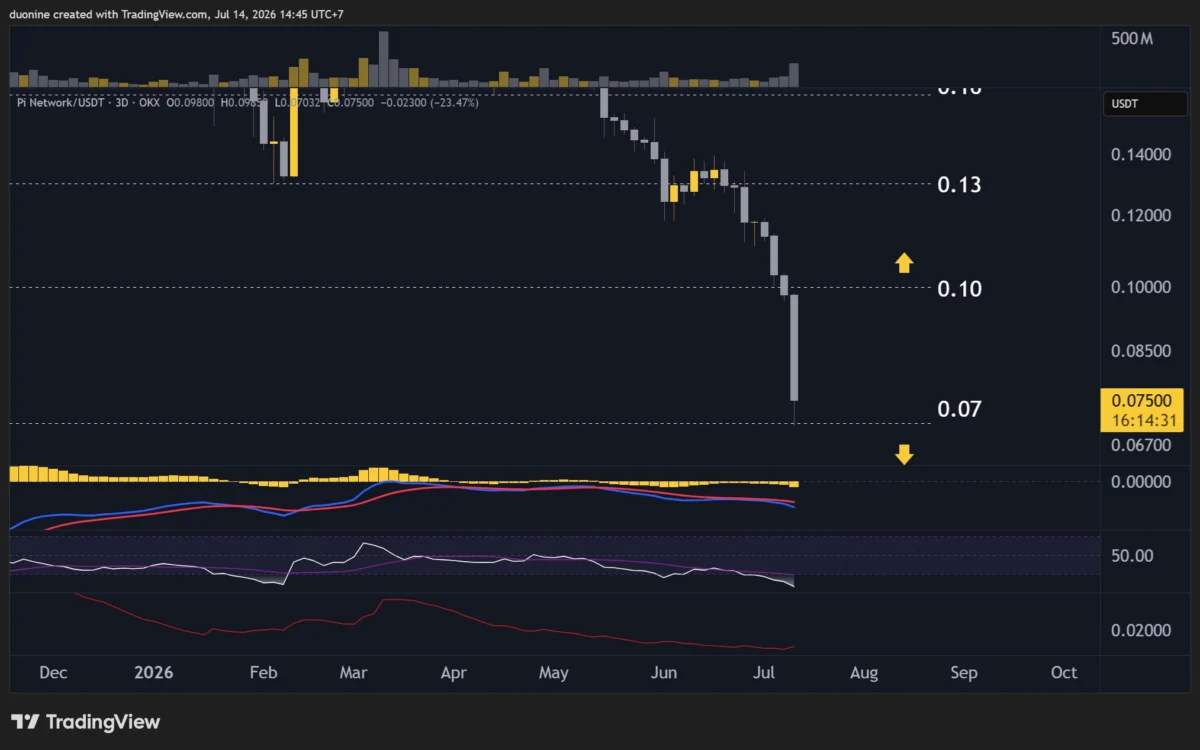
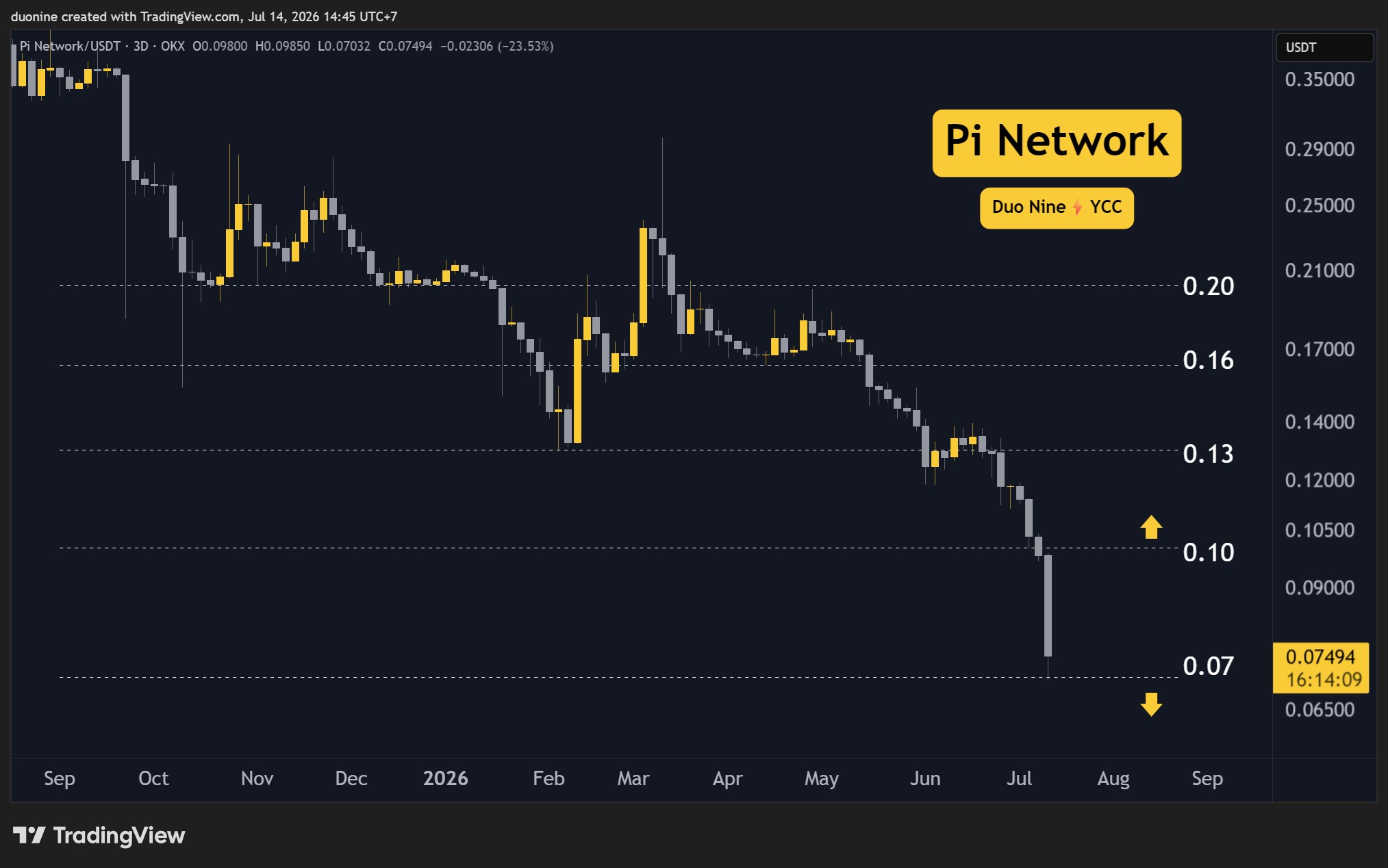
PI Network experienced one of its most brutal weeks in 2026, characterized by a loss of critical support at the $0.10 level. Following this breakdown, the $0.10 mark, once a consolidation point, transformed into a significant resistance barrier. This shift in market sentiment triggered a wave of selling pressure, sending the price into a sharp decline and establishing a new record low at $0.07. The loss of this key support level signaled a significant breach in buyer confidence, leading to a widespread exodus of potential investors.
The data from the past ten days vividly illustrates the prevailing bearish sentiment. Only a single trading day concluded with a positive price movement, underscoring the dominance of sellers and the aggressive downtrend. This pattern suggests that the market for PI has entered a new, potentially accelerated phase of its downturn, where the formation of a sustainable bottom could occur more rapidly than in a gradual decline. However, the speed of such a reversal is highly uncertain and depends on a confluence of market forces.
As of the latest reports, PI has shown a modest recovery, climbing back to $0.08. While this 10% bounce from the absolute lows offers a glimmer of hope, the question remains whether this is a genuine sign of recovery or merely a "dead cat bounce" – a temporary price surge in a declining market that is quickly followed by further declines. The market will be closely watching to see if this upward momentum can be sustained and build upon itself.
Sell-Side Volume Surges Amidst Market Sell-Off
The breach of the $0.10 support level was accompanied by an explosive surge in sell-side volume. This increased selling activity exacerbated the downward pressure on PI’s price, likely triggering a cascade of liquidations for leveraged traders who had bet on the asset’s continued rise. Such cascading liquidations can create a self-reinforcing downward spiral, rapidly pushing prices to new lows as forced selling adds to the existing supply shock.
While there has been a discernible decrease in sell pressure compared to the preceding day, the trading session is far from over, and the situation remains fluid. The ability of PI to hold above the $0.07 level and its subsequent bounce to $0.08 are critical immediate indicators. However, without sustained buying interest and a clear reversal pattern, this recovery could prove to be short-lived, potentially giving way to further price depreciation towards lower support levels.
Momentum Indicators Reach Extreme Levels
The intense selling pressure that has characterized PI’s recent price action has pushed its momentum indicators to extreme levels, a phenomenon that often precedes significant market turning points. For instance, the daily Relative Strength Index (RSI) has plummeted to an unprecedented 12 points. Historically, RSI values below 30 are considered oversold, and values this low, particularly on a daily chart, suggest that the asset is deeply undervalued by the market. Such extreme readings often coincide with market bottoms, as they indicate that selling exhaustion may be imminent.
These extreme levels in momentum indicators, while alarming in the context of a steep decline, can also be interpreted as potential precursors to a reversal. When an asset is oversold to this degree, the probability of a significant bounce or a sustained recovery increases, assuming that fundamental factors or renewed investor interest come into play. However, it is crucial to note that extreme readings do not guarantee a reversal; prolonged periods of oversold conditions can persist, especially in heavily bearish markets.
Key Support and Resistance Levels for PI Network:
- Key Support Level: $0.07
- Key Resistance Levels: $0.10, $0.13, $0.16
If the current support at $0.07 fails to hold, the next logical price targets for sellers to aim for would be $0.06, and potentially even lower, down to $0.05. These levels represent previous price floors where significant buying interest might have emerged in the past, but the current bearish momentum could overwhelm them. Conversely, for a sustained recovery, PI would need to decisively break above the $0.10 resistance level, which has now become a significant psychological and technical barrier. Further upside targets would then be $0.13 and $0.16.
Background and Context of PI Network’s Price Action
PI Network is a cryptocurrency project that aims to provide a platform for decentralized applications and services, built on its own blockchain. Launched with the promise of mass adoption and accessibility, it has garnered a significant community of users who mine PI tokens through a mobile application. However, the project has faced scrutiny and criticism regarding its development pace, tokenomics, and the eventual launch of its mainnet, which has been subject to delays.
The price action observed this week is likely a culmination of several factors. Firstly, broader market sentiment in the cryptocurrency space has been predominantly bearish throughout 2026, with major cryptocurrencies experiencing significant drawdowns. This macro-economic environment often leads to a "risk-off" sentiment, where investors divest from speculative assets like cryptocurrencies. Secondly, specific concerns surrounding the PI Network project itself, such as perceived delays in key developmental milestones or the lack of clear utility for the PI token beyond its mining phase, may have contributed to increased selling pressure. The transition from a mining phase to a fully functional ecosystem is a critical juncture for any such project, and any perceived shortcomings can lead to investor disillusionment.
The year 2026 has been marked by a heightened level of uncertainty in the digital asset markets. Following a period of significant growth in previous years, many cryptocurrencies have struggled to maintain their valuations amidst rising interest rates, regulatory crackdowns, and a general macroeconomic slowdown. This has led to a shakeout in the market, where projects with less robust fundamentals or unproven utility are particularly vulnerable. PI Network’s sharp decline can be seen as a reflection of these broader market dynamics interacting with the specific challenges and perceptions surrounding the project.
Implications of the Current Price Trajectory
The current trajectory of PI Network’s price has several immediate implications for its ecosystem and stakeholders. For existing holders, the significant depreciation in value represents a substantial loss of unrealized gains or capital. This can lead to capitulation selling, where investors, unable to bear further losses, exit their positions, thereby exacerbating the downward pressure.
For the development team and the broader PI Network community, this period of intense selling and record lows presents a critical test. It highlights the need for clear communication regarding the project’s roadmap, upcoming developments, and strategies to enhance token utility and adoption. A sustained recovery would require not only favorable market conditions but also demonstrable progress in delivering on the project’s promises and building a robust, functional ecosystem.
The extreme levels of bearish sentiment, as indicated by the momentum indicators, could also present an opportunity for contrarian investors. If the underlying fundamentals of PI Network remain sound and the project is able to overcome its developmental challenges, the current price levels could represent an attractive entry point for long-term investment. However, such a strategy carries significant risk, as the possibility of further declines cannot be ruled out.
The ability of PI Network to regain the crucial $0.10 resistance level will be a key determinant of its short-to-medium term price action. A decisive break above this level, supported by increasing trading volume and positive market sentiment, could signal the end of the current downtrend and the beginning of a recovery phase. Conversely, failure to overcome this resistance could lead to further consolidation at lower levels or a continuation of the bear market.
The situation also underscores the importance of diversification in investment portfolios. Relying heavily on a single, volatile asset like PI Network can expose investors to significant risks. A diversified approach, incorporating assets with different risk profiles and correlations, can help mitigate the impact of severe downturns in individual holdings.
As the market digests these developments, investors will be keenly observing any official statements or announcements from the PI Network team. Clarity on development timelines, partnerships, and strategies to boost adoption and utility will be crucial in shaping future market sentiment and potentially reversing the current bearish trend. The coming weeks and months will be pivotal in determining whether PI Network can navigate this challenging period and re-establish investor confidence.
The volatility experienced by PI Network is not unique in the cryptocurrency landscape. Many digital assets have undergone similar cycles of rapid ascent followed by sharp corrections. However, the magnitude of the recent decline and the extreme readings on technical indicators emphasize the speculative nature of this asset class and the importance of thorough due diligence and risk management for all participants. The question of whether the bottom is truly in for PI Network remains open, awaiting further price action and market confirmation.