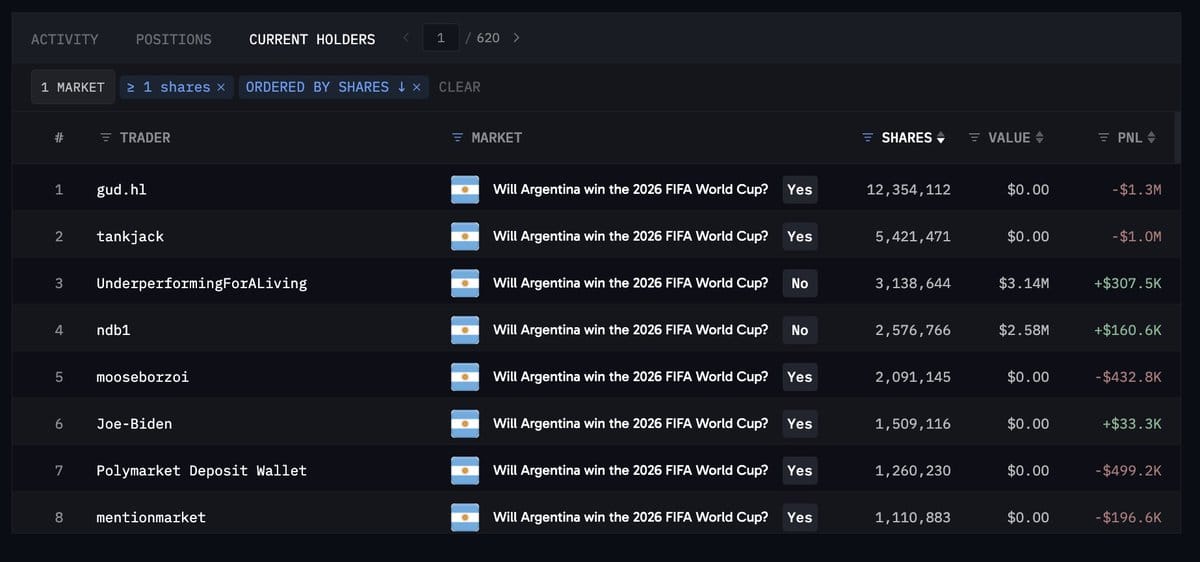
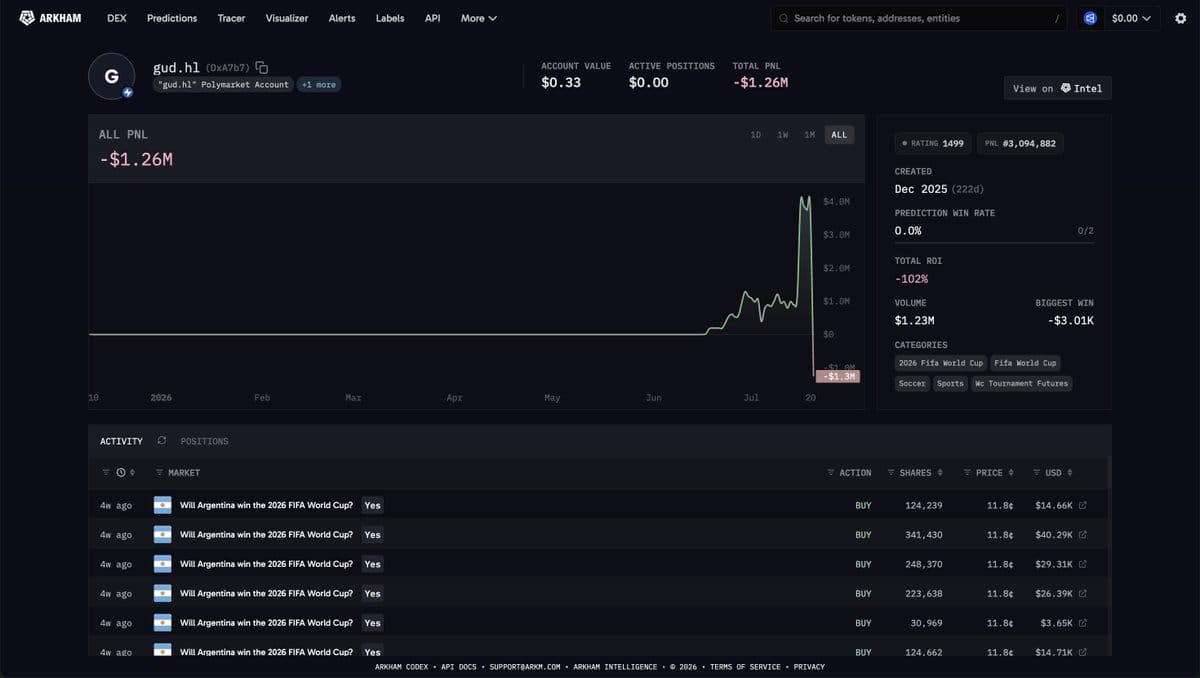
Spain’s dramatic 1-0 extra-time victory over Argentina in the 2026 FIFA World Cup Final culminated in a stunning financial loss for crypto trader ‘gud.hl’, whose entire $5.2 million position, wagered on an Argentine win, was liquidated the moment the final whistle blew. This singular event, meticulously tracked by blockchain analytics firm Arkham, not only underscored the volatile intersection of global sports and decentralized finance but also highlighted an unprecedented surge in activity across crypto prediction markets, which collectively processed billions in trading volume during the tournament. The incident has become a stark emblem of the high-stakes, high-reward, and ultimately high-risk nature of leveraging substantial capital on a single, binary outcome within the rapidly evolving landscape of Web3.
The High-Stakes Wager: A Fortune on a Football Match
The trader identified as ‘gud.hl’ had reportedly committed nearly their entire Hyperliquid PnL (Profit and Loss) – a significant accumulation of trading profits from the Hyperliquid decentralized exchange – to a single bet on Argentina securing the 2026 World Cup title. This was not a casual side wager funded by disposable income; it represented a consolidation of substantial trading success into a colossal speculative position. For many in the crypto space, losing a leveraged position due to volatile market movements is a frequent, albeit painful, occurrence. However, to witness an entire fortune, meticulously built through active trading, vanish in the space of a football match’s extra time adds a profoundly visceral dimension to the concept of financial liquidation. The final score, a solitary Spanish goal, was all it took to convert a multi-million-dollar profit into a complete loss, leaving gud.hl’s crypto wallet effectively empty. The question of whether this trader can or will rebuild their fortune remains a significant point of discussion within the crypto community, serving as a cautionary tale for those drawn to the allure of all-or-nothing bets.
The 2026 FIFA World Cup Final: A Sporting Spectacle with Financial Ramifications
The 2026 FIFA World Cup, co-hosted by the United States, Canada, and Mexico, was already a historic tournament, generating record revenues for FIFA, reportedly exceeding $9 billion. The final match itself, contested between football giants Spain and Argentina, was a captivating display of skill, strategy, and sheer determination. Played out in front of a global audience of billions, the game remained a tense deadlock through 90 minutes of regulation time, pushing it into extra time. It was during this nail-biting period that Spain scored the decisive goal, shattering Argentina’s hopes of a repeat victory and simultaneously sealing gud.hl’s financial fate. The roar of the crowd, the jubilation of the Spanish team, and the despair of the Argentinian players were mirrored by the immediate, irreversible financial consequences for those who had placed their fortunes on the match’s outcome. The World Cup, traditionally a celebration of sport and national pride, had, for a select few, become the ultimate financial arena.

Chronology of a Record-Breaking Tournament in the Digital Sphere
The 2026 World Cup’s journey to becoming a crypto betting phenomenon began long before the final whistle. From the initial group stages, prediction markets like Polymarket and Kalshi saw an exponential increase in activity.
- Pre-Tournament Buzz: Even before the first kick-off, national teams were assessed, odds fluctuated based on team form, player injuries, and expert analysis. Millions of dollars were committed to outright winner markets.
- Group Stage Dynamics: Early upsets and strong performances by underdog teams fueled further speculation, drawing in more bettors. The binary outcomes of individual matches, combined with the longer-term ‘tournament winner’ market, provided continuous opportunities for engagement.
- Knockout Rounds Intensify: As the tournament progressed into the elimination rounds, the stakes grew higher. Each victory or defeat had immediate and dramatic impacts on market odds, attracting both seasoned crypto traders and new users intrigued by the potential for rapid gains.
- The Final Countdown: The anticipation leading up to the Spain vs. Argentina final reached fever pitch, driving unprecedented liquidity into the winner markets. It was during this period, likely in the hours or days leading to the final, that gud.hl’s substantial $5.2 million bet on Argentina was firmly placed, consolidating their Hyperliquid PnL into a single, high-leverage position.
- Extra-Time Drama and Liquidation: The extra-time goal by Spain was the critical juncture. Within moments of the final whistle confirming Spain’s victory, automated smart contracts on the prediction platforms executed, liquidating all positions that had wagered on Argentina, including gud.hl’s multi-million-dollar stake. The process was instantaneous and irreversible, demonstrating the unforgiving efficiency of decentralized finance protocols.
The Rise of Decentralized Prediction Markets
The 2026 World Cup served as a watershed moment for decentralized prediction markets, platforms like Polymarket and Kalshi, which operate on blockchain technology. Unlike traditional centralized sportsbooks, these platforms offer:
- Transparency: All bets and market movements are recorded on a public blockchain, ensuring auditability and reducing concerns about manipulation.
- Global Accessibility: Users from virtually anywhere in the world can participate, often with fewer geographical restrictions than traditional gambling sites.
- Liquidity: The peer-to-peer nature of these markets allows for deep liquidity, enabling large-scale bets like gud.hl’s.
- Verifiable Outcomes: For events like a World Cup final, the outcome is unambiguously verifiable, making them ideal for smart contract execution.
Hyperliquid, the platform where gud.hl reportedly amassed their PnL, is a decentralized perpetual exchange. It allows users to trade perpetual futures contracts on various cryptocurrencies with high leverage. The PnL generated from such a platform represents significant trading acumen and risk management in the volatile crypto markets. The decision to transfer these hard-won profits into a single, high-stakes sports bet on a prediction market underscores a profound belief in a specific outcome, or perhaps an extreme appetite for risk, characteristic of some corners of the crypto trading world.
Unprecedented Market Activity and User Growth
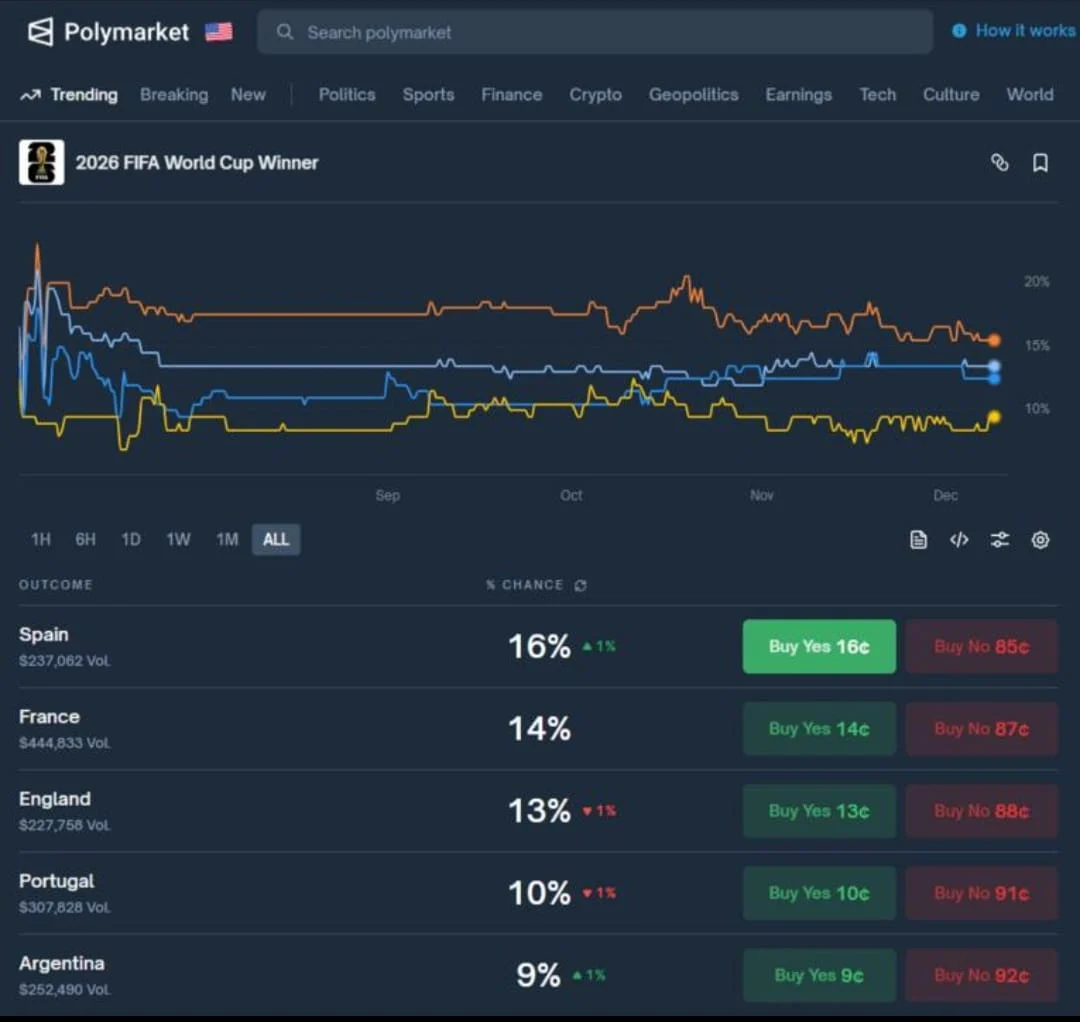
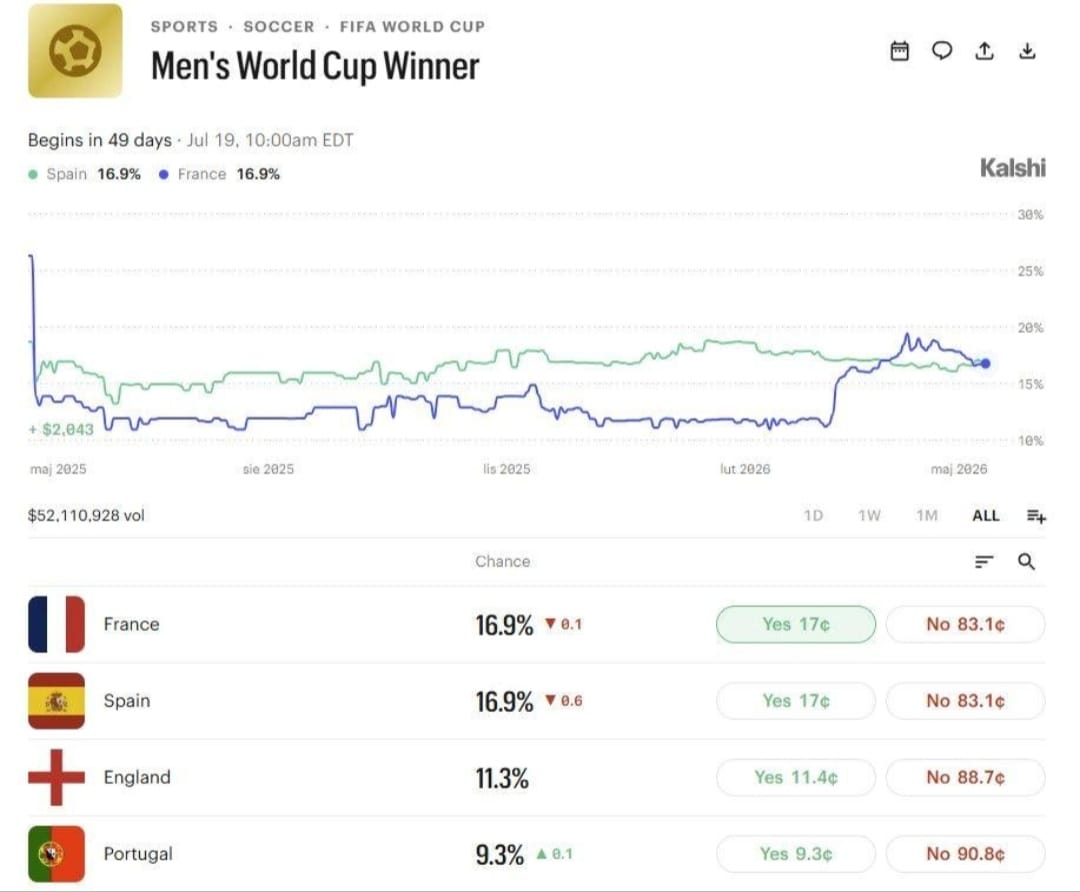
The financial scale of betting on the 2026 World Cup through crypto prediction markets dwarfed previous records. Polymarket’s World Cup winner market alone recorded over $4 billion in trading volume, a figure unparalleled in the platform’s history. Similarly, Kalshi’s winner market crossed $1.2 billion, setting a new benchmark for that platform. At its peak, the total monthly volume across the entire prediction market sector surged past $50 billion.
To put these figures into perspective, traditional sportsbooks have spent decades building the infrastructure, brand recognition, and user trust required to achieve such monumental transaction volumes. Decentralized prediction markets, relatively nascent in comparison, accomplished this feat in just five weeks. This extraordinary growth signals a significant shift in how large-scale global events are monetized and engaged with by a digitally native audience.
Beyond financial volume, user acquisition numbers were equally staggering. Kalshi reported adding three million new users during the tournament window alone. This influx is particularly noteworthy within the broader context of crypto adoption. A single global football event onboarded more new users onto a decentralized platform than many entire blockchain networks have managed to attract throughout their operational lifespan. This phenomenon suggests that the intrinsic appeal of a universally understood, globally celebrated event, coupled with the transparent and accessible nature of prediction markets, can act as a powerful catalyst for mainstream crypto adoption, transcending the typical barriers of technical complexity or niche interest.
Winners and Losers: A Spectrum of Outcomes
While gud.hl’s multi-million-dollar loss captured headlines, the 2026 World Cup prediction markets produced a wide spectrum of dramatic financial outcomes, underscoring the zero-sum nature of these high-stakes environments. For every significant loss, there was a corresponding gain.
- Contrasting Fortunes: One notable success story involved a trader who reportedly converted a $4 million position against Spain into a staggering $9 million payout. This individual’s astute "fade" of the eventual champions at a critical juncture exemplifies the potential for massive returns for those who correctly anticipate market movements or sporting outcomes.
- Consistent Misjudgment: On the flip side, another trader reportedly incurred an $11.6 million loss over a mere ten days, consistently betting against the prevailing momentum as the tournament unfolded. This illustrates the brutal efficiency with which capital can be eroded when predictions repeatedly miss the mark in a highly liquid and dynamic market.
These diverse financial narratives collectively paint a more comprehensive picture than any single headline. The tournament was a crucible for fortunes, where wealth was rapidly redistributed based on sporting prowess and predictive accuracy. The direct, visceral connection between a global sporting event and such profound financial consequences made the stakes feel far more tangible and immediate than typical crypto trading scenarios.
Why the World Cup Became a Crypto Battleground
The convergence of the World Cup and crypto prediction markets was not accidental; it was a perfect storm of aligning factors:
- Clear, Verifiable, Binary Outcomes: A football match, particularly a final, presents an unambiguous "win or lose" scenario. This clarity is ideal for smart contracts, which execute based on predefined conditions without human intervention or interpretation.
- Global Attention and Engagement: The World Cup is arguably the most-watched sporting event globally, commanding unparalleled attention across demographics and geographies. This broad appeal naturally translates into widespread interest in betting and prediction.
- Fixed Timeline: The tournament’s defined start and end dates provide a clear time horizon for bets, making it easier for participants to manage their positions and for markets to price in various stages of the competition.
- High Liquidity and Volatility: The sheer volume of participants and capital flowing into these markets during the World Cup ensured deep liquidity, allowing for large bets without significant slippage. The dynamic nature of the tournament also created ample volatility in odds, providing opportunities for savvy traders.
Crucially, the underlying infrastructure of platforms like Polymarket and Kalshi proved remarkably resilient. Handling $50 billion in monthly volume and millions of new users without major technical failures or outages is a testament to the maturation of decentralized finance technologies. This ability to absorb unprecedented demand without the system collapses that have plagued smaller crypto markets during peak activity periods signifies a robust technological foundation capable of scaling to mainstream adoption levels.
Implications for the Future of Prediction Markets and Crypto
The 2026 World Cup will likely be remembered as a pivotal moment for prediction markets and their integration into the broader financial and entertainment landscape.
- Validation of Scalability and Robustness: The successful handling of billions in volume and millions of users unequivocally validates the technological scalability and operational robustness of decentralized prediction market platforms. This performance lays a strong foundation for future growth and wider adoption.
- Pathway to Mainstream Crypto Adoption: The tournament demonstrated that global cultural phenomena can serve as powerful on-ramps for new users into the crypto ecosystem. By connecting familiar events with innovative financial tools, prediction markets can demystify blockchain technology and attract a broader demographic beyond existing crypto enthusiasts.
- Increased Regulatory Scrutiny: The massive scale of financial activity will undoubtedly draw the attention of financial regulators worldwide. Governments and regulatory bodies, increasingly concerned with consumer protection, anti-money laundering (AML), and know-your-customer (KYC) compliance, will likely intensify their examination of these platforms. This could lead to new regulatory frameworks, potentially impacting the global accessibility and operational models of decentralized markets.
- Redefining Sports Betting: The success of crypto prediction markets challenges the traditional sportsbook industry. Their transparency, lower fees (often), and global reach could force traditional players to innovate or risk losing market share to decentralized alternatives.
- Risk Management and Financial Education: The stark reality of gud.hl’s loss serves as a powerful reminder of the extreme risks associated with high-leverage, all-in bets. As prediction markets gain traction, there will be an increased need for comprehensive financial education and responsible trading tools to help users understand and mitigate inherent risks.
- Economic Impact and Capital Flow: The significant capital flow through these platforms during a single event underscores their growing economic influence. This represents a new avenue for wealth creation and redistribution, potentially impacting local economies and global financial markets in unforeseen ways.
The Human Element: A Cautionary Tale
Beyond the technical achievements and financial statistics, gud.hl’s $5.2 million loss remains a deeply personal story. It highlights the often-overlooked human element in the cold, calculated world of finance. The psychological impact of losing an entire fortune, painstakingly built through skill and effort, on a single sporting event, is immense. It transforms what might have been a success story into a stark cautionary tale about the perils of concentrated risk and the intoxicating allure of "getting rich quick." Whether this event marks the end of gud.hl’s trading career or becomes a catalyst for a future comeback remains to be seen. The crypto market, with its inherent volatility, offers opportunities for rapid recovery as much as it does for sudden devastation. Only time will tell if this story evolves into one of redemption or serves as a permanent reminder of a fateful bet.
In conclusion, the 2026 FIFA World Cup was more than just a football tournament; it was a proving ground for decentralized prediction markets. It showcased their capacity to handle unprecedented scale, attract millions of new users, and facilitate billions in trading volume. While the dramatic liquidation of gud.hl’s $5.2 million position offered a poignant reminder of the inherent risks, the overall success of these platforms signals a new era where global events and decentralized finance are increasingly intertwined, poised to reshape the future of betting, trading, and mainstream crypto adoption.
Disclosure: This is not trading or investment advice. Always do your research before buying any cryptocurrency or investing in any services.