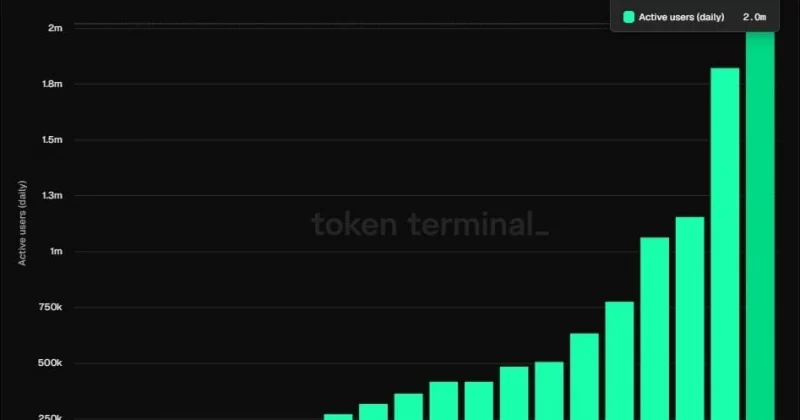
Tron has achieved a significant milestone, crossing the 4 million daily active user (DAU) threshold, a feat that propels it past competitor Solana and positions it as the leading major blockchain network in terms of user engagement. This surge in activity is not fueled by speculative trading in decentralized finance (DeFi) or the volatile NFT market, but rather by the robust utility of stablecoins, with Tether (USDT) emerging as the primary driver. This development underscores a paradigm shift in blockchain adoption, highlighting the foundational role stablecoins play in fostering widespread network participation.
The Enduring Strength of the Stablecoin Engine
The trajectory of Tron’s user growth has been nothing short of remarkable. In the fourth quarter of 2025, the network consistently averaged around 2.8 million DAUs, placing it in close proximity to Solana’s 2.9 million DAUs during the same period. This competitive landscape shifted dramatically by February 2026, when Tron’s DAUs climbed to approximately 3.2 million, signaling an accelerating trend. The most recent data confirms this upward momentum, with the network now comfortably exceeding 4 million daily active users, a testament to its expanding user base and the increasing reliance on its infrastructure.
The engine powering this expansion is the consistent and high-volume transfer of stablecoins, particularly USDT. On Tron, USDT transfer volumes frequently surpass $20 billion on a daily basis. This level of activity is further corroborated by the sheer scale of USDT’s presence on the network. As of May 2025, the circulating supply of USDT on Tron had already exceeded an astounding $75 billion, representing more than half of Tether’s total global supply. This concentration highlights Tron’s pivotal role in the stablecoin ecosystem, serving as a primary conduit for billions of dollars in digital dollar transactions.
Beyond stablecoins, Tron’s underlying infrastructure demonstrates its capacity to handle substantial transaction volumes. The network consistently processes over 8 million daily transactions, a figure that underscores its efficiency and scalability. This high throughput has contributed to the accumulation of an impressive user base, with more than 306 million total user accounts having been registered on the platform since its inception. This broad adoption suggests that Tron is not merely a speculative playground but a functional network supporting a diverse range of activities.
Stablecoins: The Unsung Heroes of Blockchain User Growth
The question naturally arises: why have stablecoins, specifically USDT on Tron, become such a potent force in driving user growth, surpassing the allure of DeFi speculation and NFT trading? The answer lies in the fundamental utility and accessibility that stablecoins offer. Unlike volatile cryptocurrencies that are primarily seen as investment vehicles, stablecoins provide a digital representation of traditional fiat currencies, offering price stability and predictability.
This stability is crucial for a wide array of real-world applications that are now increasingly leveraging blockchain technology. Remittances, cross-border payments, and everyday commerce are prime examples. For individuals and businesses operating in economies with unstable local currencies or facing high remittance fees, stablecoins offer a more reliable and cost-effective alternative. Tron’s architecture, designed for high throughput and low transaction fees, is ideally suited to facilitate these high-volume, low-value transactions that are essential for global financial inclusion.
The foundational principles laid out by Tron’s founder, Justin Sun, since its inception in 2017, with its mainnet launching in 2018, have been instrumental in creating an environment conducive to stablecoin adoption. From its early days, Tron prioritized achieving high transaction speeds and maintaining exceptionally low fees. This strategic focus has made the network an attractive proposition for developers and users seeking efficient and affordable ways to move value. The low-cost nature of transactions on Tron is particularly appealing for stablecoin transfers, as it minimizes the overhead associated with frequent or large-scale transactions, making it a more practical choice for everyday financial activities.
Implications for Investors and the Broader Ecosystem
The sustained growth in Tron’s DAUs, driven by stablecoin activity, carries significant implications for investors and the broader blockchain ecosystem. The network’s transaction volume exhibits a baseline that is structurally tied to global remittance flows and cross-border commerce. This means that a substantial portion of Tron’s activity is not contingent on speculative market sentiment but on the fundamental need for efficient international money transfer and trade.
The native token, TRX, plays a crucial role in this ecosystem. TRX is required to pay transaction fees on the network and is also integral to the governance mechanisms, allowing token holders to participate in decision-making processes related to the network’s development and future direction. As the network’s utility and user base expand, the demand for TRX, both for transactional purposes and for governance participation, is likely to increase, potentially influencing its market value.
However, this reliance on a single asset, USDT, also presents a notable risk. The principle of concentration risk is paramount here. When a blockchain network’s activity becomes overwhelmingly dependent on a single asset, any disruption to that asset’s stability or dominance can pose an existential threat to the network’s user numbers and overall health.
For instance, if Tether were to face significant regulatory scrutiny or enforcement actions from global financial authorities, or if its peg to the US dollar were to be compromised, the consequences for Tron could be severe. Similarly, if a competing stablecoin, such as Circle’s USDC, were to gain substantial traction and adoption on the Tron network, it could dilute USDT’s dominance and potentially lead to a fragmentation of user activity. In such scenarios, the impressive DAU figures that Tron has achieved could rapidly reverse, impacting investor confidence and the network’s long-term viability.
A Look at the Chronology of Growth
The journey to surpassing Solana in daily active users has been a process of steady, strategic growth for Tron, underpinned by its focus on utility and affordability.
- 2017: Tron is founded by Justin Sun with the vision of decentralizing the internet and creating a more equitable digital ecosystem.
- 2018: Tron’s mainnet is launched, marking the beginning of its operational phase and the implementation of its core technologies, emphasizing high throughput and low fees.
- Q4 2025: Tron consistently records approximately 2.8 million daily active users, positioning it as a strong contender in the blockchain space, closely trailing Solana’s 2.9 million DAUs. This period highlights Tron’s established presence and its ability to attract a significant user base.
- February 2026: Tron experiences a notable surge in user activity, with DAUs climbing to around 3.2 million. This increase signals a growing adoption rate and suggests that the network’s offerings are resonating more strongly with users.
- Recent Data (Post-February 2026): Tron officially crosses the critical milestone of 4 million daily active users, solidifying its position as the leading major blockchain network in terms of user engagement and outperforming competitors like Solana. This achievement is primarily attributed to the widespread adoption and utility of stablecoins, particularly USDT, on the network.
- May 2025 (Concurrent Data Point): The circulating supply of USDT on Tron surpasses $75 billion, representing over half of Tether’s total supply. This data point, while preceding some of the DAU growth figures, illustrates the foundational strength of USDT adoption that likely fueled subsequent user engagement.
Supporting Data and Network Metrics
The impressive DAU figures are backed by a robust set of network metrics that highlight Tron’s capacity and scale:
- Daily Active Users (DAU): Exceeds 4 million, surpassing Solana.
- Daily Transactions: Consistently over 8 million transactions processed daily.
- Total User Accounts: Over 306 million accounts created on the network.
- USDT Circulating Supply on Tron: Surpassed $75 billion as of May 2025, accounting for more than 50% of Tether’s total supply.
- Daily USDT Transfer Volume: Frequently exceeds $20 billion.
These metrics collectively paint a picture of a highly active and functional blockchain network, with stablecoin transactions forming the bedrock of its current success. The low transaction fees and high throughput capabilities of the Tron network are key enablers of this sustained high volume of stablecoin activity.
Broader Impact and Future Considerations
Tron’s ascent to the top of the DAU charts, propelled by stablecoins, offers valuable insights into the evolving landscape of blockchain adoption. It demonstrates that utility-driven use cases, such as remittances and cross-border commerce, can be more effective in driving mass adoption than speculative financial activities. This shift could encourage other blockchain networks to re-evaluate their strategies and focus on building infrastructure that supports real-world financial applications.
For investors, Tron presents an intriguing proposition. The network’s reliance on stablecoins for its core activity suggests a more resilient demand base compared to networks heavily dependent on speculative trading. However, the concentration risk associated with USDT cannot be ignored. Investors will need to closely monitor regulatory developments surrounding stablecoins and the competitive landscape for stablecoin issuance and adoption.
The success of Tron also underscores the critical role of stablecoins in the broader digital asset ecosystem. As global financial systems become increasingly digitized, stablecoins are poised to become the primary bridge between traditional finance and the decentralized world. Tron’s ability to facilitate billions of dollars in stablecoin transactions daily positions it as a key player in this ongoing transformation. The network’s future growth will likely depend on its ability to maintain its competitive edge in terms of fees and speed, while also navigating the evolving regulatory environment and potential competition from other stablecoin-centric blockchain solutions. The continued success of Tron will serve as a significant case study in the power of utility-driven growth within the blockchain space.