


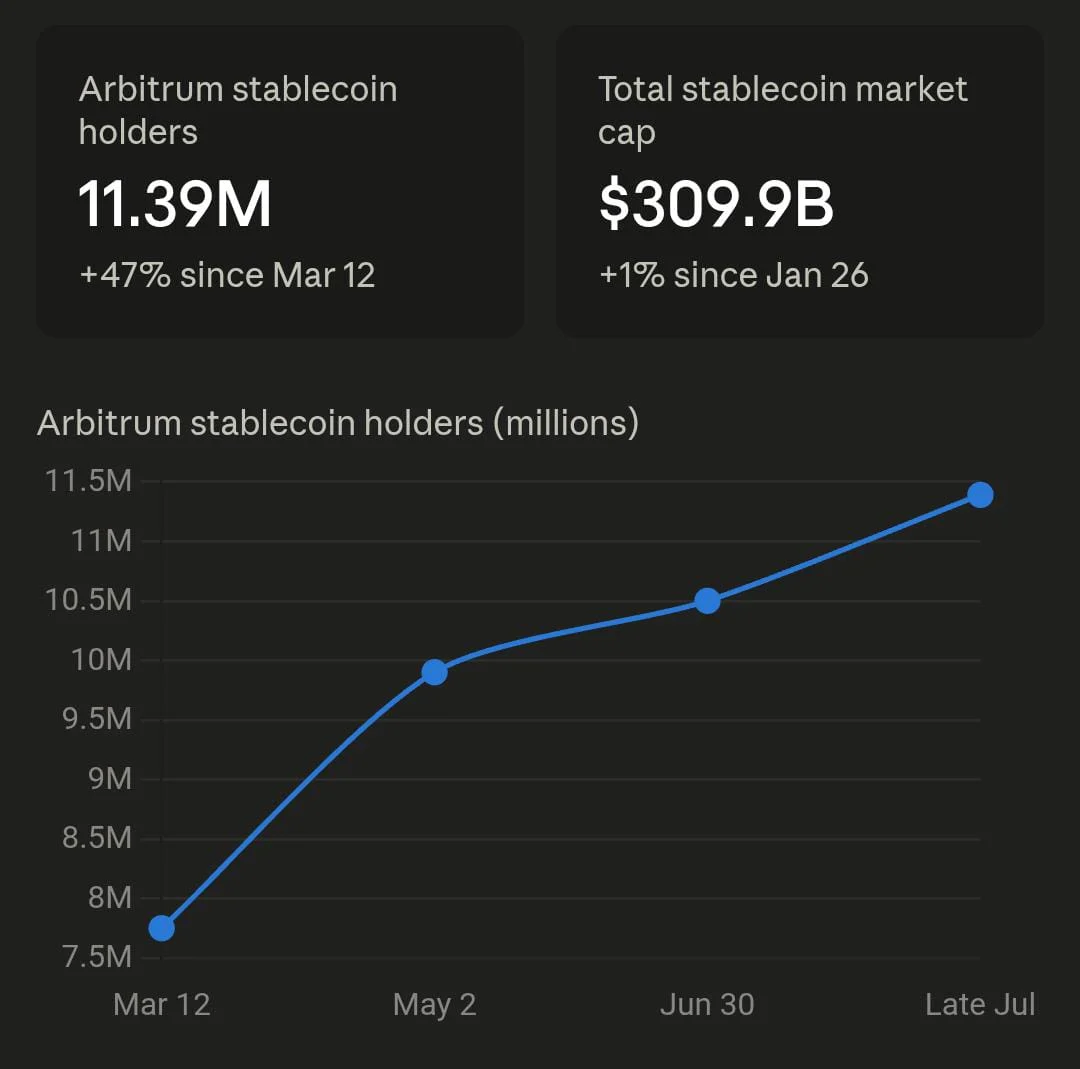
The data reveals Arbitrum now hosts 11,386,904 stablecoin holders, marginally surpassing Solana’s 11,173,947. This difference, approximately 213,000 unique holders or about 1.9%, is narrow enough to suggest a dynamic and intensely competitive environment where leadership could easily shift back and forth within weeks. Nevertheless, for the present moment, this signifies Arbitrum’s emergence as a preferred destination for users parking their dollar-denominated assets on-chain, a role typically associated with its robust ecosystem of blue-chip DeFi protocols such as GMX and Uniswap. This quiet achievement underscores a strategic victory in the race for fundamental network utility, distinguishing itself from metrics driven purely by transient trading activity.
The Significance of Stablecoin Holders in a Volatile Market
Stablecoin holder counts are often overlooked in favor of more volatile metrics like trading volume or token price, yet they serve as a crucial barometer for a blockchain network’s underlying health and utility. Unlike speculative trading, where assets may move in and out of a network rapidly, stablecoin holdings typically represent a more "sticky" form of capital. These funds are often held for practical purposes: facilitating payments, serving as collateral in decentralized finance (DeFi) protocols, hedging against market volatility, or simply as a secure on-chain savings vehicle. Therefore, a growing number of stablecoin holders suggests an expanding base of users who are genuinely integrating the network into their financial activities, rather than merely using it as a transient stop for speculative trades. This metric provides a clearer picture of real economic activity and sustained user engagement, making Arbitrum’s ascent in this category particularly noteworthy.
Arbitrum’s Journey to Stablecoin Dominance: A Chronology
Arbitrum’s current position at the forefront of stablecoin adoption is not an overnight phenomenon but the culmination of a consistent, strategic build-out. The network’s foundational objective as an Ethereum Layer-2 has always been to enhance scalability and reduce transaction costs for decentralized applications, thereby making the Ethereum ecosystem more accessible and efficient.

The Arbitrum team itself highlighted significant growth in stablecoin holders earlier this year. In March, the network reported approximately 7.75 million stablecoin holders, demonstrating a clear trajectory of increasing user adoption. At that time, Arbitrum was already strategically positioning itself as a dedicated settlement layer for dollar-denominated activities, recognizing the critical role stablecoins play in on-chain commerce and finance.
This growth accelerated remarkably. By May, the stablecoin holder count had surged to nearly 10 million, marking an impressive 28% increase in just three months. This period also saw Arbitrum facilitate over $50 billion in monthly stablecoin transfers, indicating not just an accumulation of stablecoins but also significant transactional utility. Such a growth curve, while perhaps not generating splashy headlines, represents a formidable expansion of the network’s user base and capital inflows.
Now, just two months later, Arbitrum has added well over a million more holders, pushing its total past the 11.3 million mark and securing its latest all-time high. This consistent upward trend, marking the third all-time high for this metric within the past year, underscores a sustained and deliberate expansion rather than a temporary spike. It reflects a growing confidence among users to store and transact stablecoins within the Arbitrum ecosystem, leveraging its security, efficiency, and expanding suite of DeFi applications.
Deep Dive into the Competitive Landscape
To truly appreciate Arbitrum’s achievement, it is essential to contextualize it within the broader blockchain ecosystem, comparing it with other prominent networks vying for stablecoin dominance.
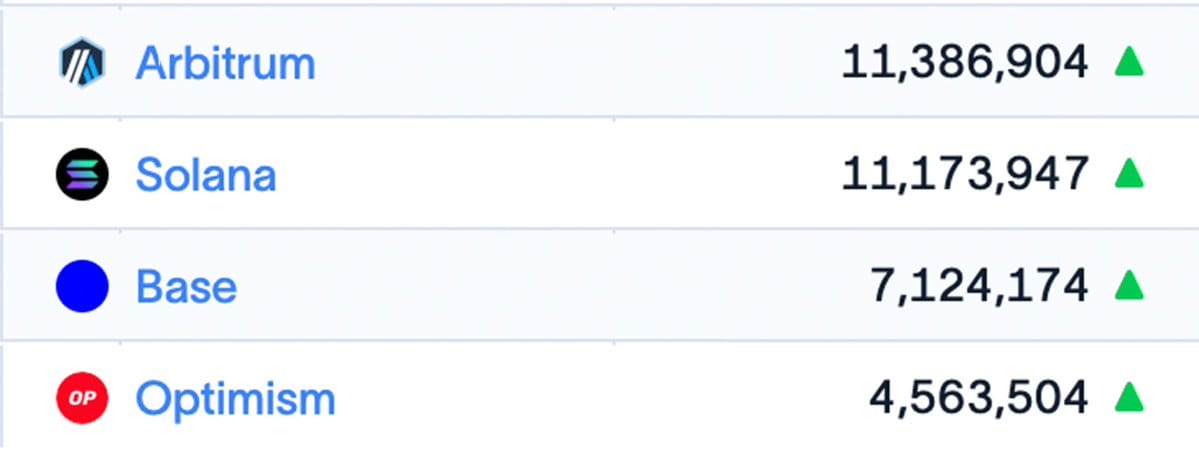
Solana’s Persistent Challenge: While Arbitrum has taken the lead in stablecoin holders, Solana remains a formidable competitor. Its 11,173,947 stablecoin holders represent a robust and growing user base, largely fueled by its high transaction throughput, ultra-low fees, and the recent explosion in meme coin trading, which has attracted a massive influx of retail users. Solana continues to lead in several other critical stablecoin metrics, most notably raw transaction throughput, demonstrating its capacity for handling immense volumes of rapid transactions. Its ecosystem also boasts a vibrant DeFi landscape and NFT market, contributing to its overall appeal for various on-chain activities. The close margin between Arbitrum and Solana underscores the intense competition and the dynamic nature of user preferences in the crypto space.
Base’s Rapid Ascent: Trailing Arbitrum and Solana, but with an impressively rapid growth trajectory, is Base, Coinbase’s Layer-2 network. With 7,124,174 stablecoin holders, Base has accumulated a substantial user base in a remarkably short period since its launch in 2023. This rapid adoption is largely attributable to the massive retail funnel provided by Coinbase, one of the world’s largest cryptocurrency exchanges. Base benefits from seamless integration with Coinbase’s user interface, making it exceptionally easy for millions of existing Coinbase users to bridge funds and interact with decentralized applications on its network. This strategic advantage positions Base as a significant long-term contender for retail stablecoin adoption.
Optimism’s Foundational Role: Optimism, another leading Ethereum Layer-2, rounds out the top four with 4,563,504 stablecoin holders. While its consumer footprint might appear smaller compared to the other three, Optimism plays a crucial foundational role in the broader Layer-2 ecosystem through its OP Stack. The OP Stack is a modular, open-source development framework that allows other networks to build their own Layer-2 solutions, forming what is known as the "Superchain." This strategy, while potentially leading to a distributed user base across various OP Stack chains, solidifies Optimism’s influence as a core infrastructure provider within the Ethereum scaling landscape. Its stablecoin holder count, while lower, still represents a significant user base engaged in its ecosystem and the broader Superchain vision.
What’s Fueling Arbitrum’s Stablecoin Surge?
Several strategic and infrastructural elements contribute to Arbitrum’s impressive stablecoin holder growth:
- Robust Infrastructure and Integrations: Arbitrum has proactively focused on building a stablecoin-friendly environment. This includes courting native support for major stablecoins like Tether (USDT) and integrating newer offerings such as PayPal USD (PYUSD). By ensuring broad stablecoin availability and offering low-cost transaction rails, Arbitrum makes it economically viable and convenient for users to move and hold dollar-denominated assets on its network without incurring prohibitive fees.
- Deep Ecosystem Gravity: The presence of established and highly liquid DeFi protocols like GMX (a decentralized perpetual exchange) and Uniswap (the leading decentralized exchange) creates a strong "gravity" for stablecoin holders. Large holders and institutional participants are incentivized to keep their stablecoin balances on Arbitrum to leverage the deep liquidity and diverse financial instruments available, rather than bridging assets back to Ethereum Mainnet for every transaction. This rich ecosystem fosters a vibrant environment for trading, lending, and yield farming, all of which rely heavily on stablecoins.
- Arbitrum Orbit and Ecosystem Expansion: A critical structural component of Arbitrum’s growth strategy is Arbitrum Orbit. Orbit allows developers to launch custom, dedicated Layer-3 chains (or even Layer-2s) that settle directly onto Arbitrum One or Nova. These custom chains, known as "Orbit chains," inherit Arbitrum’s security and efficiency. Every new wallet that interacts with an application or service built on an Orbit chain directly contributes to Arbitrum’s overall stablecoin holder count, as these chains effectively funnel fresh users and stablecoin balances into the broader Arbitrum ecosystem. This expanding network of interconnected chains creates a powerful pipeline for continuous user and capital inflow, ensuring sustained growth.
- Developer Activity and Innovation: A thriving developer community is essential for long-term network health. Arbitrum has consistently attracted developers due to its EVM compatibility, robust tooling, and a supportive foundation. This vibrant developer activity leads to the creation of new decentralized applications and services, further enhancing the utility and appeal of the network for stablecoin holders seeking diverse financial opportunities.
- Security and Reliability: As an Ethereum Layer-2, Arbitrum inherits the robust security guarantees of the Ethereum blockchain. This inherent security, combined with Arbitrum’s proven track record of operational stability, instills confidence in users who are entrusting significant stablecoin balances to the network. This institutional-grade security posture is particularly appealing to larger holders and institutional entities.
Broader Implications for the Stablecoin Race and Future of DeFi
While Arbitrum’s recent milestone is significant, it does not unilaterally determine the "winner" of the broader stablecoin era. Ethereum Mainnet still commands an overwhelming majority of the total stablecoin supply across the entire crypto ecosystem, dwarfing all Layer-2s and alternative chains combined. Similarly, Tron continues to dominate in terms of raw dollar transfer volume, especially for smaller, peer-to-peer transactions often involving emerging markets. These established giants maintain their positions due to different use cases and network effects.
However, among the challenger chains and scaling solutions vying for retail and DeFi mindshare, the stablecoin holder count is rapidly becoming one of the clearest and most indicative scoreboards for genuine adoption. It speaks to a network’s ability to attract and retain users who view it as a reliable and efficient platform for their financial activities, moving beyond purely speculative trading.
This intensifying competition among Layer-2s and high-performance alternative chains for stablecoin holders has several profound implications:
- Decentralized Finance (DeFi) Evolution: As more stablecoins and users migrate to Layer-2s, the DeFi landscape on these networks will continue to deepen, offering more liquidity, diverse products, and greater accessibility. This fosters innovation and makes DeFi more practical for a wider audience.
- Institutional Interest: A growing base of stablecoin holders, particularly on robust and secure Layer-2s like Arbitrum, is a strong signal for institutional investors. It indicates a maturing ecosystem with real economic activity, potentially attracting more traditional financial players to explore on-chain opportunities.
- User Experience Prioritization: The competition forces networks to prioritize user experience, focusing on lower fees, faster transaction finality, and seamless bridging solutions. This ultimately benefits end-users by making decentralized finance more efficient and user-friendly.
- Network Specialization: Different chains may continue to specialize. Solana might excel in high-frequency trading and low-latency applications, Base in retail onboarding, Optimism in modular chain deployment, and Arbitrum in deep DeFi liquidity and general-purpose stablecoin utility.
The question of whether Arbitrum can maintain its lead is genuinely open. Solana’s aggressive growth trajectory, particularly its ability to onboard new users through viral trends and its inherently fast architecture, means a single strong week of inflows or a new killer application could easily swing the lead back. For now, however, Arbitrum, a network long celebrated for its robust DeFi protocols and technical prowess, has quietly cultivated the largest base of stablecoin holders among its immediate competitors. This quiet milestone, indicative of durable adoption rather than fleeting speculation, is undoubtedly worth watching closely as the battle for the future of on-chain finance continues to unfold.














