
On-chain indicators are painting a potentially bullish picture for Bitcoin, suggesting that the cryptocurrency might be entering the final stages of its prolonged nine-month bear market. A prominent crypto analyst, known as Darkfost, recently highlighted a critical development on the blockchain: a downward crossover of the cost basis between Short-Term Holders (STH) and Long-Term Holders (LTH). This event, confirmed over a three-day period, is being interpreted by some as a significant signal that the market has endured its most challenging phase and may be poised for a recovery.
The concept of cost basis for different holder groups is fundamental to understanding market sentiment and potential future price movements. Short-Term Holders are typically defined as those who have held their Bitcoin for less than 155 days, often characterized by more speculative behavior and quicker reactions to market fluctuations. Long-Term Holders, conversely, have held their assets for over 155 days, generally exhibiting a more HODL-centric approach and a belief in the long-term value proposition of Bitcoin. When the cost basis of STHs falls below that of LTHs, it implies that newer entrants to the market are buying Bitcoin at significantly lower prices than those who have held for longer periods. This can indicate capitulation by some short-term holders who are selling at a loss, thereby lowering the average purchase price for new buyers and potentially establishing a new, lower floor for the asset.
Darkfost’s analysis, shared through a detailed tweet and accompanied by a comparative graph, indicated that the STH cost basis had seen a dramatic decline, plummeting from an approximate $112,500 to around $69,000. This significant drop suggests that a substantial number of recent buyers have acquired Bitcoin at substantially reduced prices. The overlap and potential descent of the STH cost basis below the LTH cost basis is a recurring pattern observed at the tail end of previous bear markets, historically preceding periods of recovery and subsequent bull runs.
Historical Context and the Significance of Cost Basis Crossovers
To fully appreciate the implications of this on-chain signal, it’s essential to examine historical Bitcoin market cycles. Bitcoin has historically operated on roughly four-year cycles, often influenced by its halving events – programmed reductions in the rate at which new bitcoins are created. These cycles typically involve a period of accumulation, a parabolic bull run, a significant correction, and a prolonged bear market.
The current bear market, which began in late 2021 after Bitcoin reached its all-time high above $69,000, has been one of the longest and most challenging for investors. Several factors contributed to this downturn, including macroeconomic headwinds such as rising inflation and interest rate hikes by central banks, the collapse of major crypto firms like Terra/Luna and FTX, and increased regulatory scrutiny worldwide. This period of sustained price depreciation has led to significant losses for many investors, particularly those who entered the market at or near its peak.

The STH/LTH cost basis crossover is not an isolated indicator but rather one piece of a larger on-chain analysis puzzle. When STHs are selling at a loss, it often signifies that weaker hands are being shaken out of the market. This process of capitulation can be painful but is often a necessary precursor to a sustainable recovery. The LTH cost basis, on the other hand, represents the average purchase price of long-term holders. If this line remains relatively stable or even starts to trend upwards slightly, it suggests that those with a conviction in Bitcoin’s long-term value are holding firm, absorbing some of the selling pressure.
The specific figure of $69,000 as the STH cost basis is particularly poignant, as it aligns with Bitcoin’s previous all-time high before its extended decline. The fact that the cost basis for short-term holders has fallen to this level suggests that recent buyers are acquiring Bitcoin at prices comparable to the previous market peak, but at a time when the overall market sentiment is subdued. This could create a scenario where new capital entering the market at these lower prices can exert significant upward pressure once the broader market sentiment shifts.
The Terminal Phase and Dollar Cost Averaging
Darkfost’s analysis suggests that the current conditions are indicative of the "terminal phase" of the bear market. This doesn’t necessarily mean the bear market is over, but rather that it is entering its final, often most challenging, period before a potential bottom is established. During this phase, price action can remain volatile, with occasional sharp rallies and dips. However, the underlying trend of decreasing selling pressure from short-term holders and accumulation by more resilient investors can pave the way for a more sustained recovery.
The analyst also pointed out that these conditions make them "ripe for a viable Dollar Cost Averaging (DCA) strategy." DCA is an investment strategy where an investor invests a fixed amount of money into an asset at regular intervals, regardless of the asset’s price. This approach helps to mitigate the risk of buying at a market top and can lead to a lower average purchase price over time, especially in a volatile or declining market. In a bear market, DCA allows investors to accumulate more units of an asset when prices are low, potentially benefiting significantly when the market eventually turns bullish.
Future Outlook and Potential Scenarios
While the STH/LTH cost basis crossover is a strong signal, it is not a foolproof predictor of an immediate price surge. The crypto market is influenced by a myriad of factors, and the confirmation of a true bull market onset typically requires further evidence.
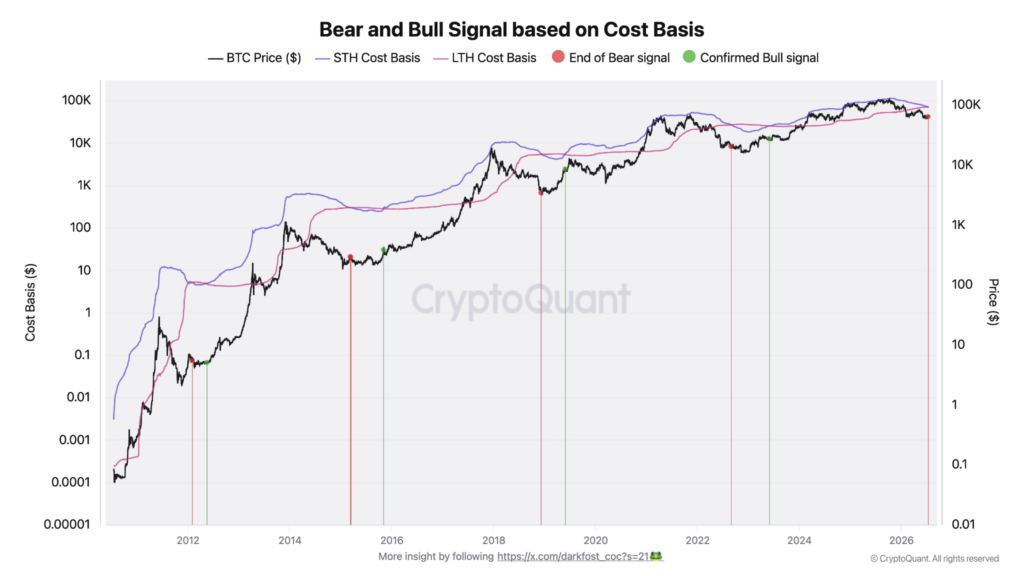
One of the key indicators to watch for will be a subsequent upward crossover of the STH and LTH cost bases. This would signify that short-term holders have begun to acquire Bitcoin at higher prices than long-term holders, a clear indication that demand is increasing and the market is moving into a recovery phase. However, the timeframe for this development remains uncertain. As Darkfost noted, it could take months or even over a year for this confirmation to occur.
The debate among analysts and investors continues regarding the exact bottom for Bitcoin. Some believe that the current lows, hovering around the $58,500 mark, might represent the final capitulation point. Others argue that further downside is still possible, and a deeper dip might be necessary to definitively establish a market bottom before a sustained recovery can begin. This divergence of opinion highlights the inherent uncertainty and speculative nature of the cryptocurrency market.
Despite the complexities and potential for further volatility, the observed on-chain signals underscore Bitcoin’s ongoing maturation as an asset class. While critics have questioned the adherence to its traditional four-year cycle, particularly in light of recent market disruptions, the enduring cyclical investor behavior suggests that these patterns may still hold relevance. The current phase, if it indeed marks the end of the bear market, would further solidify the narrative of Bitcoin’s resilience and its capacity to navigate through challenging economic and market conditions, ultimately reinforcing its position as a significant digital asset.
The broader implications of a potential end to the bear market extend beyond just price appreciation. A sustained recovery could reignite investor confidence, attract new institutional and retail capital, and spur further innovation and development within the broader cryptocurrency ecosystem. It could also lead to increased regulatory clarity as markets stabilize and demonstrate their resilience. However, until definitive signals of a sustained upward trend emerge, caution and a long-term perspective remain paramount for investors navigating this dynamic landscape. The current on-chain data provides a glimmer of hope, suggesting that the arduous journey through the bear market may be nearing its conclusion, paving the way for a new chapter in Bitcoin’s price history.