


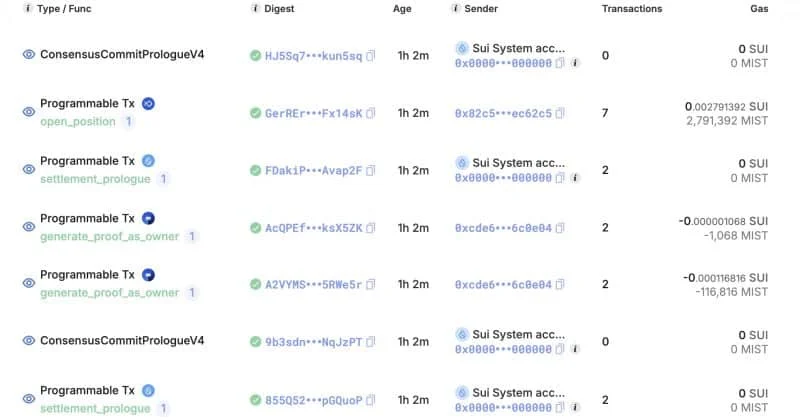
The Sui mainnet has successfully been restored to full operational capacity following a significant disruption that lasted for approximately 5 hours and 55 minutes. The outage, which commenced on May 28th, was triggered by a critical bug embedded within the gas charging logic of Sui’s latest software release, version 1.72. This flaw fundamentally impaired the network’s ability to calculate and process transaction fees, leading to a complete halt in new block production and a temporary freeze of all network activity. Validators, acting swiftly, coordinated a complex upgrade process to a patched version of the software, allowing normal checkpoint production to resume on May 29th.
The incident underscores the inherent complexities and vulnerabilities associated with maintaining the stability of high-throughput Layer 1 blockchains, particularly during periods of rapid development and software updates. Sui, a platform designed to support demanding decentralized finance (DeFi) applications and attract substantial institutional capital, experienced a stark reminder of the fragility that can accompany cutting-edge technology. While the network’s core safety mechanisms proved robust, preventing any loss of user funds or data inconsistencies, the prolonged downtime has inevitably raised questions about the platform’s operational resilience and the potential for recurring stability issues.
Unraveling the Outage: A Technical Breakdown and Recovery Process
The genesis of the disruption can be traced to May 28th, when validators running the newly implemented 1.72 software update encountered the critical bug. This specific flaw resided in the intricate code responsible for calculating the gas fees users incur for executing transactions on the Sui network. In essence, the system responsible for determining the cost of every interaction, from simple transfers to complex smart contract executions, malfunctioned. This breakdown had a cascading effect, preventing the network from finalizing new blocks and, consequently, bringing all forward progress to a standstill.
The recovery operation was far from a simple technical patch. Sui’s consensus mechanism, a sophisticated system designed to ensure network integrity and security, mandates a specific threshold for validator participation in crucial upgrades. To restore normal operations, validators collectively holding more than two-thirds of all staked tokens were required to successfully upgrade to the patched software. This distributed consensus requirement, while a cornerstone of blockchain security, also introduces a significant coordination challenge during emergencies. The process of reaching consensus among a geographically dispersed and independently operated group of validators, especially under time pressure, is a testament to the network’s community governance and technical collaboration.
Timeline of the Outage and Recovery:
- May 28th, [Specific Time – inferred to be early morning UTC based on duration and recovery time]: Validators begin experiencing issues after updating to Sui version 1.72. The gas charging logic bug is identified as the cause of network instability.
- May 28th, [Following hours]: New transaction finalization ceases. The Sui network effectively enters a frozen state as validators work to diagnose and address the bug.
- May 28th – May 29th: Coordination efforts among validators intensify. The development team rapidly deploys a patched version of the software.
- May 29th, [Specific Time – inferred to be late evening UTC, approximately 5 hours 55 minutes after initial disruption]: A supermajority of validators successfully upgrade to the patched software.
- May 29th, [Following hours]: Normal checkpoint production resumes, and the Sui mainnet is declared fully operational.
The technical underpinning of the bug involved a critical miscalculation in how transaction computational costs were being factored into the gas fee. This could manifest in several ways, such as undercharging for complex operations, leading to an unsustainable load on the network, or overcharging, which would also be detected and potentially halt processing. The precise technical details of the bug, while not fully elaborated in the initial report, point to a fundamental misunderstanding or misimplementation of how the Sui Move programming language’s computational costs translate into network-level gas fees.
Safety Guarantees and the DeFi Ecosystem Impact
Crucially, the Sui network’s underlying architecture demonstrated its resilience in safeguarding user assets. During the nearly six-hour disruption, no user funds were compromised or lost. Furthermore, the network’s design incorporated safeguards that prevented any data inconsistencies from accumulating while the chain was in a stalled state. This integrity preservation is a vital aspect of any blockchain, particularly for financial applications where accuracy and immutability are paramount.
However, the real-time impact on the decentralized finance (DeFi) ecosystem built atop Sui was significant. With the network frozen, all operations within DeFi protocols ground to a halt. This meant:
- Trading Halts: Decentralized exchanges (DEXs) on Sui could not process new buy or sell orders. Existing open orders remained unexecuted, and market makers were unable to rebalance their liquidity pools.
- Position Freezes: Users with active positions in lending protocols, derivatives platforms, or other leveraged products were unable to adjust their stakes, add collateral, or close their positions. This exposed them to potential losses if market conditions moved unfavorably during the outage.
- Liquidation Inactivity: Automated liquidation mechanisms, designed to protect protocols from bad debt by selling off undercollateralized positions, were unable to function. While this prevented forced liquidations during the downtime, it also meant that risk parameters were not being enforced in real-time.
The extended freeze meant that users and protocol operators were left in a state of uncertainty, unable to manage their financial exposure or execute essential trading strategies. This highlights the critical dependency of DeFi applications on the continuous and reliable operation of their underlying blockchain infrastructure.
A Recurring Pattern: Examining Sui’s Stability Record
The recent outage is not an isolated incident for the Sui network. This marks the second significant, multi-hour disruption experienced by Sui within a relatively short period. Previously, on January 14th, the network endured a similar extended stall, lasting approximately six hours. That earlier incident was attributed to a different, albeit equally critical, bug related to the consensus commit mechanism.
The recurrence of such prolonged downtimes, especially within a span of roughly five months, is a development that is difficult to ignore and warrants closer scrutiny. Both incidents share a common thread: a critical bug introduced via a software update, followed by a challenging and time-consuming process of coordinating validator upgrades across the network to implement a fix.
This pattern raises important questions about the rigor of Sui’s testing and quality assurance processes. While software development, particularly in the rapidly evolving blockchain space, is inherently prone to bugs, the magnitude and duration of these outages suggest potential areas for improvement in the development lifecycle. The need for rapid, network-wide consensus on critical fixes underscores the importance of robust testing environments and comprehensive pre-deployment validation procedures.
Market Reaction and Investor Sentiment
The financial markets reacted swiftly to the news of the Sui network outage. The SUI token, the native cryptocurrency of the Sui blockchain, experienced a noticeable decline in value during the period of disruption. Reports indicate that the price dipped to approximately $0.89, representing a decline in the range of 6-8% from its pre-outage levels. This price action serves as a real-time barometer of investor sentiment, reflecting the immediate concerns surrounding network stability and its potential impact on future adoption and usability.
Following the successful restoration of normal operations, the SUI token saw a partial recovery, indicating that the market’s immediate apprehension may have subsided. However, the event has undoubtedly introduced a new risk factor into the investment calculus for SUI. The memory of two significant outages within a short timeframe could influence future trading dynamics, potentially leading to a more cautious approach from investors and traders.
Implications for Investors and the Broader Blockchain Landscape
Sui has ambitions to position itself as a leading high-throughput Layer 1 blockchain, a critical piece of infrastructure designed to power the next generation of demanding DeFi applications and, crucially, to attract significant institutional investment. The growth of its ecosystem, evidenced by the total value locked (TVL) reaching hundreds of millions of dollars since its launch, signals considerable developer and user interest. However, the repeated stability challenges pose a direct threat to these aspirations.
For investors, the 6-8% price fluctuation observed during the outage and subsequent partial recovery offers a potential playbook for future events. If a third significant incident were to occur, the market might react in a similar fashion, leading to price dips followed by a gradual, but perhaps incomplete, recovery. This suggests that sustained investor confidence will hinge not only on technological innovation and ecosystem growth but also on a demonstrable track record of unwavering network stability.
The broader implications extend beyond Sui itself. The blockchain industry is still maturing, and incidents like these, while undesirable, offer valuable learning opportunities for the entire space. They highlight:
- The Importance of Robust Testing: The need for more rigorous, end-to-end testing of software updates, especially those impacting core network functions like gas fee mechanisms and consensus.
- Decentralized Coordination Challenges: The inherent difficulties in achieving rapid, unanimous consensus among decentralized validator sets during emergencies. This may spur further innovation in governance mechanisms and emergency response protocols.
- The Interdependence of Infrastructure and Applications: The direct and immediate impact of Layer 1 stability on the functionality and viability of applications built on top of it.
While Sui’s commitment to safety and its ability to prevent fund loss are commendable, the recurring nature of these disruptions cannot be overlooked. For Sui to solidify its position as a leading blockchain platform capable of supporting high-value financial activities and attracting institutional capital, a sustained period of operational excellence and demonstrable reliability will be paramount. The path forward for Sui will likely involve a deep dive into the root causes of these vulnerabilities and the implementation of enhanced engineering and governance practices to prevent future occurrences.














