


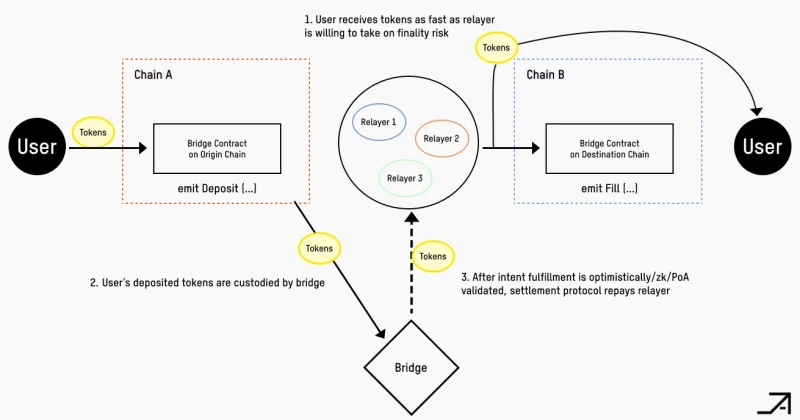
The nascent landscape of blockchain technology, while promising unprecedented decentralization and innovation, has long been hindered by its inherent siloed nature. Each blockchain, a sovereign entity, operates independently, creating friction and complexity for users and developers alike seeking to interact across these disparate networks. This challenge, commonly referred to as the "interoperability problem," has been a significant bottleneck in the broader adoption of decentralized applications (dApps) and digital assets. In response to this persistent issue, a significant collaborative initiative, the Open Intents Framework (OIF), was launched in February 2025. Spearheaded by the Ethereum Foundation, and developed in close partnership with leading interoperability protocol Hyperlane and blockchain infrastructure provider Bootnode, the OIF is rapidly emerging as a foundational layer for building and executing cross-chain intents – a novel approach to facilitating seamless communication and asset transfer between different blockchain networks.
The framework’s ambition is clear: to establish a neutral, open-source standard for cross-chain interactions, deliberately eschewing the proprietary models that have characterized much of the industry’s past attempts at bridging. This commitment to openness has resonated within the blockchain community, attracting substantial backing from over 30 prominent development teams. Among its notable supporters are industry heavyweights such as Arbitrum, Optimism, Polygon, ZKsync, and Starknet, each a significant player in the Layer 2 scaling and zero-knowledge proof ecosystems. This broad coalition of support underscores the perceived value and potential of the OIF to address a fundamental challenge in the Web3 space.
The Mechanics of the Open Intents Framework
At its core, the Open Intents Framework provides a comprehensive toolkit designed to enable cross-chain intents to function effectively across a multitude of blockchain networks. This toolkit comprises a suite of essential components, including smart contracts, open-source "solvers" (entities responsible for executing intents), aggregators, and a Software Development Kit (SDK). Developers can integrate these components into their applications without requiring explicit permission from any central authority, fostering an environment of unhindered innovation.
The architectural backbone of the OIF is built upon three pivotal contract types: InputSettler, OutputSettler, and Oracle contracts. These contracts work in concert to manage the lifecycle of a cross-chain intent. The InputSettler contract acts as the entry point, receiving and validating an intent submitted by a user. The OutputSettler contract then facilitates the execution of the intent on the destination chain, ensuring the transaction is settled correctly. Oracle contracts, a crucial element in any cross-chain solution, are responsible for providing reliable external data to the system, ensuring that the conditions for intent execution are accurately met. These core contracts are seamlessly integrated and managed through an interoperability SDK, which acts as the connective tissue, simplifying the development process for builders.
Crucially, the OIF builds upon the established ERC-7683 standard. This standard serves as a universal blueprint, defining the precise structure and format for cross-chain intents. By adhering to ERC-7683, the OIF ensures that intents submitted across different applications and chains are interoperable and interpretable. When a user expresses an intent, such as a cross-chain token swap – for instance, exchanging ETH on Ethereum for MATIC on Polygon – this intent is broadcast to the network. A competitive ecosystem of solvers then emerges, vying to fulfill this request in the most efficient and cost-effective manner possible. This competitive dynamic is a key differentiator, driving performance and reducing latency.
Early deployments of the OIF have already been successfully launched on multiple testnets, including Ethereum Sepolia and Optimism Sepolia, demonstrating the framework’s immediate applicability. Under optimal network conditions, the OIF has demonstrated the ability to complete solver-filled orders within a remarkably short timeframe, typically ranging from 10 to 60 seconds. This speed is critical for user experience, as it mimics the near-instantaneous transaction confirmations expected in traditional financial systems.
Coinbase’s Strategic Embrace of OIF
A significant milestone in the OIF’s trajectory occurred in September 2025, with the announcement that Coinbase Payments, the institutional and merchant-focused division of the prominent cryptocurrency exchange Coinbase, had become a core contributor to the framework. This endorsement from one of the largest and most reputable players in the digital asset space lends substantial credibility to the OIF’s mission and technical design.
Coinbase Payments’ involvement is particularly focused on leveraging the OIF to standardize cross-chain asset transfers. For a global exchange like Coinbase, facilitating seamless and secure movement of assets between different blockchain networks is paramount for both its institutional clients and its expanding suite of consumer products. By contributing to the OIF, Coinbase Payments signals its commitment to an open, interoperable future for digital assets, rather than relying on proprietary solutions that could create walled gardens. This strategic alignment suggests a shared vision for a more interconnected and accessible blockchain ecosystem.
The OIF’s design is deliberately engineered for modularity and permissionless operation. This means that any development team can independently deploy, extend, and build upon the OIF’s contracts without the need for approval from a central governing body. This ethos is further reinforced by the framework’s complete absence of a governance token, protocol fee extraction mechanisms, or any form of vendor lock-in. This commitment to decentralization and open access is a cornerstone of the OIF’s philosophy. As of its latest updates, production-ready contracts have been deployed across various testnets and mainnets, with ongoing security audits and the development of additional solver functionalities slated for completion later this year.
The Significance of a "No-Token" Approach
The OIF’s deliberate decision to operate without a dedicated token or cryptocurrency asset is a foundational element of its positioning as neutral infrastructure. This choice carries significant implications for developers and the broader ecosystem. By eschewing tokenomics, the framework removes the complexities and potential volatilities associated with token-powered networks. Developers are liberated from the need to navigate intricate tokenomics, staking requirements, or fluctuating fee structures that are often subject to the outcomes of token holder votes. This allows them to focus purely on building robust applications and user experiences, rather than being preoccupied with the economic incentives of a native token.
However, the absence of a token also presents a unique challenge: the absence of a direct financial incentive mechanism to bootstrap a network of solvers and participants. Traditional blockchain networks often rely on token emissions and rewards to incentivize early adoption and participation. The OIF, in contrast, relies entirely on the competitive dynamics of the solver market. Solvers are motivated to participate and optimize their operations by the prospect of earning revenue from efficiently fulfilling user intents. This creates a scenario where performance, speed, and cost-effectiveness become the primary drivers of success, rather than speculative token price appreciation. The economic viability of the OIF ecosystem hinges on the ability of solvers to generate profit through their service, fostering a market-driven approach to cross-chain interoperability.
Historical Context and Future Implications
The quest for blockchain interoperability has a long and often fragmented history. Early attempts often involved centralized bridges, which proved to be vulnerable to hacks and single points of failure. More decentralized solutions emerged, such as LayerZero and various cross-chain messaging protocols, each with its own architectural nuances and security considerations. However, many of these solutions often involved proprietary elements or complex tokenomics, limiting their universal appeal.
The launch of the OIF in February 2025 can be seen as a culmination of lessons learned from these prior endeavors. The Ethereum Foundation’s involvement, a historically significant player in driving blockchain standards, signals a strategic push towards a more standardized and collaborative approach. Hyperlane, with its expertise in secure cross-chain communication, and Bootnode, providing critical infrastructure support, bring essential technical capabilities to the table.
The broad adoption by major L2 scaling solutions like Arbitrum, Optimism, Polygon, ZKsync, and Starknet is particularly telling. These networks are already processing vast amounts of transactions and are at the forefront of scaling Ethereum. Their embrace of OIF suggests a recognition that true scalability and utility in the Web3 space will ultimately depend on seamless cross-chain functionality. For these ecosystems, OIF represents an opportunity to enhance their user experience by abstracting away the complexities of inter-chain communication, making their platforms more accessible to a wider audience.
The implications of the Open Intents Framework are far-reaching:
- Enhanced User Experience: By simplifying cross-chain transactions, OIF can significantly improve the user experience for dApps. Users will no longer need to manually bridge assets or navigate complex multi-step processes.
- Increased Developer Innovation: The permissionless and modular nature of OIF empowers developers to build innovative cross-chain applications without being constrained by proprietary protocols or complex integrations.
- Reduced Fragmentation: A standardized framework can help mitigate the fragmentation of liquidity and user bases across different blockchains, fostering a more cohesive and interconnected Web3 ecosystem.
- Competitive Landscape for Solvers: The competitive solver model incentivizes efficiency and innovation in transaction fulfillment, potentially leading to lower fees and faster settlement times for users.
- Catalyst for Institutional Adoption: With endorsements from entities like Coinbase Payments, OIF is well-positioned to become a foundational element for institutional adoption of decentralized finance and digital assets, as it provides a standardized and secure method for cross-chain asset management.
While the OIF is still in its early stages, its collaborative genesis, robust technical foundation, and growing ecosystem support suggest a significant potential to reshape the future of cross-chain interoperability. The framework’s commitment to open standards and permissionless innovation positions it as a critical piece of infrastructure for the continued evolution and mainstream adoption of blockchain technology. The success of OIF will likely be measured not only by its technical capabilities but also by its ability to foster a thriving, decentralized ecosystem of developers and solvers working together to build a truly interconnected blockchain future.














