


While the broader cryptocurrency market for large-cap assets largely meandered through July 2026, exhibiting sideways trading patterns as investors awaited a decisive catalyst, Uniswap (UNI) carved out a notable exception. The decentralized exchange (DEX) protocol, rather than passively observing market trends, proactively engineered its own significant momentum through a series of critical on-chain governance decisions. This proactive stance led to a distinct upward price movement for its native token, UNI, supported by a verifiable surge in network activity that diverged sharply from the general market inertia. The clean correlation between documented governance outcomes and subsequent market behavior in this instance is a rare occurrence in the often-speculative crypto landscape, underscoring the fundamental impact of transparent, on-chain decision-making.
Uniswap’s Foundational Role in Decentralized Finance
Uniswap stands as a cornerstone of the decentralized finance (DeFi) ecosystem, pioneering the Automated Market Maker (AMM) model that revolutionized how digital assets are traded without intermediaries. As the largest DEX by trading volume, Uniswap provides essential liquidity across thousands of token pairs, facilitating billions of dollars in daily transactions. Its native token, UNI, grants holders governance rights, allowing them to vote on key protocol upgrades, fee structures, and strategic developments. This decentralized governance mechanism is central to Uniswap’s ethos, empowering its community to shape its future.
For years, a significant debate within the Uniswap community has revolved around the activation of "protocol fees," often referred to as the "fee switch." While Uniswap pools generate fees for liquidity providers (LPs), a portion of these fees could, in theory, be directed to the protocol itself. The activation of such a mechanism has historically been approached with caution, primarily due to regulatory ambiguities concerning whether protocol fees distributed directly to token holders could classify UNI as a security. This regulatory tightrope has kept the fee switch dormant, despite its potential to generate substantial value for the protocol and its token. The events of July 2026 marked a pivotal shift in this cautious approach, leveraging an innovative tokenomic design to navigate these challenges.
The Genesis of Change: A Detailed Chronology of Governance and Growth
The groundwork for July’s transformative events was laid months prior, reflecting a deliberate and structured approach by the Uniswap community and the Uniswap Foundation. Understanding this chronology is crucial to grasping the full scope of Uniswap’s recent performance.
December 2025: The UNIfication Proposal Lays the Groundwork
The journey towards protocol fee activation began with the successful passage of the UNIfication proposal in December 2025. This landmark governance vote established the overarching framework for the future implementation of protocol fees. It signified a strong community consensus that the time was right to explore mechanisms to capture value for the protocol, provided these mechanisms could be implemented in a legally sound and economically beneficial manner. The UNIfication proposal was not an immediate fee activation but rather an authorization for the Foundation and community to develop and deploy specific proposals for its implementation, setting the stage for subsequent, more granular decisions.
July 1, 2026: Robinhood Chain’s Launch and Strategic Integration
Adding a critical layer of strategic timing to Uniswap’s unfolding narrative was the launch of Robinhood Chain on July 1, 2026. This new Arbitrum-based Layer 2 solution quickly emerged as a significant player in the blockchain ecosystem. Uniswap solidified its strategic positioning by becoming a day-one partner on Robinhood Chain, deploying its v2, v3, v4, and UniswapX protocols as the chain’s primary public Automated Market Maker (AMM). This early and comprehensive integration meant Uniswap was at the forefront of a rapidly expanding ecosystem.
The immediate success of Robinhood Chain was evident in its transaction volumes. Within just ten days of its launch, by July 10, cumulative swap volume on Uniswap’s deployments across Robinhood Chain had already surpassed an impressive $6 billion. This rapid accumulation of volume signaled a vibrant and highly active new venue for decentralized trading, making it an ideal candidate for early inclusion in any protocol fee activation strategy. The strategic decision to integrate deeply with Robinhood Chain from its inception proved prescient, setting the stage for an immediate and impactful application of the forthcoming fee mechanism.
July 27, 2026: The Pivotal Governance Proposals 99 and 100
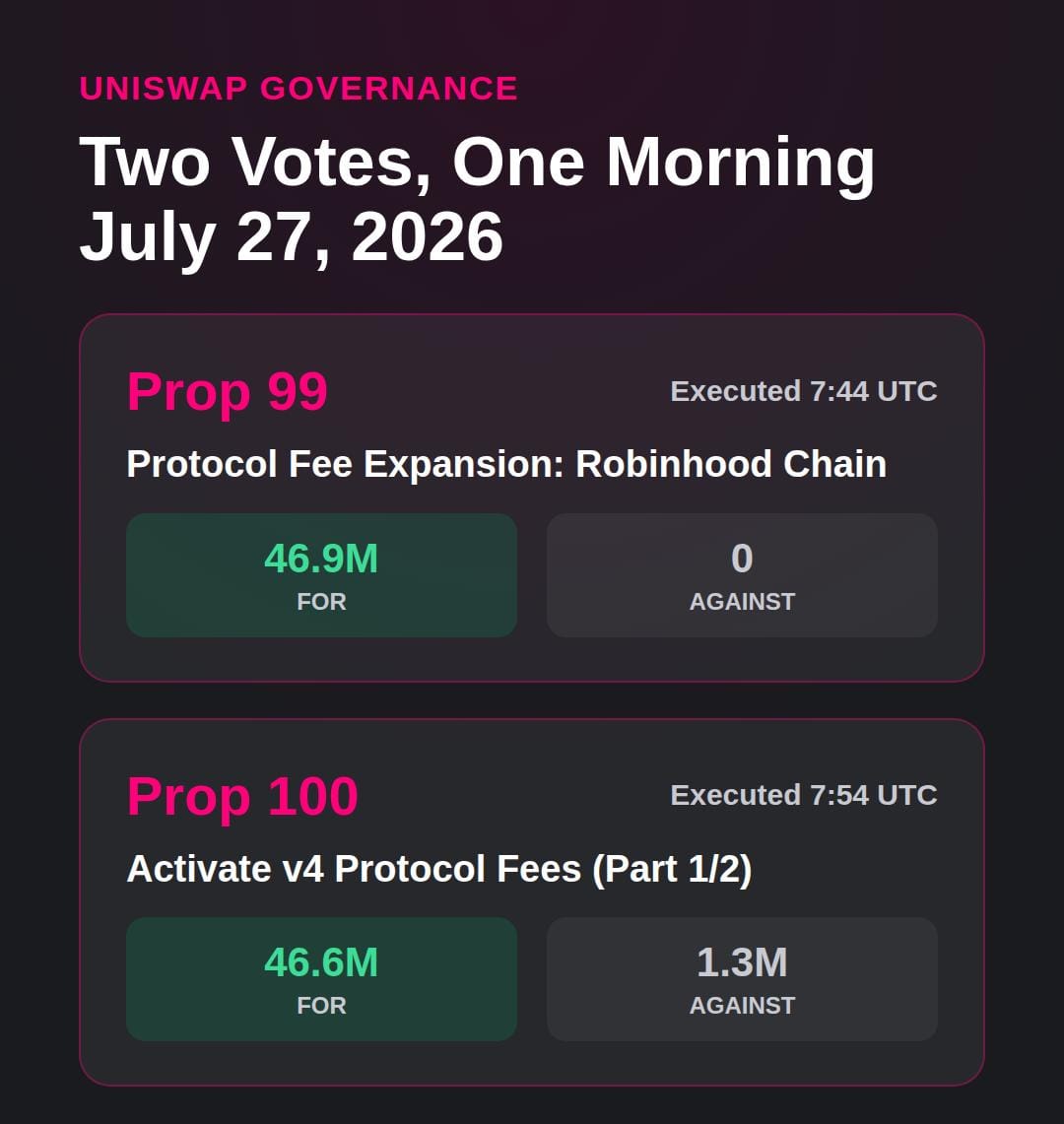
The culmination of these preparatory steps arrived on July 27, 2026, when two critical Uniswap governance proposals, Proposal 99 and Proposal 100, were executed on-chain within minutes of each other. These proposals were the direct implementers of the framework established by UNIfication, explicitly activating the protocol fee mechanism.
Proposal 100, "Activate v4 Protocol Fees (Part 1/2)," passed with overwhelming support, recording 46,604,583 UNI in favor against only 1,274,746 opposed. This comfortably cleared the required 40 million UNI quorum, demonstrating broad community backing for the initiative. The proposal executed at 7:54 am UTC. This proposal was designated "Part 1/2," signaling that this was the initial phase of a broader rollout plan, with more chains to follow.
Its companion, Proposal 99, "Protocol Fee Expansion: Robinhood Chain," passed even more decisively, garnering 46,881,791 UNI in favor with zero opposition. This proposal executed minutes earlier at 7:44 am UTC. The unanimous support for Proposal 99 underscored the community’s recognition of Robinhood Chain’s strategic importance and its rapid growth potential.
Both proposals, crucial for their transparency and verifiability, are meticulously logged with their full on-chain execution transactions directly on Etherscan (e.g., Etherscan transaction for Proposal 100). This on-chain record allowed for direct, immutable verification of the voting outcomes and execution, eliminating any reliance on third-party reporting or speculative narratives.
Together, these two proposals effectively activated protocol fees for select v4 pools across a significant array of seven major networks: Ethereum, Arbitrum, Base, BNB Chain, Polygon, OP Mainnet, and the newly launched Robinhood Chain. This broad activation across key ecosystems marked a monumental step in Uniswap’s evolution, transforming its tokenomics and revenue capture model.
Dissecting the Innovative Fee-and-Burn Mechanism
The method by which Uniswap’s protocol fees are collected and utilized is central to understanding their economic impact and regulatory design. This innovative "fee-and-burn" mechanism departs significantly from traditional dividend-like distributions, positioning Uniswap uniquely within the DeFi regulatory landscape.
How the Burn Mechanism Operates
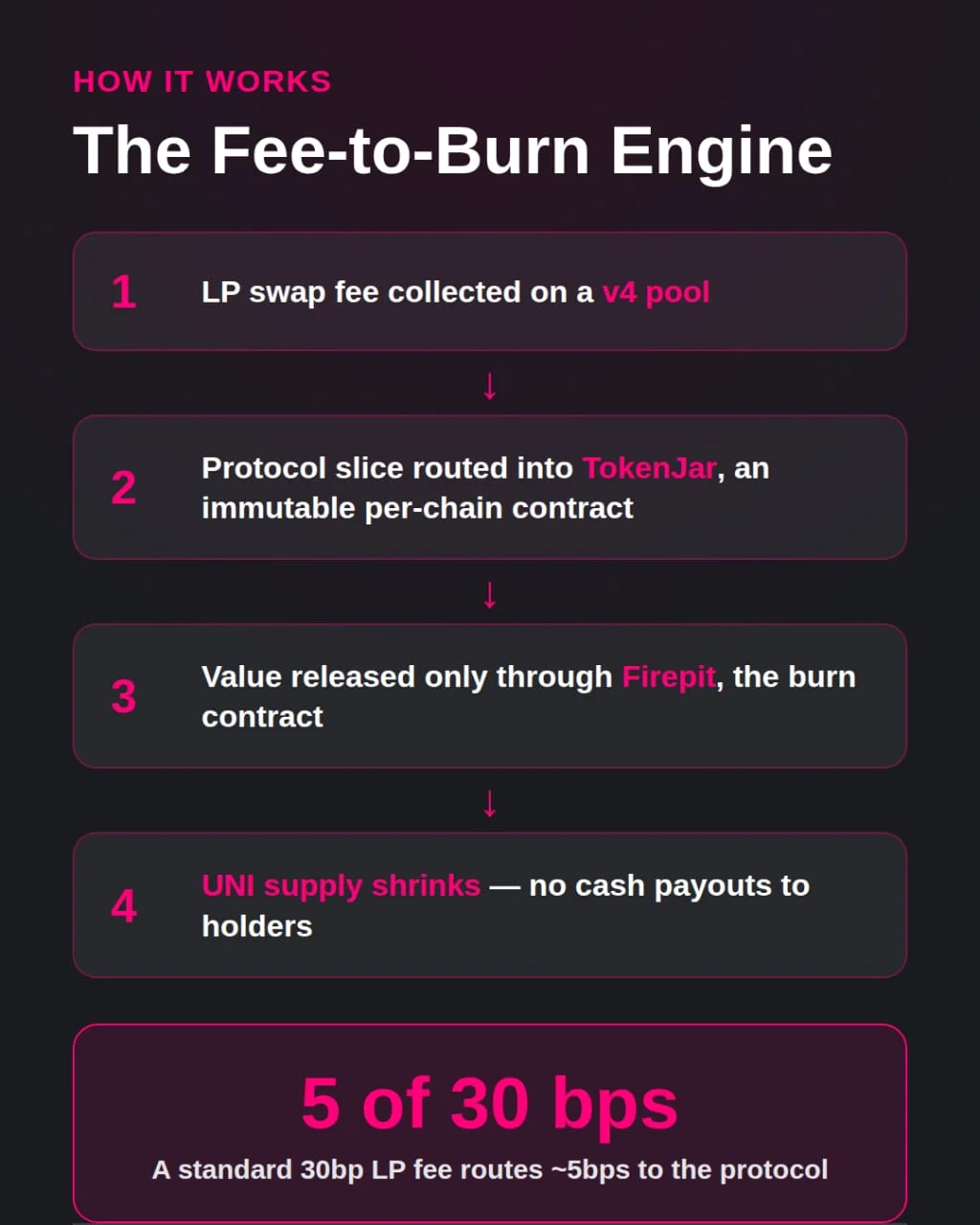
Under the newly activated system, fees collected from designated v4 pools do not directly flow to UNI token holders as payouts. Instead, these fees are routed into an immutable, per-chain smart contract known as TokenJar. The core innovation lies in how value is extracted from TokenJar: the only prescribed method is by burning UNI tokens through a companion contract called Firepit.
For instance, a standard v4 liquidity pool charging a 30 basis-point (0.30%) fee to liquidity providers will now route approximately 5 basis points (0.05%) of that fee to the protocol’s TokenJar. The precise mechanics, including the fee sizing and curve governance, were explicitly approved within the text of Proposal 100. The full v4 fee-adapter contracts and deployment addresses are openly published on Uniswap’s GitHub (Uniswap Protocol Fees GitHub), allowing for complete transparency and independent verification of the entire mechanism.
Rationale and Regulatory Foresight
This structure is a deliberate and sophisticated design choice, carefully crafted to tie protocol revenue to a shrinking token supply rather than a direct distribution model that could resemble a dividend. This distinction is paramount in navigating the complex and evolving regulatory landscape surrounding digital assets. By avoiding direct payouts to token holders, Uniswap aims to sidestep the classification of UNI as a security, a concern that has kept the fee switch dormant for years. The burn mechanism presents a model where value accrual is indirect, through supply reduction, rather than direct yield distribution.
The economic implications are significant. As swap volume across the fee-enabled pools generates revenue for the TokenJar, and UNI tokens are subsequently burned via Firepit, the total supply of UNI is gradually reduced. This creates deflationary pressure on the token, theoretically enhancing the value of remaining UNI tokens by making them scarcer. This model aligns the long-term interests of UNI holders with the overall success and activity of the Uniswap protocol, as increased utility and volume directly translate into a more aggressive burn rate and a diminishing supply.
Market Response and On-Chain Validation
The impact of these governance decisions on the UNI token price and network activity was immediate and discernible, providing a compelling case study of how verifiable on-chain events can drive market sentiment.
UNI’s Price Surge
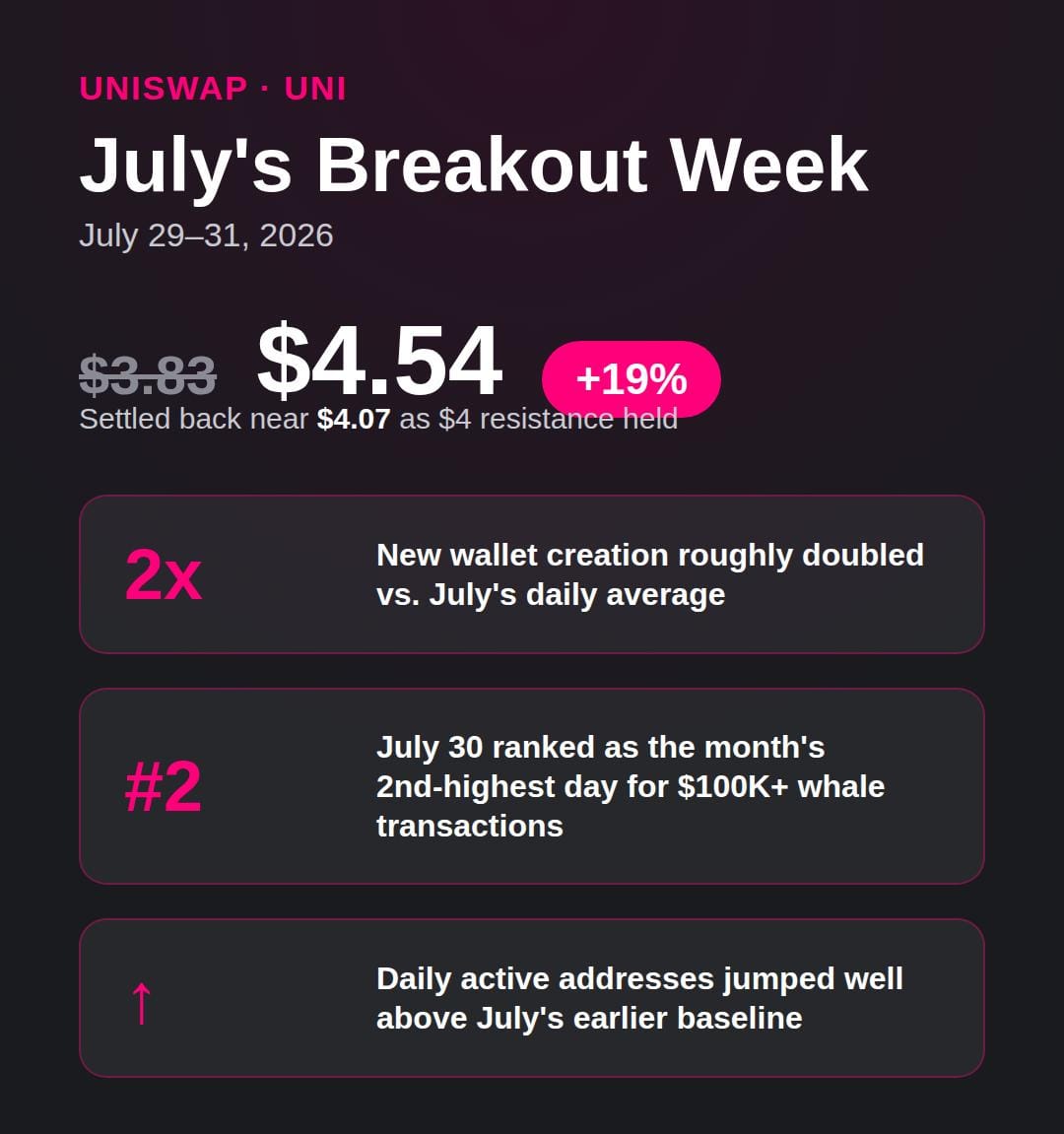
Following the execution of Proposals 99 and 100 on July 27, UNI’s price experienced a robust rally. Between July 29 and 31, the token surged from approximately $3.83 to $4.54, marking an impressive gain of about 19% in just three days. This upward trajectory was a stark contrast to the general sideways movement observed across most large-cap crypto assets during the same period. While UNI later settled back near $4.07, the initial surge provided a clear signal of market approval and investor confidence in the newly activated protocol fee mechanism. The direct correlation of this price action with the 48-hour window following the governance execution is particularly noteworthy, distinguishing it from rallies driven by rumors or speculative narratives.
Verifiable On-Chain Activity
Further solidifying the link between the governance events and market reaction was a significant uptick in key on-chain metrics:
- New Wallet Creation: Over July 30 and 31, the rate of new wallet creation roughly doubled compared to the daily average observed earlier in the month. This suggests a fresh influx of participants, potentially drawn by the positive news surrounding Uniswap’s tokenomics.
- Daily Active Addresses: Similarly, the number of daily active addresses on those same two days ran well above anything logged earlier in July. This indicates increased engagement from existing users and new participants interacting with the Uniswap protocol.
- Large-Holder Transactions: Transactions exceeding $100,000, often indicative of "whale" activity, hit their second-highest single-day count of the month on July 30. This signals that significant capital allocators were actively reacting to the governance outcome, either accumulating UNI or rebalancing their positions in anticipation of future value accrual.
Collectively, these on-chain patterns—increased participation from both new entrants and large holders—strongly suggest a coordinated market response to the tangible, verifiable governance event. This confluence of price movement and on-chain metrics provides compelling evidence that the market recognized and reacted positively to Uniswap’s strategic pivot.
Strategic Impact of Robinhood Chain Integration
The timing and inclusion of Robinhood Chain in the initial phase of protocol fee activation were not merely coincidental but a strategic masterstroke that amplified the immediate impact of the burn mechanism. By integrating fees onto Robinhood Chain right as its transaction volume was rapidly scaling, Uniswap ensured that its new revenue engine received a powerful and immediate fuel source.
As noted, Robinhood Chain had already generated $6 billion in cumulative swap volume within its first ten days. Extending the fee-and-burn mechanism to such a high-growth venue at the moment of activation meant that the protocol’s burn engine could immediately tap into a substantial and rapidly expanding stream of fees. This avoided a common pitfall where new mechanisms are introduced to older, more mature ecosystems where growth might be slower, or where a significant lag occurs before a meaningful impact is observed. The synchronous activation with Robinhood Chain’s surge ensured that the excitement surrounding the fee switch translated quickly into tangible fee collection and token burning, providing immediate validation of the new tokenomic model.
Future Outlook and Broader Implications
While July’s performance was remarkable, the path forward for Uniswap involves continued strategic execution and monitoring of market dynamics. The "Part 1/2" designation of Proposal 100 indicates that this is an ongoing process.
The Road Ahead: Further Fee Activations
Five additional chains—Celo, Soneium, X Layer, Worldchain, and Zora—are still awaiting follow-up governance votes before v4 fees are activated on their respective networks. The successful implementation and positive market reaction to the initial phase set a strong precedent for these subsequent proposals. The community’s decision on these future activations will be crucial for the full realization of Uniswap’s new tokenomic strategy. Each successful activation on additional high-volume chains will further bolster the protocol’s revenue streams and, consequently, the UNI burn rate.
Sustainability and Market Position
The long-term sustainability of UNI’s July gains, and its future value trajectory, will hinge directly on the sustained swap volume across all newly fee-enabled pools. The efficiency of the "burn engine" is directly proportional to the volume of fees flowing into the TokenJar contracts. Consistent, high trading activity across these networks will ensure a continuous and robust burning of UNI tokens, reinforcing the deflationary pressure and strengthening the token’s value proposition.
Beyond its immediate financial implications, this strategic move by Uniswap carries broader implications for the DeFi ecosystem. It establishes a significant precedent for other decentralized protocols grappling with how to capture value for their native tokens while navigating regulatory complexities. Uniswap’s innovative burn mechanism could inspire similar models, fostering a new wave of tokenomic designs that prioritize regulatory clarity and sustainable value accrual. Furthermore, the successful exercise of decentralized governance underscores the power and maturity of the Uniswap community, reinforcing the credibility of decentralized decision-making in the crypto space. Such clear, verifiable actions may also enhance institutional interest in DeFi, as they offer greater transparency and a more defined path for value generation.
In a month where many top-tier crypto assets experienced stagnation, Uniswap’s performance stood out not just for its percentage gains, but for the clear, verifiable narrative linking its market movement directly to on-chain governance action. This convergence of price appreciation, robust on-chain activity, and transparent protocol development is a rare and compelling combination in the dynamic world of cryptocurrency, positioning Uniswap for continued scrutiny and potential leadership in evolving DeFi tokenomics.
Disclosure: This is not trading or investment advice. Always conduct thorough research before purchasing any cryptocurrency or investing in any services.














