
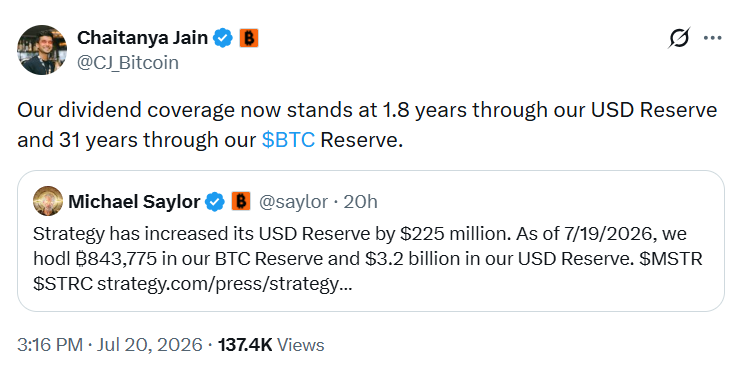
Strategy’s substantial Bitcoin treasury is now positioned to cover approximately 31 years of shareholder dividend payments, a revelation that significantly underscores the company’s audacious embrace of digital assets as a core component of its financial strategy. This remarkable projection, disclosed by the firm’s corporate treasurer, Chaitanya Jain, contrasts sharply with the limited coverage offered by its traditional U.S. dollar reserves, which Jain indicated would only sustain dividend obligations for about 1.8 years. The announcement arrives as Bitcoin continues its ascent, recently breaching the $124,000 all-time high, further amplifying the significance of Strategy’s considerable holdings.
Strategic Shift: Bitcoin as a Dividend Payout Engine
The core of Strategy’s financial resilience, according to its leadership, is increasingly tied to its formidable Bitcoin reserves. Corporate Treasurer Chaitanya Jain articulated this strategic pivot in a recent statement, highlighting that the company’s Bitcoin holdings are not merely an investment but a foundational element for long-term financial stability and shareholder returns. "Our Bitcoin reserve could cover approximately 31 years of dividend payments," Jain stated, a figure that dramatically eclipses the 1.8-year coverage provided by the company’s U.S. dollar reserves. This assertion paints a vivid picture of how Strategy has reoriented its balance sheet, positioning digital assets as a primary buffer against financial obligations, including dividend payouts.
This strategic allocation comes after a period of significant accumulation of Bitcoin. Strategy founder Michael Saylor confirmed on July 19th that the company held a staggering 843,775 Bitcoin. This substantial reserve solidifies Strategy’s position as the world’s largest corporate holder of the digital currency. The company has maintained a policy of not actively trading its Bitcoin holdings, instead opting to preserve and grow this strategic asset.

Funding Operations and Strengthening Liquidity
While Bitcoin forms the bedrock of its long-term financial outlook, Strategy has simultaneously continued to bolster its liquidity through traditional financial markets. Between July 13th and July 19th, the company successfully generated approximately $263.5 million by selling shares of its Class A common stock through its at-the-market (ATM) common stock program. These proceeds have been instrumental in increasing the company’s U.S. dollar reserve to roughly $3.225 billion. This injection of capital serves multiple critical functions: supporting preferred stock dividend payments, meeting interest obligations on outstanding debt, and providing overall greater financial flexibility.
The company’s reliance on equity markets to fund its operations and fortify its treasury is a nuanced aspect of its financial strategy. Despite its massive Bitcoin holdings, Strategy continues to leverage its access to capital markets. Regulatory filings reveal that Strategy still has substantial capacity remaining under its common stock ATM program, with an estimated $23.5 billion in potential capital raising still available. This indicates a dual approach: securing substantial long-term value through Bitcoin while maintaining the agility to raise short-term capital as needed.
The Economics of Strategy’s Bitcoin Holdings
Strategy’s Bitcoin acquisition strategy has been remarkably consistent and long-term oriented. The company’s total holdings of 843,775 Bitcoin were acquired at an average cost of approximately $75,476 per Bitcoin, for a total investment of roughly $63.69 billion. This approach emphasizes a buy-and-hold strategy, rather than speculative trading, with the aim of maximizing the long-term appreciation of its digital asset portfolio.
This strategy is particularly noteworthy in the context of Bitcoin’s volatile price action. While the cryptocurrency has experienced significant swings, Strategy’s consistent accumulation and commitment to holding have allowed it to benefit from the upward trajectory of Bitcoin’s value. The recent surge in Bitcoin’s price, which has seen it climb to new all-time highs above $124,000, significantly enhances the paper value of Strategy’s holdings, further bolstering the confidence in its long-term financial projections.
Investor Perspectives: Preferred Shares and Long-Term Value
The financial structure of Strategy, particularly its preferred stock, has also become a focal point for investors evaluating its unique financing model. Credit investor Khing Oei has voiced an opinion that the market may be undervaluing Strategy’s STRC preferred shares. Oei argues that investors are overly focused on the current yield of these preferred shares, neglecting their potential for longer-term cash generation. He suggests that these preferred shares should be analyzed more akin to traditional bonds, with their value intrinsically linked to the company’s ability to sustain dividend payments over extended periods.
Oei’s analysis further posits that any appreciation in Bitcoin’s value could serve to reinforce Strategy’s financial standing, thereby potentially enhancing the valuation of its preferred securities over time. This perspective highlights a complex interplay between Strategy’s digital asset holdings, its traditional equity and debt instruments, and the market’s perception of its unconventional treasury management.
Broader Implications and Future Outlook
Strategy’s financial model represents a significant departure from traditional corporate treasury management. By integrating a substantial Bitcoin reserve into its core financial planning, the company is pioneering a new approach to corporate finance. The success of this model hinges on several factors: the continued growth and stability of Bitcoin, the company’s ability to manage its equity and debt obligations effectively, and the market’s ongoing acceptance of its unconventional treasury strategy.
The company’s latest figures clearly illustrate a dramatic shift in its balance sheet towards digital assets. While its cash reserves continue to grow through strategic stock issuances, executives clearly view their Bitcoin holdings as the primary engine for long-term financial resilience. As Strategy continues to expand its capital-raising programs and maintain its significant Bitcoin exposure, investors and analysts will be keenly observing whether this innovative treasury model can consistently deliver both balance sheet stability and enduring shareholder value. The current market environment, with Bitcoin demonstrating strong upward momentum, provides a favorable backdrop for Strategy’s strategy, but the long-term viability will ultimately be tested by market cycles and the company’s continued execution.

At the time of reporting, Bitcoin (BTC) was trading at approximately $64,880, reflecting a modest gain of 0.45% over the preceding 24-hour period, a testament to the ongoing dynamism of the cryptocurrency market that underpins Strategy’s bold financial vision.