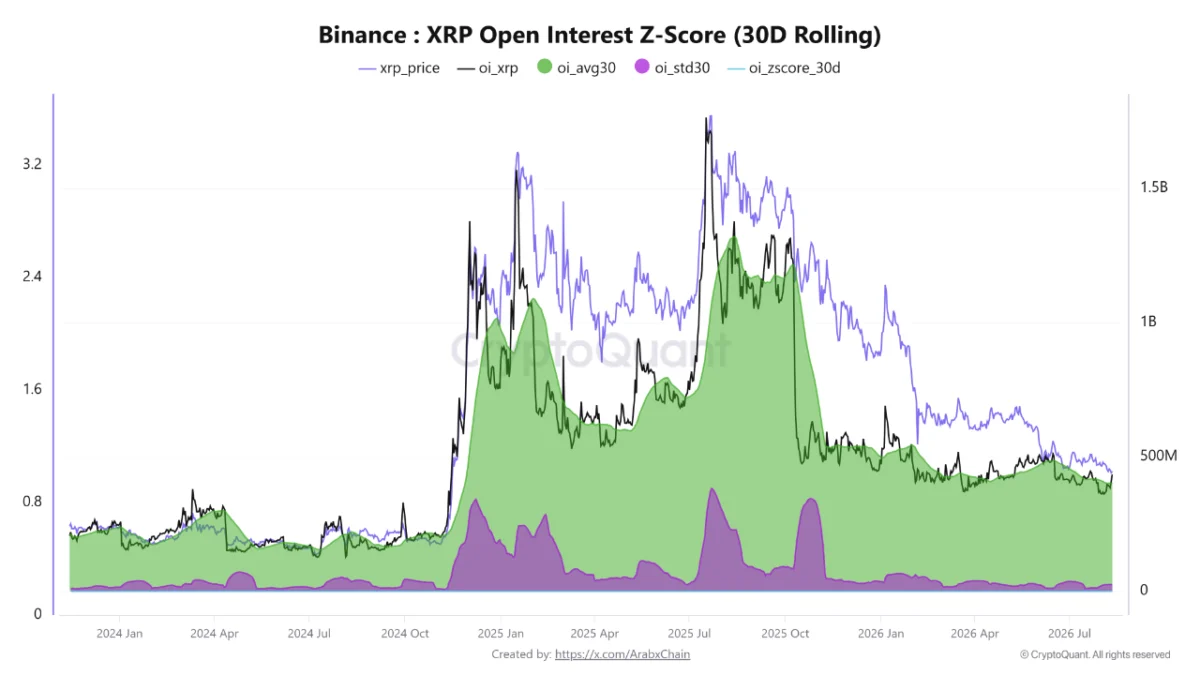
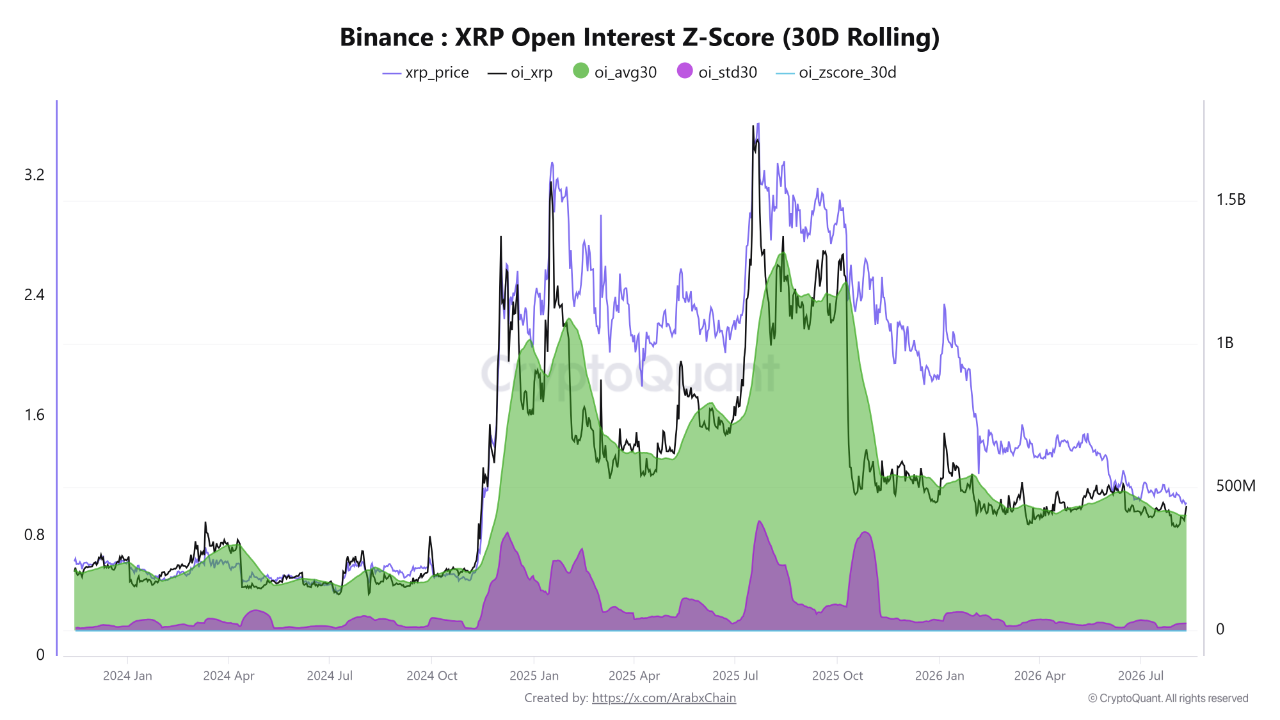
XRP open interest on Binance, a leading cryptocurrency exchange, has remained notably elevated despite the token’s consistent price softening, according to recent market data. This divergence between high derivatives activity and a declining spot price suggests a complex interplay of speculative positioning and underlying market sentiment. The volume of open XRP futures contracts has surged to approximately 435.1 million XRP, significantly surpassing its 30-day moving average, which hovered near 403.6 million XRP. This substantial gap has pushed the Open Interest Z-Score to approximately 1.20, a metric that quantitatively indicates derivatives activity is currently operating above its typical historical ranges. At the time of this report, XRP was trading near $1.01, reflecting a continued trend of price depreciation even amidst this heightened speculative interest on the derivatives front.
Understanding Open Interest and Its Market Significance
Open interest represents the total number of outstanding derivatives contracts, such as futures or options, that have not yet been settled or closed. It serves as a crucial indicator of market liquidity and the overall level of participation in the derivatives market. A rising open interest suggests that new money is entering the market, either from new participants or increased positions from existing ones. Conversely, falling open interest indicates that contracts are being closed, potentially signaling a reduction in market liquidity or a shift in sentiment.
In the case of XRP, the current open interest stands at roughly 435.1 million XRP. To put this into perspective, the standard deviation for XRP open interest over the past 30 days has been approximately 26.3 million XRP. The fact that current open interest is more than one standard deviation above this recent average is a significant statistical observation. This calculation places the Z-Score reading at approximately 1.20. The Z-Score, a statistical measure that describes a value’s relationship to the mean of a group of values, indicates how many standard deviations an element is from the mean. A Z-Score of 1.20 suggests that the current open interest is 1.20 standard deviations above the 30-day average, confirming that derivatives activity is indeed higher than its typical fluctuations.
It is critical to note that a high Z-Score or elevated open interest itself does not inherently signal a bullish or bearish market outlook. This metric purely tracks the aggregate volume of open positions on an exchange; it does not differentiate between long (buy) and short (sell) positions. Therefore, an increase in open interest can reflect a rise in speculative bets on either side of the market. Traders might be opening new long positions, anticipating a price rebound, or initiating new short positions, betting on further declines. The persistent elevation of open interest above its average while XRP spot prices continue to soften, hovering near $1.02, strongly suggests that speculative positioning has not abated. Instead, it indicates that market participants are maintaining or even increasing their leveraged exposure, implying an expectation of a significant price movement rather than prolonged sideways trading or a gradual drift.
The Divergence: High Open Interest vs. Softening Spot Price
The current market scenario for XRP presents a classic divergence: a robust and expanding derivatives market contrasting with a weakening underlying spot asset. This situation often puzzles market observers and traders alike. Typically, when a cryptocurrency’s price falls, traders might reduce their exposure, leading to a decrease in open interest as positions are closed. However, XRP’s situation defies this conventional wisdom. The sustained high open interest suggests a strong conviction among a segment of traders that the current price levels are temporary, or that a significant directional move is imminent.
One interpretation is that a substantial number of traders are accumulating short positions, betting on further price declines. If this is the case, the elevated open interest could indicate increasing bearish sentiment and potentially fuel a downward spiral if selling pressure intensifies. Conversely, it could also imply that long-term holders or institutional players are using derivatives to hedge their spot holdings against further losses, or that contrarian traders are opening long positions, anticipating a bounce back from what they perceive as oversold conditions. The lack of distinction between long and short positions within the open interest data makes precise interpretation challenging, yet the overall message is one of heightened market tension and anticipation.
This pattern suggests that market participants are willing to keep their contracts open, absorbing daily fluctuations and even moderate losses, because they believe a more decisive price action is on the horizon. The resolution of these open positions will likely dictate the next major move for XRP. Should a rise in open interest coincide with a reversal and firmer spot prices, it could provide the necessary momentum for a renewed bullish rally. Conversely, a continued decline in XRP’s price alongside persistent elevated open interest significantly increases the risk of forced liquidations, particularly if selling pressure accelerates and triggers margin calls for leveraged long positions, potentially leading to a cascade of further selling.
Broader Market Context: XRP and the Ripple-SEC Lawsuit
To fully understand XRP’s market dynamics, it is imperative to consider the protracted legal battle between Ripple Labs and the U.S. Securities and Exchange Commission (SEC). The SEC filed a lawsuit against Ripple in December 2020, alleging that XRP was an unregistered security and that Ripple had conducted an illegal securities offering. This lawsuit has cast a long shadow over XRP’s price performance and market adoption, particularly in the United States.
Before the lawsuit, XRP was one of the top cryptocurrencies by market capitalization and enjoyed significant exchange listings and institutional interest. However, following the SEC’s filing, many exchanges delisted XRP or suspended its trading for U.S. customers to avoid regulatory complications. This severely impacted XRP’s liquidity and accessibility, contributing to its "underwhelming" performance compared to other major cryptocurrencies that experienced significant bull runs in subsequent years.
The legal proceedings have been marked by various twists and turns, including key summary judgment rulings. In July 2023, a U.S. District Court judge ruled that XRP sales on secondary exchanges did not constitute unregistered securities offerings, a partial victory for Ripple that led to a temporary surge in XRP’s price. However, the court also found that Ripple’s institutional sales of XRP did violate securities laws. This mixed ruling left considerable ambiguity, and the case continues to unfold, with ongoing discussions regarding penalties for institutional sales and potential appeals.
The lingering uncertainty surrounding the lawsuit continues to weigh heavily on XRP’s price. While other cryptocurrencies have been able to leverage periods of market optimism, XRP’s potential regulatory classification issues in the U.S. have often capped its upside potential and made it more susceptible to price declines during market downturns. This regulatory overhang is a crucial piece of background context explaining why XRP might struggle to gain significant traction despite other potentially positive indicators, such as elevated open interest or whale accumulation. Market participants are constantly weighing the potential outcomes of the lawsuit, and their speculative positions in derivatives often reflect these complex regulatory considerations.
Large XRP Wallets Accumulate During Downturn
Despite the persistent price weakness and regulatory uncertainty, on-chain analytics from Santiment Intelligence reveal a contrasting trend among large XRP holders, often referred to as "whales." Santiment noted that XRP Ledger wallets holding over one million tokens saw a net addition of 32 new wallets over a three-month period. This accumulation by significant holders occurred concurrently with a approximately 29% decline in XRP’s market capitalization during the same timeframe.
The phenomenon of large-holder wallets increasing their holdings during a market downturn is often interpreted as a strong signal of conviction. These sophisticated investors, typically with deeper pockets and longer-term investment horizons, often view price dips as opportunities to accumulate assets at a discount. Their accumulation suggests a belief in XRP’s long-term value proposition, potentially anticipating a favorable resolution to the SEC lawsuit or a broader resurgence in market interest. This pattern stands in stark contrast to the short-term speculative activity seen in the derivatives market, hinting at a bifurcated market sentiment where long-term investors are positioning for recovery while short-term traders navigate immediate volatility.
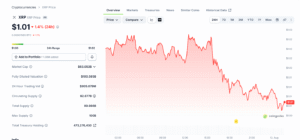
XRP has traded consistently near the $1.00 mark throughout much of the summer, a performance widely described as underwhelming given the broader crypto market’s potential. However, the accumulation by large wallets indicates that this price level is seen as an attractive entry point by those with significant capital. This could provide a floor for XRP’s price in the long run, even if short-term speculative pressures continue to push it lower.
Ripple’s Expanding Ecosystem and Infrastructure Developments
Beyond the token’s price action and speculative trading, Ripple Labs, the company behind XRP, has continued to develop and expand its broader ecosystem and infrastructure. This ongoing development provides a fundamental layer of utility and adoption that operates somewhat independently of XRP’s short-term price fluctuations.
A notable development in this context is Ripple’s RLUSD stablecoin. Trading around $0.99, RLUSD has begun to establish a significant presence within institutional stablecoin markets. This initiative highlights Ripple’s strategic focus on expanding its offerings beyond just the XRP token, leveraging its underlying technology to facilitate broader financial services. Stablecoins are crucial for institutional adoption, providing a bridge between traditional finance and the crypto world with reduced volatility.
Ripple’s overarching infrastructure continues to support a wide array of settlement activities on the XRP Ledger. This includes payment processing, custody solutions, and tokenization services, all of which remain tied to ongoing use cases for XRP. RippleNet, the company’s global payments network, facilitates cross-border transactions for financial institutions, often utilizing XRP as a bridge currency for efficient and low-cost transfers. Furthermore, Ripple has been actively exploring and developing solutions for Central Bank Digital Currencies (CBDCs), collaborating with various central banks globally. These initiatives underscore Ripple’s commitment to transforming global payments and finance, leveraging the inherent advantages of blockchain technology.
This persistent network activity and expansion of use cases provide a crucial foundational layer for XRP’s long-term viability. While speculative traders focus on immediate price movements, the underlying utility and adoption driven by Ripple’s infrastructure development can contribute to sustainable demand for XRP over time. This continuous evolution of the Ripple ecosystem can be seen as a counter-narrative to the short-term price pressures and regulatory uncertainties, suggesting that the asset has intrinsic value beyond pure speculation.
Derivatives Market Dynamics: Funding Rates and Liquidation Risks
To further analyze the elevated open interest, examining funding rates provides additional insights into market sentiment in the perpetual futures market. Funding rates are periodic payments exchanged between traders holding long and short positions in perpetual futures contracts. A positive funding rate indicates that long positions are paying short positions, suggesting a bullish sentiment where more traders are going long. Conversely, a negative funding rate means short positions are paying long positions, indicating a bearish sentiment.
If XRP’s funding rates remain positive despite the softening spot price, it would suggest that there is still a significant number of leveraged long positions, possibly anticipating a rebound. If funding rates are negative, it would reinforce the idea of a growing short interest. The interplay between high open interest and funding rates is crucial for predicting potential market movements.
Elevated open interest, especially when paired with a declining spot price, significantly amplifies the risk of forced liquidations. In a leveraged derivatives market, traders borrow funds to increase their exposure. If the market moves against their position beyond a certain threshold, they face a margin call, and if they cannot add more collateral, their positions are automatically closed by the exchange – a process known as liquidation. For leveraged long positions, a continued price decline can trigger a cascade of liquidations, forcing more sell orders into the market and exacerbating the downward price pressure. This creates a "long squeeze."
Conversely, if there is a substantial number of leveraged short positions, a sudden upward price movement could trigger a "short squeeze," where short sellers are forced to buy back XRP to cover their positions, pushing the price even higher. Given the current high open interest and price softness, the market is delicately balanced, with the potential for increased volatility driven by liquidation events on either side. Traders are advised to monitor these metrics closely as they can often precede sharp price movements.
Historical Price Performance and Future Outlook
XRP’s historical price performance has been characterized by periods of significant volatility, often influenced by broader market trends, regulatory news, and developments within the Ripple ecosystem. While it experienced substantial growth during the 2017 and 2021 bull markets, its journey has been uniquely complicated by the SEC lawsuit. The token’s inability to break decisively above key resistance levels, particularly the psychological $1.00 to $1.20 range, reflects the ongoing market indecision.
The current trading volume over the past 24 hours reached $905,040,648, alongside a modest 1.76% price drop for the day. The seven-day decline for XRP stands at 6.07% as of writing. These figures underscore the continued selling pressure and lack of strong buying momentum in the spot market.
Looking ahead, the resolution of the SEC lawsuit remains the most significant catalyst for XRP’s long-term price trajectory. A definitive favorable ruling for Ripple could unlock significant institutional interest and potentially lead to re-listings on major U.S. exchanges, boosting liquidity and investor confidence. Conversely, an unfavorable outcome could further entrench its regulatory challenges. In the short to medium term, the dynamics between elevated open interest and the spot price will dictate immediate market movements. A sustained period of price consolidation followed by a clear directional break, supported by either a reduction in open interest (indicating position closing) or a sharp increase accompanied by strong volume, will be crucial for establishing the next trend.
The confluence of elevated open interest, whale accumulation, ongoing ecosystem development, and persistent regulatory uncertainty paints a complex picture for XRP. It suggests a market in flux, where different participant groups hold divergent views and strategies. While short-term traders are betting on immediate directional moves, larger holders and Ripple itself are focused on long-term utility and infrastructure. The coming weeks will be pivotal in determining how these varied forces ultimately resolve, potentially leading to a significant price adjustment for the digital asset.