



A significant shift in Bitcoin holdings has been observed in the cryptocurrency market, with large-scale investors, commonly referred to as "whales," demonstrably accumulating substantial amounts of Bitcoin, while smaller retail investors appear to be divesting. Over the past 60 days, these substantial holders have reportedly added over $4.3 billion worth of BTC to their portfolios. This aggressive accumulation by whales stands in stark contrast to the actions of smaller investors, defined as wallets holding between 100 and 1,000 BTC, who have collectively sold off more than $5 billion worth of Bitcoin during the same period.
These insights, provided by the prominent cryptocurrency analytics firm CryptoQuant, paint a picture of diverging strategies among different investor demographics within the Bitcoin ecosystem. The data suggests a potential consolidation of wealth among the largest Bitcoin holders, even as the broader market sentiment remains somewhat subdued.
Decoding the Divergence: Whales Accumulate, Fish Sell
CryptoQuant’s analysis, disseminated via a recent tweet, highlighted this notable disparity. The firm defined "fish" as wallets holding between 100 and 1,000 BTC, a segment that has seen considerable selling activity throughout June and July. Conversely, "whales" are identified as addresses possessing over 10,000 BTC. The data indicates that the smaller players have been actively liquidating their Bitcoin holdings, a trend that appears to follow a significant buying spree during the first and second quarters of the year.
The rationale behind this synchronized selling by smaller investors, particularly when Bitcoin is trading well below its all-time highs and below the $70,000 mark, remains a subject of analysis. One plausible explanation is that these investors acquired Bitcoin with the expectation of a swift return to bull market conditions, a scenario that has not materialized as anticipated. The premier cryptocurrency has experienced a period of relative stagnation, failing to generate the rapid profits that some short-term traders may have been seeking. This lackluster performance could be prompting them to exit their positions in search of more immediate gains in other markets.
Dolphins Join the Accumulation Wave
Adding another layer to this complex market dynamic, a third significant investor cohort, known as "dolphins" (those holding between 1,000 and 10,000 BTC), have also engaged in aggressive Bitcoin buying over the past couple of months. In fact, their buying activity has reportedly been even more pronounced than that of the whales. The parallel behavior observed between dolphins and whales, and their stark divergence from the selling patterns of the fish, could be interpreted as a strong signal that the long-term bottom for Bitcoin may have already been established. This collective accumulation by major holders suggests a conviction in the future price appreciation of the digital asset.
Background Context: A Market in Transition

This current market behavior is unfolding against a backdrop of evolving institutional interest in Bitcoin. The approval and subsequent performance of U.S. spot Bitcoin Exchange-Traded Funds (ETFs) have played a pivotal role in reintroducing institutional capital into the ecosystem. Throughout July, several of the leading spot Bitcoin ETFs, including BlackRock’s iShares Bitcoin Trust (IBIT), have experienced consistent, multi-day inflow streaks. On July 20th alone, these exchange-traded products saw inflows of approximately $227 million, and a cumulative tally over a five-day period exceeded $700 million.
The resurgence of institutional demand, evidenced by these ETF inflows, provides a foundational support for the current Bitcoin price levels. It signifies a growing acceptance and integration of Bitcoin into traditional financial portfolios. However, the ongoing accumulation by whales and dolphins, even amidst fluctuating institutional inflows, suggests a deeper, more conviction-driven buying pressure from established players in the cryptocurrency space.
The Missing Piece: Retail Investor Engagement
While institutional interest shows signs of recovery and large holders are actively accumulating, a crucial demographic remains conspicuously absent from this positive trend: the retail investor. The data from CryptoQuant indicates that smaller players, who typically represent a significant portion of market activity, are currently on the selling side. For Bitcoin to truly regain its upward momentum and break out of its current trading range, a resurgence in retail participation is likely to be essential. Without this broad-based demand, the cryptocurrency may continue to experience periods of consolidation and struggle to achieve significant price breakthroughs in the near future.
Bitcoin’s Price Trajectory and Market Sentiment
Bitcoin’s price has recently found stability above the critical $60,000 support level. After testing lower supports in the $58,000-$60,000 range earlier in the summer, the leading cryptocurrency has been trading within the $63,000 to $66,000 band. This period of consolidation follows a challenging performance over the past three quarters, during which Bitcoin experienced a notable downturn. This prolonged downturn has, understandably, prompted many short-term speculators to seek more immediate and substantial returns in the booming stock and equities markets, which have offered more predictable and robust growth opportunities.
The divergence in investor behavior, with whales and dolphins accumulating and fish selling, can be analyzed through several lenses. One perspective is that the larger players, with their greater capital reserves and potentially longer investment horizons, are capitalizing on what they perceive as a favorable entry point. They may be less susceptible to the short-term price volatility that can deter smaller investors. Their conviction could be rooted in a belief that current price levels represent an undervalued opportunity for future gains, especially in anticipation of upcoming market cycles or further institutional adoption.
Potential Implications of Whale Accumulation
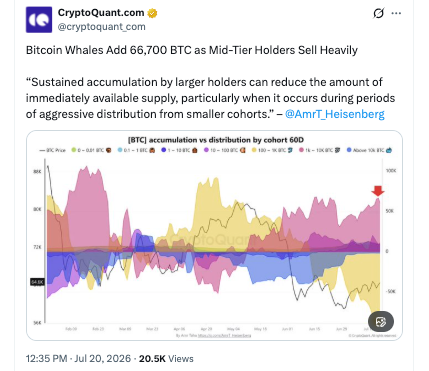
The sustained accumulation by whales carries several potential implications for the Bitcoin market. Firstly, it can contribute to a reduction in the circulating supply of Bitcoin available on exchanges. When large holders move their assets from exchanges to private wallets, it typically signifies an intention to hold rather than trade. This reduction in readily available supply can, in theory, put upward pressure on prices if demand remains constant or increases.
Secondly, the actions of whales often influence market sentiment. When major players are seen to be accumulating, it can instill confidence in other investors, potentially encouraging them to hold or even increase their positions. This can create a virtuous cycle of positive sentiment and buying pressure. Conversely, if whales were to begin a large-scale selling campaign, it could trigger widespread panic and a significant price decline.
The current trend, however, points towards confidence and strategic accumulation. The fact that dolphins are also participating aggressively suggests a broader consensus among significant holders regarding Bitcoin’s long-term value proposition. This could be a strong indicator that the market is maturing and that larger, more established investors are viewing Bitcoin as a legitimate asset class with significant growth potential.
The Role of Macroeconomic Factors and Future Catalysts
While on-chain data provides valuable insights into investor behavior, it is also crucial to consider the broader macroeconomic environment and potential future catalysts that could influence Bitcoin’s trajectory. Global inflation rates, interest rate policies by central banks, and geopolitical events can all impact investor appetite for risk assets like Bitcoin.
Looking ahead, several factors could serve as catalysts for renewed bullish momentum in Bitcoin:
- Further ETF Inflows: Continued strong inflows into U.S. spot Bitcoin ETFs would signal sustained institutional demand and could drive prices higher.
- Halving Event Impact: The next Bitcoin halving event, anticipated in 2024, will reduce the rate at which new Bitcoins are created. Historically, halving events have been followed by significant bull runs, as the reduced supply meets consistent or increasing demand.
- Regulatory Clarity: Increased regulatory clarity around cryptocurrencies in major jurisdictions could reduce uncertainty and encourage broader adoption by both institutional and retail investors.
- Technological Developments: Ongoing advancements in the Bitcoin network, such as Layer 2 scaling solutions, could enhance its usability and appeal as a medium of exchange and store of value.
Conclusion: A Market Divided, Yet Potentially Charting a Course
The current landscape of Bitcoin holdings presents a fascinating dichotomy. While smaller investors appear to be exiting positions, potentially due to profit-taking or a reevaluation of short-term market prospects, larger holders—whales and dolphins—are demonstrating a strong commitment to the asset. This divergence, coupled with the resurgence of institutional interest through ETFs, suggests that despite the recent lack of explosive growth, a significant portion of the market remains optimistic about Bitcoin’s long-term future. The continued accumulation by large players could be a powerful indicator of an impending upward trend, provided that broader market conditions and retail participation align to support such a move. The coming months will be critical in determining whether this sustained buying pressure from the biggest players translates into a sustained recovery for the flagship cryptocurrency.














