


The transition of the Ethereum network from a Proof-of-Work (PoW) consensus mechanism to Proof-of-Stake (PoS), a milestone event known as "The Merge," has triggered a seismic shift in the global cryptocurrency mining landscape, leaving millions of miners facing negative profit margins. As the Ethereum network officially retired its reliance on graphics processing units (GPUs) to secure the chain, a massive surplus of hashing power was suddenly unleashed upon the remaining PoW coins. This influx has caused mining difficulty on alternative networks to skyrocket, effectively rendering GPU mining unprofitable for the vast majority of participants under current market conditions and electricity costs.
The Mechanics of the Post-Merge Migration
For years, Ethereum served as the primary ecosystem for GPU-based mining, offering a lucrative balance of high block rewards and a market capitalization large enough to sustain hundreds of terahashes per second (TH/s) in computational effort. When The Merge successfully executed on September 15, 2022, the revenue stream for Ethereum miners—previously estimated at billions of dollars annually—vanished overnight. Unlike Bitcoin, which utilizes specialized ASIC (Application-Specific Integrated Circuit) hardware, Ethereum was the stronghold of the GPU miner.
Following the transition, these miners were faced with a critical choice: liquidate their hardware or migrate to other "GPU-mineable" PoW chains. The result was a massive, uncoordinated migration to networks such as Ethereum Classic (ETC), Ravencoin (RVN), Ergo (ERG), and Flux. However, these networks possess significantly lower market capitalizations and liquidity than Ethereum. The sudden arrival of thousands of miners did not increase the value of these coins; instead, it simply increased the competition for a fixed amount of daily rewards.
The Difficulty Explosion and Negative Yields
In any Proof-of-Work system, the "mining difficulty" is a self-adjusting parameter that ensures blocks are produced at a consistent interval, regardless of how much total hashing power is connected to the network. When the hashrate increases, the difficulty adjusts upward to prevent blocks from being found too quickly.
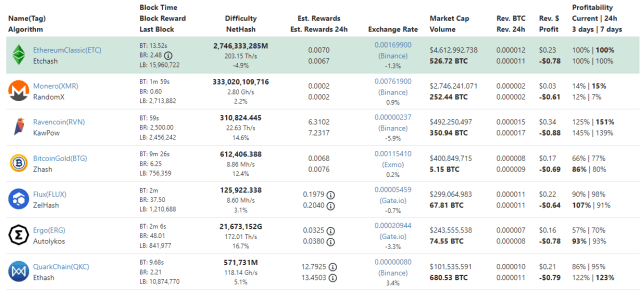
Data from mining profitability aggregators, such as WhatToMine, illustrates a grim reality for those who attempted to stay in the game. Before The Merge, Ethereum’s hashrate hovered around 850 TH/s to 1 petahash per second (PH/s). When that power moved to Ethereum Classic, the ETC hashrate surged from roughly 60 TH/s to over 300 TH/s in a matter of hours. Because the block rewards for ETC remained the same, the share of the reward for each individual miner was diluted by a factor of five or more.
Current metrics indicate that even with efficient hardware, the cost of electricity now exceeds the value of the cryptocurrency mined. For instance, a setup utilizing three AMD RX 480 graphics cards—a once-standard mid-range mining configuration—now yields an estimated profit of -$0.78 per hour, assuming a global average electricity cost of $0.10 per kilowatt-hour (kWh). Even the most powerful consumer hardware, such as the NVIDIA RTX 3090 Ti, struggles to break even, often posting losses of -$0.50 per hour or more. For miners in regions with higher utility rates, such as parts of Europe or the United States, the losses are even more pronounced.
Timeline of the Mining Collapse
The path to this "mining apocalypse" was paved by several years of development and multiple delays in the Ethereum roadmap.
- 2015–2021: Ethereum establishes itself as the most profitable chain for GPU miners. The "Difficulty Bomb" is repeatedly delayed to allow the network to prepare for the PoS transition.
- Early 2022: As The Merge approaches, GPU prices begin to soften from their pandemic-era highs as professional mining farms start to hedge their bets.
- August 2022: Ethereum developers confirm the mid-September date for the Bellatrix and Paris upgrades. Hashrates on Ethereum Classic begin to creep upward as early movers seek to test their configurations.
- September 15, 2022: The Merge completes. Within minutes, Ethereum’s hashrate drops to zero. Within the hour, hashrates on ETC, RVN, and ERG hit all-time highs.
- Post-Merge Week One: The market realizes that the "profitability floor" has collapsed. Major mining pools report a massive exodus of miners as they realize they are paying more for electricity than they are earning in rewards.
The Secondary Market and Hardware Devaluation
The collapse of mining profitability has had an immediate and cooling effect on the global hardware market. During the 2020-2021 bull run, GPUs were frequently sold at 200% to 300% of their Manufacturer’s Suggested Retail Price (MSRP) due to insatiable demand from miners.
In the wake of The Merge, the secondary market has been flooded with used "mining cards." Platforms like eBay and Facebook Marketplace have seen a surge in listings for bulk GPUs, often at prices well below MSRP. This has been a boon for the PC gaming community, which had been priced out of the market for years, but it represents a massive capital loss for mining operations that purchased hardware at peak prices.

Industry analysts suggest that the "GPU mining era" may be entering a permanent hibernation. While new PoW coins could theoretically emerge, the sheer scale of the displaced Ethereum hashrate means that any new chain would likely suffer the same fate: an immediate difficulty spike that destroys profitability before the coin can gain enough market value to support its miners.
Industry Reactions and Stakeholder Perspectives
The reaction from the crypto community has been polarized. Proponents of Ethereum’s move to Proof-of-Stake, including co-founder Vitalik Buterin, have championed the 99.9% reduction in the network’s energy consumption. From an ESG (Environmental, Social, and Governance) perspective, The Merge is viewed as a triumph that makes Ethereum more attractive to institutional investors.
Conversely, the mining community has expressed frustration. Some miners attempted to maintain a PoW version of the network via a hard fork known as EthereumPoW (ETHW). While the fork successfully launched, it has struggled with technical glitches, a lack of ecosystem support from major decentralized finance (DeFi) protocols, and a rapidly declining token price, further compounding the losses for those who chose to support it.
Mining pool operators, such as Ethermine, have been forced to pivot their business models. Ethermine, once the largest Ethereum mining pool, announced it would not support any PoW forks and instead launched a "Staking-as-a-Service" platform to cater to the new PoS reality.
Broader Implications and Future Outlook
The current state of negative profitability suggests a "survival of the fittest" scenario. Only miners with access to "stranded energy" (energy that is otherwise wasted or free) or those with extremely low industrial electricity rates (under $0.03/kWh) can afford to keep their machines running. For the average home miner or small-scale "hobbyist" operation, the era of passive income via GPU mining appears to be over.
This shift also has implications for the security of smaller PoW chains. While a high hashrate generally means a more secure network, the extreme volatility in mining participation can lead to instability. If a chain is only profitable for a few hours a day due to price fluctuations, miners may "hop" between chains, leading to inconsistent block times and potential vulnerabilities.
Furthermore, the death of GPU mining marks a centralization of hashing power in the Proof-of-Work space toward Bitcoin and ASIC-based mining. As GPUs become irrelevant for securing major networks, the hardware decentralization that once allowed anyone with a gaming PC to participate in the crypto economy has largely vanished.
In the long term, the market may eventually reach a new equilibrium. As more miners turn off their machines, the difficulty on chains like Ethereum Classic will eventually decrease. If the price of these tokens increases in a future bull market, mining could once again become profitable for a limited number of participants. However, for the millions of GPUs that once secured the Ethereum network, the "Golden Age" of mining has officially come to an end, replaced by a cold, calculated reality where the cost of the spark is greater than the value of the coin.














