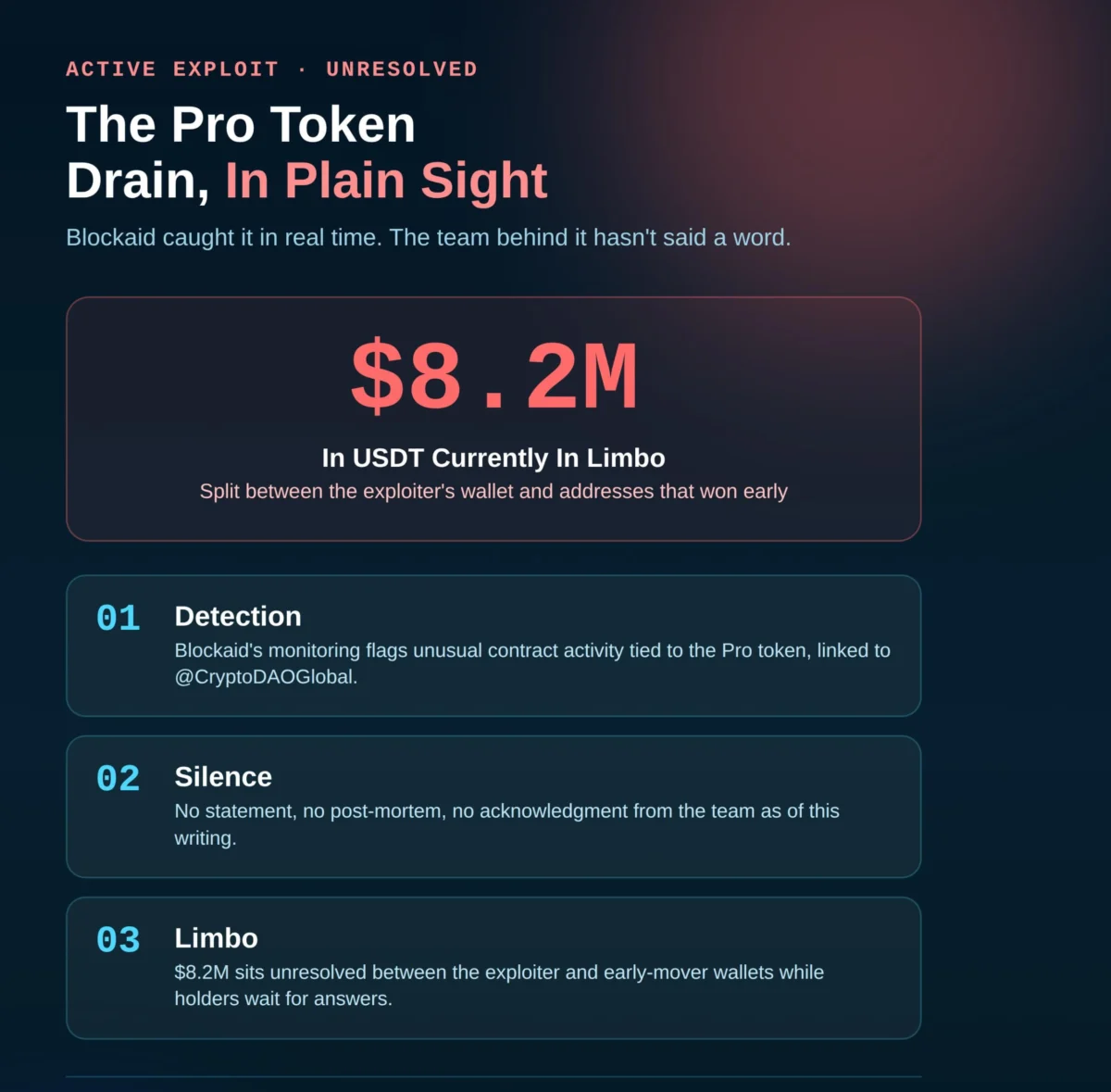
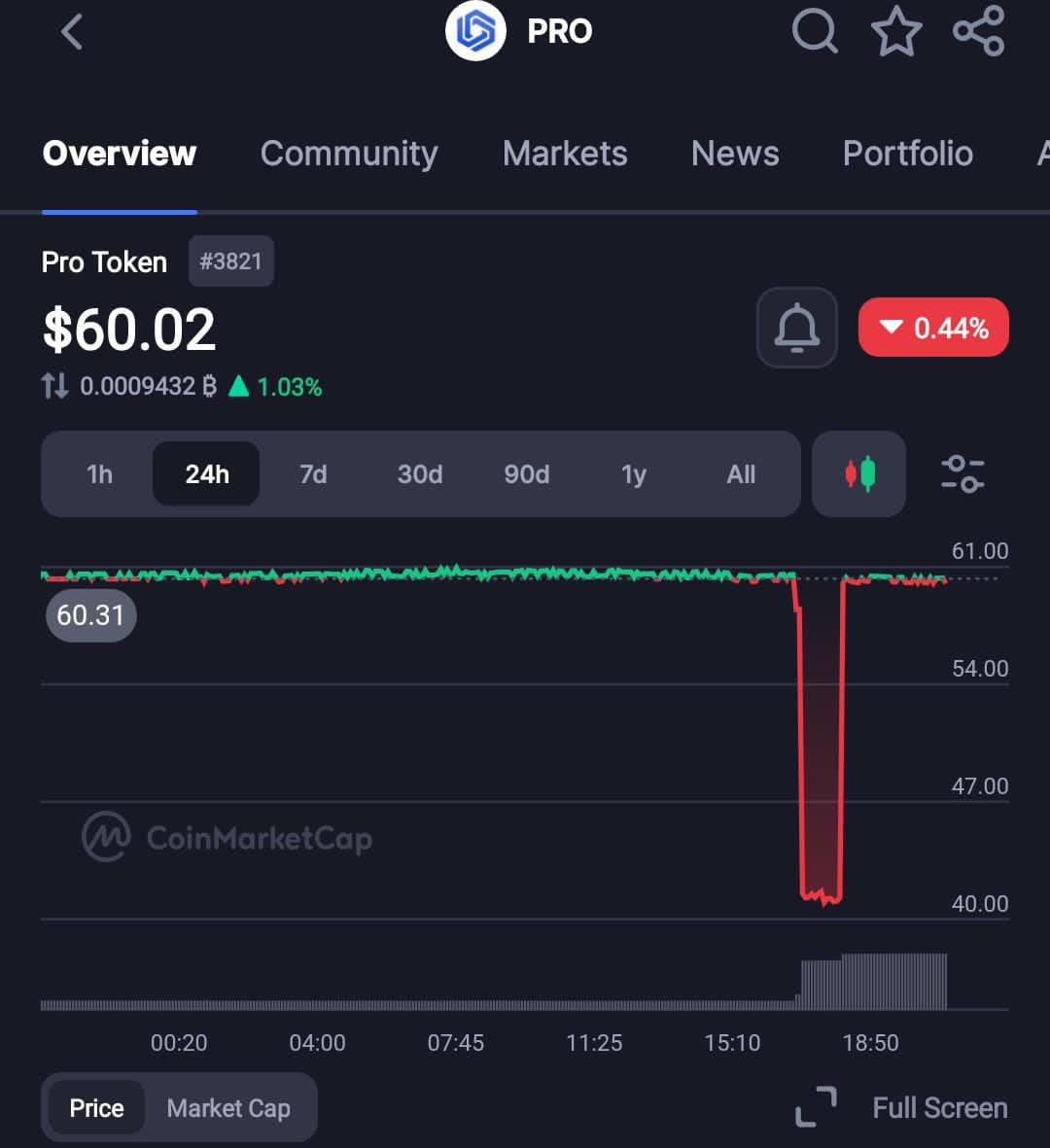
If you’re holding Pro token right now, you already know the feeling: refreshing the chart, refreshing X, waiting for the team to say literally anything. This palpable anxiety stems from a significant onchain event unfolding on the Ethereum network, where an exploiter currently controls approximately $8.2 million in USDT. The project behind the drained Pro token, linked to the entity @CryptoDAOGlobal, has maintained a complete and unsettling silence in the aftermath. This incident is not an isolated anomaly but rather a stark illustration of a disturbing trend that has defined the first half of 2026, marking it as the most challenging period for onchain security in the history of the cryptocurrency industry.
The Pro Token Incident: An Unfolding Crisis and Unanswered Questions
The exploit targeting the Pro token was detected in real-time by Blockaid’s advanced exploit detection system. The security firm promptly issued an alert, detailing the ongoing attack in a thread on social media platforms. According to Blockaid’s comprehensive tracking, the pilfered $8.2 million in USDT is currently distributed between the primary exploiter’s wallet and a cluster of associated addresses. These additional addresses appear to have capitalized on the attack, either by front-running the exploit transaction itself or by strategically positioning themselves to benefit from the immediate market chaos and liquidity shifts that invariably follow such high-profile security breaches.
As of this report, the team behind CryptoDAOGlobal, the entity to which the Pro token is ostensibly tied, has not released any official communication. There has been no statement acknowledging the breach, no preliminary post-mortem analysis, nor even a basic public acknowledgment that a significant security incident has occurred. For the community of Pro token holders, who are meticulously monitoring the token’s fluctuating chart and anxiously seeking information, this prolonged silence serves as a profound red flag. It aligns with a concerning pattern that security researchers have observed throughout the year: project teams are increasingly learning about major exploits affecting their protocols through public alerts issued by third-party security firms, rather than through their own internal detection and incident response mechanisms. This reactive posture, coupled with a lack of transparency, exacerbates the damage to investor confidence and further compounds the frustration of those directly impacted.
The rhythm of live exploit alerts has become distressingly familiar within the crypto space. A security system designed for continuous, round-the-clock monitoring of onchain activity identifies unusual contract behavior, aberrant minting patterns, or suspicious fund movements within minutes, sometimes even seconds, of the initial malicious transaction. Blockaid has built a formidable reputation on its ability to provide precisely this kind of real-time detection, with a track record this year that encompasses a wide array of incidents, from complex bridge exploits to governance takeovers, often flagging these events before the broader crypto community becomes aware of any irregularity. The Pro token case perfectly fits this mold: an active, unresolved exploit, a substantial dollar figure that keeps a community glued to block explorers, and a project team that has retreated into silence at the very moment its stakeholders are most in need of clarity and reassurance. Until CryptoDAOGlobal breaks its silence and provides a comprehensive response, the $8.2 million currently held in the exploiter’s wallet and the associated winning addresses remains the most concrete public record of the events, starkly highlighting the persistent accountability gap within the decentralized finance (DeFi) industry.

A Record-Breaking Half-Year for Onchain Crime
Stepping back from the specifics of the Pro token incident reveals a far grimmer and more extensive panorama of onchain security challenges. The first half of 2026 has been unprecedented in its volume of security incidents. Blockaid’s research arm verified an staggering 212 separate security incidents during this six-month period alone. To put this into perspective, this volume represents a 3.4-fold increase over the total number of incidents recorded across the entirety of 2025. This dramatic escalation signifies a fundamental shift in the threat landscape, where the frequency and sophistication of attacks are outpacing the industry’s defensive capabilities.
The total verified losses for this period surged to approximately $1.1 billion. Ethereum and Solana, two of the largest and most active blockchain ecosystems, bore the brunt of this financial damage, absorbing the majority of the stolen funds. The pace of these losses is alarming: an industry that once measured major exploits in the dozens per year is now experiencing a comparable count roughly every few weeks. This data substantiates the widespread sentiment among crypto participants that their social media feeds and news timelines have been relentlessly bombarded with exploit alerts. It is not merely a perception; the data unequivocally confirms that the industry is navigating an unprecedented wave of onchain crime.
Beyond Code: The Rise of Operational Security Failures
Perhaps the most critical finding from Blockaid’s H1 2026 report, and one that demands a fundamental re-evaluation of security paradigms for every project and every individual investor, concerns the nature of these breaches. A staggering 74% of all funds stolen in the first half of 2026 did not originate from traditional smart contract bugs or vulnerabilities within the underlying code. Instead, these massive losses stemmed from operational security (OpSec) failures.
Operational security failures encompass a broad spectrum of weaknesses that exist around the code, rather than within it. These include compromised private keys, which serve as the master access credentials to critical project funds and infrastructure; hijacked signer infrastructure, where the mechanisms responsible for authorizing transactions are subverted; and sophisticated social engineering attacks that trick internal team members into inadvertently approving malicious transactions or granting unauthorized access. These social engineering tactics can range from phishing campaigns to elaborate impersonations, all designed to exploit human vulnerabilities rather than technical ones.
Historically, code audits were considered the gold standard and often the perceived finish line for ensuring a project’s security. While still vital for identifying inherent smart contract vulnerabilities, audits are increasingly addressing only a smaller fraction of the overall problem. The larger, more financially devastating failures are occurring in the periphery: within the human elements, the procedural frameworks, and the administrative controls that govern access to and management of critical digital assets. This paradigm shift has profound implications for how investors should evaluate projects before committing capital. A pristine audit badge displayed prominently on a project’s landing page, while reassuring, provides almost no insight into the robustness of the team’s internal operational security – whether their individual laptops are secure, if their multi-signature (multisig) wallets are adequately protected, or if their internal communication channels like Slack workspaces are susceptible to infiltration. The "human factor" has emerged as the most critical and often overlooked attack surface.
The Shadow of State-Sponsored Actors: North Korea’s Outsized Role
Attribution data from the same period paints a concerning picture regarding the perpetrators of these attacks. Blockaid’s research strongly links North Korea-backed operators to an astonishing 55% of all H1 2026 losses. This concentrated activity by a single actor cluster corroborates independent reports from other prominent blockchain security firms, which have similarly highlighted the immense scale and sophistication of Pyongyang’s state-sponsored crypto theft operations. These are not opportunistic "smash-and-grab" hacks; rather, they represent meticulously planned and executed campaigns.
Security researchers consistently describe a pattern involving patient, methodical infiltration strategies. These often begin with seemingly innocuous approaches, such as fake job offers meticulously crafted to target blockchain developers, or sophisticated impersonations of reputable venture capital firms designed to engage and compromise key project personnel. The objective is typically a long-term infiltration of trusted infrastructure, sometimes months before any significant funds are actually moved. This insidious strategy means that a team behind a token an investor holds could unknowingly have a compromised individual on staff, or their systems infiltrated, long before any visible signs of wrongdoing emerge. This reality underscores the deep and pervasive threat posed by state-sponsored cybercriminal enterprises to the entire crypto ecosystem.
Anticipating the Next Wave: Blockaid’s Forward-Looking Analysis
The forward-looking component of Blockaid’s research is arguably the most valuable for anyone involved in building or holding cryptocurrency. The firm’s team has identified a distinct set of newer attack vectors that they anticipate will scale significantly through the second half of 2026. While these patterns have appeared in isolated incidents so far, they have not yet crystallized into industry-wide trends. Given the rapid trajectory with which this year’s dominant tactics – operational compromises and infrastructure targeting – evolved from niche concerns to the primary vectors for stolen funds, this forecast carries substantial weight.
If the first half of 2026 has offered any definitive lesson, it is that the next wave of losses will likely not mirror the last. This necessitates a proactive shift in the questions that investors and project participants should be asking. Beyond merely inquiring, "Was the code audited?", the critical questions now include, "Who holds the keys to this project’s critical assets, and what robust, transparent mechanisms are in place to ensure I would be notified if that changed or if those keys were compromised?" This emphasis on access control, key management, and incident response transparency is paramount.
The Accountability Gap and The Path Forward
For the immediate future, the Pro token exploit remains active and unresolved. CryptoDAOGlobal’s silence persists, and the approximate $8.2 million continues to reside in limbo, partitioned between the exploiter’s wallet and the addresses that benefited from the chaos. This specific incident serves as a microcosm within a much larger, ongoing narrative: an industry that, despite its rapid innovation and technological advancements, continues to build at a pace that often outstrips its ability to secure itself comprehensively. The threat landscape, characterized by its adaptability and sophisticated targeting, consistently demonstrates its keen awareness of precisely where these security gaps lie.
For every individual holding digital assets today, this situation offers a sobering reminder. The next time a project team goes conspicuously quiet after a token’s chart begins a precipitous decline, it is a signal that demands immediate attention and critical evaluation of one’s exposure. The collective experience of H1 2026 demands a renewed commitment to robust security practices, transparent communication, and an industry-wide effort to close the persistent accountability gap that continues to undermine trust and stability in the burgeoning digital economy. The future resilience of the crypto ecosystem hinges on its ability to learn from these costly lessons and proactively build a more secure foundation.