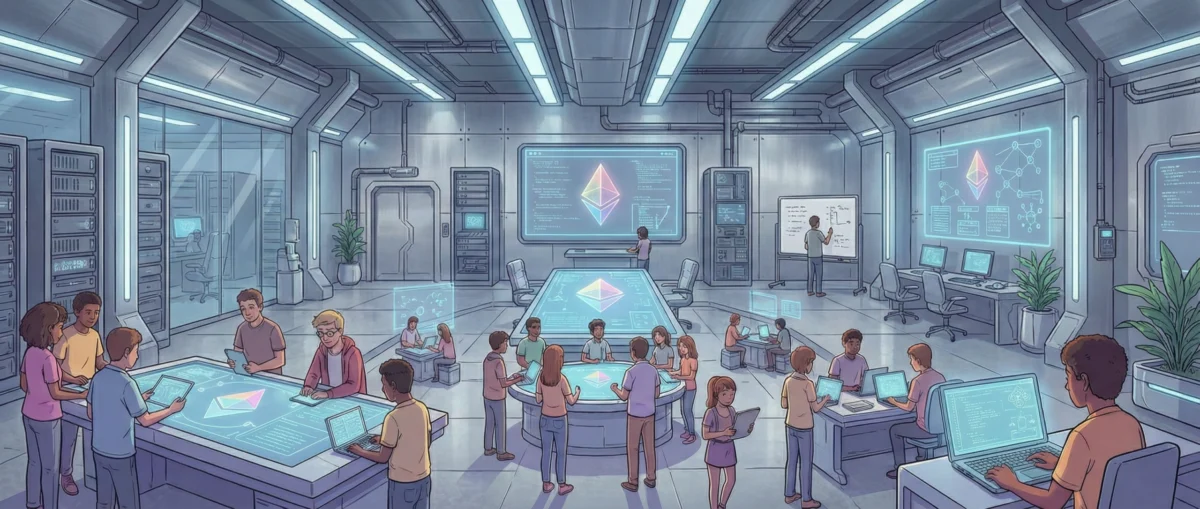
Ethereum Protocol Studies (EPS) is set to return for its 2026 iteration, promising a significantly expanded and more accessible program designed to onboard individuals into the intricate workings of the Ethereum protocol. Building on its success as a vital educational resource, EPS 2026 will introduce new specialized content tracks focusing on cryptography, lean consensus mechanisms, and Zero-Knowledge Ethereum Virtual Machines (zkEVMs). Complementing these advancements, the program is launching a novel self-paced learning platform, making its comprehensive curriculum available year-round and catering to a wider range of learning styles and schedules. The initiative officially kicks off on February 23rd, with interested parties encouraged to visit epf.wiki to begin their journey.
Since its inception as a 10-week study group preceding the Ethereum Protocol Fellowship (EPF) 5, EPS has evolved into a cornerstone for anyone seeking to grasp the fundamental architecture and ongoing development of the Ethereum network. The program has demonstrably empowered hundreds of participants, guiding them from a general familiarity with Ethereum to a sophisticated understanding capable of interpreting technical specifications, navigating complex client codebases, and ultimately contributing to protocol development. The upcoming 2026 program represents a significant leap forward in both the depth of its subject matter and the flexibility of its delivery format.
Expanding Horizons: New Content Tracks for 2026
The 2026 iteration of EPS introduces two critical new content tracks, reflecting the Ethereum roadmap’s increasing emphasis on advanced cryptographic techniques and scalable consensus solutions. These additions underscore the program’s commitment to staying at the forefront of blockchain innovation and preparing participants for the future of decentralized systems.
Deep Dive into Cryptography
The new "Cryptography" track is meticulously designed to demystify the mathematical underpinnings of Ethereum’s security and functionality. Starting with foundational mathematical concepts, participants will embark on a comprehensive exploration of advanced cryptographic primitives. Key areas of focus will include elliptic curve pairings, which are crucial for efficient signature aggregation and zero-knowledge proofs; KZG (Kzg Commitments), a powerful tool for data availability and verifiable computation; and the intricacies of various hash functions that form the backbone of blockchain integrity. Furthermore, this track will delve into the cryptographic constructions that are shaping Ethereum’s future, such as advanced zero-knowledge proof systems (like zk-SNARKs and zk-STARKs) and the development of post-quantum signature schemes, anticipating and addressing the evolving landscape of cryptographic threats. This deep dive is particularly relevant as Ethereum continues to explore privacy-enhancing technologies and quantum resistance.
The Frontier of Lean Consensus and zkEVMs
The "Lean Consensus and zkEVM" track addresses the rapidly evolving landscape of Ethereum’s scalability and consensus mechanisms. In light of recent breakthroughs in zkEVM implementations, this module will provide participants with a thorough understanding of how these innovative solutions prove the correctness of off-chain execution. The curriculum will explore the architectural designs and underlying principles of various zkEVM approaches, highlighting their potential to dramatically enhance transaction throughput and reduce gas fees. Crucially, the track will connect these advancements to Ethereum’s broader strategic objectives of achieving massive scalability and "SNARKifying" the protocol, a term referring to the integration of zero-knowledge proofs across various layers of the network. This focus is timely, as zkEVMs are widely seen as a pivotal technology for Ethereum’s future scalability, enabling more complex computations to be verified efficiently and securely.
A Revolution in Learning: The New Self-Paced Platform
Recognizing the diverse learning needs and schedules of its global audience, EPS is launching a state-of-the-art, self-paced learning platform. This innovative addition aims to democratize access to high-quality Ethereum protocol education, making it available beyond the traditional constraints of live sessions.
Previously, EPS relied on a combination of live interactive sessions, dedicated Discord channels for community discussions, and the Ethereum Protocol Fellowship (EPF) Wiki as the primary learning resources. While these elements remain integral to the program, the new platform, built on the robust Moodle framework, offers a structured, self-directed learning experience. The platform meticulously hosts the existing EPS curriculum, transforming it into a comprehensive, module-based course. Each segment is thoughtfully curated, pairing video content from past study group sessions with interactive assessments. These comprehension checks are seamlessly integrated directly within the lecture recordings, allowing participants to test their understanding in real-time as they learn. This feature provides immediate feedback and reinforces key concepts, significantly enhancing the learning process.
Participants can now progress through the material at their own pace, benefiting from progress tracking features and clearly defined learning objectives for every section. This flexibility is a game-changer, enabling busy professionals, students, and enthusiasts worldwide to engage with the material on their own terms. The self-paced platform is designed to complement, not replace, the live program. Cohort participants will continue to benefit from the invaluable experience of seminar-style discussions led by seasoned protocol engineers, real-time question-and-answer sessions, and collaborative problem-solving facilitated through the EPF Wiki and Discord community. The platform acts as a powerful tool to monitor progress, solidify knowledge, and ensure that the barrier to entry for understanding Ethereum’s core protocol is as low as possible, fostering a more inclusive and knowledgeable community.
What to Expect in the 2026 Program
The Ethereum Protocol Studies 2026 program is structured to provide a comprehensive and engaging learning experience. Participants can anticipate a multi-faceted approach that blends theoretical knowledge with practical application.
Structured Curriculum: The program will offer a clear progression from foundational concepts to advanced topics, ensuring a solid understanding of Ethereum’s architecture. This includes detailed explanations of the execution layer, consensus mechanisms, and the broader ecosystem of client software.
Expert-Led Instruction: Live sessions will continue to feature insights and guidance from experienced protocol engineers and researchers who are actively contributing to Ethereum’s development. This direct access to leading minds in the field is a hallmark of the EPS program.
Interactive Learning Environment: Beyond lectures, participants will engage in discussions, collaborative projects, and hands-on exercises. The integration of the EPF Wiki and Discord channels fosters a dynamic community where knowledge is shared and challenges are overcome collectively.
Hands-on Experience: The program encourages participants to explore client codebases, analyze protocol specifications, and potentially contribute to open-source development efforts. This practical engagement is crucial for developing a deep, functional understanding.
Community and Networking: EPS 2026 provides an unparalleled opportunity to connect with a global network of peers, mentors, and industry leaders who share a passion for Ethereum’s future. Building these relationships can open doors to new opportunities and collaborations.
Continuous Learning Resources: The new self-paced platform ensures that learning does not end with the program’s formal duration. Participants can revisit materials, reinforce their understanding, and stay updated with ongoing developments in the Ethereum ecosystem.
The EPF Wiki: A Living Knowledge Base
The EPF Wiki, accessible at epf.wiki, continues to serve as an indispensable, community-driven repository of knowledge for the Ethereum protocol. It offers an extensive and ever-expanding collection of information covering critical areas such as the execution layer and consensus layer specifications, the intricate architecture of various Ethereum clients (e.g., Geth, Prysm, Lighthouse), the infrastructure supporting protocol testing, and the bleeding edge of ongoing research initiatives.
The contributions from participants of previous EPS cohorts have been instrumental in maintaining the wiki’s currency and comprehensiveness. This collaborative spirit is central to the wiki’s success, and the EPS 2026 program actively encourages all participants to contribute to its growth and refinement. By engaging with the wiki, participants not only enhance their own understanding but also play a direct role in building a more robust and accessible knowledge base for the entire Ethereum community. This living document serves as a testament to the power of collective intelligence in advancing complex technological ecosystems.
Getting Involved: A Gateway to Protocol Understanding
The Ethereum Protocol Studies program is designed for anyone possessing a genuine interest in understanding the intricate mechanisms that power the Ethereum network at its core. Whether you are a seasoned developer aiming to make substantive contributions to the protocol, a researcher meticulously following the evolving roadmap, or an individual simply driven by an insatiable curiosity about the inner workings of this groundbreaking decentralized system, EPS offers a structured and clear pathway. This journey commences with grasping fundamental concepts and progresses to the most advanced and forward-looking aspects of Ethereum’s technological frontier.
To embark on this educational expedition, prospective participants are strongly encouraged to begin by thoroughly exploring the comprehensive resources available at epf.wiki. This initial step will provide a foundational overview and context for the program. Subsequently, joining the dedicated Discord server, accessible via the provided link, will immerse you in a vibrant and supportive community where you can connect with fellow learners, ask questions, and engage in discussions with experienced members. The combination of self-directed study through the wiki and interactive community engagement on Discord, augmented by the structured learning opportunities within the EPS 2026 program, creates a potent learning environment. This integrated approach ensures that participants not only acquire theoretical knowledge but also develop practical skills and build valuable connections within the Ethereum ecosystem. The program’s commitment to accessibility and depth positions it as a vital resource for the continued growth and innovation of the Ethereum network.