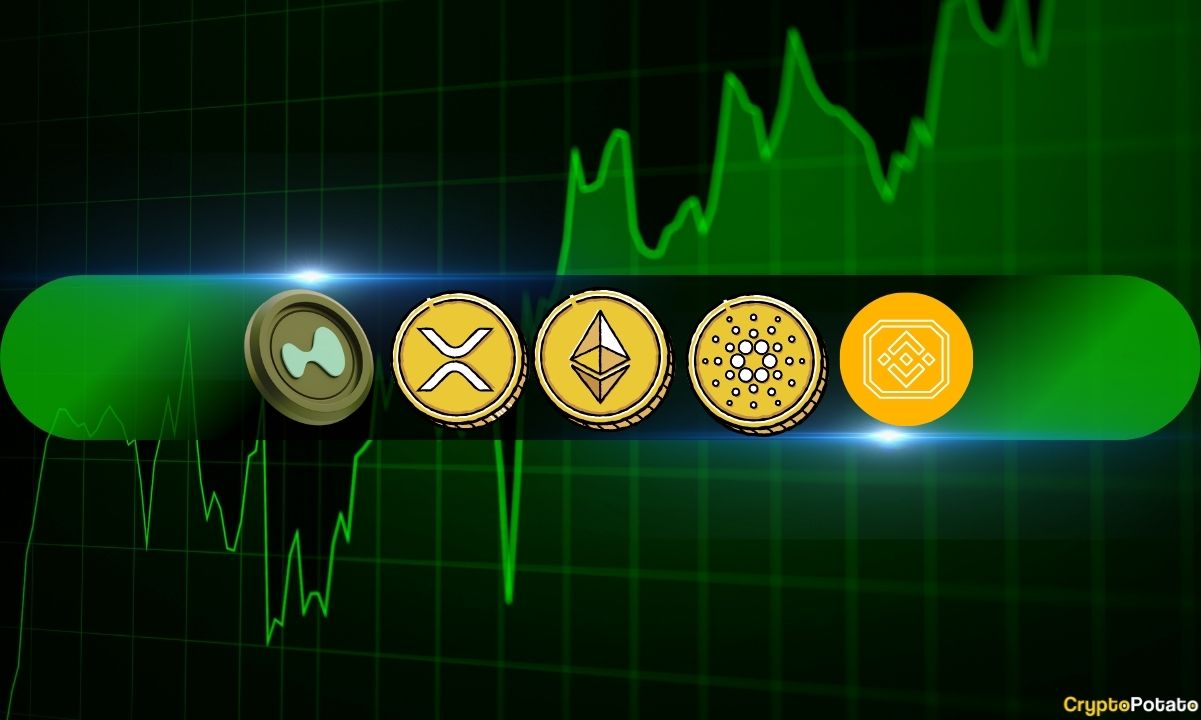
This Friday, the cryptocurrency market presents a mixed landscape, with several major altcoins navigating crucial support and resistance levels. Investors and traders are closely watching Ethereum (ETH), Ripple (XRP), Cardano (ADA), Binance Coin (BNB), and Hyperliquid (HYPE) for signs of potential trend shifts and future price movements. This in-depth analysis will examine the current technical positions of these digital assets, providing context and potential implications for the broader market.
Ethereum (ETH): Testing the $1,800 Lifeline Amidst Bearish Pressure
Ethereum, the second-largest cryptocurrency by market capitalization, has spent the past week treading water around the significant support level of $1,800. This consolidation, marked by a minor loss of approximately 2% over the week, indicates a delicate balance between buyers and sellers. While this zone has historically provided a floor, persistent bearish sentiment could challenge its integrity.
The recent price action for ETH reveals a notable weakening of bullish momentum. The formation of a lower high just below the $2,000 mark signifies that buyers were unable to decisively reclaim this level as support. This failure has emboldened sellers, who are now poised to exert further downward pressure. The inability of bulls to establish a strong foothold above $2,000 suggests a potential shift in market sentiment, where bears are regaining the initiative.
Looking ahead, the immediate future for Ethereum appears to involve further testing of the $1,800 support. Should this critical level falter, the cryptocurrency could face a steeper decline, potentially revisiting the $1,500 support zone. This level proved to be a significant turning point for buyers in early July, and its retest could serve as another crucial battleground for market direction. The sustained trading below key resistance levels indicates a cautious outlook for ETH in the short term, with traders watching for any decisive break below $1,800.
Supporting Data: As of late August 2023, Ethereum’s market capitalization hovered around $220 billion, reflecting its substantial influence within the digital asset ecosystem. The network’s transition to Proof-of-Stake (PoS) via "The Merge" in September 2022 was a landmark event, aiming to improve scalability and energy efficiency. However, macroeconomic factors and regulatory uncertainties continue to play a significant role in its price performance. Recent on-chain data indicates a slight increase in ETH held by long-term investors, suggesting a degree of confidence in its future prospects, but this has not yet translated into sustained price appreciation.
Ripple (XRP): The $1 Mark – A Crucial Psychological and Technical Barrier
Ripple’s XRP has endured a challenging week, struggling to maintain its position above the psychologically significant $1 price level. With a weekly decline of nearly 3%, XRP is now precariously close to seeing $1 transition from a support to a formidable resistance. A sustained push by sellers could solidify this bearish shift, potentially triggering further downside.
If $1 becomes a firmly established resistance, it would likely prolong the current downtrend that began in August 2023. This level is not only a major psychological barrier but also a critical technical juncture. Any loss of support at $1 could lead to a significant retreat for buyers, with the next key support level identified at $0.80. The implications of breaking $1 are substantial, potentially signaling a deeper correction for XRP.
The technical outlook for XRP suggests a low probability of an immediate reversal of its current downtrend. The recent price action, including a fall from two identical pennant formations, has served to reconfirm the dominance of bears in the market. These chart patterns are often interpreted as continuation signals, indicating that the prevailing trend is likely to persist. The market participants are keenly observing whether the $1 level can hold as support, as a break below it could usher in a period of increased volatility and further price erosion.
Supporting Data: XRP’s price performance has been significantly influenced by the ongoing legal proceedings between Ripple Labs and the U.S. Securities and Exchange Commission (SEC). While a partial victory for Ripple in July 2023 provided a temporary boost, the lingering uncertainty continues to cast a shadow over its price trajectory. The network’s focus on facilitating cross-border payments and its growing ecosystem of financial institutions are underlying strengths, but these fundamentals are currently being overshadowed by the regulatory overhang. The sustained struggle to hold $1 underscores the market’s caution in pricing in future growth amidst this legal ambiguity.
Cardano (ADA): Navigating a 10% Weekly Decline and the 15-Cent Support
Cardano (ADA) began the month with promising gains, but the tide has turned this week, with sellers pushing the price down by a significant 10%. This sharp decline has placed bulls on the defensive, potentially driving them back to the critical support level at $0.15.
Should the current corrective move persist, a re-test of the $0.15 mark appears highly probable. The integrity of this support level is paramount for ADA’s prospects, as a failure to hold here could expose the cryptocurrency to new lows. Any indication of weakness at this price point could trigger a rapid and substantial downward price movement.
Looking ahead, Cardano’s immediate future hinges on its ability to stabilize above the $0.15 support. If buyers can successfully defend this zone, it could lead to a period of consolidation. Such a phase would be beneficial for ADA, offering a much-needed respite after its prolonged downtrend that commenced in 2025. The market is watching closely to see if buyers can muster enough strength to prevent a breach of this crucial support.
Supporting Data: Cardano, known for its peer-reviewed research and methodical development approach, has faced challenges in translating its technological advancements into consistent price appreciation. The network’s focus on scalability and sustainability through its Ouroboros Proof-of-Stake consensus mechanism remains a long-term strength. However, the broader market sentiment and the performance of other altcoins have a significant impact on ADA’s price. The recent 10% weekly drop highlights the sensitivity of ADA to prevailing market trends and the need for strong buying pressure to counter selling momentum. The $0.15 level represents a significant historical support, and its defense will be critical for maintaining bullish sentiment.
Binance Coin (BNB): Consolidating Above $580 with Low Buy Volume Concerns
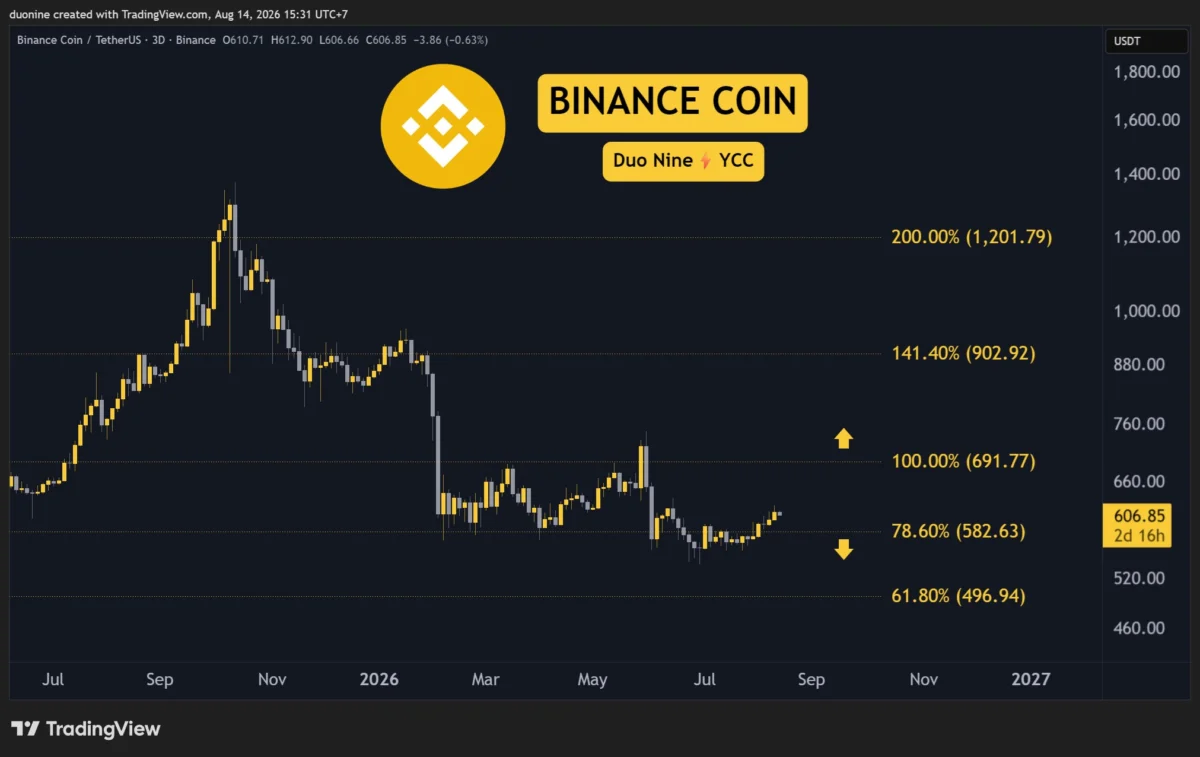
Binance Coin (BNB) concluded the week on a positive note, gaining 3% and confirming support at the $580 level. This development suggests that BNB has a reasonable chance of extending its gains towards the key resistance at $690, provided sellers do not re-emerge with significant force.
At the time of this report, BNB is trading around the $610 mark. As long as the price remains above $600, buyers are expected to maintain a momentum advantage. However, a point of concern for bullish sentiment is the persistently low buy volume, which could limit the sustainability of any upward price movement.
Looking ahead, BNB might be in the process of forming a large rounded bottom pattern around its current price levels. This bullish chart formation would be further validated if the price can decisively move above the $630 mark. A confirmation of this pattern would increase the likelihood of a future test of the $690 resistance. The market is monitoring BNB’s ability to build on its recent gains and overcome the challenge of low trading volumes.
Supporting Data: Binance Coin is intrinsically linked to the performance and reputation of Binance, the world’s largest cryptocurrency exchange. Its utility within the Binance ecosystem, including trading fee discounts and participation in token sales, provides a fundamental demand driver. However, Binance has also faced increased regulatory scrutiny globally, which can influence BNB’s price indirectly. The confirmation of support at $580 is a positive sign, but the low buy volume suggests that the current uptrend may lack robust conviction from the broader market. The $690 level represents a significant hurdle that BNB will need to overcome to signal a stronger recovery.
Hyperliquid (HYPE): Stuck Between Resistance and Support, Awaiting Clarity
Hyperliquid (HYPE) has traded relatively flat over the past week, experiencing rejection at the $58 resistance level. If current market dynamics persist, the cryptocurrency could find itself revisiting the key support at $52 in the coming days.
Since reaching its all-time high of $76 in June, HYPE has been characterized by a pattern of lower lows and lower highs. This indicates a bearish trend that has taken hold of the asset. Considering the significant rally observed in the first half of the year, the current correction phase could potentially extend for a considerable period, suggesting that the path to previous highs may be arduous.
Looking ahead, the $52 level stands out as the most decisive on the chart for HYPE. This critical support has, thus far, prevented sellers from establishing new lows. However, the potential for a re-test of this level looms, which could be interpreted as a bearish signal by the market. Therefore, a patient approach is advised for investors and traders monitoring HYPE, allowing the price action to provide clearer direction before making significant moves.
Supporting Data: Hyperliquid is a decentralized perpetual exchange built on its own Layer 1 blockchain, aiming to offer high performance and low transaction fees. Its unique architecture allows for high throughput, which is crucial for a derivatives trading platform. However, as a relatively newer entrant compared to established players, HYPE’s price action is often more susceptible to market sentiment and the overall health of the decentralized finance (DeFi) sector. The rejection at $58 and the potential re-test of $52 highlight the immediate challenges HYPE faces in establishing a new upward momentum. The trading volume and the ability of buyers to defend the $52 support will be key indicators of its short-term trajectory.
Broader Market Implications and Outlook
The current technical standing of Ethereum, Ripple, Cardano, Binance Coin, and Hyperliquid paints a picture of a cautious and somewhat uncertain cryptocurrency market. While some assets like BNB are showing signs of resilience and potential for upside, others like XRP and ADA are facing significant downward pressure and testing critical support levels.
The overarching theme remains the influence of macroeconomic factors, regulatory developments, and the overall risk appetite of investors. The recent period of consolidation and minor corrections across several major altcoins suggests that the market is awaiting a clear catalyst for a sustained upward move or further downside.
For Ethereum, the defense of the $1,800 support is crucial to prevent a deeper correction. A successful hold could pave the way for a re-attempt at higher prices, but a break below could signal a more prolonged bearish phase. Ripple’s fate is still largely tied to its legal battles, and any decisive resolution, positive or negative, will likely have a significant impact on XRP’s price. Cardano’s ability to defend $0.15 will be a key determinant of its short-term trend, while Binance Coin’s progress will depend on its ability to overcome low buy volume and maintain momentum above $600. Hyperliquid’s consolidation between $52 and $58 suggests a period of indecision, with the market awaiting a decisive break in either direction.
Investors are advised to remain vigilant, conduct thorough research, and consider their risk tolerance in this dynamic market environment. The coming weeks will be critical in determining the short-to-medium term direction for these prominent cryptocurrencies.
Disclaimer: The information provided in this article is for informational purposes only and does not constitute financial advice. Investing in cryptocurrencies involves significant risk, and investors should conduct their own research and consult with a qualified financial advisor before making any investment decisions. The author and publisher are not responsible for any losses incurred as a result of the information presented here.