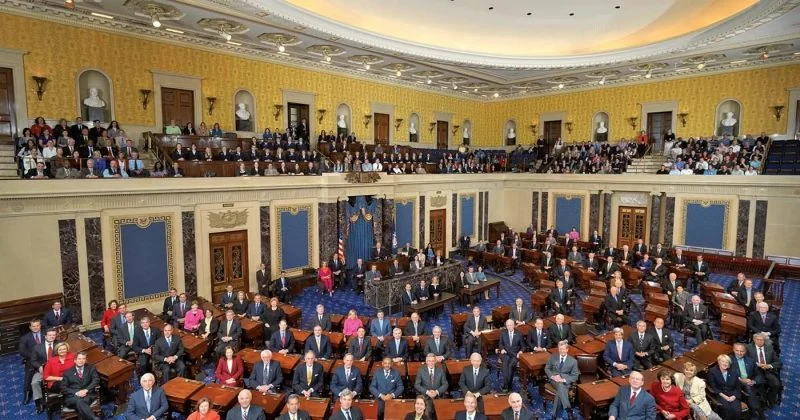
The United States Senate is currently grappling with the legislative timeline for the Digital Asset Market Clarity Act, a comprehensive framework designed to provide much-needed oversight to the burgeoning cryptocurrency industry. While Senate Majority Leader John Thune has expressed a desire to begin the floor process before the upcoming summer recess, industry experts and congressional insiders are increasingly skeptical that the bill will meet the preferred August 7 deadline. The legislative calendar is currently congested with judicial nominations, international policy resolutions, and the annual defense authorization bill, leaving a narrow window for a complex piece of financial regulation that remains the subject of intense partisan debate.
Senate Majority Leader John Thune addressed the media on Thursday, signaling a cautious optimism about the bill’s initial steps while acknowledging the mathematical and political difficulties of a full passage before the break. "I would like to at least get Clarity started," Thune stated, referring to the Act by its common shorthand. "We’ll see where the votes are." This statement highlights the precarious nature of the bill’s support, as leadership continues to whip votes in a chamber where a 60-vote threshold is required to overcome potential filibusters and move toward a final vote.
The Legislative Calendar and the August Deadline
The urgency surrounding the August 7 date is not arbitrary. In the context of a midterm election year, the legislative window narrows significantly after the summer. The Senate is scheduled to begin its state work period on August 10, returning to Washington D.C. only on September 14. This five-week hiatus represents a critical loss of momentum for any bill not already in the advanced stages of floor consideration. Historically, major financial reforms that are not finalized before the fall of an election year often languish as lawmakers shift their focus toward campaigning and constituent engagement.
Should the Senate fail to pass the bill before the recess, the remaining time in September will be limited. Furthermore, because the Senate’s current draft combines proposals from both the Banking and Agriculture committees, it differs from the version passed by the House of Representatives in July 2025. Any amended version approved by the Senate would necessitate a reconciliation process or a "ping-pong" of the legislation back to the House for a final vote before it could reach President Donald Trump’s desk for his signature.
Chronology of the Digital Asset Market Clarity Act
The journey of the Digital Asset Market Clarity Act has been a multi-year endeavor, reflecting the complexity of integrating blockchain technology into the existing federal financial regulatory structure.
- July 2025: The House of Representatives passes its version of the crypto market structure bill. This version was lauded by industry proponents for providing a clear path for digital assets to transition from "securities" to "commodities" based on the level of decentralization of their underlying networks.
- Late 2025 – Early 2026: The Senate Banking Committee and the Senate Agriculture Committee hold a series of joint and individual hearings. These sessions featured testimony from the Chairpersons of the Securities and Exchange Commission (SEC) and the Commodity Futures Trading Commission (CFTC), as well as representatives from major digital asset exchanges and stablecoin issuers.
- July 2026: Senate leadership releases a combined draft of the bill. This version attempts to bridge the gap between the Agriculture Committee’s focus on commodity spot markets and the Banking Committee’s focus on investor protection and anti-money laundering (AML) protocols.
- Late July 2026: Majority Leader John Thune admits the August 7 deadline is unlikely to be met, as the Senate floor remains occupied by the Iran war powers resolution and the National Defense Authorization Act (NDAA).
Deep Dive into the Regulatory Framework: SEC vs. CFTC
At the heart of the Digital Asset Market Clarity Act is the long-standing jurisdictional dispute between the SEC and the CFTC. For years, the digital asset industry has operated in a "regulation by enforcement" environment, where the SEC has claimed authority over the majority of tokens by classifying them as investment contracts under the decades-old Howey Test.
The Clarity Act seeks to codify the definitions of "digital goods" (commodities) and "digital securities." Under the current Senate draft:
- The CFTC would be granted primary oversight of the digital asset spot markets. This includes the authority to regulate exchanges where Bitcoin, Ethereum, and other assets deemed "sufficiently decentralized" are traded.
- The SEC would retain jurisdiction over digital assets that are used for capital raising and where the "expectation of profit" is derived primarily from the efforts of a centralized management team.
Supporting data from market analysts suggests that this shift could unlock billions of dollars in institutional investment. According to a 2026 report from a leading financial consultancy, approximately 72% of institutional investors cited "regulatory uncertainty" as the primary barrier to entering the crypto market. By clarifying which agency holds the keys to oversight, the Act aims to provide the legal certainty required for traditional banks and pension funds to offer digital asset services.
The Stablecoin Stalemate and Ethics Provisions
Despite the broad agreement on the need for a regulatory framework, two primary issues have emerged as significant "poison pills" that could derail the legislation: stablecoin rewards and ethics restrictions for government officials.
The Dispute Over Stablecoin Rewards
The Senate draft includes provisions regarding yield-bearing stablecoins. Some Democrats argue that stablecoins offering "rewards" or interest to holders function identically to high-yield savings accounts and should be subject to the same stringent banking regulations and insurance requirements as traditional deposits. They contend that without Federal Deposit Insurance Corporation (FDIC) oversight, these assets pose a systemic risk to the financial system.
Conversely, several Republicans and industry advocates argue that stablecoin rewards are more akin to money market funds or loyalty programs and should not be stifled by traditional banking "red tape." They suggest that over-regulating these products would drive innovation offshore to jurisdictions like the European Union, which has already implemented its Markets in Crypto-Assets (MiCA) framework.
Ethics and Enforcement
Another point of contention involves the enforcement of ethics rules on senior government officials who transition into the private digital asset sector. The current draft proposes strict "cooling-off" periods to prevent the "revolving door" phenomenon. However, a rift has formed over which agency should enforce these rules. Democrats have voiced strong objections to giving the Department of Justice (DOJ) the primary responsibility for enforcement, preferring instead to empower an independent ethics commission or the SEC’s existing enforcement division. Republicans, meanwhile, have expressed concerns that giving the SEC more power in this area could lead to politicized prosecutions.
Political Pressures and the 2026 Midterm Horizon
The looming 2026 midterm elections add a layer of volatility to the legislative process. Historically, as elections approach, the appetite for bipartisan compromise diminishes. Members of Congress become wary of taking votes that could be used against them in campaign advertisements.
For the Digital Asset Market Clarity Act, the stakes are high. Pro-crypto political action committees (PACs) have raised over $150 million for the 2026 cycle, signaling that they intend to support candidates who favor the bill. This financial pressure is felt on both sides of the aisle. However, the 60-vote requirement in the Senate means that the bill cannot pass on a purely partisan basis. Negotiators like Senator Cynthia Lummis have indicated that the most contentious provisions remain open to revision as they seek the necessary Democratic support to reach that 60-vote threshold.
"We are at a crossroads," said a senior legislative aide who requested anonymity. "We have a draft that is 90% there, but the final 10% involves fundamental disagreements about the nature of money and the role of the state. In an election year, that last 10% feels like a mountain."
Industry Impact and Market Sentiment
The digital asset industry has reacted to the potential delay with a mix of frustration and resignation. Leading industry groups, such as the Blockchain Association and the Crypto Council for Innovation, have spent months lobbying for a vote before the recess.
"The delay is disappointing but not entirely unexpected," a spokesperson for a major US-based exchange commented. "The industry has been asking for clear rules of the road for years. Every day that passes without this legislation is a day where American innovation is at a disadvantage compared to the rest of the world. We need the Senate to prioritize this in September."
Market data indicates that the crypto markets remain sensitive to US legislative developments. Following Thune’s comments on Thursday, the prices of major assets saw a minor contraction, reflecting the market’s realization that a "quick win" on regulation is unlikely. Analysts suggest that a failure to pass the bill in 2026 could lead to another year of litigation and uncertainty, potentially stalling the growth of the US digital economy.
The Path Forward: September and Beyond
If the Senate begins the floor process before August 10, it will likely serve as a "placeholder" to keep the bill active on the calendar. This would allow the various committees to continue refining the language during the recess. When lawmakers return on September 14, they will face a frantic three-week period before the pre-election adjournment.
The success of the Digital Asset Market Clarity Act will ultimately depend on whether the "Lummis-Thune" coalition can offer enough concessions to skeptical Democrats regarding consumer protection and DOJ enforcement while maintaining Republican support for the treatment of stablecoins.
If the bill fails to gain traction in September, it may be relegated to a "lame-duck" session following the November elections. However, the outcome of those elections will dictate the political will of the chamber. If there is a significant shift in the balance of power, the current draft may be abandoned in favor of a new version in the next Congress, effectively resetting the clock on US crypto regulation.
For now, the digital asset industry and its observers are left watching the Senate clock. The Digital Asset Market Clarity Act represents perhaps the most significant attempt to date to modernize the US financial system for the 21st century, but its fate remains tethered to the traditional, and often slow, wheels of American governance. As the August 7 deadline nears, the "clarity" the industry seeks remains just out of reach, postponed by the complex realities of a divided Congress and a looming election.