The landscape of Web3 wallets has undergone a significant evolution over the past year, moving beyond mere token storage to encompass a broader spectrum of decentralized applications (DApps). While many exchange-linked options, such as KuCoin’s Web3 Wallet, initially appeared to follow a conventional script—facilitating token storage, DApp connectivity, and basic swap functions—a deeper examination reveals a strategic divergence. This shift signals a proactive effort by centralized exchanges (CEXs) to bridge the gap between their established user bases and the burgeoning decentralized finance (DeFi) ecosystem, offering a more integrated and feature-rich experience within a self-custodial framework.
A notable illustration of this paradigm shift came with the ability to place a prediction market trade on a World Cup match directly from within what is fundamentally a crypto wallet. This seemingly minor convenience underscores a significant strategic pivot: exchange-backed Web3 wallets are increasingly positioning themselves as comprehensive dashboards for diverse crypto activities, challenging the traditional delineation between centralized and decentralized financial tools. This move is not merely about adding features but about redefining the user’s interaction with the entire Web3 space.
The Evolving Landscape of Web3 Wallets and KuCoin’s Strategic Position
For years, the standard Web3 wallet, exemplified by MetaMask, served primarily as a gateway to DApps, emphasizing self-custody and broad blockchain compatibility. Its neutrality and open-source nature made it the default choice for millions. However, as the crypto market matured and user demands grew, the need for more integrated solutions became apparent. Centralized exchanges, recognizing the potential for user migration to self-custody and DeFi, began developing their own Web3 wallets, aiming to retain users within their broader ecosystem while offering the benefits of decentralization.
KuCoin’s Web3 Wallet, on paper, aligns with the core tenets of self-custody and multichain asset management, allowing users to control their private keys and interact across various networks. However, its true distinction lies in the extensive suite of functionalities bundled directly into the wallet interface. Supporting over 20 blockchain networks, it integrates a cross-chain decentralized exchange (DEX) aggregator, native perpetual futures trading, access to tokenized real-world assets (RWAs), and advanced "Smart Money" tools for on-chain tracking of informed wallets. This comprehensive offering is designed to provide a holistic Web3 experience even before a user navigates to an external DApp.
This approach starkly contrasts with the more neutral stance of wallets like MetaMask. KuCoin is not attempting to be an exchange-agnostic tool; rather, it is deliberately engineered as a connective tissue between a user’s centralized exchange account and the decentralized world. This strategic positioning also defines its competitive edge against offerings from other major exchanges, such as Binance Web3 Wallet and OKX Wallet. While OKX Wallet has often been lauded for its depth in Web3 infrastructure and DeFi integrations, and Binance leverages its immense scale and brand trust, KuCoin carves out a distinct niche by treating the wallet as a singular dashboard for an expansive range of crypto activities, from token discovery to speculative prediction markets. It transcends the abstract concept of a "portal to Web3" to become an "everything-in-one" application for current crypto functionalities.
Deep Dive into KuCoin Web3 Wallet’s Differentiating Features
The robust feature set of KuCoin’s Web3 Wallet is designed to cater to a diverse user base, from casual participants to seasoned DeFi traders. Each integrated function aims to reduce friction and enhance the overall user experience within the self-custodial environment.
Integrated DEX Aggregation and Perpetual Futures Trading
A cornerstone of KuCoin’s integrated strategy is its built-in cross-chain DEX aggregator. This feature allows users to find the most efficient routing for token swaps across various decentralized exchanges and blockchain networks, optimizing for price and liquidity. In a market where slippage and fragmented liquidity can significantly impact trade execution, an aggregator provides a crucial utility, simplifying complex cross-chain transactions and ensuring users get competitive rates without needing to manually compare multiple DEXs. The global DEX volume consistently processes billions of dollars monthly, underscoring the importance of efficient trading tools within this segment.
Beyond spot trading, the wallet also offers native perpetual futures trading, powered by infrastructure from platforms like Hyperliquid. This integration allows users to open leveraged positions directly from their self-custodial wallet, combining the speed and efficiency typically associated with centralized exchange derivatives platforms with the security of holding one’s own keys. While the inherent risks of leveraged trading, such as liquidation, remain, the execution speed and depth of order books provided by such integrations significantly enhance the DeFi trading experience. This capability targets a segment of traders who seek advanced financial instruments without relinquishing self-custody. The perpetual futures market on decentralized platforms has seen substantial growth, with daily trading volumes often exceeding hundreds of millions of dollars, highlighting the demand for such high-octane trading environments.
The Airdrop Hub: Streamlining Reward Discovery and Claiming
Airdrop farming has become a popular, albeit often chaotic, activity within the crypto community, offering potential rewards for early adopters or active users of nascent projects. Traditionally, participating in airdrops involves tracking numerous announcements across social media, navigating complex eligibility criteria, and interacting with various DApps and wallets, often leading to confusion and potential security risks from unofficial sources.
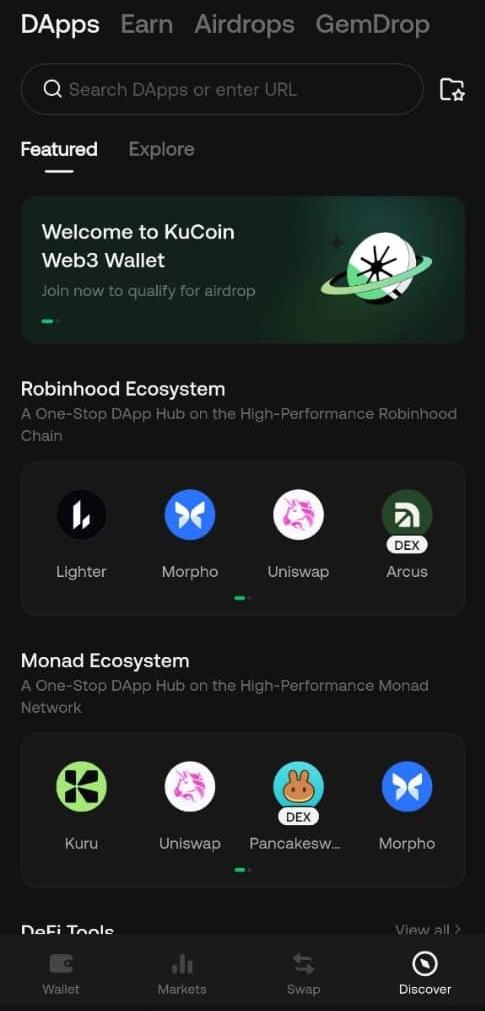
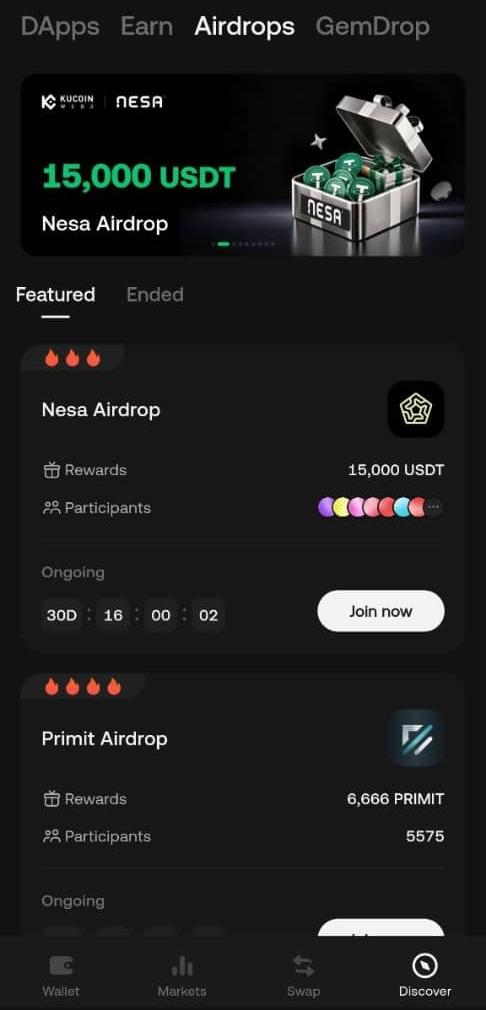
KuCoin’s Airdrop Hub addresses this by consolidating campaign discovery directly within the wallet’s Discover tab. Users can browse active campaigns, review requirements (such as maintaining a minimum balance or trading specific tokens), and participate with relative ease. Rewards, following an internal review period (typically 5-10 business days), are then sent directly to the user’s wallet address. This streamlined process mitigates much of the guesswork and security concerns associated with third-party airdrop trackers, as campaigns run through KuCoin’s vetted infrastructure.
However, it is crucial to acknowledge that while the hub simplifies participation, it does not eliminate the underlying speculative nature of airdrops. KuCoin’s terms explicitly state that participating tokens are not guaranteed to launch through a token generation event, nor does the platform assume liability if a project’s token fails to materialize or gain liquidity. Therefore, while offering genuine convenience, the Airdrop Hub remains a tool for informed speculation rather than a risk-free investment mechanism. The total value of airdrops distributed annually can run into hundreds of millions of dollars, making dedicated hubs an attractive proposition for users seeking these opportunities.
The NFT Layer: Windvane Integration and Market Context
Non-fungible tokens (NFTs) experienced a monumental boom in 2021-2022, leading many platforms to integrate NFT functionalities. KuCoin’s NFT integration is powered by Windvane, its dedicated NFT marketplace, allowing users to buy, store, and display collections directly within the wallet interface. This direct integration is a thoughtful design decision, as many exchange wallets often treat NFTs as an ancillary feature, relegated to a separate, less frequently visited tab. By embedding Windvane, NFT holdings are presented alongside fungible tokens, fostering a more cohesive asset management experience.
Despite the well-executed integration, the relevance of a dedicated NFT marketplace within a wallet warrants consideration in the current market climate. Industry-wide NFT trading volumes have cooled considerably since their peak, reflecting a broader market correction and a shift in investor focus. While the feature demonstrates a commitment to a comprehensive Web3 experience, its current utility for a significant portion of the user base may be more about completeness than a primary draw. Nonetheless, for collectors and traders who remain active in the NFT space, having a seamless, integrated solution for managing their digital collectibles is a distinct advantage.
KCS Staking: Bridging CEX Loyalty with On-Chain Yield
A unique aspect of exchange-linked wallets is their ability to integrate native exchange tokens. Historically, holding an exchange’s native token (like KuCoin’s KCS) in a self-custodial wallet often meant foregoing platform-level perks such as trading fee discounts or daily bonuses, which were typically tied to holdings on the centralized exchange.
KuCoin’s Web3 Wallet effectively bridges this gap by enabling KCS Staking and access to on-chain liquid staking derivatives (like SKCS) directly from the Earn tab. This allows users to generate daily yield on their KCS holdings within a self-custodial environment, eliminating the need to choose between retaining control of private keys and earning passive returns. The low barrier to entry, with staking possible from as little as 1 KCS, makes this feature accessible to a broad spectrum of users. This move reflects a growing trend of CEXs extending the utility of their native tokens into the DeFi space, acknowledging user preference for self-custody while still rewarding ecosystem participation.
However, it is important to provide a realistic assessment. Staking KCS in a Web3 wallet does not insulate users from the token’s inherent price volatility. Furthermore, while beneficial, it may not entirely replicate the deep VIP tier discounts or other benefits associated with holding substantial amounts of KCS on the centralized exchange platform. Liquid staking variants, while offering flexibility, introduce additional smart contract risk and exposure to protocol liquidity conditions. Despite these considerations, for users prioritizing self-custody, an integrated on-chain yield mechanism for KCS significantly enhances the token’s practical utility.
Prediction Markets via Polymarket: Betting on Reality
Perhaps the most surprising and forward-looking feature is the integration with Polymarket, a leading platform for event-driven prediction markets. This allows KuCoin Web3 Wallet users to trade on a wide array of outcomes, from sports results and crypto price milestones to broader geopolitical or news events, all without leaving the wallet interface. The ability to fund, execute, and settle a prediction within the same environment used for token management dramatically reduces friction and enhances the accessibility of these markets.
Prediction markets have witnessed significant growth, processing billions of dollars in volume annually. Their appeal lies in their ability to aggregate information and provide real-time probabilistic forecasts on future events, often proving more accurate than traditional polling or expert opinions. By folding this activity directly into a crypto wallet, KuCoin signals a vision for its wallet as more than just an asset holder; it becomes a platform for users to express and monetize their views on real-world outcomes. Gas Meng, who leads KuCoin Web3 Wallet operations, has articulated the goal of making the wallet a gateway connecting on-chain activity to real-world information flows. This integration validates that strategic framing, moving beyond marketing rhetoric to tangible utility.
Tokenized Real-World Assets (RWAs) and Smart Money Tools
The wallet further extends its utility with access to tokenized real-world assets. This feature allows holders to gain exposure to traditional financial instruments, such as treasury products, directly on-chain. The tokenization of RWAs is a rapidly expanding sector, aiming to bring the liquidity and transparency of blockchain to illiquid assets, bridging traditional finance with DeFi.
Additionally, the inclusion of "Smart Money" tools enables users to track the on-chain activities of wallets with a proven track record. In the transparent world of blockchain, identifying and following the movements of successful traders or institutional investors can provide valuable insights. These tools aggregate and present such data, empowering users with more informed decision-making capabilities. Combined with access to over 1,000 DApps through its built-in browser, KuCoin’s Web3 Wallet positions itself as one of the most feature-dense offerings from a major exchange today.
Competitive Landscape and Strategic Implications
The emergence of comprehensive exchange-linked Web3 wallets like KuCoin’s represents a significant trend in the broader crypto ecosystem. It signifies a blurring of the lines between centralized and decentralized services, with CEXs increasingly recognizing the demand for self-custody and direct DeFi interaction.
Compared to Binance Web3 Wallet, which leverages Binance’s unparalleled user base and extensive ecosystem, KuCoin aims for deeper functional integration. Binance’s offering often focuses on ease of access for its existing users, while KuCoin appears to target a more sophisticated user seeking a single point of access for diverse DeFi and speculative activities. OKX Wallet, frequently cited for its robust Web3 infrastructure and advanced DeFi integrations, often edges out competitors in raw depth for experienced DeFi users. However, KuCoin’s unique blend of prediction markets and RWAs presents a different value proposition, focusing on a broader range of practical, everyday crypto applications.
The strategic implication of these developments is profound. As CEXs build increasingly sophisticated self-custodial wallets, they aim to capture users who might otherwise migrate entirely to pure DeFi platforms. This approach allows them to maintain a degree of influence and provide a familiar, integrated experience while offering the benefits of decentralization. It also suggests a future where the distinction between CEX and DEX interfaces becomes less pronounced, replaced by hybrid models that offer the best of both worlds.
Identified Weaknesses and Areas for Improvement
Despite its impressive array of features, KuCoin’s Web3 Wallet is not without its limitations, which are important considerations for potential users.
A significant drawback is the absence of a direct fiat on-ramp or off-ramp. Users are currently required to rely on an external platform or their KuCoin centralized exchange account to convert between crypto and traditional fiat currency. This additional step introduces friction, especially for new users, and contrasts with wallets like Coinbase Wallet, which offer integrated fiat gateways, simplifying the entry and exit points for crypto investments.
Furthermore, the manual handling of network selection, gas fees, and transaction approvals, while standard in many Web3 wallets, can still pose a challenge for less experienced users. While the wallet’s interface is generally polished, these technical intricacies can lead to user errors or frustration, potentially hindering broader adoption among mainstream audiences.
Another factor to consider is the matter of trust and historical perception. KuCoin’s centralized exchange has faced past regulatory and security scrutiny, which, regardless of its current operational status, can influence how some users perceive the broader KuCoin ecosystem, including its associated Web3 wallet. This historical context forms part of the reputational landscape within which the wallet operates.
Finally, in head-to-head user ratings and comparative analyses against competitors like OKX Wallet, KuCoin’s wallet products have sometimes scored lower on metrics such as ease of use and overall feature satisfaction. This suggests that while the ambition behind its feature set is high, the execution has not always translated into the most seamless or universally lauded everyday usability. It is a genuinely capable and feature-rich wallet, offering an extensive range of functionalities. However, it may not yet be the most polished or intuitively simple option on the market.
Conclusion: A Vision for the Future of Integrated Web3 Experience
KuCoin’s Web3 Wallet represents a bold step towards an integrated crypto experience, pushing the boundaries of what a self-custodial wallet can be. By bundling advanced features like cross-chain DEX aggregation, perpetual futures, prediction markets, and RWA access alongside conventional wallet functionalities, it offers a compelling vision of a "super-app" for Web3. This approach aims to reduce user friction, enhance utility, and ultimately accelerate the mainstream adoption of decentralized technologies.
The wallet’s strength lies in its comprehensive range, catering to users who desire a single application that touches nearly every corner of the crypto world. While it still presents some rough edges, particularly concerning fiat on/off-ramps and the inherent complexities of on-chain interactions, its strategic positioning and innovative feature set are indicative of where the industry is heading. As the lines between centralized and decentralized finance continue to blur, integrated platforms like KuCoin’s Web3 Wallet are poised to play a crucial role in shaping the future of digital asset management and interaction, offering a practical and powerful bridge for users navigating the evolving Web3 landscape.