The traditional web browser, a ubiquitous tool in human interaction with the internet, has always been predicated on a fundamental assumption: a human user is at the helm. Features like customizable themes, intuitive tab management, seamless scrolling, and pixel-perfect rendering exist solely to cater to human eyes and hands. This deeply ingrained design philosophy, however, has been fundamentally challenged by Cloudflare’s latest infrastructure release, Kitesurf. This novel browser, developed over a focused twelve-week period, discards these human-centric assumptions entirely, instead being engineered from the ground up for the burgeoning world of AI agents. Cloudflare describes Kitesurf as a stateless, highly scalable web browser operating entirely on its Workers platform, purpose-built for what the company terms the "Agentic Cloud." Its emergence marks a quietly significant, yet potentially revolutionary, development for anyone building sophisticated AI agents that require web access.
The Unseen Browser: Redefining Web Interaction for AI
At the heart of Kitesurf’s innovative design is a simple yet profound observation: artificial intelligence agents do not perceive the web in the same way humans do. While humans prioritize visual aesthetics, responsive interfaces, and an intuitive user experience, AI agents operate on an entirely different set of metrics. Their primary concerns revolve around token count, the size of context windows, operational scalability, and computational cost. Traditional browser engines, such as the widely adopted Chromium, were never conceived with these AI-specific priorities in mind. Consequently, every AI agent that necessitates web browsing has been forced to incur the overhead of rendering and processing features it neither uses nor benefits from, essentially paying for a luxurious interface it will never "see."
This fundamental mismatch has led to significant inefficiencies. AI agents performing tasks like data extraction, content monitoring, or automated web navigation often operate in headless mode, meaning the graphical user interface is never displayed. Yet, the underlying browser engine still dedicates substantial resources to render elements, execute complex JavaScript for visual effects, and maintain session states that are irrelevant to the agent’s objective. Kitesurf boldly eliminates this unnecessary baggage. It operates without tabs, themes, or any particular interest in visual fidelity, precisely because its intended users are algorithmic entities that process information programmatically, not visually. This lean approach directly addresses the core needs of AI: maximizing efficiency and minimizing resource consumption.
Genesis of an Agent-Native Solution: Cloudflare’s Journey to Kitesurf

The origin story of Kitesurf offers insight into Cloudflare’s strategic foresight and iterative development philosophy. According to internal accounts, the concept of building an in-house browser had surfaced repeatedly within the company over several years, only to be consistently shelved due to the perceived technical complexity and the uncertain justification for such a massive undertaking. The turning point arrived with a unique convergence of technological advancements and market demand.
A critical enabler was the maturation of WebAssembly (Wasm) support within Cloudflare Workers. Wasm provides a high-performance, language-agnostic execution environment, allowing developers to run code written in languages like Rust or C++ directly on Cloudflare’s global network edge. Concurrently, Cloudflare introduced new primitives to its Workers platform, including Dynamic Workers for more flexible compute environments and SQLite-based Durable Objects for persistent state management. These architectural enhancements provided the robust foundation necessary to host a complex application like a browser engine efficiently at the edge. At the precise moment these capabilities aligned, the demand for agent-native browsing solutions from the rapidly expanding AI sector exploded, creating an undeniable impetus for the project.
The development journey itself featured a remarkable detail: Kitesurf wasn’t just for AI agents; it was significantly built with the help of one. The project commenced with a Rust-based headless engine named Obscura. An AI agent was then tasked with porting this engine onto the Cloudflare Workers platform. While initial attempts faced challenges, the team refined their instructions, providing the AI with a clearer plan for iteration. This collaborative process ultimately yielded a working proof of concept, underscoring the symbiotic relationship between human innovation and advanced AI capabilities in developing cutting-edge infrastructure. This particular aspect deserves more widespread recognition, as it highlights a novel approach to software development, where AI transitions from a mere consumer of tools to an active participant in their creation.
Architectural Ingenuity: Building for Efficiency and Security
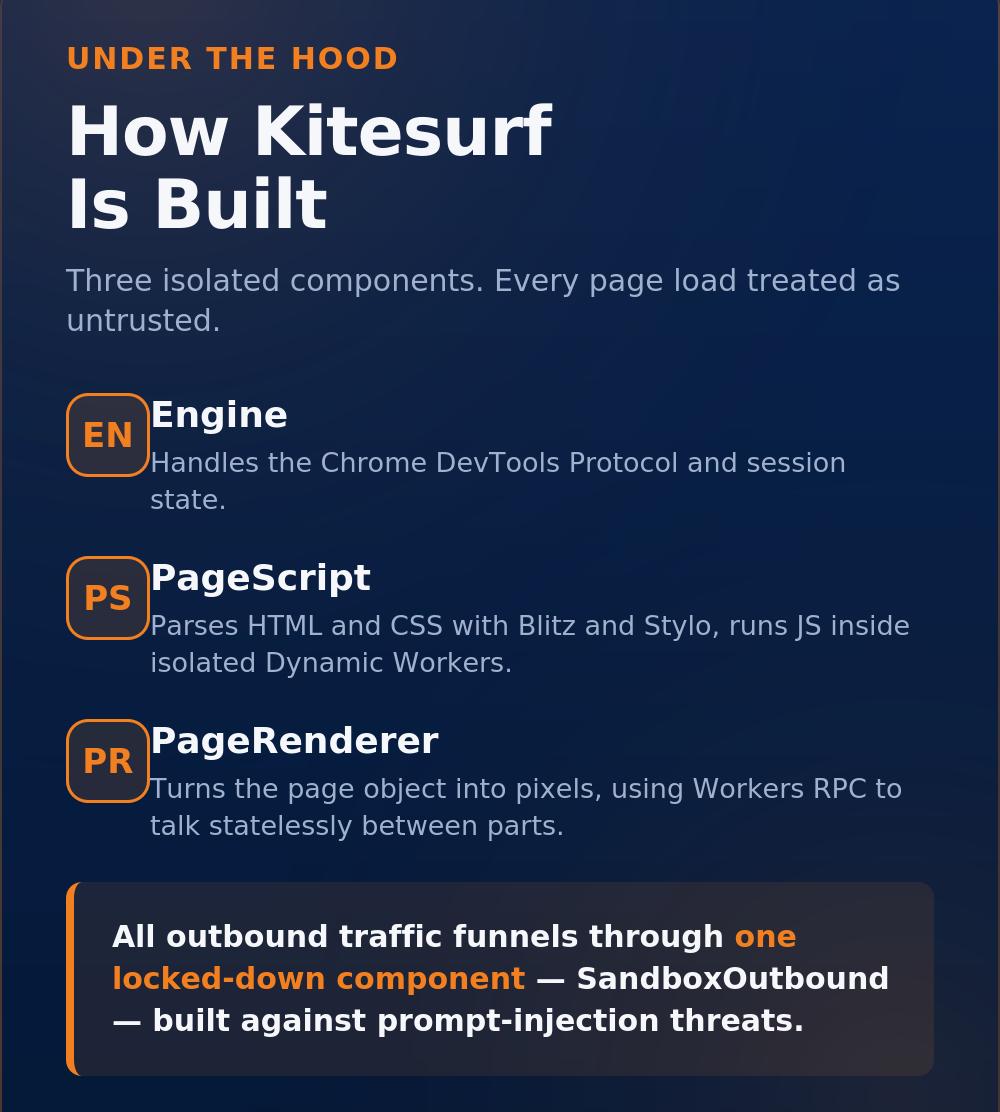
Kitesurf’s architecture is a testament to Cloudflare’s commitment to both performance and security, earning it substantial credit for architectural ambition beyond mere marketing. The browser is meticulously segmented into three distinct core components, designed for optimal isolation and stateless communication:
- The Engine: This component is responsible for managing the Chrome DevTools Protocol (CDP) and maintaining session state. CDP compatibility is crucial, as it allows Kitesurf to integrate seamlessly with existing browser automation tools like Puppeteer, Playwright, and chrome-remote-interface, enabling developers to leverage their familiar workflows.
- PageScript: Tasked with the intricate work of parsing HTML and CSS, PageScript utilizes highly efficient, Rust-based tools named Blitz and Stylo. Blitz is a fast HTML parser, and Stylo is a powerful CSS engine, both optimized for performance. Crucially, JavaScript execution is handled within isolated Dynamic Workers, preventing malicious scripts from impacting other parts of the browser or the underlying infrastructure.
- PageRenderer: This component takes the processed page object and transforms it into actual pixels, or more accurately, into a representation that can be consumed by AI agents (e.g., screenshots, HTML extraction). It communicates statelessly between components using Workers’ built-in Remote Procedure Call (RPC) system, further enhancing efficiency and scalability.
What truly sets Kitesurf apart, particularly in the context of AI agents, is its deeply integrated security model. Cloudflare treats every single page load as inherently untrusted input. To mitigate risks, each architectural component is rigorously isolated, ensuring that it can only access the resources strictly necessary for its function. Furthermore, all outbound network requests are routed through a single, tightly controlled component aptly named SandboxOutbound. This isolation-first design is not an afterthought; it is a genuinely considered response to the unique threat landscape faced by AI browsers. Unlike human users, AI agents are particularly susceptible to sophisticated attacks such as prompt injection, where malicious web content attempts to manipulate the agent’s behavior. By isolating components and strictly controlling network egress, Kitesurf significantly enhances the security posture of AI agents interacting with the untrusted internet. This proactive security approach represents a new standard for agentic browsing, addressing vulnerabilities that traditional human-centric browsers were not designed to counter.
Performance Metrics: A Compelling Case for Cost Efficiency
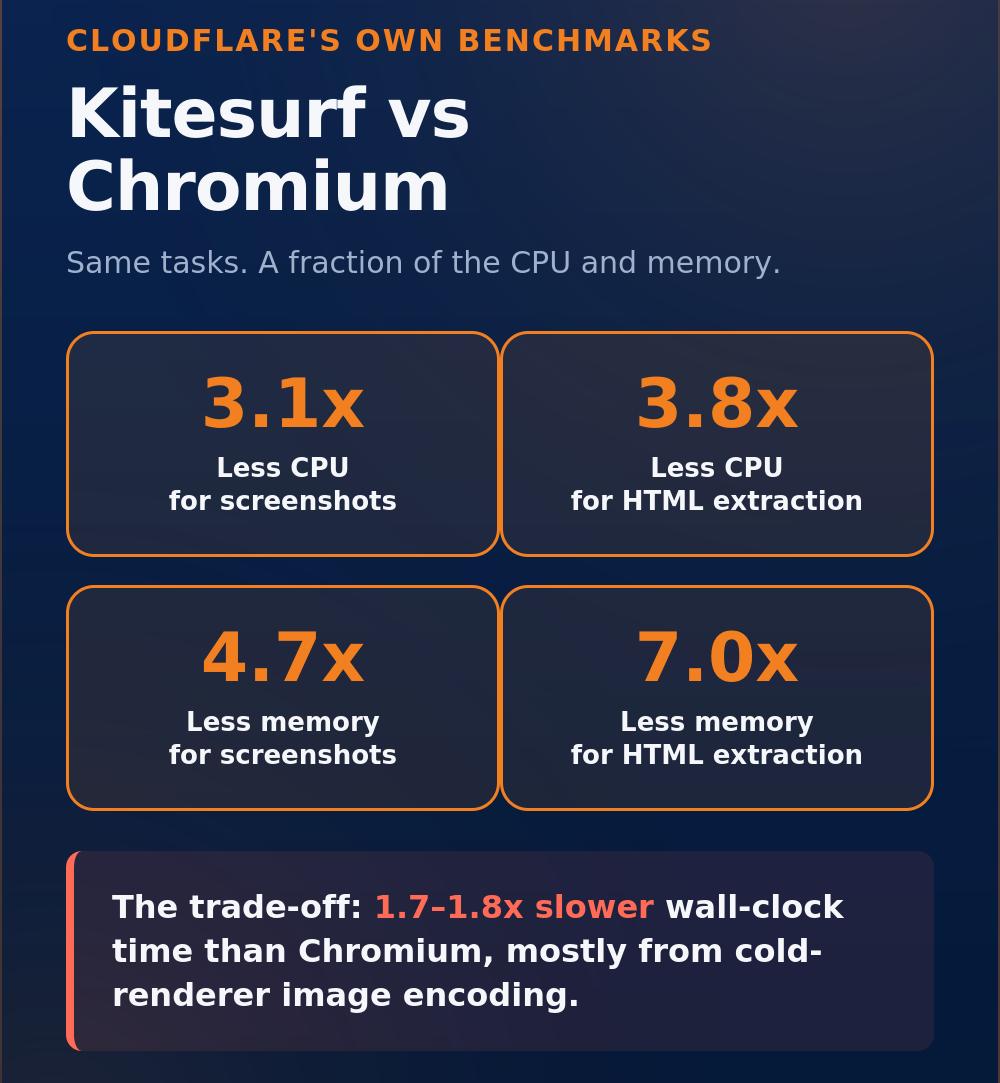
The practical benefits of Kitesurf’s specialized design are quantifiable, particularly in terms of resource efficiency and operational cost. Cloudflare’s own benchmarks, conducted across a diverse corpus of 14 test URLs, reveal compelling performance advantages over a warm-pool Chromium instance:
- CPU Usage: Kitesurf demonstrated a remarkable 3.1 times less CPU consumption for screenshot capture and an even more impressive 3.8 times less for HTML extraction.
- Memory Footprint: The memory efficiency gap was even wider, with Kitesurf using 4.7 times less memory for screenshots and a staggering 7.0 times less for HTML extraction.
These reductions in CPU and memory consumption are not merely academic figures; they translate directly into substantial cost savings for organizations operating AI agents at scale. In cloud environments, infrastructure bills are predominantly driven by CPU cycles and memory usage. For AI applications performing millions of web interactions daily, these efficiency gains can result in dramatically lower operational expenses, making sophisticated AI agent deployments more economically viable and scalable.
However, Cloudflare has been transparent about the trade-offs. Kitesurf, in its current iteration, exhibits slower raw speed in terms of wall-clock time. It took approximately 1.7 to 1.8 times longer to complete the same tasks compared to Chromium. This latency is primarily attributed to the overhead associated with rasterization and image encoding in a cold software renderer, contrasting with Chromium’s highly optimized, mature JIT (Just-In-Time) compiler. For tasks that demand instantaneous real-time interaction, this speed difference might be a consideration. However, for many common AI agent tasks—such as batch data extraction, periodic content monitoring, or generating reports—the long-term cost savings derived from superior resource efficiency often outweigh the slightly increased processing time per individual task.
Despite the current speed differential, Kitesurf is rapidly evolving. Cloudflare reports that the browser currently passes over 215,000 Web Platform Tests, a robust indicator of its compatibility with web standards, and is actively adding hundreds more tests weekly. This aggressive development pace suggests that the compatibility and performance gap will continue to narrow as the project matures.
Accessibility and Integration: Getting Started with Kitesurf
Cloudflare has made Kitesurf remarkably accessible, particularly during its beta phase where it is currently offered free of charge. For developers and curious users who wish to explore Kitesurf without writing any code, Cloudflare provides a public playground. This intuitive interface allows users to input any URL and observe Kitesurf render it live. Crucially, the playground integrates Chrome DevTools directly into the interface, enabling users to inspect DOM elements, monitor console output, and even analyze WebAssembly memory usage on a per-page basis. This hands-on environment provides an excellent opportunity to understand Kitesurf’s capabilities and limitations firsthand.
For actual development and production use, Kitesurf integrates seamlessly with Cloudflare’s existing Browser Run product. A significant advantage is its compatibility with the standard Chrome DevTools Protocol (CDP). This means that developers can continue to use their preferred and familiar client libraries and tools, such as Puppeteer, Playwright, or chrome-remote-interface, without requiring any modifications to their existing codebases. The only adjustment needed is to append a simple browser=kitesurf parameter to their existing Browser Run API calls, directing the request to the Kitesurf engine instead of the default Chromium instance. This low-friction integration strategy minimizes the adoption barrier for developers already leveraging browser automation in their AI workflows.
Current Limitations and Future Trajectory
An honest assessment of Kitesurf necessitates acknowledging its current limitations, which Cloudflare transparently discloses. As it stands today, Kitesurf is not designed to handle all types of web content or interactions. Specifically, it currently cannot:
- Play video content.
- Render complex WebGL graphics.
- Negotiate advanced bot-challenge handshakes that rely on real TLS fingerprints.
- Maintain long, authenticated sessions with persistent state.
For tasks that require these functionalities, Cloudflare explicitly advises developers to revert to Browser Run’s standard Chromium-backed option. This clear demarcation of capabilities is crucial for developers to make informed decisions about when and where to deploy Kitesurf effectively.
These limitations indicate that Kitesurf, in its present form, is genuinely well-suited for specific, stateless tasks. These include efficient content extraction, high-volume screenshot generation, and PDF generation from reasonably standard web pages. It is not yet ready for applications involving complex, interactive, long-lived sessions on heavily protected websites or media-rich platforms. This focused scope underscores Cloudflare’s strategic intent: to solve a specific, high-value problem for AI agents rather than attempting to replicate a full-fledged human browser experience.
Looking ahead, Cloudflare has confirmed plans to eventually open-source the Kitesurf project. While no firm timeline has been provided for this, open-sourcing would allow customers to deploy their own instances, fostering community contributions and further accelerating its development and adoption. This move would also align with Cloudflare’s broader strategy of democratizing powerful infrastructure tools.
Broader Implications: Reshaping the Agentic Cloud Landscape
Kitesurf represents more than just a new product; it signals a fundamental shift in how we conceive of web browsers and their role in the evolving digital ecosystem. Its introduction has several significant broader implications:
- A New Browser Paradigm: Kitesurf challenges the entrenched human-centric design of browsers, paving the way for specialized, purpose-built agents that prioritize efficiency and programmatic interaction. This could inspire other infrastructure providers to develop similarly specialized tools for AI.
- Economic Impact on AI Development: The drastic reduction in CPU and memory consumption offers a compelling economic argument for deploying AI agents at scale. By significantly lowering the operational cost of web interaction, Kitesurf could democratize access to advanced web-scraping, data analysis, and automation capabilities for a wider range of AI projects, from startups to large enterprises.
- Advancing AI Security: The isolation-first security model sets a new benchmark for protecting AI agents from sophisticated web-based threats, particularly prompt injection. As AI agents become more prevalent and powerful, robust security frameworks like Kitesurf’s will be indispensable.
- Catalyst for Innovation in the Agentic Cloud: By providing a highly efficient and secure means for AI to interact with the web, Kitesurf could unlock new possibilities for AI-driven automation, research, and data synthesis. Developers can now design agents with web browsing capabilities without being burdened by the overhead of traditional browsers, fostering creativity and new application development.
- Edge Computing and Distributed AI: Kitesurf’s reliance on Cloudflare Workers leverages the power of edge computing. Running browser instances closer to the data source or the end-user minimizes latency and further optimizes resource utilization, accelerating the trend towards distributed AI processing.
Weighing all these factors, Kitesurf emerges as a genuinely thoughtful and strategic bet on the future trajectory of agentic browsing. Its unique design philosophy, robust security model, and undeniable cost-efficiency for AI operations at scale make it a standout infrastructure release. While it acknowledges its current limitations and doesn’t aim to replace a full Chromium instance for every task, Kitesurf is carving out a critical niche in the burgeoning Agentic Cloud, promising to redefine how artificial intelligence interacts with the vast expanse of the internet.