
Foundry, the Rochester-based powerhouse behind the world’s largest Bitcoin mining pool, has officially signaled its intent to diversify its operations by launching a specialized Zcash (ZEC) mining pool tailored specifically for institutional participants. Scheduled for a commercial debut in April 2026, the initiative represents a significant strategic pivot for Foundry, which currently dominates the Bitcoin mining landscape through its Foundry USA pool. By expanding into the privacy-centric Zcash ecosystem, Foundry aims to provide the same level of rigorous, enterprise-grade infrastructure to ZEC that has historically been reserved for Bitcoin, addressing a long-standing void in the mining sector for publicly traded companies and large-scale financial institutions.
The announcement comes at a pivotal moment for the cryptocurrency mining industry, which is increasingly characterized by a flight to quality and a demand for regulatory-compliant service providers. Foundry’s move into Zcash is not merely a technical expansion but a calculated bet on the growing relevance of financial privacy within a regulated framework. As the operator of Foundry USA—a pool that consistently accounts for a massive plurality of the global Bitcoin hashrate—Foundry brings a level of operational maturity and reputational weight that the Zcash mining ecosystem has arguably lacked since its inception.
The Strategic Rationale Behind the Zcash Expansion
The primary driver for this expansion, as articulated by Foundry leadership, is the perceived maturation of Zcash as an asset class. Despite its reputation for advanced cryptography, the underlying mining infrastructure for Zcash has often been fragmented or catered primarily to retail-scale miners and hobbyists. Mike Colyer, CEO of Foundry, noted that while Zcash has evolved into an institutional-grade asset, the hardware and pool-side infrastructure supporting the network has failed to keep pace with the needs of sophisticated investors and corporate entities.
By launching a US-based, institutional-grade pool, Foundry is positioning itself to capture the growing interest from public companies that require strict adherence to North American compliance standards, transparent reporting, and reliable uptime. The new pool will mirror the operational philosophy of Foundry USA, focusing on high-performance computing, low-latency connectivity, and a robust suite of tools for miners to manage their digital assets.
Understanding the Zcash Ecosystem and Privacy Technology
Zcash was launched in 2016 as a fork of the Bitcoin codebase, inheriting many of its predecessor’s core economic principles while introducing groundbreaking privacy features. Unlike Bitcoin, where the entire history of transactions, including sender and receiver addresses and transaction amounts, is visible on a public ledger, Zcash offers the option of "shielded" transactions. This is achieved through Zero-Knowledge Succinct Non-Interactive Arguments of Knowledge, or zk-SNARKs.

This technology allows users to prove that a transaction is valid without revealing any of the sensitive data associated with it. In a corporate context, this is increasingly seen as a necessity rather than a luxury. For institutional entities, the ability to conduct business on a blockchain without broadcasting trade secrets, payroll data, or sensitive supply chain payments to competitors is a vital requirement for the mass adoption of decentralized finance.
Foundry’s press release emphasized that Zcash demonstrates how financial privacy and compliant digital infrastructure can coexist. By providing a transparent, US-based mining pool, Foundry is bridging the gap between the inherent anonymity of the ZEC token and the transparency required by modern financial regulators.
Tokenomics and the Mining Landscape
The economic structure of Zcash is intentionally similar to Bitcoin, which makes it an attractive secondary asset for miners already familiar with PoW (Proof-of-Work) dynamics. Zcash has a hard supply cap of 21 million tokens. New ZEC is introduced into circulation through block rewards given to miners who successfully solve complex mathematical puzzles to secure the network.
A critical component of this economic model is the "halving" event, which occurs approximately every four years. During a halving, the reward for mining a block is cut by 50%, a mechanism designed to control inflation and mimic the scarcity of precious metals. For miners, these events necessitate a high degree of operational efficiency, as the revenue generated per unit of electricity consumed drops significantly overnight. Foundry’s entry into the space suggests a belief in the long-term price appreciation of ZEC, which would be necessary to offset the diminishing block rewards over time.
Recent Trends: The Zcash Hashrate Boom
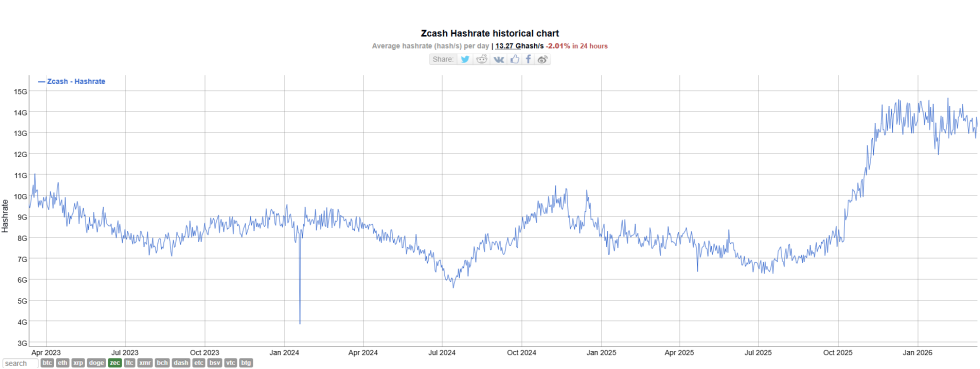
Foundry’s decision to enter the Zcash market is supported by compelling network data. Over the past several months, the Zcash network has experienced a significant surge in computing power, known as hashrate. Data from BitInfoCharts reveals a dramatic upward trajectory in the total computational effort dedicated to securing the Zcash blockchain.
In October 2025, the ZEC hashrate was hovering around 8 Ghash/s. By early 2026, that figure had climbed to over 13 Ghash/s, representing a nearly 60% increase in network security in a relatively short period. This surge in hashrate is often a leading indicator of miner confidence and institutional interest. Higher hashrate levels make the network more resistant to 51% attacks, thereby increasing its appeal to large-scale capital allocators who prioritize security above all else.

The increase in hashrate also suggests that more efficient mining hardware, likely specialized ASIC (Application-Specific Integrated Circuit) miners designed for the Equihash algorithm used by Zcash, is being deployed at scale. Companies like Bitmain have continued to iterate on Equihash miners, and the entry of a major pool operator like Foundry will likely encourage further hardware investment in North America.
Collaborative Support and Industry Reactions
The announcement has been met with enthusiasm from the core developers and support organizations within the Zcash community. Shielded Labs, an independent support organization based in Switzerland, has voiced strong support for the move. Zooko Wilcox, the founder of Zcash and Chief Product Officer at Shielded Labs, highlighted the importance of having a North American-based, enterprise-grade pool.
Wilcox noted that Foundry’s reputation as the largest Bitcoin mining pool brings a level of credibility that will likely attract new participants to the Zcash ecosystem. The collaboration between Shielded Labs and Foundry signifies a maturation of the Zcash project, moving it further away from its "experimental" roots and closer to a foundational pillar of the digital asset economy.
Market Context and Price Performance
At the time of the announcement, the price of Zcash (ZEC) was trading at approximately $209. While the asset has seen significant recovery from its previous lows, it remains a volatile instrument, having experienced an 11% decline in the week leading up to the Foundry news. This price action reflects the broader cooling of the cryptocurrency markets following a period of intense speculation.
However, for industrial-scale miners, short-term price fluctuations are often secondary to long-term network health and infrastructure stability. Foundry’s commitment to a 2026 launch indicates a multi-year horizon, suggesting that the company views Zcash as a permanent fixture in the institutional landscape regardless of immediate price volatility.
Broader Implications for the Mining Industry
Foundry’s expansion marks a significant shift in the competitive landscape of mining pools. Traditionally, mining pools have been siloed, focusing on a single major asset like Bitcoin or Ethereum (prior to its transition to Proof-of-Stake). Foundry’s diversification into Zcash suggests a new model where "mega-pools" provide a one-stop-shop for institutional miners to manage a diversified portfolio of PoW assets.
This move also has geopolitical implications. Since the 2021 mining ban in China, North America has become the global hub for Bitcoin mining. By launching a Zcash pool based in the United States, Foundry is extending this North American dominance to the privacy coin sector. This centralization of hashrate in a single geographic region and under a single corporate umbrella has raised some concerns regarding network decentralization. However, proponents argue that the professionalization and transparency offered by Foundry are necessary trade-offs for the survival of PoW networks in a regulated world.
Conclusion and Future Outlook
The launch of the Foundry Zcash pool in April 2026 will be a litmus test for the institutional appetite for privacy-focused digital assets. If successful, it could pave the way for other major pool operators to diversify their offerings, leading to a more robust and resilient mining ecosystem.
For Zcash, the arrival of Foundry represents the "institutional seal of approval." It validates the project’s technological foundation and its economic model. As the world moves toward greater digitization of financial assets, the tension between transparency and privacy will only intensify. Foundry is betting that Zcash, supported by world-class mining infrastructure, will be the primary solution to that tension.
As April 2026 approaches, the industry will be watching closely to see if Foundry can replicate its Bitcoin success within the Zcash network. If the current hashrate trends continue and institutional interest remains steady, the Zcash ecosystem may be on the verge of its most significant growth phase since its inception a decade ago. For now, the move solidifies Foundry’s position not just as a Bitcoin mining leader, but as a comprehensive infrastructure provider for the entire Proof-of-Work landscape.