
The digital asset market has witnessed a significant reshuffling of its top-tier rankings as BNB, the native utility token of the BNB Chain ecosystem, solidified its position as the world’s fourth-largest cryptocurrency by market capitalization. By successfully reclaiming its lead over XRP in mid-May, BNB has once again turned the attention of institutional and retail investors toward its long-term valuation potential. While the immediate narrative focuses on the token’s ability to revisit its previous all-time highs, a deeper analytical debate has emerged regarding the feasibility of BNB reaching astronomical price targets ranging from $10,000 to $20,000. Such valuations, while theoretically possible within the framework of long-term supply dynamics, would require a fundamental transformation of the global financial landscape and a massive expansion of the total cryptocurrency market cap.
The Mathematical Framework of BNB’s Valuation Targets
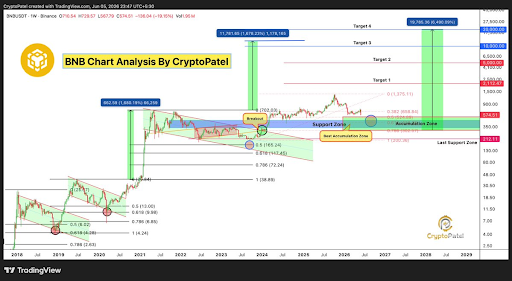
To understand the trajectory required for BNB to reach five-figure price points, one must first examine the relationship between circulating supply and market capitalization. According to data provided by market analyst Crypto Patel, the current valuation of BNB sits at approximately $80.6 billion. This valuation places it firmly behind only Bitcoin (BTC), Ethereum (ETH), and the stablecoin Tether (USDT). For BNB to reach a price of $10,000, the underlying mathematics suggest a market capitalization of $1 trillion, assuming the successful execution of the protocol’s long-term "burn" strategy.
The BNB ecosystem operates on a programmatic scarcity model. Since its inception, the Binance exchange and the BNB Chain community have committed to a burn mechanism intended to reduce the total supply of tokens from an initial 200 million to a final target of 100 million. This is achieved through two primary methods: the Auto-Burn mechanism, which uses a formula based on the price of BNB and the number of blocks produced on the BNB Chain, and the BEP-95 real-time burn, which destroys a portion of gas fees spent on the network.
At a supply of 100 million tokens, a $10,000 price point would indeed result in a $1 trillion market cap. To put this in perspective, $1 trillion is roughly equivalent to the current market capitalization of Bitcoin. For BNB to achieve this, it would essentially need to capture the same level of institutional dominance and store-of-value status currently held by the world’s first cryptocurrency. Furthermore, an even more ambitious target of $20,000 per token would imply a $2 trillion valuation. As noted by analysts, a $2 trillion valuation for a single asset would exceed the combined value of the entire cryptocurrency market as it exists in the current economic cycle. Consequently, such targets are viewed by many experts as long-term projections that could only be realized in a future where digital assets have achieved near-universal adoption.

The Competitive Landscape: The Battle for the Number Two Spot
While the $10,000 target remains a subject of long-term speculation, the more immediate hurdle for BNB is its rivalry with Ethereum. The "flippening"—a term traditionally used to describe the potential for Ethereum to overtake Bitcoin—is increasingly being applied to the prospect of BNB overtaking Ethereum.
In mid-May, BNB successfully distanced itself from XRP, growing the gap in market capitalization significantly. The next logical target in the hierarchy is Ethereum, which currently maintains a market cap of approximately $203 billion. For BNB to match Ethereum’s current valuation at its present supply, the token would need to trade at approximately $1,500. This level is slightly above its previous all-time high of roughly $1,370, recorded in late 2025 in various market projections.
However, the comparison is rarely static. In a bullish market environment where BNB rises to $1,500, it is highly probable that Ethereum would also experience significant price appreciation, thereby moving the goalposts for a market cap flip. Ethereum currently benefits from a more decentralized developer base and a robust Layer-2 ecosystem, whereas BNB Chain prides itself on high throughput, lower transaction costs, and a more direct integration with the world’s largest centralized exchange.
Historical Context and the Evolution of BNB
To understand BNB’s current standing, one must look back at its evolution from a simple "discount token" on the Binance exchange to a foundational layer for decentralized finance (DeFi). Launched in 2017 via an Initial Coin Offering (ICO), BNB was originally an ERC-20 token on the Ethereum network. Its primary utility was to provide Binance users with reduced trading fees.
The trajectory changed significantly in 2019 with the launch of Binance Chain, followed by the more impactful launch of Binance Smart Chain (now BNB Chain) in 2020. By introducing EVM (Ethereum Virtual Machine) compatibility, BNB Chain allowed developers to easily port their Ethereum-based applications to a faster, cheaper environment. This led to an explosion of activity during the 2021 bull run, catapulting BNB from a double-digit asset to a peak of nearly $700 during that cycle.

In late 2023 and early 2024, the asset faced significant headwinds due to regulatory challenges in the United States. The settlement between Binance and the Department of Justice (DOJ), which included a $4.3 billion fine and the stepping down of founder Changpeng Zhao (CZ), initially created uncertainty. However, the market’s reaction proved resilient. Under the new leadership of Richard Teng, the exchange has moved toward a "compliance-first" era, which has paradoxically bolstered institutional confidence in the long-term viability of the BNB token.
The Binance Concentration Risk: A Double-Edged Sword
A critical component of Crypto Patel’s analysis involves what is known as "concentration risk." Unlike Bitcoin, which is entirely decentralized, or Ethereum, which has a broad spectrum of institutional contributors, BNB is intrinsically linked to the health and reputation of the Binance exchange.
The value drivers for BNB are almost entirely dependent on the Binance ecosystem:
- Exchange Utility: BNB is used for trading fee discounts and participation in the Binance Launchpad.
- Burn Mechanism: The quarterly burns are funded by Binance’s profitability.
- On-Chain Activity: While the BNB Chain is technically a separate entity, a significant portion of its liquidity and user base flows from the centralized exchange.
- Institutional Custody: Much of the institutional interest in BNB is facilitated through Binance’s custody solutions.
This concentration means that any regulatory action, legal dispute, or operational failure at Binance has an immediate and magnified impact on the price of BNB. Analysts warn that for BNB to reach the $3,000 to $10,000 range, the ecosystem must continue to diversify its utility away from the centralized exchange and further into independent decentralized applications (dApps) and Real-World Assets (RWAs).
Expanding the Ecosystem: DeFi and Real-World Assets
Despite the risks, the BNB Chain has shown remarkable growth in sectors beyond simple trading. Recent reports indicate that the total value of Real-World Assets (RWAs) on the BNB Chain has hit the $3 billion mark. This includes tokenized versions of traditional financial instruments like treasury bills and private credit.
Furthermore, the BNB Chain continues to dominate global stablecoin transactions. Because of its low fees, it has become the preferred network for users in emerging markets who use USDT for daily remittances and savings. This high velocity of transactions ensures a steady demand for BNB to pay for gas fees, creating a floor for the token’s valuation that is independent of speculative trading.
Chronology of Recent Key Events
- November 2023: Binance reaches a historic settlement with U.S. regulators; BNB price stabilizes after an initial dip, signaling market maturity.
- January 2024: The BNB Chain introduces "One BNB," a strategy to unify the ecosystem’s various chains (BSC, opBNB, and Greenfield) to improve scalability.
- May 2024: BNB market capitalization overtakes XRP, securing the #4 spot in global rankings.
- June 2024: Institutional interest grows as firms like Grayscale and VanEck amend filings for various altcoin-related products, sparking rumors of future BNB-based exchange-traded products.
- Projected 2025-2029: Analysts suggest a "believable" bull case of $2,000 to $3,000, with $10,000+ targets relegated to the end of the decade.
Conclusion: Realistic Expectations vs. Speculative Ambition
The analysis provided by market experts suggests a bifurcated outlook for BNB. In the short to medium term, the token appears well-positioned to reclaim its all-time highs and potentially challenge Ethereum for the second-largest non-stablecoin market cap. The "compliance-first" transition of Binance, combined with the continued deflationary pressure of the burn mechanism, provides a strong fundamental backdrop.
However, the $10,000 and $20,000 price targets remain in the realm of long-term "moon math." As the analyst Crypto Patel noted, anyone promising these prices in the near term may be prioritizing marketing over objective financial analysis. For such prices to manifest, the cryptocurrency market would need to grow from a $2.5 trillion industry to one valued at $10 trillion or more, with BNB serving as a primary pillar of global digital finance.
For now, investors are watching the $1,500 resistance level. Breaking this mark would not only set a new record for BNB but would also signify a major shift in the competitive hierarchy of the crypto world, potentially placing the Binance-backed asset within striking distance of the "silver medal" currently held by Ethereum. As the industry moves toward 2025, the focus remains on whether the BNB Chain can maintain its technical edge and whether the broader market can support the trillion-dollar valuations that these ambitious price targets demand.