While many disputes within the volatile cryptocurrency landscape often recede from public view after an initial period of outrage, the protracted case involving Gate.io user @jheioff has defied this trend. What began as a claim of a $1.7 million theft against the exchange has escalated significantly, culminating in the recent announcement of a public, six-figure bounty for information, following weeks of alleged inaction and silence from Gate.io. This development marks a critical turning point, transforming a private user complaint into a crowd-sourced investigation with substantial financial incentives.
This week, the user Jheioff, driven by growing frustration over the perceived lack of progress, committed a personal sum of $100,000 to incentivize leads that could unravel the mystery behind the missing funds. This extraordinary measure was accompanied by a pointed observation from Jheioff: that Gate.io, after an initial flurry of public statements, has reportedly ceased communication on the matter entirely, leaving the user to pursue alternative avenues for resolution.
The Genesis of a High-Stakes Crypto Controversy
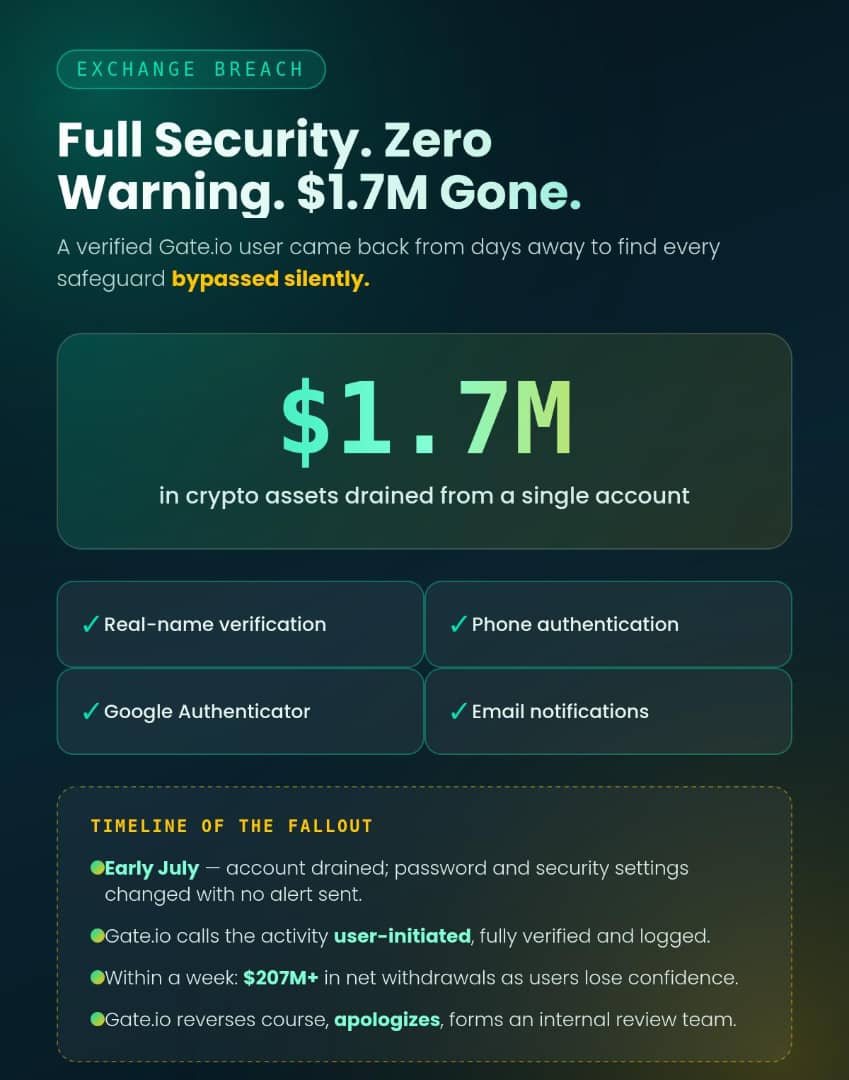
To fully grasp the significance of Jheioff’s bounty, it is essential to revisit the origins of this complex case. The incident first came to light in early July when Jheioff, a verified user of the Gate.io platform, logged into their account after a period of absence. The discovery was alarming: their entire crypto portfolio, valued at approximately $1.7 million, had been inexplicably drained.
What immediately distinguished this case from typical unauthorized access incidents was the robust security posture of Jheioff’s account. According to Jheioff, every available security layer offered by Gate.io had been activated. This included real-name verification (KYC), phone authentication, Google Authenticator for two-factor authentication (2FA), and email notifications for account activity. Despite these comprehensive safeguards, Jheioff maintains that no alerts were received when critical account parameters, such as the password and other security settings, were allegedly altered without authorization. This raises profound questions about the efficacy of the exchange’s security protocols and the nature of the breach.
Gate.io’s Initial Response and Public Backlash
Gate.io’s initial handling of the incident compounded the user’s distress and quickly drew widespread criticism from the crypto community. The exchange publicly asserted that the actions recorded on Jheioff’s account appeared to be user-initiated, fully verified, and properly logged within its backend systems. This stance effectively implied that Jheioff was responsible for their own substantial losses, a position that immediately triggered a wave of skepticism and outrage across various crypto social media platforms.

The public outcry was not merely confined to online discourse. Within a week of Gate.io’s initial response, the exchange reportedly experienced net withdrawals exceeding $207 million. This significant outflow of capital served as a tangible indicator of widespread user apprehension regarding the platform’s security integrity and its perceived reluctance to take responsibility for the alleged theft. Facing intensifying backlash and a palpable erosion of user trust, Gate.io eventually capitulated. The exchange reversed its initial position, issued a public apology, and announced its intention to form an internal team dedicated to reinvestigating Jheioff’s claim.
The CEO’s Public Commitment and the $3.4 Million Pledge
Weeks prior to Jheioff’s bounty announcement, Gate.io’s CEO, Han, had attempted to address the burgeoning crisis with a strong public statement. In a post published on the social media platform X (formerly Twitter), Han committed to taking full responsibility for the matter, emphasizing that the exchange’s legal team was actively engaged and that Gate.io was fully cooperating with law enforcement agencies to ascertain the truth of the incident.
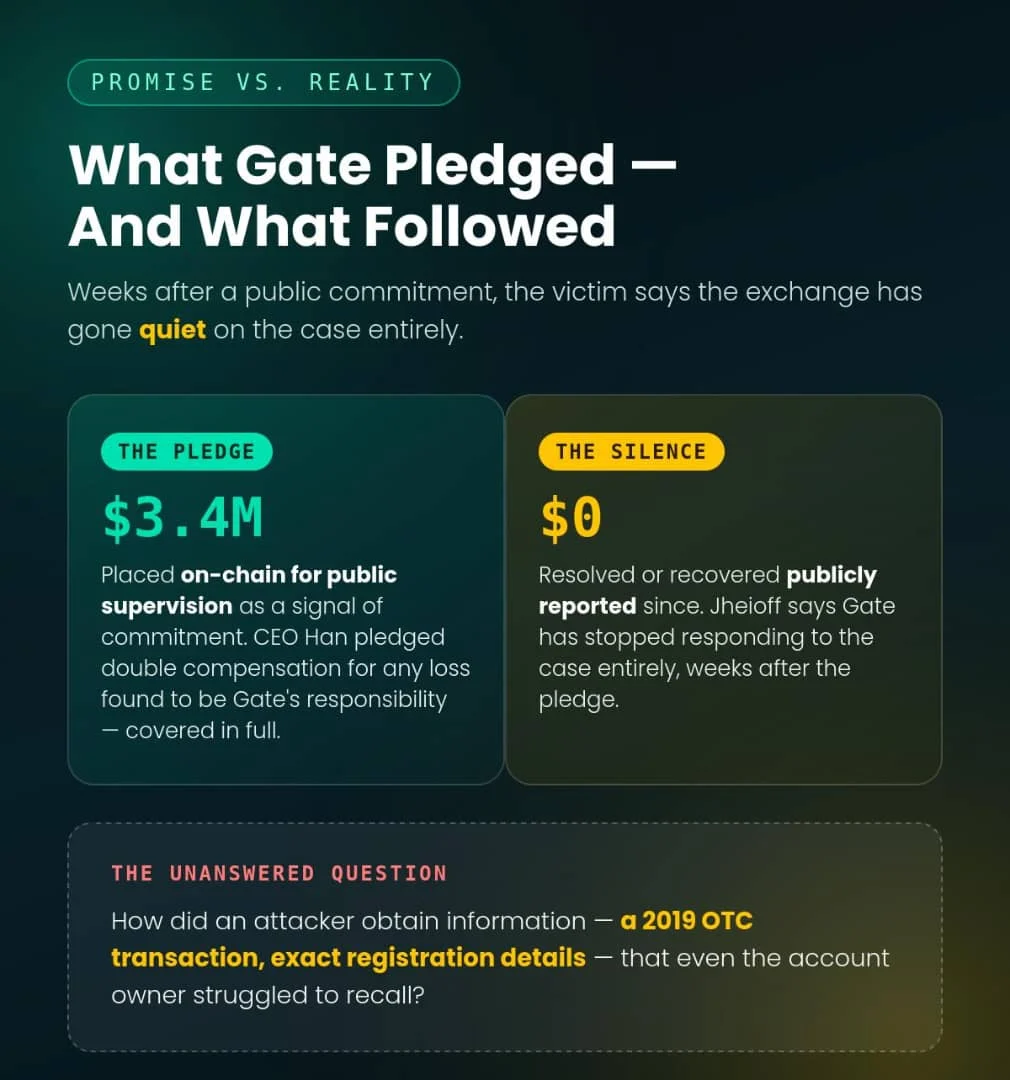
Han went further, pledging that should any portion of the case be officially determined to be Gate.io’s responsibility, the exchange would compensate the affected user with double the amount of their losses, unequivocally stating that the platform would not shirk its obligations. As a tangible demonstration of this commitment, Han announced that Gate.io had placed $3.4 million on-chain, ostensibly for public supervision, framing it as concrete evidence of the exchange’s dedication to resolving the issue. This pledge was extended to all Gate.io users, with Han assuring that any loss proven to be caused by the platform’s own responsibility would be covered in full. Such a public and financially backed commitment from an exchange CEO is rare in the crypto industry, typically signaling a serious intent to restore confidence.
The Stalling Investigation: Allegations of Procedural Hurdles
Despite the public apology and the CEO’s emphatic pledges, the path to resolution has, according to Jheioff, been anything but smooth. Jheioff’s account of the weeks following Gate.io’s reversal paints a picture of a drawn-out and frustrating process, particularly concerning cooperation with law enforcement.
Once police initiated a formal investigation, Jheioff claims to have promptly provided Gate.io with all requested documentation: the official case filing decision, the identification details of the investigating officers, and a judicial evidence request letter. However, Jheioff alleges that Gate.io subsequently introduced a series of new and seemingly escalating procedural obstacles. Initially, the exchange reportedly requested documents in a different file format, citing concerns about potential viruses. This was allegedly followed by suggestions from Gate.io that the submitted materials might be falsified or that the police officers involved could be impersonators. Ultimately, Jheioff states that Gate.io demanded video verification of the officers’ identities, a request that the police were reportedly only able to fulfill via voice call at the time.
Gate.io has publicly denied withholding evidence or deliberately delaying the investigation. Nevertheless, the ongoing dispute over these procedural requirements has, according to Jheioff, continued to overshadow any substantive progress toward resolving the underlying theft, leading to a prolonged stalemate.
The $100,000 Bounty: A Desperate Call for Information
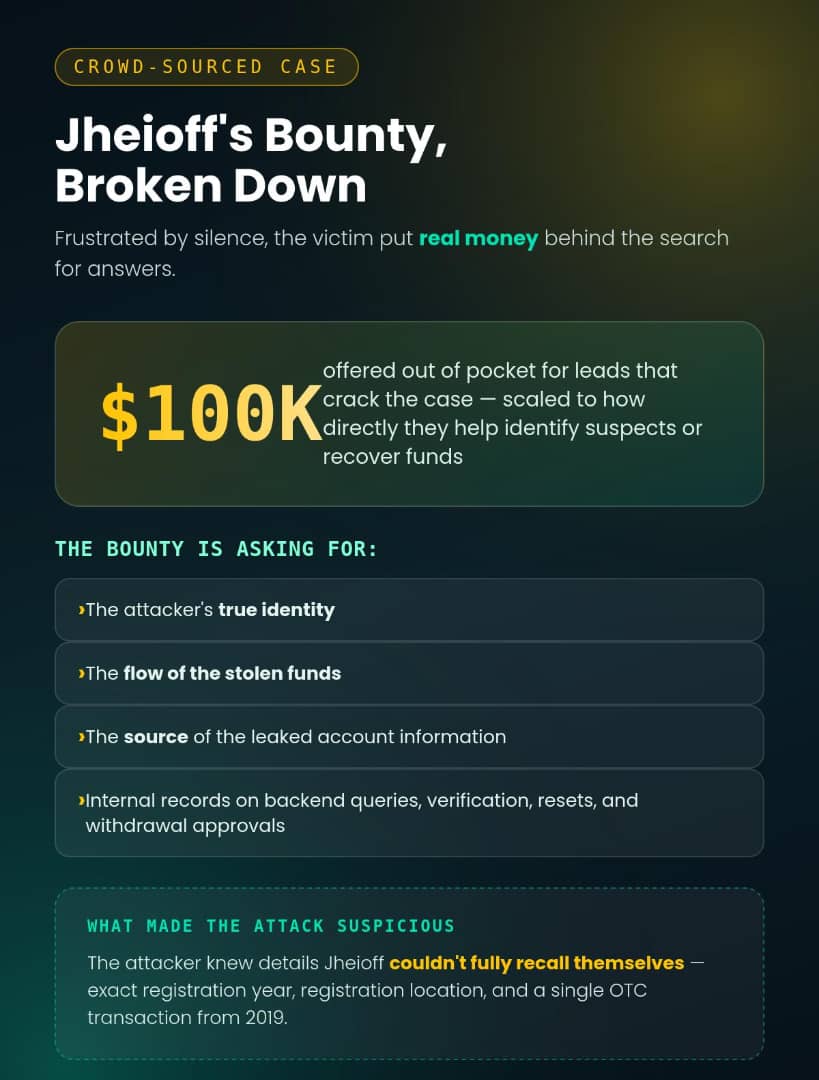
It is this perceived stalemate and the alleged cessation of communication from Gate.io that ultimately prompted Jheioff to launch the $100,000 public bounty this week. In a detailed post outlining the offer, Jheioff highlighted a crucial piece of evidence that has fueled suspicions of an inside job or a significant data breach: the attacker’s apparent access to highly specific information that even Jheioff struggled to recall. This included the exact year and location of Jheioff’s account registration, as well as precise details of a single Over-The-Counter (OTC) transaction dating back to 2019.
This granular level of detail, Jheioff argues, strongly suggests a scenario far more sophisticated than a typical phishing attack. Instead, it points towards potential data breaches within Gate.io, unauthorized internal queries, abuse of backend access privileges, or the leakage of sensitive information by an individual connected to the exchange.
The bounty is meticulously structured to solicit specific categories of information: the true identity of the attacker, the complete flow of the stolen funds, the precise source of the leaked information, and internal records pertinent to the case. These records include backend queries, identity verification logs, liveness detection results, security reset requests, withdrawal approvals, and internal communications related to Jheioff’s account. Jheioff has explicitly extended an invitation for current or former Gate.io employees, partner service providers, or any other informed individuals to come forward. The offer stipulates that leads will be verified by legal counsel and law enforcement, with rewards scaled proportionally to their direct contribution to identifying suspects or recovering the stolen funds, up to the full $100,000. The concluding statement of Jheioff’s post is particularly cutting: that Gate.io "no longer dares" to respond to tweets, but that the facts of the case will not simply vanish due to the exchange’s silence.
Broader Context: Security Challenges in Centralized Exchanges
The Jheioff case resonates within a broader context of persistent security challenges faced by centralized cryptocurrency exchanges. While these platforms offer convenience and liquidity, they also represent significant honeypots for cybercriminals. Incidents of hacks, phishing attacks, and internal breaches are unfortunately not uncommon in the crypto space. According to reports from firms like Chainalysis, billions of dollars are stolen from cryptocurrency platforms annually, highlighting the constant threat landscape.
The implementation of Know Your Customer (KYC) and Two-Factor Authentication (2FA) protocols, such as Google Authenticator and phone verification, are industry standard and crucial for user security. However, as Jheioff’s case illustrates, even with these layers in place, vulnerabilities can still emerge, whether through sophisticated social engineering, malware, or, as suspected here, potential internal compromises. The attacker’s alleged knowledge of deep historical account details is particularly concerning, as it bypasses typical external attack vectors and points to a possible systemic issue.
The mention of stolen funds being laundered through services like Tornado Cash, as referenced in the original article, further complicates recovery efforts. Crypto mixers are designed to obscure the trail of digital assets, making it exceptionally difficult for law enforcement and blockchain analytics firms to trace funds back to their origin or destination, thereby enhancing the anonymity of perpetrators.
The Gap Between Promise and Perceived Silence
The central tension driving this unfolding narrative lies in the stark contrast between CEO Han’s unequivocal public commitment to responsibility and cooperation, and Jheioff’s subsequent account of total silence and stalled progress. Han’s pledge, supported by the on-chain placement of $3.4 million, was a robust public relations move designed to reassure users and restore confidence. However, if Jheioff’s allegations are accurate, this public commitment has not translated into concrete action or transparent communication regarding the specifics of the investigation.
The questions Jheioff is now posing through the bounty are fundamental: How did an unauthorized party gain access to such detailed, historical user information? Why has the exchange reportedly ceased engagement on a case involving such a substantial sum and high-profile public statements? This perceived discrepancy between public promises and private conduct not only undermines trust in Gate.io but also casts a shadow over the broader principles of accountability within the centralized crypto exchange ecosystem.
Implications for Gate.io and the Crypto Industry
The ongoing dispute carries significant implications for Gate.io and, by extension, the wider cryptocurrency industry. For Gate.io, the prolonged and public nature of this case, coupled with the user’s extraordinary measure of offering a private bounty, risks further erosion of its reputation and user base. The initial $207 million in net withdrawals following the first response serves as a stark reminder of how quickly user confidence can evaporate when security and accountability are questioned. Continued silence, especially in the face of a direct financial incentive for information, is likely to attract more scrutiny, not less, potentially leading to increased regulatory attention or a further decline in market perception.
For the crypto industry, this case highlights the critical balance exchanges must strike between robust security, transparent communication, and timely user support. It also underscores the ongoing challenges of fund recovery in a decentralized and often anonymous environment, even when dealing with centralized platforms. Jheioff’s bounty could set a precedent for future high-value crypto theft cases, where frustrated users bypass traditional channels to crowdsource justice, potentially leading to novel investigative pathways but also raising questions about legal frameworks and ethical considerations surrounding such private incentives.
What Lies Ahead
As of now, the $1.7 million remains unrecovered, and Jheioff’s bounty represents a direct and audacious attempt to inject momentum into an investigation that, from the user’s perspective, has stalled. The coming weeks will reveal whether this $100,000 offer can indeed produce genuine leads, whether from within Gate.io’s current or former employee ranks, or from other informed individuals.
The outcome of this case could determine whether it becomes a landmark study in successful crowd-sourced crypto investigation, showcasing the power of community and financial incentive in an industry often plagued by untraceable thefts. Alternatively, it risks becoming another unresolved exchange dispute, eventually fading from public consciousness as new controversies emerge. However, with significant real money now attached to the pursuit of real answers, Jheioff has made it unequivocally clear that this matter will not be allowed to dissipate quietly, ensuring that Gate.io’s actions—or lack thereof—will continue to be under intense public and journalistic scrutiny.