
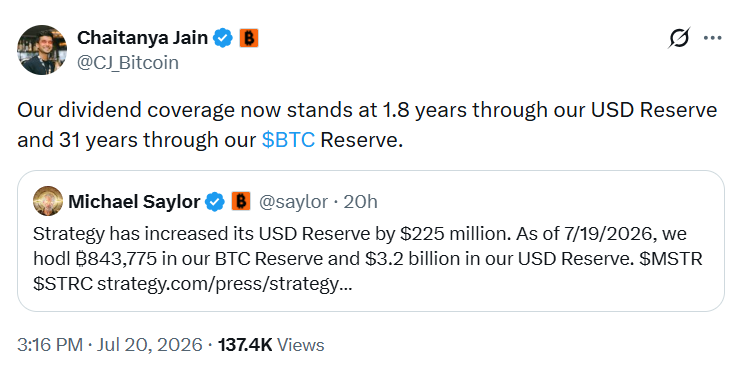
Strategy, a prominent entity in the financial technology and investment landscape, has once again brought its substantial Bitcoin holdings into sharp focus. A recent revelation from the company’s corporate treasurer, Chaitanya Jain, indicates that its Bitcoin treasury could theoretically cover approximately 31 years of shareholder dividend payments. This astonishing figure dwarfs the duration that the company’s traditional U.S. dollar reserves could sustain such payouts, underscoring the transformative impact of digital assets on corporate balance sheets and financial strategy.
The Strategic Shift Towards Bitcoin
The announcement comes as Bitcoin continues to demonstrate its resilience and growing acceptance as a store of value and a strategic asset for corporations. While the original report from ZyCrypto does not explicitly detail the current market price of Bitcoin, it implies a scenario where Bitcoin’s value has seen significant appreciation, leading to such a substantial valuation for Strategy’s holdings. For context, if Strategy’s Bitcoin stash is indeed worth over a billion dollars as suggested by the image caption in the original article, and assuming an average acquisition cost of $75,476 per Bitcoin, this implies a considerable unrealized gain on their investment.
This strategic pivot by Strategy, under the leadership of its founder Michael Saylor, has been a long-term endeavor. Saylor has consistently advocated for Bitcoin as a superior form of money and a hedge against inflation, leading the company to accumulate a significant portion of its treasury in the digital asset. As of July 19th, Strategy held a staggering 843,775 Bitcoin, solidifying its position as the world’s largest corporate holder of the cryptocurrency. This accumulation has not been a matter of speculative trading, but rather a deliberate strategy to preserve and grow long-term value.
A Tale of Two Treasuries: Bitcoin vs. Fiat
Chaitanya Jain’s disclosure paints a stark contrast between the financial security offered by Strategy’s Bitcoin holdings and its traditional cash reserves. According to Jain, the company’s U.S. dollar reserve could only support approximately 1.8 years of dividend obligations. This highlights a critical vulnerability in traditional treasury management and positions Bitcoin as a critical pillar of Strategy’s financial stability, particularly concerning its commitment to shareholder returns.

The rationale behind this diversification and emphasis on Bitcoin lies in its perceived long-term value appreciation and its potential to act as a hedge against the devaluation of fiat currencies. In an environment where central banks globally have engaged in quantitative easing and maintained historically low interest rates, traditional cash reserves can see their purchasing power eroded over time. Bitcoin, with its capped supply and decentralized nature, presents an alternative that many, including Strategy’s leadership, believe offers superior long-term protection against such risks.
Financial Maneuvering and Capital Generation
Despite the immense value of its Bitcoin treasury, Strategy has not ceased its engagement with traditional financial markets to bolster its liquidity. The company recently raised approximately $263.5 million between July 13th and July 19th through its at-the-market (ATM) common stock program. These proceeds were strategically deployed to increase its U.S. dollar reserve, bringing it to roughly $3.225 billion. This dual-pronged approach—holding significant Bitcoin while actively managing fiat liquidity—provides Strategy with substantial financial flexibility.
The capital raised through stock issuance serves multiple purposes. It is intended to cover preferred stock dividend payments, service interest obligations on outstanding debt, and provide a buffer for operational expenses. This approach allows Strategy to continue its aggressive Bitcoin accumulation strategy without jeopardizing its immediate financial obligations. It also demonstrates a sophisticated understanding of capital markets, leveraging equity issuance to fund its digital asset strategy.
The Mechanics of Strategy’s Bitcoin Holdings
Strategy’s Bitcoin holdings were acquired at an average cost of $75,476 per Bitcoin, totaling approximately $63.69 billion. This significant investment reflects a deep conviction in the future value of Bitcoin. The company’s strategy has been to avoid active trading of its Bitcoin reserves, instead focusing on using it as a long-term strategic asset. This "hodling" approach, combined with the appreciation of Bitcoin, has significantly amplified the value of their treasury.
The decision to issue common shares and preferred securities to expand liquidity, rather than selling Bitcoin, is a key element of Strategy’s financial architecture. This allows the company to preserve its substantial cryptocurrency holdings, which are viewed as a core component of its long-term growth and value proposition.
Investor Perspectives and Preferred Stock Valuation
The unique financing model employed by Strategy has also attracted considerable attention from investors and financial analysts. Credit investor Khing Oei, for instance, has argued that the market may be undervaluing Strategy’s STRC preferred shares. Oei suggests that investors are often too focused on the current yield of these preferred shares, overlooking their potential for long-term cash generation, especially in light of Strategy’s robust Bitcoin treasury.
Oei’s analysis draws a parallel between Strategy’s preferred shares and traditional bonds, emphasizing the company’s demonstrated ability to support dividend payments over extended periods. He posits that any further appreciation in Bitcoin’s value could significantly enhance Strategy’s financial standing, potentially leading to a re-evaluation and upward revision of the valuation of its preferred securities. This perspective suggests that the market may not be fully accounting for the collateral and underlying asset strength provided by Strategy’s Bitcoin holdings when assessing its preferred equity.
The Evolving Corporate Treasury Landscape
Strategy’s embrace of Bitcoin represents a broader trend observed among forward-thinking corporations. As the digital asset class matures, more companies are exploring its potential as a reserve asset, a hedge against inflation, and a diversification tool. The success of Strategy’s approach, particularly its ability to sustain significant dividend payments through its Bitcoin holdings, could serve as a compelling case study for other corporations contemplating similar diversification strategies.
However, this unconventional treasury model also presents ongoing challenges and areas of scrutiny. Investors will continue to monitor Strategy’s capital-raising activities and its ability to maintain balance sheet stability while expanding its Bitcoin exposure. The long-term viability of this model hinges on several factors, including the continued price appreciation of Bitcoin, the company’s ability to access capital markets effectively, and the regulatory environment surrounding digital assets.
Market Context and Future Outlook
At the time of the original report’s publication, Bitcoin (BTC) was trading at $64,880, reflecting a modest 0.45% gain over the preceding 24 hours. This price point, while significant, is considerably lower than the all-time high of above $124,000 mentioned in the original image caption, indicating that the valuation of Strategy’s Bitcoin holdings has likely experienced substantial fluctuations since its initial accumulation. The implication of the image caption suggesting a Bitcoin price above $124,000 and a SpaceX Bitcoin stash hitting $1 billion, although not directly part of the ZyCrypto article’s core narrative about Strategy, hints at a potentially very bullish market environment that would have significantly benefited Strategy’s holdings.

The strategic decision by Strategy to continue raising capital through equity while preserving its Bitcoin reserves suggests a calculated approach to navigating market volatility and maximizing long-term shareholder value. The company’s significant remaining capacity under its common stock ATM program, estimated at around $23.5 billion, provides substantial room for further capital infusion should market conditions or strategic opportunities arise.
Ultimately, Strategy’s bold adoption of Bitcoin as a cornerstone of its treasury represents a significant evolution in corporate finance. As the company continues to execute its strategy, the market will be closely watching to see if this innovative approach can indeed deliver sustained balance sheet resilience and robust long-term shareholder returns in the burgeoning digital asset era. The interplay between traditional financial instruments and the nascent digital asset class, as exemplified by Strategy, is likely to shape corporate treasury management for years to come.