
Digital currency markets experienced a powerful upward movement on Thursday, August 19, 2026, following a pivotal announcement from the Treasury Department regarding a significant expansion of its bond repurchase program. This strategic move injected substantial liquidity into the financial system, creating a palpable momentum that reverberated across both cryptocurrency prices and traditional equities, marking a notable day of gains for investors in risk assets. The announcement, coming amidst ongoing economic discussions about inflation and interest rates, underscores the increasing interconnectedness of global financial markets and the profound impact of governmental fiscal policies on diverse asset classes.
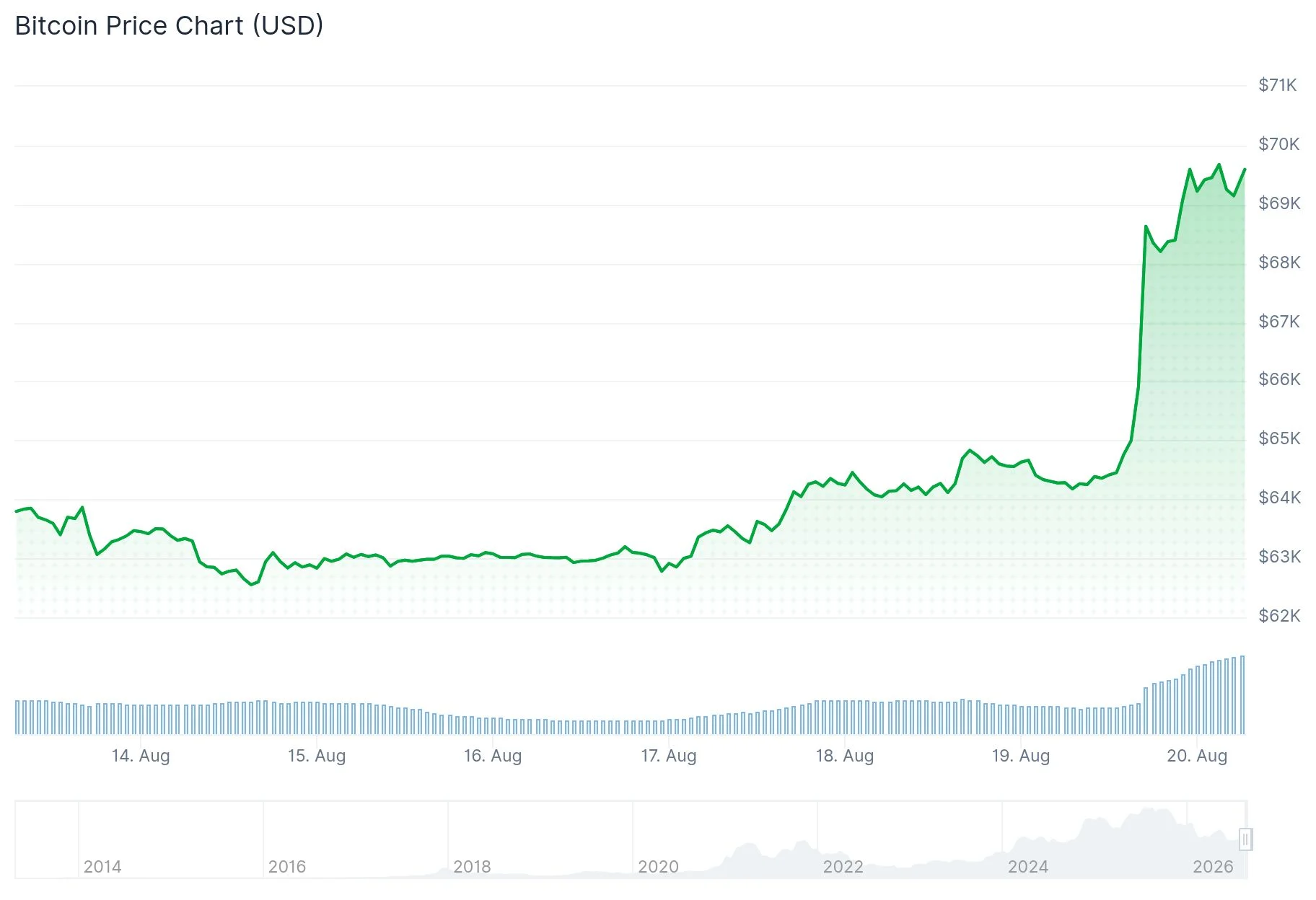
The cryptocurrency sector was particularly buoyant, with Ether (ETH) leading the charge. The second-largest digital asset by market capitalization surged approximately 18% within a 24-hour span, propelling its price to just over $2,250. This impressive daily performance further extended Ether’s weekly appreciation to roughly 20%, solidifying its position as the strongest performer among prominent digital assets in the current trading period. Bitcoin (BTC), the flagship cryptocurrency, also saw substantial gains, advancing to slightly above $69,100. This represented an approximately 8% daily gain, with the leading cryptocurrency briefly approaching the $69,900 mark during overnight trading before experiencing a modest pullback. The price movement for Bitcoin alone exceeded $5,700 from its Wednesday trough near $64,100, demonstrating significant buying pressure and a rapid shift in market sentiment.
Treasury Announcement Ignites Market Momentum and Liquidity Injection
The primary catalyst for this widespread market rally emerged when Treasury Secretary Scott Bessent revealed the department’s plans to expand its buyback operations for extended-maturity bonds. The Secretary announced that these operations would be at least double their current volume, a move interpreted by market participants as a direct injection of liquidity into the government debt marketplace. Historically, bond buybacks are employed by treasuries to manage debt, improve market functioning, and influence interest rates. By increasing the demand for long-term bonds, the Treasury effectively reduces their yields, making fixed-income investments less attractive and thereby encouraging capital to flow into higher-yielding, riskier assets such as equities and cryptocurrencies.
The specific details outlined by Secretary Bessent indicated an increase in repurchases from $2 billion to "at least" $4 billion for long-term U.S. government debt. This expansion was explicitly framed as a measure to counteract the rapid surge in U.S. Treasury yields, which had been a growing concern for economic stability. The market’s immediate reaction was a sharp appreciation in Treasury securities. The benchmark 10-year yield, a key indicator for borrowing costs across the economy, declined to approximately 4.63%, while the 30-year rate dropped to 5.18%. A Bloomberg gauge specifically monitoring Treasuries with maturities of 20 years or longer recorded its most substantial one-day advance since February 2025, underscoring the profound impact of the Treasury’s intervention on the long end of the yield curve. This immediate effect on bond yields signaled a shift towards a more accommodative financial environment, reducing the cost of capital and making speculative investments more appealing.
Chronology of a Market Resurgence: From Policy to Price Action
The sequence of events unfolded rapidly, illustrating the immediate feedback loop between governmental policy and financial market dynamics.
- Early Thursday (August 19, 2026): The U.S. Treasury Department issues its formal announcement, detailing the doubling of its long-term bond buyback program.
- Minutes Following Announcement: Global bond markets react almost instantaneously. U.S. Treasury yields, particularly for longer-dated instruments, experience sharp declines as institutional investors adjust positions to reflect the increased demand from the Treasury. The 10-year yield drops from its previous level, while the 30-year yield follows suit.
- Within Hours (Late Morning/Early Afternoon): The liquidity injection and the shift in yield curves begin to ripple through the broader financial ecosystem. Cryptocurrency markets, known for their sensitivity to liquidity and macro-economic signals, show initial signs of strong upward momentum. Traders, anticipating a "risk-on" environment, begin accumulating digital assets.
- Mid-Afternoon: The rally in digital assets intensifies. Ether posts its most significant gains, breaking through key resistance levels. Bitcoin follows suit, attracting substantial buying volume.
- Late Afternoon/Evening: The surge in crypto prices triggers a cascading effect, notably in the derivatives market. Approximately $1.4 billion worth of short positions across various digital assets face liquidation within a compressed four-hour timeframe. This "short squeeze" forces bearish market participants to rapidly exit their positions, further fueling the upward price movement as they buy back assets to cover their bets.
- Close of Trading Day: Traditional equity markets, while reacting with less volatility than their digital counterparts, close with moderate advances. The Dow Jones Industrial Average, S&P 500, and Nasdaq Composite all register gains, reflecting a broader positive sentiment driven by the perceived increase in market liquidity and reduced interest rate pressures.
- Overnight Trading: Bitcoin briefly touches near $69,900, demonstrating sustained momentum before a slight correction. Ether maintains its strong gains, consolidating above the $2,250 mark.
This rapid sequence highlights how a single, significant policy announcement can quickly recalibrate investor expectations and drive substantial capital reallocation across different asset classes.

Widespread Digital Asset Appreciation Beyond the Majors
While Ether and Bitcoin dominated headlines, the positive sentiment permeated across the broader digital asset landscape, indicating a market-wide liquidity-driven rally. Several other cryptocurrencies demonstrated significant strength, reflecting investor confidence in the sector’s immediate prospects.
Hyperliquid’s HYPE token, a prominent asset in the decentralized finance (DeFi) space, experienced a notable increase of more than 19%, approaching the $70 mark. This surge underscores the growing interest in DeFi protocols and their associated tokens, often seen as higher-beta plays within the crypto market. Solana (SOL), a high-performance blockchain platform, advanced over 10% to reach $84.50, reclaiming crucial psychological resistance levels. Solana’s robust ecosystem and ongoing development efforts continue to attract investor attention, and the broader market rally provided an additional boost.
XRP, the digital asset associated with Ripple Labs, also posted impressive gains, rising 10% to hit $1.09. This move allowed XRP to reclaim the psychological dollar threshold, a level it had lost earlier in the week amidst broader market uncertainty. Dogecoin (DOGE), the popular meme-inspired cryptocurrency, contributed roughly 8% gains, demonstrating that even assets with less fundamental utility can benefit significantly from periods of heightened market liquidity and speculative fervor.
However, not all major cryptocurrencies performed equally. BNB, the native token of the Binance ecosystem, advanced a more modest 3.5%, though it maintained a respectable weekly gain slightly above 2%. Tron (TRX), another significant blockchain platform, remained essentially unchanged over the 24-hour period and stood out as the sole major cryptocurrency posting weekly losses. This divergence in performance suggests that while general market liquidity was a dominant factor, specific project fundamentals, market positioning, or prior price action might have influenced individual token responses. Analysts posited that some assets might have been experiencing profit-taking after earlier rallies, or simply did not attract the same level of speculative capital as the leading gainers.
Regulatory Tailwinds and White House Engagement Boost Optimism
Adding an additional layer of optimism to the digital asset space was news from a White House gathering earlier in the week. President Donald Trump met with senior leadership from several prominent cryptocurrency firms, including Coinbase, Gemini, Ripple, and Chainlink Labs. During this high-profile meeting, President Trump called upon Congressional lawmakers to push forward the Digital Asset Market Clarity Act. This legislative initiative aims to provide much-needed regulatory certainty for the cryptocurrency industry in the United States, a factor consistently cited by industry leaders as crucial for mainstream adoption and institutional investment.
The engagement of the highest office in the nation with key players in the crypto sector signals a potential shift towards a more supportive regulatory environment. Industry executives present at the meeting reportedly expressed cautious optimism, emphasizing the importance of clear guidelines to foster innovation and protect consumers. A spokesperson for Coinbase, speaking off the record, noted, "The President’s direct call for clarity is a game-changer. It signals that the government recognizes the immense potential of digital assets and is willing to work towards a framework that allows the industry to thrive within the U.S." This political momentum, coupled with the liquidity injection from the Treasury, created a powerful narrative for the digital asset market, suggesting both short-term gains and long-term structural improvements.
Equity Markets Post Moderate Advances Amidst Sectoral Shifts
The positive sentiment was not confined to digital assets. American stock indices also climbed following the bond market developments, albeit with more restrained gains compared to the volatile cryptocurrency sector. The Dow Jones Industrial Average increased approximately 120 points, representing a 0.2% gain, closing the day on a positive note. Both the S&P 500 and the Nasdaq Composite, broader market benchmarks, recorded advances around 0.2%. These movements reflected a general appetite for risk and a relief rally, as the Treasury’s actions mitigated some concerns regarding rising interest rates and tightening financial conditions.
A closer look at sectoral performance revealed interesting dynamics. Healthcare emerged as a leading sector, notably supported by Moderna’s progress in cancer vaccine research. The pharmaceutical giant’s advancements provided a significant boost to the sector, attracting investor capital seeking growth opportunities tied to medical innovation. Consumer discretionary and materials sectors also demonstrated relative strength, benefiting from improved consumer sentiment and expectations of economic stability fostered by the Treasury’s liquidity injection.
Conversely, technology and industrial segments underperformed their peers. This underperformance was attributed to ongoing pressure on artificial intelligence (AI) infrastructure-related companies. While AI remains a long-term growth driver, concerns about valuation, supply chain constraints for critical components, and potential market saturation in certain sub-sectors appeared to temper investor enthusiasm in the immediate term. Analysts suggested that the rally in these sectors might have paused as investors reallocated capital towards other promising areas or took profits after earlier, significant run-ups.
Economic Undercurrents: Inflation, Monetary Policy, and Future Outlook
Amidst these market movements, the minutes from the latest Federal Open Market Committee (FOMC) meeting were also released. The minutes revealed a degree of disagreement among officials regarding the necessity of potential interest rate increases to combat persistent inflation. While some members advocated for a more aggressive stance to tame rising prices, others expressed caution, citing concerns about the potential impact on economic growth. Despite the differing views, financial markets displayed minimal reaction to the disclosure, likely because the Treasury’s more immediate and impactful bond buyback announcement overshadowed the Fed’s internal debates. This indicates that the market’s focus was squarely on the current liquidity situation rather than nuanced monetary policy discussions.
Looking ahead, market observers are keen to monitor the sustainability of the current rally. While the Treasury’s intervention undoubtedly provided a significant boost, especially to risk assets, a critical distinction is often drawn between liquidity-driven rallies and those fueled by fundamental improvements or sustained economic growth. Analysts from major financial institutions cautioned that rapid advances driven primarily by liquidity announcements, rather than protocol-specific fundamentals in the crypto space or earnings growth in equities, frequently experience partial retracements.
"While the Treasury’s move is a clear positive for market sentiment and liquidity, investors should remain judicious," commented a senior market strategist at a global investment bank. "The underlying economic conditions, including inflation trends and the Federal Reserve’s eventual policy path, will ultimately dictate the longer-term trajectory of these markets. For digital assets, specifically, the current surge is a testament to their sensitivity to macro liquidity, but sustained growth will require continued innovation and, crucially, a clear regulatory framework."
The interplay between governmental fiscal policy, central bank monetary policy, and the rapidly evolving digital asset landscape continues to shape the global financial environment. Thursday’s events serve as a potent reminder of how interconnected these forces are and how a single, decisive action from a major financial authority can send powerful ripples across diverse asset classes, signaling both opportunities and potential risks for investors navigating the complex markets of the mid-2020s. The coming weeks will be crucial in determining whether this liquidity-fueled rally can transition into a more enduring upward trend, supported by fundamental economic and technological advancements.