
Michael Saylor, the prominent CEO of MicroStrategy and a staunch advocate for Bitcoin, has publicly addressed recent criticisms leveled against the company’s decision to sell $200 million worth of Bitcoin. The sale has sparked debate, with critics accusing Saylor of hypocrisy, given his long-standing and vocal stance against selling the cryptocurrency. Saylor, known for his maximalist Bitcoin philosophy, has countered these claims by differentiating between personal investment advice and corporate financial strategy.
In a detailed response on the social media platform X, formerly Twitter, Saylor clarified that his oft-repeated mantra of "never sell your Bitcoin" was directed at individual investors and did not represent a rigid corporate policy for MicroStrategy. He emphasized that he personally has not divested any of his own Bitcoin holdings, stating, "I myself have not sold a single satoshi." He further explained that as a publicly traded company, MicroStrategy must operate under a different set of financial considerations, allowing for strategic adjustments to its asset allocation based on its assessment of market conditions and corporate objectives.
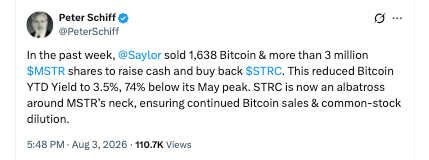
This clarification came just hours after MicroStrategy filed a Form 8-K with the U.S. Securities and Exchange Commission (SEC). The filing disclosed the sale of 1,638 Bitcoin, executed towards the end of the previous month. The sale was reportedly conducted at an average price of approximately $63,957 per Bitcoin. The proceeds from this transaction were then strategically utilized by the company to repurchase its own preferred stock, specifically the Series A convertible preferred stock, which had faced considerable scrutiny from investors and market analysts.

MicroStrategy Realigns Bitcoin Strategy Amidst Market Volatility
The recent sale of Bitcoin by MicroStrategy, while controversial, signals a potential shift in the company’s aggressive accumulation strategy. For an extended period, MicroStrategy has been a leading corporate accumulator of Bitcoin, often leveraging debt financing and innovative financial instruments to fuel its acquisitions. This aggressive approach, particularly the reliance on high-yield financial products like the STRC preferred shares, had raised concerns within the broader cryptocurrency ecosystem. Analysts, industry leaders, and even developers had voiced apprehension about the potential risks associated with such high-leverage Bitcoin investments.
Saylor had previously doubled down on his commitment to acquiring Bitcoin, often at elevated price points, framing these purchases as long-term strategic moves. However, the recent sale and the subsequent use of funds to retire preferred shares suggest a recalibration of this strategy. This move can be interpreted as an acknowledgment of the concerns raised and an effort to de-risk the company’s financial structure while optimizing its capital allocation.
By selling a portion of its Bitcoin reserves, MicroStrategy has effectively reduced its exposure to the volatility inherent in the cryptocurrency market. Concurrently, the repurchase of STRC shares addresses the financial liabilities and complexities associated with these instruments. This strategic maneuver appears to be aimed at strengthening the company’s balance sheet and enhancing financial flexibility.
Despite the recent sale, MicroStrategy remains one of the world’s largest institutional holders of Bitcoin. The company’s current holdings stand at an impressive 842,138 Bitcoin, acquired at an aggregate cost basis of approximately $63.5 billion. This substantial reserve underscores MicroStrategy’s continued conviction in Bitcoin as a long-term store of value and an asset class. The average purchase price for this vast holding is estimated to be around $75,000, a figure that has been significantly impacted by market fluctuations, with Bitcoin’s current trading price hovering around the $63,000 mark.

Criticisms and Counterarguments Surrounding the Sale
The decision by MicroStrategy to sell Bitcoin has ignited a flurry of reactions from various stakeholders within the financial and cryptocurrency communities. Critics have been vocal, with some leveling accusations of hypocrisy against Michael Saylor, citing his decades-long advocacy for Bitcoin as an unparalleled asset.
Peter Schiff, a well-known gold bug and a vocal critic of Bitcoin, seized upon the news as validation of his long-held skepticism. Schiff took to X to express his views, stating, "Michael Saylor finally admits he was wrong about never selling Bitcoin. He’s finally joined the real world and is cashing out." His statement reflects a sentiment shared by many who believe that any sale of Bitcoin, regardless of the reason, undermines the narrative of its immutability and long-term bullish outlook.
Other users on social media platforms also chimed in, expressing a range of opinions. One user commented, "Saylor selling BTC? This is like watching a vegan eat a steak." This sentiment highlights the perceived contradiction between Saylor’s public persona and the company’s actions. Another user offered a more pragmatic perspective, noting, "It’s a smart move to reduce debt and shore up the balance sheet. Companies have to do what’s best for their shareholders." This viewpoint emphasizes the fiduciary duty of corporate leadership to prioritize financial stability and shareholder value.
A more nuanced take was articulated by another X user who acknowledged Saylor’s position: "Michael Saylor has always said he’s a personal investor. MicroStrategy is a company. Different rules apply." This perspective aligns with Saylor’s own defense, drawing a clear distinction between individual investment philosophy and corporate financial management.

While Saylor’s defense is rooted in the operational realities of a public company, some of the criticism stems from the timing and execution of MicroStrategy’s past Bitcoin acquisitions. Many of the company’s significant purchases occurred when Bitcoin’s price was at or near its all-time highs, often exceeding $80,000 and even approaching $100,000. These acquisitions were frequently financed through debt, including the issuance of STRC preferred shares, which exposed MicroStrategy to considerable financial risk. The current market price, below the company’s average cost basis, has amplified these concerns.
The decision to sell Bitcoin and use the proceeds to retire preferred shares can be viewed as a strategic move to mitigate these risks and deleverage the company’s balance sheet. It represents an effort to rectify a strategy that, while bold, may have incorporated excessive leverage and exposure to market downturns.
The Broader Implications for Corporate Bitcoin Holdings
MicroStrategy’s actions and the ensuing debate carry significant implications for other corporations that have adopted Bitcoin as a treasury asset. The company’s experience underscores the complexities of managing Bitcoin holdings within a corporate structure, particularly concerning financing, risk management, and public perception.
The trend of corporations adding Bitcoin to their balance sheets began to gain momentum in late 2020, with MicroStrategy leading the charge. This trend was fueled by a combination of factors, including the increasing institutional acceptance of Bitcoin, its potential as an inflation hedge, and the desire for diversification. Companies like Tesla and Square (now Block) followed suit, albeit with smaller allocations.
However, the volatility of Bitcoin has presented challenges. When the market experiences significant downturns, companies with large Bitcoin holdings can face substantial paper losses, potentially impacting their stock prices and investor confidence. This has led to a more cautious approach among some potential corporate adopters.
MicroStrategy’s recent move suggests that a more balanced and risk-managed approach to Bitcoin treasury management might be emerging. This could involve a greater emphasis on hedging strategies, a more diversified approach to financing acquisitions, and a clearer communication strategy to manage investor expectations.
The role of Michael Saylor in this narrative remains central. His unwavering belief in Bitcoin’s long-term potential has been instrumental in driving corporate adoption. His willingness to engage with critics and explain the strategic rationale behind MicroStrategy’s decisions, even when they deviate from his personal pronouncements, demonstrates a pragmatic leadership style.
As the cryptocurrency market continues to mature, the strategies employed by major institutional players like MicroStrategy will be closely watched. The ability of these companies to navigate the inherent volatility of digital assets while delivering value to shareholders will be crucial in shaping the future of corporate cryptocurrency adoption. The sale of Bitcoin by MicroStrategy, while sparking debate, also represents a critical learning moment, highlighting the need for adaptability and sound financial stewardship in the evolving landscape of digital asset management. The company’s substantial remaining holdings indicate that its commitment to Bitcoin as a core asset remains intact, albeit with a more refined strategic framework.