
The global cryptocurrency landscape underwent its most significant transformation in years with the successful completion of the Ethereum Merge, a technical overhaul that transitioned the world’s second-largest blockchain from a Proof-of-Work (PoW) consensus mechanism to Proof-of-Stake (PoS). While the transition was hailed as a triumph for environmental sustainability—reducing the network’s energy consumption by more than 99.9%—it simultaneously triggered an existential crisis for the global community of GPU (Graphics Processing Unit) miners. For years, Ethereum served as the primary source of revenue for millions of individual and industrial-scale miners. Following the Merge, this massive computational force was suddenly "homeless," leading to a desperate migration toward alternative PoW chains that has effectively decimated the profitability of the entire GPU mining sector.
The Mechanics of the Profitability Collapse
The core of the current crisis lies in the relationship between network hashrate and mining difficulty. In a Proof-of-Work system, the "hashrate" represents the total computational power dedicated to securing the network and processing transactions. To ensure that blocks are produced at a consistent interval, blockchain protocols utilize a "difficulty adjustment" algorithm. When the hashrate increases—meaning more miners are competing for the same number of rewards—the network increases the difficulty of the mathematical puzzles required to mine a block.
Before the Merge, Ethereum’s hashrate was orders of magnitude larger than that of any other GPU-minable coin. When Ethereum’s PoW chain ceased to exist, an estimated 800 to 1,000 Terahashes per second (TH/s) of computing power was displaced. A significant portion of this power immediately flooded into smaller networks such as Ethereum Classic (ETC), Ravencoin (RVN), Ergo (ERG), and Beam.
The result was an unprecedented "difficulty explosion." Because these alternative networks have significantly smaller market capitalizations and lower transaction volumes than Ethereum, they were incapable of absorbing the massive influx of hardware. As the difficulty surged to accommodate the new hashrate, the amount of cryptocurrency earned per unit of computing power plummeted. When combined with stagnant or falling market prices for these tokens and rising global energy costs, the math for most miners no longer adds up.

Analyzing the Data: The Numbers Behind the Losses
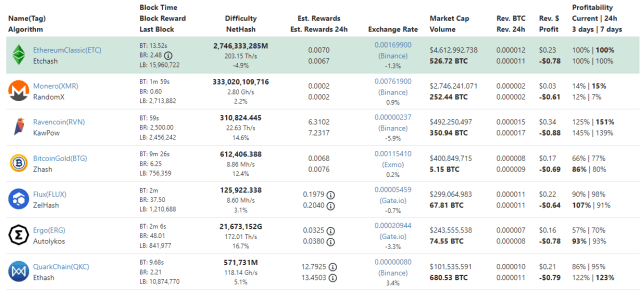
Current data from mining profitability calculators, such as WhatToMine, paints a grim picture for those still running hardware. For a standard mining setup utilizing popular mid-range hardware, such as three AMD RX 480 graphics cards, the daily returns have entered deep negative territory. Under the assumption of an average electricity cost of $0.10 per kilowatt-hour (kWh)—which is conservative in many Western regions—mining Ethereum Classic currently results in an estimated loss of approximately $0.78 per hour.
Even those equipped with flagship, high-efficiency hardware are not immune. The NVIDIA GeForce RTX 3090 Ti, one of the most powerful consumer GPUs ever produced, currently nets a loss of roughly $0.50 per hour when mining ETC. These figures indicate that for the vast majority of participants, it is currently more cost-effective to purchase the cryptocurrency directly from an exchange than it is to spend money on the electricity required to mine it.
The following table illustrates the current state of hourly net profits (after electricity costs) for several prominent PoW alternatives using a standard multi-GPU rig:
- Ethereum Classic (ETC): -$0.78/hr
- Ravencoin (RVN): -$1.02/hr
- Ergo (ERG): -$0.65/hr
- Conflux (CFX): -$1.15/hr
- Bitcoin Gold (BTG): -$0.82/hr
These negative yields are not merely a temporary dip but a fundamental shift in the market’s equilibrium. Without a massive surge in the price of these alternative assets or a significant portion of miners permanently turning off their machines, the "profitable" era of GPU mining appears to have reached a definitive conclusion.
A Chronology of the Transition
The road to this profitability collapse was paved over several years of development and delays. Understanding the timeline helps contextualize why the current market shock is so severe.

- December 2020: The Beacon Chain launches, marking the beginning of Ethereum’s multi-year transition to PoS. Miners begin to realize that the "Difficulty Bomb"—a mechanism designed to make mining impossible—is an eventual certainty.
- 2021 – Early 2022: Despite the looming Merge, GPU mining remains highly profitable due to the bull market. Mining hardware prices reach all-time highs, and many new participants enter the space, unaware of the impending shift.
- August 2022: The final testnets (Goerli) successfully complete the Merge. The Ethereum Foundation confirms a mid-September date for the mainnet transition.
- September 15, 2022: The Merge officially occurs at Terminal Total Difficulty 58750000000000000000000. Ethereum mining ends instantly.
- Post-Merge Hours: Within minutes of the Merge, the hashrate of Ethereum Classic jumps from roughly 60 TH/s to over 300 TH/s. Similar spikes are observed across Ravencoin and Ergo.
- The Current State: One week post-Merge, the difficulty adjustments have fully kicked in. Mining pools report a mass exodus of "casual" miners, while industrial farms scramble to find ways to utilize their hardware or liquidate assets.
Market Reactions and Stakeholder Sentiment
The reaction from the mining community has been a mixture of resignation, frustration, and strategic pivoting. Major mining pools, which previously focused almost exclusively on Ethereum, have been forced to diversify. Ethermine, formerly the world’s largest Ethereum mining pool, announced it would not support any PoW forks of Ethereum and instead launched a staking service to align with the new PoS model.
On the hardware side, the secondary market for graphics cards has been flooded. Platforms like eBay and Facebook Marketplace have seen a surge in listings for "bulk" GPUs as mining farms attempt to recoup capital before hardware prices crater further. This has been a boon for the PC gaming community, which faced years of hardware shortages and inflated prices due to mining demand, but it represents a massive loss of equity for the mining industry.
Industry analysts have noted that the "miner capitulation" phase is currently in full swing. "We are seeing the death of the hobbyist miner," noted one senior analyst at a leading crypto research firm. "Unless you have access to near-zero-cost electricity—perhaps through stranded energy or renewable subsidies—there is no logical reason to keep these machines running. We expect a significant amount of this hardware to be repurposed for AI compute or cloud rendering, rather than cryptocurrency mining."
Broader Implications and the Future of Proof-of-Work
The collapse of GPU mining profitability raises broader questions about the security and decentralization of smaller PoW chains. As miners shut down their rigs because they are no longer profitable, the total hashrate of these networks will eventually decline. While this will eventually bring mining difficulty back down, it also makes these networks more vulnerable to 51% attacks. A smaller hashrate is easier for a malicious actor to overwhelm, particularly if there is a large amount of "idle" hardware available for rent on platforms like NiceHash.
Furthermore, the transition marks a ideological shift in the crypto ecosystem. For over a decade, Proof-of-Work was the gold standard for decentralized security, popularized by Bitcoin. However, the Ethereum Merge has proven that a massive, high-value network can successfully transition to a more energy-efficient model without sacrificing uptime or security. This puts pressure on remaining PoW networks to justify their energy consumption to regulators and ESG-conscious investors.
Bitcoin remains the outlier in this discussion. Because Bitcoin utilizes SHA-256 ASICs (Application-Specific Integrated Circuits) rather than general-purpose GPUs, the Ethereum Merge had no direct impact on the Bitcoin mining ecosystem. The two worlds are technically and economically decoupled. However, the "death" of GPU mining may lead to a consolidation of the mining industry, where Bitcoin becomes the only relevant PoW asset, and all other chains either transition to PoS or fade into obscurity due to lack of economic viability.
Conclusion: Is There a Path Back to Profitability?
For GPU mining to become profitable again, one of two things must happen: either the price of alternative coins like Ethereum Classic must increase by several hundred percent, or a vast majority of the current hashrate must go offline permanently. Given the current macroeconomic environment and the lack of significant utility or developer adoption on these alternative chains compared to the main Ethereum PoS network, a price-led recovery seems unlikely in the short term.
The Ethereum Merge was a historic success for the protocol, but it has left a trail of economic destruction for the infrastructure providers who secured the network for seven years. As the dust settles, the "Great Mining Migration" appears to have led not to a new land of opportunity, but to a dead end. The era of generating easy passive income through home-based GPU mining rigs has, by all objective measures, come to an end. The industry must now look toward new horizons, whether in the form of staking, decentralized physical infrastructure networks (DePIN), or high-performance computing, as the traditional PoW landscape continues to contract.