A significant and highly suspicious event has cast a deep shadow over Memecore, a cryptocurrency project whose M token recently saw approximately one billion new units materialize through its proprietary cross-chain bridge. These newly minted tokens were subsequently consolidated into a single, previously inactive wallet, creating an immediate and profound transparency crisis for the project. The incident has been met with a deafening silence from Memecore, save for an incongruous marketing teaser, further exacerbating concerns among investors and the broader crypto community. This development unfolds against a backdrop of long-standing allegations of insider control and questionable tokenomics previously highlighted by prominent on-chain sleuths, painting a troubling picture of potential systemic issues within the project.
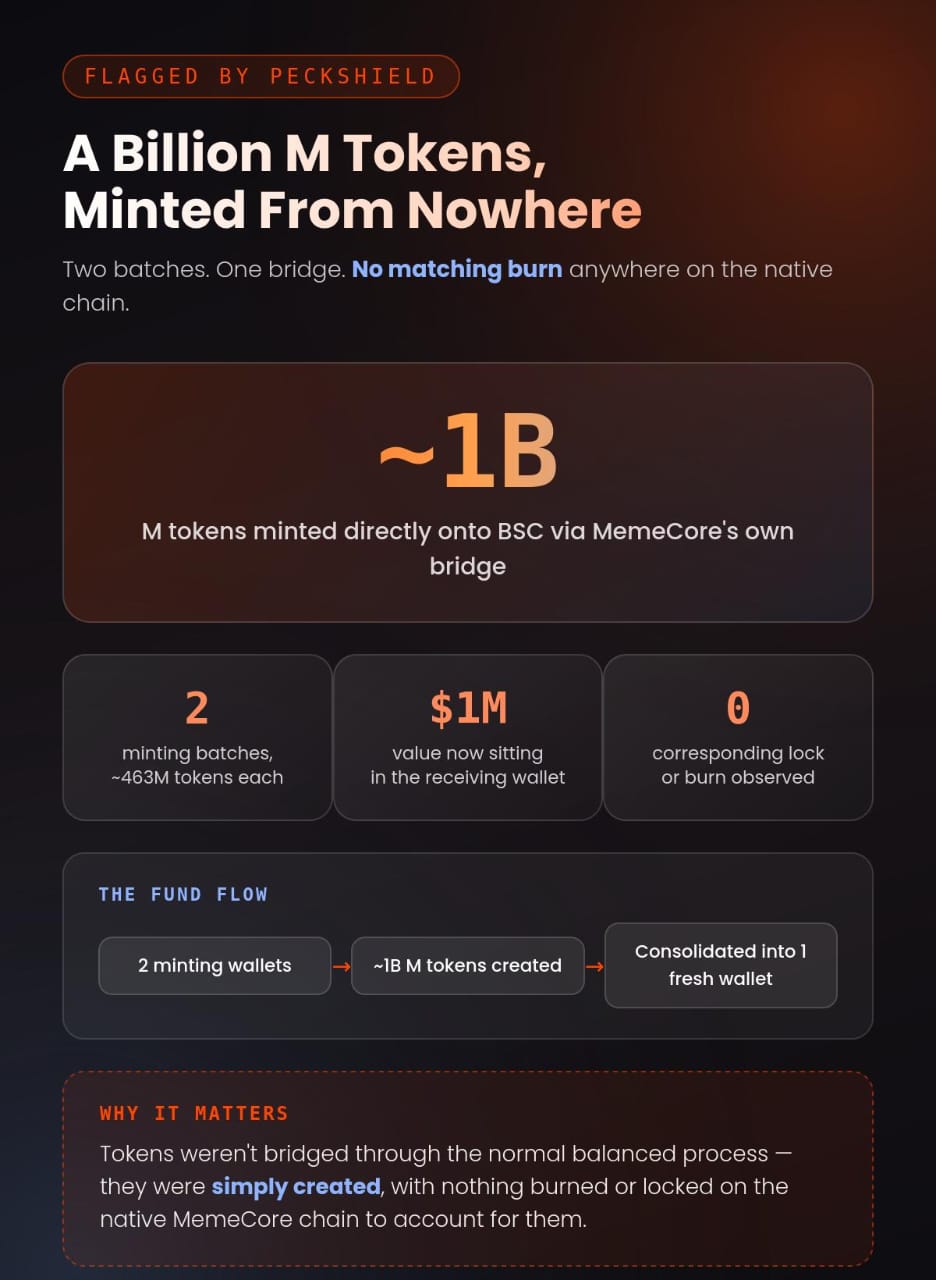
The extraordinary minting event, initially flagged by leading blockchain security firm PeckShield, involved the creation of roughly one billion M tokens, valued at approximately $1 million at the time of consolidation. This substantial influx of new supply did not follow the standard, secure procedures typically associated with cross-chain bridging, where tokens are either locked or burned on a native chain before equivalent units are minted on another. Instead, the M tokens were simply created on the Binance Smart Chain (BSC) via Memecore’s own bridge, with no corresponding record of a burn or lock on the project’s native blockchain. This mechanism strongly suggests that the tokens were generated through authorized access to the bridge’s minting function, rather than an external hack or exploit, redirecting accountability squarely towards the project’s internal operations or its affiliated operators.
The Unprecedented Minting Event: A Detailed Chronology
The timeline of this unfolding saga reveals a rapid sequence of events that began earlier this week. Blockchain security analysts at PeckShield were quick to identify and publicly flag the unusual activity, drawing attention to the precise on-chain mechanics. According to their detailed alerts, two distinct batches of M tokens, each comprising approximately 463 million units, were generated. These batches originated from two specific wallets identified as 0xfdea…447a7BF and 0x4388…C919dd7. Crucially, these newly minted tokens were then almost immediately transferred and consolidated into a single, fresh address: 0x69cB…F6FF4681. This destination wallet now holds the entirety of the newly created one billion M tokens, which, at the prevailing market rates, represents a value of roughly $1 million.
The sheer volume of tokens involved—one billion units—is staggering, especially considering the current market capitalization and liquidity of M. While the initial report from the original article suggested "roughly a billion dollars materialize out of nowhere," the consolidated wallet’s current value of $1 million for a billion tokens points to a per-token value of $0.001. This discrepancy highlights the extreme volatility inherent in meme coins and underscores the massive devaluation the M token has undergone, or suggests an initial overestimation of the dollar value based on inflated past valuations. Regardless of the exact dollar figure, the creation of such a massive, unbacked supply is a critical event for any cryptocurrency.
Understanding Cross-Chain Bridges and the Critical Anomaly
To fully grasp the gravity of this incident, it is essential to understand the fundamental principles of cross-chain bridges in the decentralized finance (DeFi) ecosystem. Cross-chain bridges are vital infrastructure components that enable the transfer of digital assets and data between different blockchain networks, addressing the inherent interoperability challenges of isolated chains. A typical, secure bridging process for a token like M would involve one of two primary mechanisms:
- Lock and Mint: When a user wants to move tokens from the native chain (Chain A) to another chain (Chain B), their tokens are locked in a smart contract on Chain A. An equivalent amount of wrapped or new tokens is then minted on Chain B, backed by the locked assets. When moving back, the tokens on Chain B are burned, and the original tokens on Chain A are unlocked.
- Burn and Mint: Alternatively, tokens are burned on Chain A, and an equivalent amount is minted on Chain B. This ensures that the total supply across all chains remains constant and balanced.
The critical anomaly identified by PeckShield in the Memecore case is the absence of a corresponding lock or burn event on the native MemeCore chain. This means the one billion M tokens minted on BSC were not backed by any corresponding reduction in supply on the native chain. In essence, these tokens were simply created out of thin air, adding to the total circulating supply without any equivalent asset being removed from circulation elsewhere. This unilateral minting directly inflates the token’s total supply, diluting the value of existing holdings and raising severe questions about the project’s tokenomics, security, and integrity.
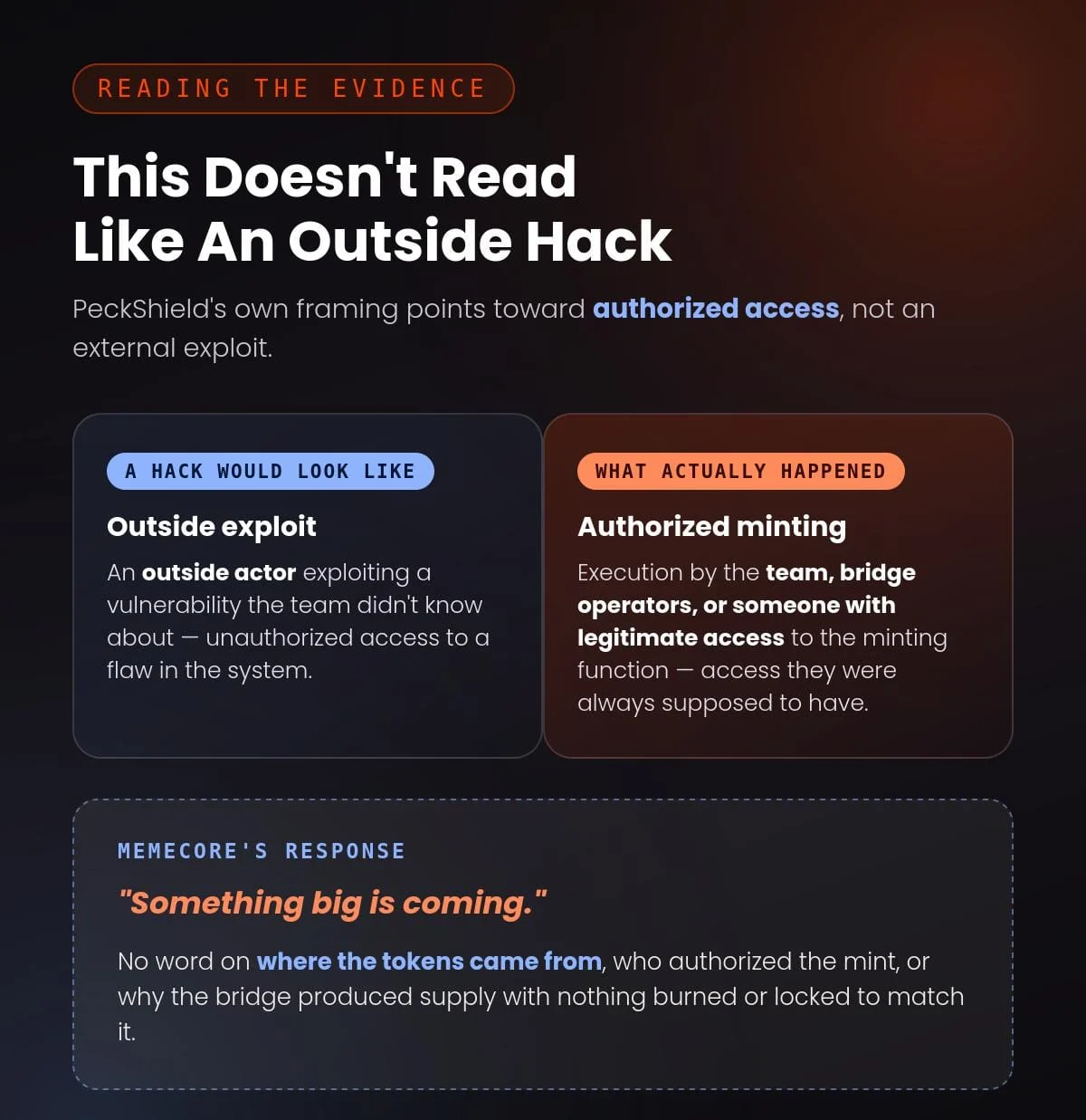
Why This Doesn’t Look Like an Outside Attack
PeckShield’s analysis of the on-chain data provides a crucial distinction that separates this incident from a typical "hack" or external exploit. While the outcome—an unauthorized increase in token supply—is devastating, the mechanism suggests an internal origin. A hack generally implies an external malicious actor exploiting a vulnerability in the smart contract code or infrastructure that the project team was unaware of. However, the evidence in this case points towards the utilization of Memecore’s own cross-chain bridge and its legitimate minting functions.
This pattern strongly suggests execution by an authorized party—be it the project’s core team, bridge operators, or another entity with legitimate administrative access to the minting capabilities. If an external attacker were involved, they would typically need to exploit a bug or a flaw in the bridge’s code to force an unauthorized mint. The fact that the minting occurred through the established bridge mechanism, albeit without the necessary corresponding burn/lock, implies that someone with the keys or administrative privileges initiated the transaction. This distinction is profoundly important because it shifts the narrative from a technical vulnerability to one of potential insider misuse, gross operational negligence, or a deliberate act by those entrusted with the project’s infrastructure. Such a scenario places the onus of explanation and accountability directly on Memecore’s leadership.
A History of Scrutiny: ZachXBT’s Prescient Warnings
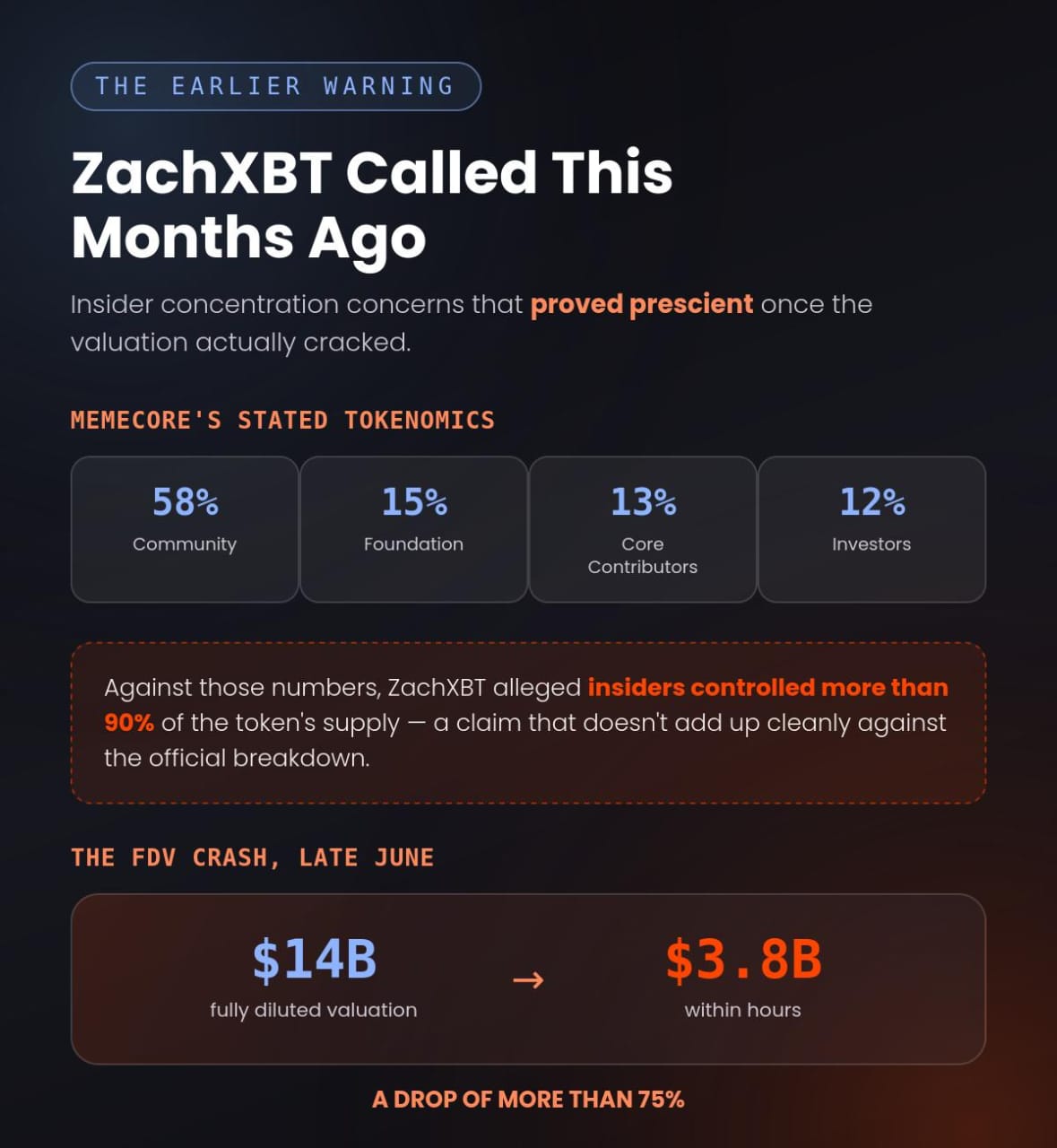
This recent minting anomaly cannot be viewed in isolation; it tragically echoes and amplifies concerns that have plagued Memecore for months. The prominent on-chain investigator ZachXBT previously raised significant red flags regarding the project’s tokenomics and its multi-billion dollar valuation. Months before this minting event, ZachXBT publicly challenged Memecore to justify its valuation, alleging that insiders controlled a staggering 90% of the token’s total supply.
ZachXBT’s earlier scrutiny was not a passing comment. His detailed analysis emerged just days after the RaveDAO token suffered a precipitous collapse of over 90%, which he described as a suspected pump-and-dump scheme. He drew parallels between RaveDAO and Memecore, pointing to similar warning signs: a thin circulating float propping up an enormous fully diluted valuation (FDV). Memecore’s stated tokenomics—58% for the community, 15% for the foundation, 13% for core contributors, and 12% for investors—did not align cleanly with ZachXBT’s assertion of 90% insider concentration.
These concerns proved eerily prescient. By late June, M’s fully diluted valuation plummeted from approximately $14 billion to $3.8 billion within a matter of hours—a brutal drop of over 75%. Following this crash, ZachXBT intensified his calls for transparency, pressing major cryptocurrency exchanges like Binance and Bybit to explain how a token with such limited verifiable liquidity and questionable supply distribution could have been listed at such inflated multi-billion-dollar valuations in the first place. The current minting event, therefore, acts as a devastating sequel to an already troubled narrative, adding another layer of distrust and confirming the precarious nature of the M token’s supply dynamics.
Memecore’s Response: A Teaser, Not an Explanation
Faced with an on-chain revelation of one billion freshly minted tokens and a well-documented history of insider concentration concerns, Memecore’s official communication has been, at best, tone-deaf and, at worst, deliberately evasive. Instead of providing a direct, technical explanation for the unprecedented minting, the project’s official account posted a cryptic message stating, "something big is coming."
This marketing-centric response, delivered in the midst of a severe crisis of confidence, has been met with widespread incredulity and frustration. The crypto community, PeckShield, and concerned investors are not seeking teasers about future announcements. They demand immediate answers to fundamental questions: Where did these one billion tokens originate? Who authorized the minting? Why did the project’s own bridge produce such a massive supply without any corresponding burn or lock on the native chain, thereby violating established cross-chain bridging protocols? Responding to such critical inquiries with generic marketing copy, regardless of intent or timing, does absolutely nothing to address the severe technical and ethical questions now confronting the project. The silence on the core issue, coupled with a superficial marketing message, only deepens suspicions about the project’s integrity and its willingness to be transparent with its community.
Broader Implications for the Crypto Ecosystem
The Memecore incident carries significant implications that extend far beyond the immediate concerns of M token holders. It touches upon several critical facets of the broader cryptocurrency ecosystem:
- Erosion of Investor Confidence: This event deals a severe blow to investor trust, particularly in the volatile meme coin sector, which often thrives on community sentiment and perceived decentralization. When a project’s core team or operators appear to unilaterally control or manipulate token supply, it undermines the fundamental premise of transparent and immutable blockchain technology.
- Market Integrity and Stability: The creation of one billion unbacked tokens can have a dramatic impact on M’s market price and liquidity. Such events can trigger sell-offs, create arbitrage opportunities for insiders, and ultimately lead to significant financial losses for retail investors. It also highlights the fragility of valuations in projects with opaque tokenomics.
- Regulatory Scrutiny: Incidents like Memecore’s minting anomaly are likely to attract heightened attention from financial regulators worldwide. The lack of transparency, coupled with allegations of insider control and potential market manipulation, could prompt investigations into token issuance practices, cross-chain bridge operations, and the accountability of project teams. This could accelerate calls for stricter oversight in the DeFi space.
- Cross-Chain Bridge Security and Governance: While not a traditional external hack, this incident underscores the critical importance of robust governance and oversight for cross-chain bridges. Bridges are powerful tools that can create or destroy token supply. Misuse of these administrative functions, whether intentional or accidental, can have catastrophic consequences for token holders and the integrity of the entire ecosystem. It emphasizes the need for multi-signature controls, time-locks, and transparent audits of bridge operations.
- Importance of Independent On-Chain Analysis: The work of firms like PeckShield and individuals like ZachXBT proves indispensable in holding projects accountable. Their ability to independently verify on-chain data serves as a crucial check against opaque project operations and misleading communications, empowering investors with factual information.
Looking Ahead: The Path to Transparency and Accountability
For anyone holding M tokens or closely observing this unfolding situation, PeckShield’s independently verifiable on-chain findings represent the most reliable information currently available. The fact that a billion tokens were minted through Memecore’s own bridge, without any corresponding burn or lock, is a serious anomaly that demands a direct and comprehensive technical explanation from the project.
The burden of proof now rests squarely on Memecore’s leadership. Until the project provides a detailed, transparent account of where these tokens originated, who authorized their minting, and why the cross-chain bridge operated outside of standard, balanced protocols, the event will continue to be perceived as a significant breach of trust. Given Memecore’s track record, where ZachXBT’s previous findings regarding insider concentration and valuation concerns proved directionally accurate ahead of a substantial market crash, a "wait and see" approach is likely an uncomfortable and potentially risky position for current token holders. The cryptocurrency market thrives on trust and transparency; without these, projects risk alienating their communities and losing their viability.
Disclosure: This is not trading or investment advice. Always conduct thorough research and consult with a qualified financial advisor before buying any cryptocurrency or investing in any services.
Follow us on Twitter @themerklehash to stay updated with the latest Crypto, NFT, AI, Cybersecurity, and Metaverse news!