
China’s economic momentum decelerated further in July 2026, with key indicators pointing to persistent weakness in domestic demand, slower factory growth, softer consumer spending, declining investment, and a deepening crisis in the property sector. Industrial output, a critical gauge of manufacturing activity, expanded by 4.5% year-over-year, falling short of June’s 5.3% increase and missing economists’ expectations of a 4.8% expansion. This broad-based slowdown underscores the significant challenges Beijing faces in sustaining its post-pandemic recovery and achieving its ambitious growth targets.
The visible impact of the economic pressures permeated households and businesses alike, as a combination of subdued spending and contracting investment reinforced the existing strain from China’s prolonged property downturn. Retail sales growth significantly tapered, increasing by a mere 0.6% compared to the previous month, while fixed-asset investment contracted further, signaling a reluctance among businesses to expand. Simultaneously, several property market indicators continued their downward trajectory, exacerbating concerns about the sector’s stability and its ripple effects across the broader economy. In stark contrast to the struggling domestic landscape, China’s export sector remained a crucial pillar of support, widening the gap between resilient external demand and the pronounced weakness within its borders.
Chronology of Economic Trends and Underlying Factors
The economic challenges observed in July 2026 are not isolated but rather a culmination of trends that have been developing over the preceding months and years. Following an initial robust rebound in early 2023 from stringent pandemic-era restrictions, China’s economy has progressively shown signs of losing steam. By the second quarter of 2026, GDP growth had already moderated to 4.3%, falling below Beijing’s stated annual target range of 4.5% to 5%. This deceleration was largely attributed to a confluence of factors including dampened consumer confidence, a deepening real estate crisis, and a complex global trade environment.
The property sector, historically a significant driver of China’s economic expansion, began showing acute signs of distress in late 2021 with the financial woes of major developers like Evergrande. This crisis progressively worsened, spreading to other giants such as Country Garden and leading to widespread concerns about housing market stability, unfinished projects, and the financial health of local governments heavily reliant on land sales. By the first half of 2026, the sector’s difficulties were already a primary drag on overall investment and consumer sentiment, with potential homebuyers becoming increasingly cautious.
In the preceding months of 2026, government efforts to stimulate demand, including targeted monetary easing and infrastructure spending, had yielded mixed results. While some sectors saw temporary boosts, the underlying structural issues, particularly in real estate and the lingering impact of strict regulatory crackdowns on various industries, continued to weigh heavily. The July 2026 data, therefore, represents a critical juncture, indicating that earlier interventions had not fully arrested the downward trend in key domestic economic engines. The slowdown in industrial output from June’s 5.3% to July’s 4.5% marked a significant setback, reversing a brief period of stronger factory activity.
Consumer Spending and Investment Lose Further Ground
The decline in consumer spending was particularly stark, highlighting a cautious populace grappling with economic uncertainties. Retail sales growth slowed from 1% in June to a mere 0.6% in July, significantly missing the 1.5% forecast by economists. A deeper dive into the data reveals that this weakness was largely concentrated in specific categories. Excluding automobiles, retail sales managed a slightly better, though still modest, increase of 2.5%, underscoring the severe contraction in vehicle demand. Official data from the China Passenger Car Association (CPCA) showed motor-vehicle retail sales plummeting by 17% in July year-over-year. Passenger-car retail sales alone dropped by an even more significant 20.9% to 1.461 million units, and were 8.8% lower than June’s figures.

Interestingly, amidst the overall decline in automobile sales, new-energy vehicle (NEV) penetration continued its upward trajectory, reaching a record 65.1%. This suggests a shift in consumer preference towards NEVs, possibly driven by government incentives and environmental consciousness, but it was not enough to offset the broader weakness in the automotive market. The overall reluctance to purchase big-ticket items like cars is a strong indicator of subdued consumer confidence and households prioritizing savings over discretionary spending.
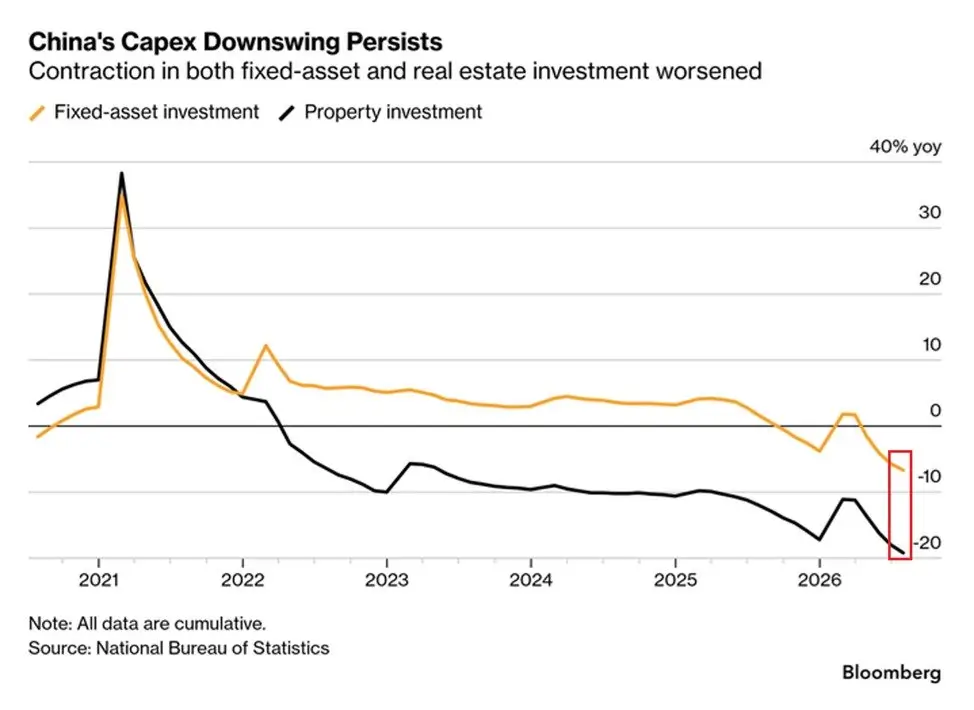
Investment figures further compounded the picture of a decelerating economy. Fixed-asset investment, excluding rural households, registered a cumulative decline of 6.7% during the January-to-July period, worsening from a 5.7% decline in the first half of the year. July alone saw a seasonally adjusted monthly decline of 1.42%, indicating an accelerating contraction in capital expenditure. Non-governmental investment, a crucial barometer of private sector confidence, fell by 9.4%. Manufacturing investment, essential for industrial upgrading and long-term growth, also declined by 1.7%, while infrastructure investment, often a tool for government-led stimulus, dropped by 3.6%. These figures collectively paint a concerning picture of businesses holding back on expansion and development plans, likely due to uncertainty about future demand and profitability.
The Property Sector: A Relentless Drag
The real estate sector remained the most significant impediment to China’s economic health, with its struggles exerting a heavy drag on investment, consumer wealth, and financial stability. Real-estate development investment plummeted by 19.2% to 4.30 trillion yuan during the first seven months of the year. This steep decline reflects developers’ reluctance to embark on new projects, likely due to tight financing conditions, falling sales, and an oversupply of existing properties in many urban areas.
The indicators of new activity and sales were equally grim. New construction starts, measured by floor area, dropped by a staggering 24%, signaling a sharp reduction in future housing supply. Commercial-building sales by floor area declined by 11.8%, with the sales value falling by 13.1%, indicating both lower transaction volumes and potentially falling prices. The financial lifeline for developers also continued to constrict, with funds available to developers dropping by 20.3%. Domestic loans to developers, a critical source of capital, saw an even sharper decline of 32.1%, highlighting the severe financing stress gripping the sector. This ongoing liquidity crunch not only threatens the solvency of more developers but also risks disrupting the completion of pre-sold homes, further eroding consumer trust and potentially sparking social unrest among homebuyers.
Exports Surge Amidst Domestic Weakness and Youth Employment Concerns
In a stark contrast to the prevailing domestic economic gloom, China’s export sector demonstrated remarkable resilience in July 2026. Exports surged by 23.9% year-over-year, providing a much-needed external boost to the economy. This strong performance was primarily driven by robust shipments of semiconductors, high-tech products, and vehicles. High-tech exports, in particular, saw a significant increase of 40.7%, indicating China’s growing competitiveness in advanced manufacturing and technology despite global trade tensions and efforts by some nations to diversify supply chains. This export strength helped to partially offset the profound weakness in household spending and subdued private investment at home.
Beyond traditional exports, online retail sales of goods also registered a healthy increase of 4.6% during the January-to-July period. Within this, telecommunications-equipment retail sales climbed by an impressive 15.1%. These figures suggest that certain technology-related categories continued to expand, demonstrating pockets of resilience and perhaps a shift in consumer spending patterns towards digital goods and services, even as broader consumer demand slowed significantly.
Despite these bright spots, the overall inflationary environment remained subdued, reinforcing concerns about domestic demand. Consumer prices rose by a modest 0.5% year-over-year in July but actually slipped by 0.1% from June, signaling limited pricing power for businesses and the potential for deflationary pressures. This lack of inflation, while seemingly positive, can be a symptom of weak demand and can discourage investment and consumption, as consumers may delay purchases in anticipation of further price drops.
The labor market also presented a worrying picture, particularly for younger demographics. Urban unemployment among people aged 16 to 24, excluding students, escalated to 17.9% in July, a significant increase from 14.9% in June. This marked an 11-month high for youth unemployment and adds another substantial constraint on consumption. High youth unemployment not only affects immediate purchasing power but also raises long-term concerns about social stability, skill development, and the future workforce. Premier Li Qiang publicly acknowledged the challenge, stating that there was "insufficient domestic demand" and calling for "stronger support" to address the economic headwinds.
Official Responses and Broader Implications
The deepening economic slowdown in July 2026 places significant pressure on Beijing to implement more forceful and effective policy measures. Premier Li Qiang’s acknowledgment of insufficient domestic demand signals a readiness at the highest levels to consider further interventions. Historically, China has responded to economic downturns with a mix of monetary and fiscal stimuli.
In terms of monetary policy, the People’s Bank of China (PBOC) may consider further cuts to benchmark interest rates and reductions in the reserve requirement ratio (RRR) for banks to inject liquidity into the financial system and lower borrowing costs. However, the effectiveness of such measures might be limited if consumer and business confidence remains low, and if banks are reluctant to lend due to concerns about asset quality, especially in the property sector. The expansion of China’s digital yuan network, which saw the PBOC authorize eight more operators, bringing the total to 30 banks, could be viewed as part of a broader strategy to modernize financial infrastructure and potentially facilitate targeted stimulus or improve financial oversight, though its direct impact on the immediate slowdown is likely marginal.
On the fiscal front, the government could increase infrastructure spending, offer tax cuts or subsidies to businesses, and implement direct consumption vouchers or other support mechanisms for households. Targeted measures to stabilize the property market, such as providing financial guarantees for developers to complete unfinished projects, easing restrictions on property purchases, and addressing local government debt issues, are also likely to be high on the agenda.
The implications of China’s economic struggles extend far beyond its borders. As the world’s second-largest economy and a major global trade partner, a significant slowdown in China can have ripple effects on global growth, commodity prices, and international supply chains. Countries reliant on exporting raw materials or manufactured goods to China could see reduced demand. Furthermore, the property crisis could pose risks to international financial markets if it leads to widespread defaults or contagion.
For domestic investors and businesses, the prolonged slowdown and uncertainty could further dampen confidence, potentially leading to capital outflows and reduced foreign direct investment. The high youth unemployment rate poses a significant social challenge, risking discontent and potentially undermining Beijing’s long-term goals of social harmony and "common prosperity."
The July 2026 economic data thus provides a sobering assessment: China’s economy is experiencing a critical divergence where resilient exports are battling against deeply rooted weaknesses in domestic consumption, private investment, and the crucial real estate sector. The path to recovery will require comprehensive and sustained policy interventions that not only address immediate demand shortfalls but also tackle structural issues to restore long-term confidence and ensure sustainable growth.