


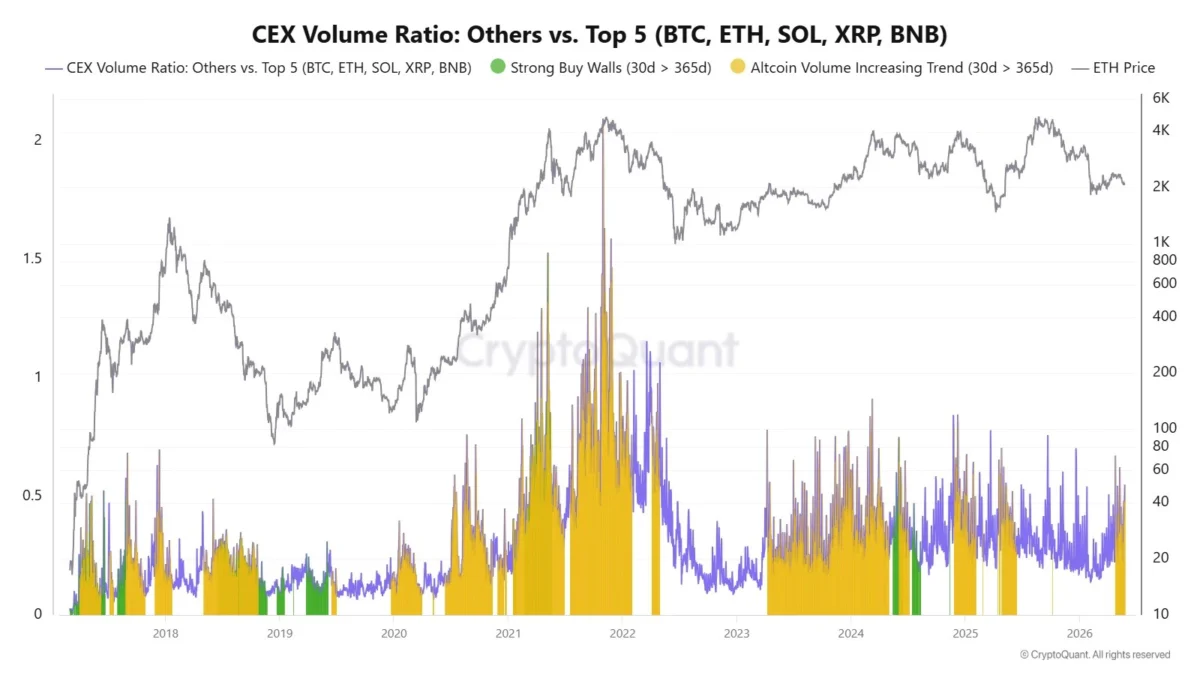
The global cryptocurrency market is currently navigating a period of profound structural transition, characterized by a notable divergence between aggregate market sentiment and specific localized trading activity. While the broader digital asset landscape has been marred by months of selling pressure, regulatory ambiguity, and a general sense of investor exhaustion, recent on-chain data provided by CryptoQuant suggests that a sophisticated cohort of market participants is quietly positioning themselves within the altcoin sector. This activity is not occurring in the high-profile, large-cap assets that typically dominate the headlines, but rather in the "OTHERS" category—a segment of the market comprising smaller-cap altcoins that exclude the top five assets: Bitcoin (BTC), Ethereum (ETH), Solana (SOL), XRP, and BNB.
The emergence of this behavioral divergence comes at a time when traditional metrics of market health appear lackluster. Across major centralized exchanges (CEXs), total trading volumes have seen a steady decline, and social sentiment has dipped into territory often associated with capitulation or total disinterest. However, the anomalous rise in exchange volume for smaller altcoins indicates that beneath the surface of a stagnant market, a deliberate and strategic accumulation phase may be underway. This phenomenon suggests that while retail investors may be disengaged, "smart money" or high-conviction traders are identifying value in the peripheral corners of the crypto ecosystem.
The Macroeconomic Backdrop and Market Stagnation
To understand the significance of the current volume divergence, one must first examine the macro environment that has shaped the crypto market throughout 2024 and the early months of 2025. Following a brief period of exuberance during a February recovery attempt, the market entered a protracted phase of sideways price action. This stagnation has been driven by several factors, including fluctuating expectations regarding the Federal Reserve’s interest rate policy, a cooling of the initial hype surrounding spot Bitcoin ETFs, and a lack of a clear narrative catalyst for the broader altcoin market.
During this period, Bitcoin has largely maintained its dominance, acting as a "safe haven" within the volatile crypto asset class. This has left the majority of altcoins in a state of "structural decay," with many assets trading 70% to 90% below their all-time highs. For the average investor, this environment has fostered a sense of "altcoin fatigue," where the promise of an "altseason"—a period where altcoins significantly outperform Bitcoin—has repeatedly failed to materialize. Consequently, aggregate exchange volumes have dwindled as participants move to the sidelines, waiting for a definitive trend to emerge.

Deciphering the CryptoQuant Volume Signal
Against this backdrop of declining participation, the CryptoQuant data highlighting rising volume in the "OTHERS" segment is particularly striking. In professional trading, volume is often viewed as the "fuel" of price movement. When volume increases while prices are flat or declining, it typically indicates a period of absorption, where sellers are being met by a consistent wall of buy orders.
The fact that this volume is concentrating in assets outside the top five is significant. Bitcoin, Ethereum, Solana, XRP, and BNB represent the "institutional" tier of the crypto market; they are the assets found in ETFs, institutional portfolios, and major payment integrations. By contrast, the "OTHERS" category represents the speculative frontier—Layer 2 scaling solutions, AI-integrated protocols, decentralized finance (DeFi) primitives, and emerging niche sectors.
The CryptoQuant report notes that this is not a transient spike caused by a single news event or a "pump and dump" scheme involving a specific token. Instead, it is a sustained, directional development. The increasing volume ratio of "OTHERS" versus the top five suggests a rotation of capital. It implies that certain investors are moving away from the "crowded trades" of the large caps and seeking outsized returns in the more volatile, lower-cap segments of the market before a broader recovery takes hold.
Technical Analysis: The OTHERS/BTC Ratio and the 0.12 Floor
The technical health of the altcoin market is best visualized through the OTHERS/BTC index, which measures the total market capitalization of all cryptocurrencies (excluding the top 10) relative to the price of Bitcoin. This ratio has been in a persistent downtrend for over two years, reflecting the harsh reality of the current cycle: Bitcoin has outperformed almost everything.
However, recent chart patterns indicate that this multi-year decline may be reaching a point of "momentum exhaustion." The ratio has begun to stabilize near the 0.12 region, a level that has historically acted as a zone of interest for long-term buyers. While the index remains below its 50-week, 100-week, and 200-week moving averages—confirming that the macro trend is still bearish—the transition from an aggressive sell-off to a sideways consolidation phase is a classic precursor to a trend reversal.

Market analysts observe that major rotations in the crypto space rarely happen overnight. They are usually preceded by a "basing" process where the rate of decline slows down and volume begins to bottom out. The repeated defense of the 0.12 level suggests that the supply of these altcoins is being moved from "weak hands" (investors selling out of frustration) to "strong hands" (investors buying for the next cycle). If the OTHERS/BTC ratio can reclaim its 50-week moving average, it would serve as a technical confirmation that the period of Bitcoin-only leadership is coming to an end.
Behavioral Divergence: Deliberate vs. Reactive Trading
One of the most compelling aspects of the CryptoQuant analysis is the distinction between "deliberate" and "reactive" market behavior. Reactive trading is driven by headlines, FOMO (fear of missing out), or panic. It typically occurs during periods of high volatility and high volume. Deliberate trading, on the other hand, occurs when the market is quiet. It is the result of research, conviction, and long-term positioning.
The current market is characterized by extreme quietness, yet the "OTHERS" volume is rising. This suggests that the participants currently active in the market are not the retail crowd chasing the latest trend, but rather sophisticated entities—such as venture funds, family offices, or "whales"—who are utilizing the lack of liquidity to build large positions without significantly moving the price.
This cohort is operating under the thesis that the "altcoin winter" has purged the market of speculative excess. By accumulating when sentiment is at its lowest, they are positioning themselves for a potential "mean reversion" event. Historically, when the OTHERS/BTC ratio reaches extreme lows while internal volume begins to rise, the subsequent recovery tends to be violent and rapid, as the market suddenly realizes that the supply has been constrained.
Chronology of the Current Altcoin Cycle
To provide context for this shift, it is helpful to look at the timeline of the altcoin market’s performance over the last 18 months:

- Q4 2023 – Q1 2024 (The Bitcoin Lead): The anticipation and eventual approval of spot Bitcoin ETFs in the United States led to a massive concentration of capital in BTC. Altcoins saw some "spillover" gains, but remained largely secondary to the Bitcoin narrative.
- February 2024 (The False Start): A brief surge in Ethereum and Solana-based memecoins gave the impression that "altseason" had arrived. However, this was short-lived as macro pressures and a lack of sustained retail inflow caused a sharp retracement.
- Q2 – Q3 2024 (The Great Washout): Most altcoins entered a brutal downtrend, losing significant value against both the USD and BTC. This period was marked by "token unlock" fears and a lack of new capital entering the space.
- Q4 2024 – Early 2025 (The Stabilization Phase): While Bitcoin hit new highs or consolidated near them, altcoins stopped making new lows. This is the period identified by CryptoQuant where "OTHERS" volume began its anomalous climb.
Implications for the Global Digital Asset Market
The rise in small-cap altcoin volume carries several implications for the broader financial landscape. First, it suggests that the "risk-on" appetite within the crypto native community remains intact, despite the lackluster performance of the last year. Investors are not leaving the crypto space; they are simply moving further down the risk curve in search of yield.
Second, this trend highlights a growing fragmentation in the crypto market. In previous cycles (such as 2017 or 2021), the entire market tended to move in lockstep. In the current "institutional era," we are seeing a decoupling. Bitcoin and a few select "blue-chip" assets are behaving more like traditional financial assets, while the rest of the market (the "OTHERS") continues to operate under a different set of liquidity and speculative dynamics.
Finally, the stabilization of the OTHERS/BTC ratio could signal a broader shift in global liquidity. Historically, altcoin surges have coincided with periods of increased global M2 money supply or a weakening U.S. Dollar. If the deliberate accumulation identified by CryptoQuant is indeed a front-running move, it may suggest that professional traders are anticipating a more favorable macroeconomic environment in the latter half of 2025.
Conclusion: A Market in Waiting
The data provided by CryptoQuant offers a rare glimpse into the "invisible" mechanics of the current market. While the surface-level narrative is one of boredom and stagnation, the underlying volume data tells a story of preparation. The divergence between declining overall sentiment and rising specific altcoin volume is a classic "hidden" signal that often precedes a major shift in market regime.
For the broader market, the message is one of cautious optimism. The multi-year underperformance of altcoins against Bitcoin has created a technical and psychological setup that is ripe for a reversal. However, as the OTHERS/BTC ratio remains structurally weak, the "altcoin season" that many are hoping for remains a possibility rather than a certainty. What is certain, however, is that the participants generating the current volume are doing so with intent, signaling that the most difficult days of the altcoin bear market may finally be in the rearview mirror. As these smaller assets attempt to reclaim their ground, the focus will remain on whether this quiet accumulation can translate into a sustained breakout that brings the rest of the market back to life.














