
Michael Saylor, the prominent CEO of MicroStrategy, has publicly addressed and refuted accusations of hypocrisy following his company’s recent decision to sell $200 million worth of Bitcoin. Saylor, a long-standing advocate for Bitcoin and often perceived as a "Bitcoin maximalist," has faced scrutiny for this move, given his consistent messaging against selling the cryptocurrency. He clarified his stance, emphasizing the distinction between personal investment philosophy and corporate financial strategy.
Saylor articulated his position via the social media platform X (formerly Twitter), stating that his oft-repeated advice to "never sell your Bitcoin" was intended as guidance for individual investors and not as a rigid corporate policy. He underscored that he personally has not divested any of his own Bitcoin holdings, down to the smallest unit, the satoshi. The justification for MicroStrategy’s recent Bitcoin liquidation, he explained, lies in the company’s nature as a publicly traded entity. As such, MicroStrategy has the prerogative to manage its balance sheet and asset allocation in a manner it deems most advantageous, responding dynamically to prevailing market conditions and corporate objectives.
This explanation came just hours after MicroStrategy filed a Form 8-K with the U.S. Securities and Exchange Commission (SEC). The filing detailed the sale of 1,638 Bitcoin by the company at the close of the previous month. The transactions were executed at an average price of approximately $63,957 per Bitcoin. The proceeds generated from this sale were earmarked for the repurchase of the company’s Series A convertible preferred stock, a financial instrument that had previously drawn criticism.

Strategic Rebalancing: MicroStrategy Adjusts Bitcoin Strategy
The decision to sell a portion of its substantial Bitcoin holdings, while generating controversy, was not entirely unexpected within the financial and cryptocurrency communities. MicroStrategy’s aggressive strategy of accumulating Bitcoin, often financed through various debt instruments and preferred stock offerings, had raised concerns among market observers and industry participants. Notably, some prominent on-chain analysts, cryptocurrency entrepreneurs, and even blockchain developers had voiced reservations about Saylor’s reliance on high-yield financial products to fund the company’s continued Bitcoin acquisitions. These funding mechanisms, particularly those involving the STRC (Series A Convertible Preferred Stock) rollouts, had exposed MicroStrategy to significant leverage and potential risks.
Initially, Saylor remained steadfast in his conviction, often doubling down on his aggressive approach to Bitcoin accumulation. However, the recent strategic adjustment suggests that he may have taken into account the critiques leveled against the company’s financial architecture. By selling a portion of its Bitcoin reserves and repurchasing preferred shares, MicroStrategy appears to be recalibrating its financial strategy. This move is interpreted as a measure to deleverage its balance sheet and reduce its exposure to the high-yield STRC instruments. Concurrently, the company has reportedly increased its dollar reserves, providing greater liquidity and financial flexibility.
Despite this partial divestment, MicroStrategy continues to hold an enormous quantity of Bitcoin. The company’s current holdings stand at an impressive 842,138 BTC, acquired at an aggregate cost basis of roughly $63.5 billion. This substantial reserve solidifies MicroStrategy’s position as one of the world’s largest institutional holders of Bitcoin.
The Genesis of the Controversy: A History of Aggressive Accumulation
MicroStrategy’s journey into becoming a significant Bitcoin accumulator began in August 2020, marking a pivotal moment in corporate adoption of the cryptocurrency. At a time when Bitcoin was still viewed with skepticism by many traditional financial institutions, MicroStrategy’s bold move signaled a growing conviction in its long-term value proposition. The company’s strategy involved leveraging its balance sheet, issuing debt, and utilizing preferred stock offerings to acquire vast amounts of Bitcoin. This approach, while demonstrating immense faith in Bitcoin, also carried inherent risks, particularly given the cryptocurrency’s notorious volatility.

Saylor’s public persona became inextricably linked with his unwavering advocacy for Bitcoin. He frequently appeared in media, articulating the benefits of Bitcoin as a store of value and an inflation hedge, often contrasting it with the perceived debasement of fiat currencies. His pronouncements often carried the weight of conviction, influencing both individual investors and other corporations considering crypto exposure.
However, the financing methods employed by MicroStrategy began to draw attention. The issuance of preferred stock, particularly the STRC, allowed the company to raise capital which was then deployed into Bitcoin. While this strategy enabled rapid accumulation, it also meant that the company was exposed to margin calls and potential financial distress if the price of Bitcoin were to fall significantly. Critics argued that this leveraged approach amplified the risks associated with Bitcoin’s price swings, potentially jeopardizing the company’s financial stability.
The criticism intensified as Bitcoin experienced periods of sharp decline. The strategy of buying Bitcoin at potentially high price points, financed by debt, became a focal point of concern. Many observers pointed out that MicroStrategy’s average cost basis for its Bitcoin holdings was often higher than prevailing market prices during downturns, raising questions about the long-term sustainability of this aggressive accumulation model.
Reactions to the Sale: A Spectrum of Opinions
The recent sale of Bitcoin by MicroStrategy has elicited a wide range of reactions from various stakeholders within the financial and cryptocurrency spheres. The move has been met with both criticism and understanding, reflecting the diverse perspectives on corporate Bitcoin strategy and Michael Saylor’s role in the industry.

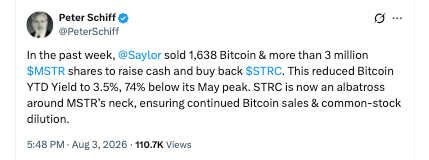
Peter Schiff, a vocal critic of Bitcoin and a proponent of gold, was among the first to weigh in on the development. Schiff, who has consistently maintained a bearish outlook on Bitcoin, seized upon MicroStrategy’s sale as validation of his long-held skepticism. He took to X to express his views, framing the sale as an admission of failure by Saylor and MicroStrategy. His commentary often highlights Bitcoin’s price volatility and questions its intrinsic value, suggesting that such sales are inevitable when the underlying fundamentals are perceived as weak.
Beyond prominent critics like Schiff, a broader segment of the cryptocurrency community has also expressed their opinions. Some users on X have voiced disappointment, viewing the sale as a betrayal of Saylor’s previous unwavering commitment to "never sell." These reactions often stem from a belief in Bitcoin’s long-term potential and a desire for institutional adoption to remain steadfast. For some, MicroStrategy’s aggressive accumulation was seen as a bullish signal, and any reduction in its holdings could be interpreted as a negative development.
However, there are also more nuanced perspectives. Some commentators have acknowledged the complexities of managing a public company’s finances. They recognize that while Saylor’s personal conviction in Bitcoin is strong, MicroStrategy, as a business entity, must operate within the constraints of financial markets, investor expectations, and risk management principles. These viewpoints often emphasize that a partial sale, particularly when used to strengthen the balance sheet or reduce leverage, does not necessarily negate the company’s overall commitment to Bitcoin.
One user on X offered a more balanced take, suggesting that Saylor’s distinction between personal and corporate advice is valid. This perspective acknowledges that while Saylor might personally advocate for never selling, a publicly traded company must make decisions that serve the interests of its shareholders. Such decisions can involve strategic asset allocation and risk mitigation, even if it means temporarily deviating from an otherwise consistent investment thesis.
Analyzing the Implications: A Shifting Corporate Crypto Landscape
Michael Saylor’s recent actions and statements mark a significant development in the ongoing narrative of institutional adoption of Bitcoin. While MicroStrategy’s decision to sell a portion of its Bitcoin holdings has drawn criticism, it also reflects a maturing understanding of the risks and rewards associated with large-scale cryptocurrency investments by public companies.
The sale can be interpreted as a strategic recalibration rather than an abandonment of Bitcoin. By using the proceeds to repurchase preferred shares, MicroStrategy is actively deleveraging its balance sheet and reducing financial risk. This move suggests a shift towards a more balanced approach, where aggressive accumulation is tempered by prudent risk management. For a company that has placed such a significant portion of its treasury into a volatile asset like Bitcoin, this adjustment is a logical step in ensuring long-term financial health.
Furthermore, Saylor’s clarification regarding his "never sell" mantra highlights the critical distinction between personal investment philosophy and corporate financial strategy. His personal conviction in Bitcoin’s future remains evident, as he continues to hold his own substantial Bitcoin reserves. However, as CEO of a public company, he is accountable to a broader set of stakeholders, including shareholders and creditors, who have different risk tolerances and financial objectives.
The broader implications of this event extend to other corporations that have embraced Bitcoin as a treasury asset. MicroStrategy’s experience serves as a case study, illustrating the challenges and complexities involved in managing significant Bitcoin holdings within a traditional corporate framework. It underscores the importance of robust risk management, diversified funding strategies, and a clear understanding of the market’s dynamics.

While some may view the sale as a negative signal, it could also be seen as a sign of maturity within the corporate Bitcoin adoption landscape. Companies are learning to navigate the volatility of cryptocurrencies and developing more sophisticated strategies for integrating them into their financial operations. MicroStrategy’s current holdings, still among the largest in the world, demonstrate a sustained commitment to Bitcoin, even as the company refines its approach to managing these assets. The future actions of MicroStrategy and other institutional players will continue to shape the perception and integration of Bitcoin within the global financial system.