



Bitcoin experienced a significant price decline on Friday, plummeting as low as $76,877 and relinquishing the majority of its double-digit weekly advance. The sharp reversal followed Federal Reserve Chair Kevin Warsh’s inaugural Jackson Hole keynote address, where he issued a stern warning that inflation was not receding at a sufficient pace, signaling a potentially prolonged period of tight monetary policy. This downturn came after Bitcoin had briefly touched an overnight high of $81,455, a price point that once again proved to be a formidable resistance barrier, having thwarted several previous breakout attempts throughout the year.
The Jackson Hole Catalyst: Warsh’s Hawkish Stance
The annual Jackson Hole Economic Symposium, hosted by the Federal Reserve Bank of Kansas City, is a highly anticipated event in the global financial calendar. Central bankers, finance ministers, academics, and financial market participants gather to discuss long-term policy issues, often setting the tone for future monetary policy direction. Fed Chair speeches, in particular, are meticulously dissected for any hints regarding interest rates, inflation outlook, and economic projections.
Kevin Warsh, marking his 100th day in the challenging role of Fed Chair, delivered a keynote address that, while devoid of explicit forward guidance on specific rate paths, conveyed a decidedly hawkish tone. His central message was unequivocal: the Federal Reserve requires clear and sufficiently rapid progress towards its 2% inflation target before it can declare its mission accomplished. Until such conditions are met, Warsh stated, the central bank still has "work to do." This phrasing was interpreted by markets as a commitment to maintaining restrictive monetary policy, even if it means further rate hikes or keeping rates elevated for an extended period. The market’s immediate reaction underscored the gravity with which Warsh’s words were received, highlighting the Fed’s ongoing battle against persistent inflationary pressures.
Bitcoin’s Immediate Reversal: Technical Levels and Liquidation Cascade
The cryptocurrency market, particularly Bitcoin, is highly sensitive to shifts in macroeconomic sentiment and central bank policy. The overnight high of $81,455 represented a critical resistance zone that has consistently capped upward movements this year. This zone, defined by previous price ceilings, has proven to be a significant psychological and technical barrier for bulls. The failure to decisively break above this level, coupled with Warsh’s remarks, triggered a rapid sell-off.

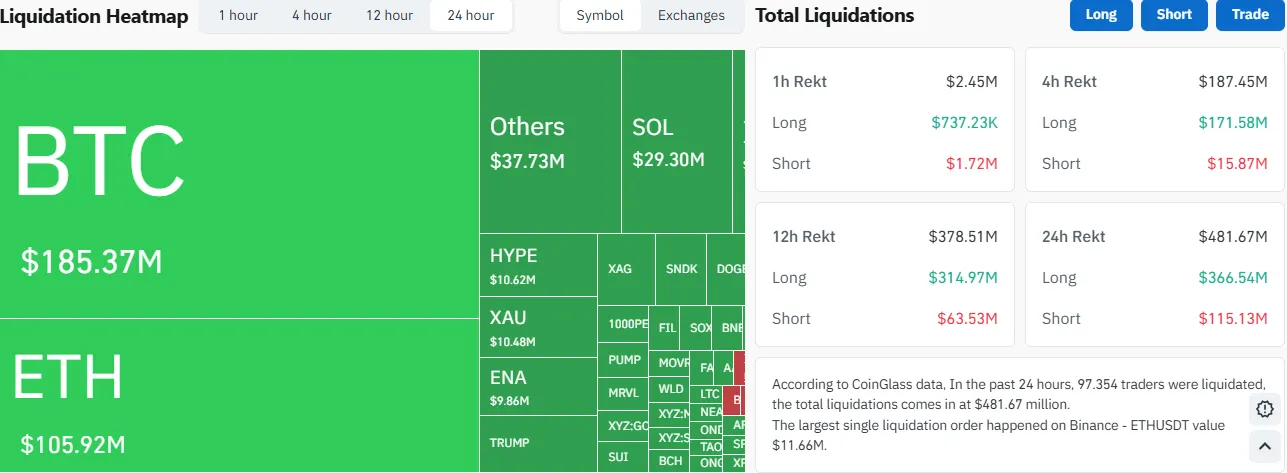
The impact of Warsh’s speech reverberated swiftly through leveraged positions in the crypto market. According to data from CoinGlass, approximately $481 million in liquidations occurred across the broader cryptocurrency market within 24 hours surrounding the speech. A substantial portion of this, exceeding $360 million, stemmed from long positions – bets that prices would rise – which were caught off-guard by the sudden downturn. Traders utilizing leverage amplify their potential gains but also their losses, making them particularly vulnerable to abrupt market shifts. The cascade of liquidations exacerbated the price drop as automated systems closed out positions, further fueling the selling pressure. By the close of the day, Bitcoin had settled at $77,557, registering a 3.39% decline, erasing much of the week’s earlier enthusiasm.
Decoding the Fed’s Message: Inflation, Interest Rates, and Market Expectations
Warsh’s emphasis on inflation not cooling fast enough directly addresses the Federal Reserve’s dual mandate of achieving maximum employment and stable prices. With the Personal Consumption Expenditures (PCE) price index, the Fed’s preferred inflation gauge, running at an annual rate of 3.7%, it remains nearly double the central bank’s 2% target. This persistent inflation figure, despite a series of aggressive interest rate hikes over the past year and a half, signals to the Fed that its job is far from complete.
The market’s interpretation of Warsh’s remarks as hawkish was evident in the immediate surge in expectations for future rate hikes. According to the CME Group’s FedWatch tool, the probability of a September rate hike jumped significantly, climbing from 35.4% a day earlier to 55.7%. This dramatic shift in probabilities reflects traders quickly repricing the likelihood of further monetary tightening. Higher interest rates typically make riskier assets like cryptocurrencies less attractive, as investors seek safer, yielding alternatives and the cost of borrowing increases, potentially slowing economic growth and corporate earnings. The Fed’s commitment to "doing what it takes" to bring inflation down, even at the risk of an economic slowdown, reinforces a cautious outlook for assets sensitive to liquidity and growth conditions.
Broader Economic Undercurrents: The "Debasement Trade" and Treasury Policy
Despite the immediate market reaction to Warsh’s speech, some underlying fundamental factors supporting Bitcoin’s longer-term bullish case remain intact. One significant factor has been the recent shift in U.S. Treasury Department policy. A Treasury announcement that it would at least double its long-dated bond buybacks starting September 9, 2026, has been a key driver. This policy supports a segment of the bond market that has experienced weak demand since June.
Lower long-end yields, a consequence of increased demand for these bonds, combined with a softer U.S. dollar, have historically revived what is often termed the "debasement trade." This concept suggests that when central banks or governments expand their balance sheets or engage in policies that might dilute the purchasing power of fiat currency, investors flock to alternative assets like gold or Bitcoin as a hedge against inflation and currency devaluation. This dynamic fueled Bitcoin’s impressive rally from approximately $62,000 to $80,000 in the preceding month. Warsh’s remarks, while impactful on short-term rate expectations, did not explicitly alter this broader backdrop, as he focused on a condition (inflation target) rather than setting an explicit, immediate rate path or dictating Treasury policy. The Treasury’s actions introduce liquidity into the market, which can be supportive of risk assets over the longer term, potentially mitigating some of the hawkish Fed sentiment.
Technical Analysis: A Deeper Dive into Bitcoin’s Chart
From a purely technical perspective, the recent pullback in Bitcoin’s price appears to be more of a "digestion" phase rather than a definitive reversal of the overall bullish trend. Key technical indicators offer insights into the market’s underlying strength. The Relative Strength Index (RSI), a momentum oscillator, currently sits at 69.7. This reading is well below the "overbought" threshold of 80, which typically precedes sharper rejections, as was observed earlier in the week. This suggests that while there was a pullback, the market is not yet excessively overheated.
Furthermore, the Average Directional Index (ADX), which measures the strength of a trend, is near 39.5. An ADX reading above 25 generally indicates a strong trend. The current level suggests that the prevailing bullish trend, which propelled Bitcoin higher in recent weeks, remains robust rather than being fundamentally broken. Price action also remains contained within the bullish leg that originated from the June low near $68,858 and extended to this week’s high of $81,455.
Looking ahead, traders will closely monitor the $73,670 to $75,157 band. This "golden zone" represents a critical support level. Should the selloff extend and Bitcoin close decisively below this range, it would raise concerns about the integrity of the 50-week moving average and potentially invalidate the June breakout structure, signaling a more significant bearish shift. Conversely, for bulls to regain momentum and push towards new highs, reclaiming the $81,000 to $82,500 shelf, which has acted as a strong resistance zone, will be paramount.
Investor Sentiment: Insights from Prediction Markets
Beyond traditional technical and fundamental analysis, prediction markets offer a unique glimpse into collective investor sentiment and expectations. Myriad’s "BTC next move" market, which has been active since late February with $231,000 traded and no fixed resolution date, tracks predictions for Bitcoin reaching either $84,000 or falling to $55,000. This market has historically seen a fluctuating lead between the two outcomes, reflecting the whipsaw price action throughout the year.
However, a notable shift occurred this month. The probability assigned to the $84,000 outcome surged by 31.7 percentage points, reaching 77%, while the $55,000 scenario dropped to 23%. Importantly, Friday’s rejection at the critical resistance level did not significantly alter this underlying split in sentiment. This indicates that despite short-term volatility, a substantial majority of participants in this prediction market maintain a long-term bullish outlook for Bitcoin. The last time predictors exhibited such a strong bullish bias was near April, preceding a period of significant upward movement. This sustained optimism, even in the face of hawkish central bank rhetoric, suggests that a significant portion of the market believes the underlying drivers for Bitcoin’s appreciation remain potent.
The Path Forward: Navigating Uncertainty and Future Fed Actions
The immediate future for Bitcoin and the broader crypto market remains intertwined with the Federal Reserve’s policy trajectory and global macroeconomic data. Warsh’s deliberate decision to eschew explicit forward guidance implies that markets will not receive clear signals until the Fed’s next rate decision meetings. This lack of pre-commitment leaves Bitcoin highly susceptible to headline-driven volatility with every upcoming inflation report, employment data release, and other economic indicators.
The PCE price index, as noted, is still running significantly above the Fed’s target, and Warsh provided no timeline for when this might change. This ambiguity creates a fertile ground for speculation and rapid price swings. Investors will be keenly watching upcoming CPI and PCE reports, along with other economic data, for any signs that inflation is indeed cooling at a rate satisfactory to the Fed. Any deviation from expectations could trigger further market adjustments.
The fact that the $81,000-$82,500 resistance zone has repeatedly rejected upward attempts in previous months, now reinforced by Warsh’s hawkish tone, suggests that bulls will face a significant challenge in the near term. The Fed has clearly communicated that it will not ease its stance prematurely, meaning the path to new highs for Bitcoin will likely require a sustained period of favorable inflation data or other significant positive catalysts.
Conclusion: A Pivotal Moment for Bitcoin and Monetary Policy
Bitcoin’s recent price action underscores its continued sensitivity to global monetary policy and the broader macroeconomic environment. Fed Chair Warsh’s Jackson Hole speech served as a stark reminder that the fight against inflation remains the central bank’s paramount concern, even if it entails maintaining restrictive conditions for longer than markets might desire. While short-term liquidations and technical rejections point to caution, the underlying demand from U.S. spot Bitcoin ETFs and the potential for a revived "debasement trade" due to Treasury policy suggest that the long-term bullish narrative for Bitcoin may persist among many investors. The interplay between aggressive central bank policy, ongoing inflationary pressures, and evolving market dynamics will define Bitcoin’s trajectory in the coming months, marking a pivotal period for the world’s largest cryptocurrency.














