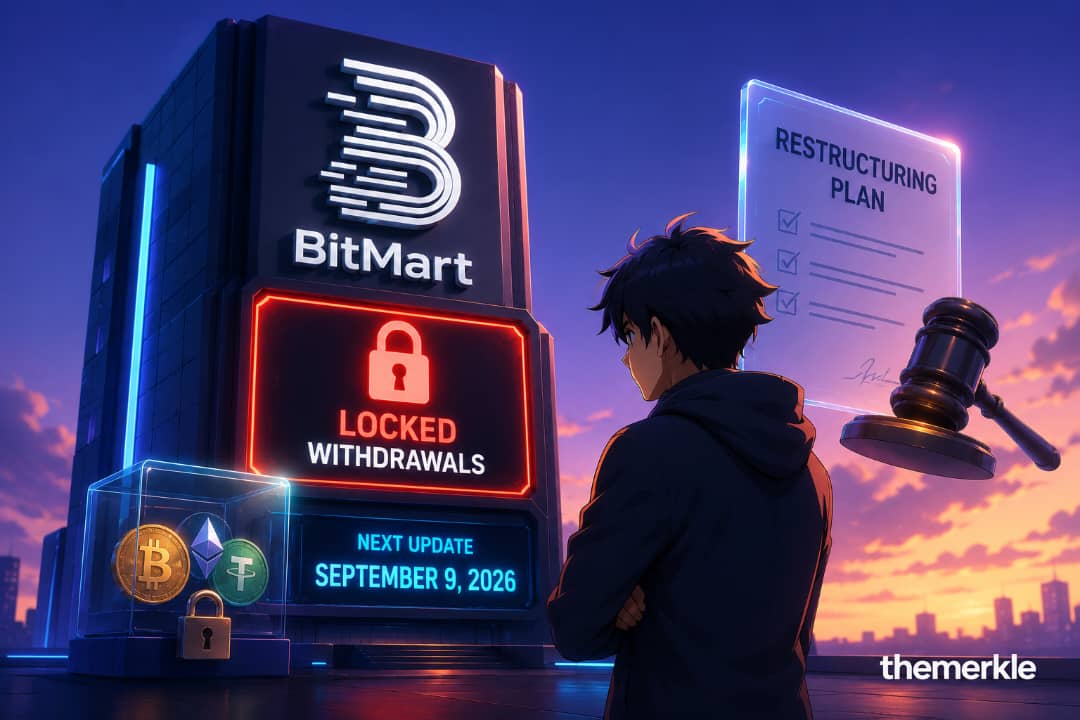
A distinct silence envelops a frozen exchange like BitMart, a void keenly felt by anyone whose funds have been locked mid-crisis. This is not a literal quietude; BitMart has indeed issued updates, engaged legal counsel, and outlined potential roadmaps. However, it is the profound absence of the single word users desperately yearn to hear: "withdrawals." This crucial term remains conspicuously omitted from BitMart’s latest public statement, a fact immediately noted and vociferously reacted to by its community. The chasm between corporate communication and user expectation continues to widen, underscoring a persistent challenge within the volatile cryptocurrency landscape.
BitMart’s Latest Communication: A Shift Towards Restructuring
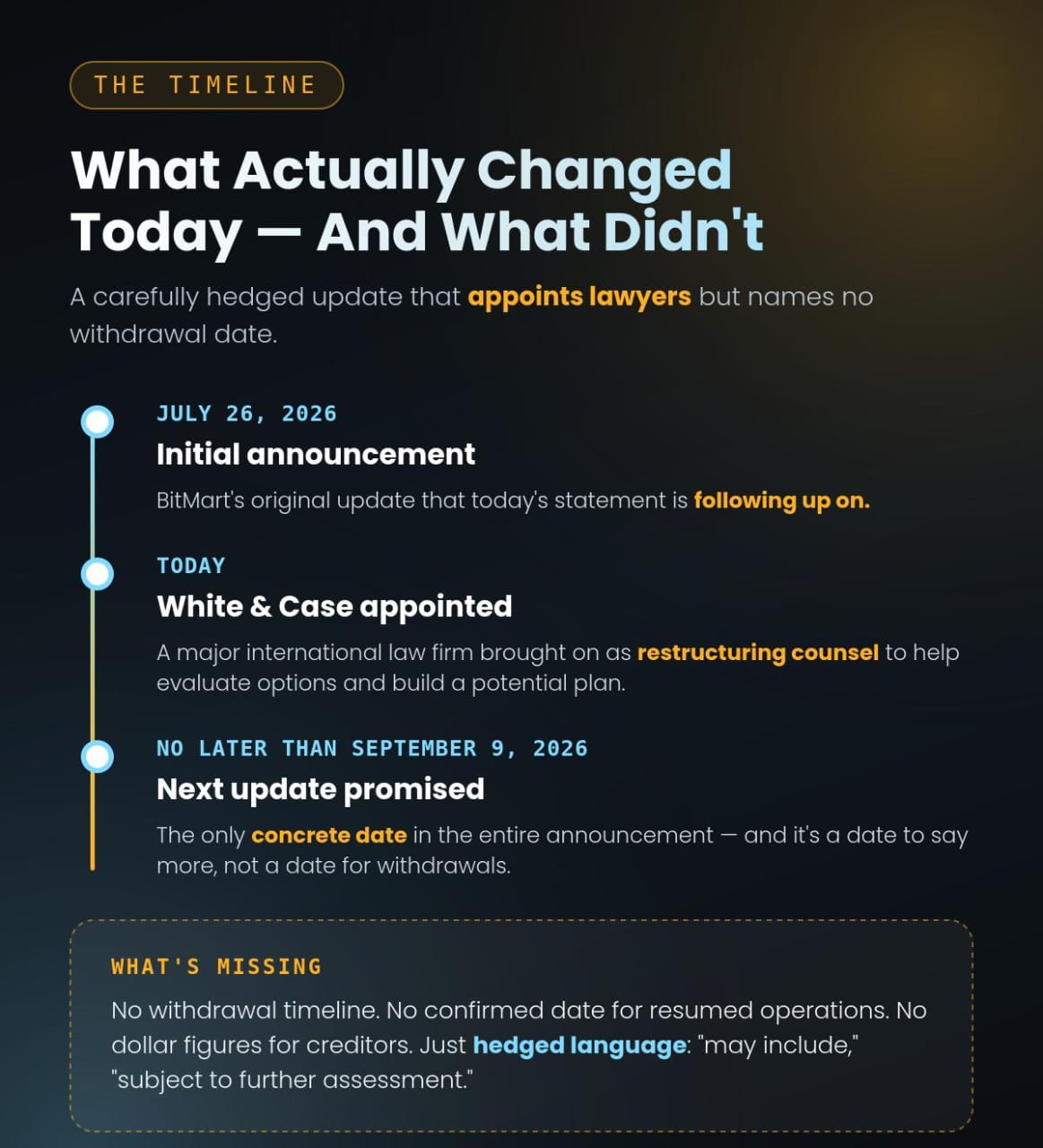
In a recent update directly addressed to its user base, BitMart elaborated on a follow-up to an earlier announcement made on July 26, 2026. The core message signals a significant strategic pivot: rather than proceeding with a full wind-down of the exchange, BitMart is now actively developing a potential restructuring plan. This alternative path is presented as a means to navigate the current crisis and potentially resume operations. According to the company, this evolving plan could encompass a phased resumption of certain operational functions, carried out in an orderly manner, alongside distributions to creditors. However, BitMart meticulously qualified these statements, emphasizing that any such plan remains rigorously "subject to further legal, financial, operational, and regulatory assessment."
To underpin this complex process, BitMart confirmed the formal appointment of White & Case, a globally recognized international law firm, as its restructuring counsel. This firm is tasked with collaborating alongside BitMart’s existing professional advisers to thoroughly evaluate the exchange’s available options and construct the proposed restructuring framework. This includes designing the eventual structure that would govern a phased return of operations. BitMart indicated that a detailed roadmap is currently under development with these advisers, with a firm commitment to provide a subsequent update no later than September 9, 2026.
Decoding the Corporate Lexicon: "Potential Plans" and Legal Nuances
A close examination of BitMart’s language reveals a meticulously crafted statement, each phrase carefully chosen to convey intent without promising definitive outcomes. The update consistently frames its initiatives with qualifiers: "developing a potential plan," "may include," "subject to further assessment," and "endeavor to provide." This cautious phrasing is not necessarily an attempt to mislead; from a legal standpoint, a company in BitMart’s precarious position genuinely cannot guarantee specific results or timelines until they are finalized and legally viable.
However, the functional consequence for users is a continued state of uncertainty. Despite the corporate activity, nothing tangible has fundamentally changed for account holders. There is no concrete withdrawal timeline, no confirmed date for resumed operations, and no preliminary figures on what creditors might ultimately recover. The immediate takeaway for users is the engagement of a prominent restructuring law firm and a promise of more information by early September. This gap between corporate procedure and user reality fuels a deep sense of frustration and impatience.
Background of Crisis: A History of Exchange Instability and BitMart’s Past Challenges
The current predicament facing BitMart is not an isolated incident but rather echoes a recurring pattern within the nascent and often turbulent cryptocurrency industry. The sector has been marred by numerous high-profile exchange collapses, hacks, and liquidity crises, ranging from QuadrigaCX to FTX, Celsius, and the Terra/Luna ecosystem implosion. These events have collectively eroded user trust and drawn intense scrutiny from global regulators.
BitMart itself is no stranger to significant security incidents. In December 2021, the exchange suffered a major security breach, with hackers siphoning off approximately $196 million in various cryptocurrencies. While BitMart eventually reimbursed affected users, the incident highlighted vulnerabilities inherent in centralized exchanges and the critical importance of robust security protocols and transparent communication during crises. This prior event, coupled with the current withdrawal freeze, contributes to a heightened sense of skepticism among users regarding the platform’s stability and long-term viability. The cumulative effect of such incidents creates a climate where any disruption to service, especially halted withdrawals, immediately triggers alarms and flashbacks to past failures.
The Anatomy of a Crypto Exchange Crisis: User Perspective
When a cryptocurrency exchange freezes withdrawals, the immediate impact on users is profound and multi-faceted. Financially, funds become inaccessible, potentially disrupting personal finances, investment strategies, and even daily living expenses for those who rely heavily on their crypto holdings. The psychological toll is significant, characterized by anxiety, helplessness, and a profound loss of trust. Users often report feeling trapped, with their assets held hostage by corporate decisions beyond their control.
Operationally, the freezing of withdrawals signals a deeper underlying issue, typically related to liquidity problems, solvency concerns, or regulatory pressures. While exchanges often cite "operational adjustments" or "security reviews" initially, a prolonged freeze almost invariably points to a fundamental financial imbalance. For users, the lack of transparency regarding the precise nature of the problem, coupled with the slow pace of legal and financial due diligence, exacerbates their distress. They are left in limbo, often with significant portions of their net worth tied up in an unresponsive system, watching as the value of their holdings fluctuates without the ability to act.
The Role of Restructuring Counsel: White & Case’s Mandate
The appointment of White & Case as restructuring counsel is a critical development, signaling BitMart’s intent to navigate its financial difficulties through formal legal channels. White & Case is a prestigious global law firm renowned for its expertise in complex financial restructurings, bankruptcy, and corporate governance. Their involvement indicates that BitMart is taking its current challenges seriously and is preparing for a sophisticated, multi-jurisdictional legal process.
The firm’s mandate will likely involve several key areas:
- Financial Assessment: Conducting a comprehensive review of BitMart’s assets, liabilities, and overall financial health to determine the extent of its liquidity issues and potential insolvency.
- Stakeholder Negotiations: Engaging with various stakeholders, including creditors (i.e., users with locked funds), investors, and potentially regulatory bodies, to devise a viable path forward that seeks to balance competing interests.
- Restructuring Plan Development: Drafting a detailed restructuring plan that could involve various strategies such as debt renegotiation, asset sales, operational streamlining, and potentially a capital injection. This plan would aim to reorganize the company’s financial structure to ensure its long-term sustainability.
- Regulatory Compliance: Ensuring that any proposed restructuring plan adheres to relevant financial regulations and legal frameworks across the jurisdictions in which BitMart operates.
- Legal Representation: Providing legal advice and representation in any potential litigation, regulatory inquiries, or court proceedings that may arise during the restructuring process.
The engagement of such a high-profile firm underscores the gravity of BitMart’s situation and the complexity of disentangling its financial and operational issues in the crypto space. However, it also comes at a significant cost, which will ultimately be borne by the company’s assets, potentially affecting the recovery rates for creditors.
Restructuring vs. Bankruptcy: Key Distinctions for Users
It is crucial for affected users to understand the distinction between "restructuring" and "bankruptcy," as these terms carry different implications for recovery prospects.
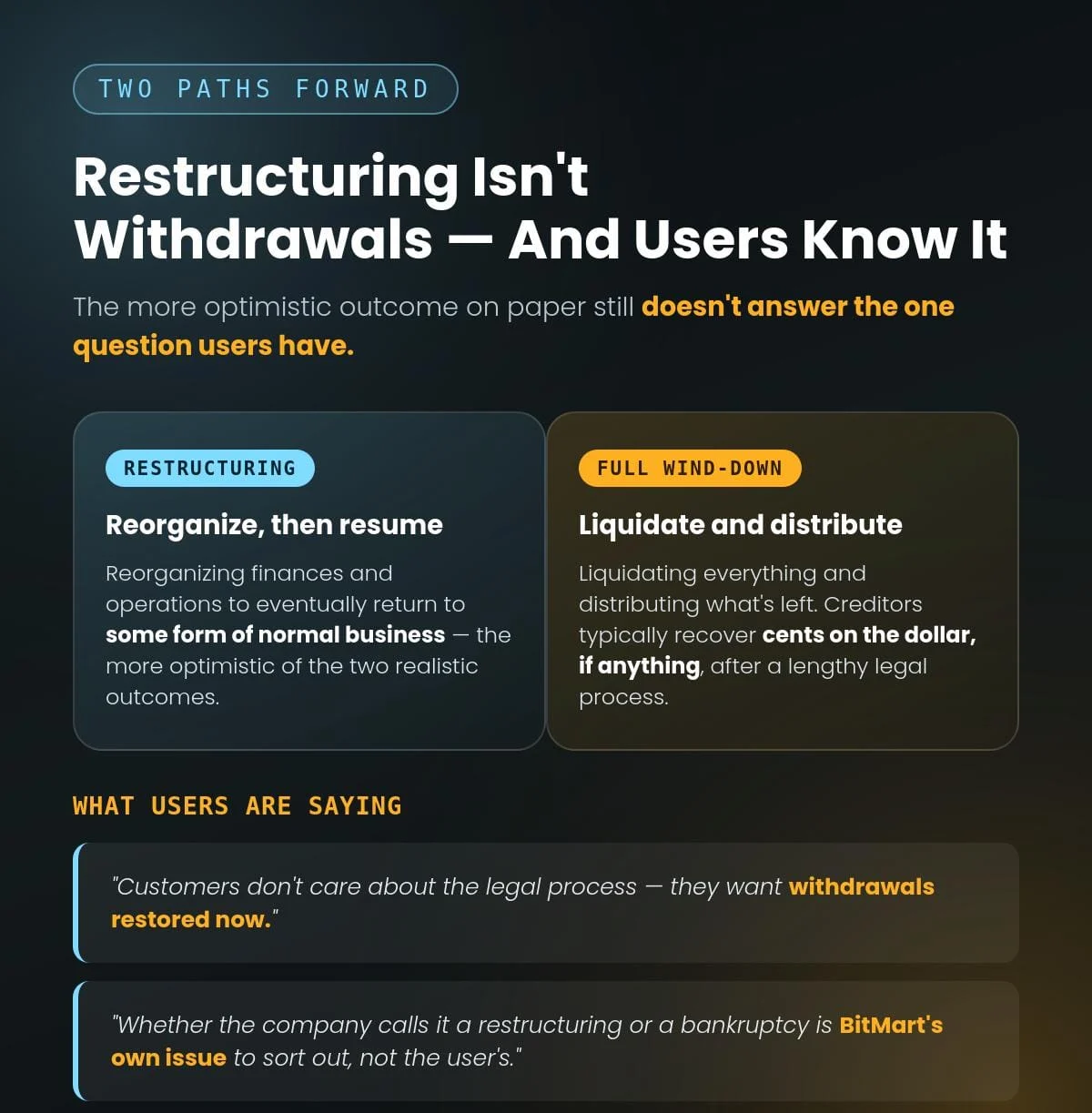
- Restructuring: In this context, restructuring typically implies that BitMart is attempting to reorganize its finances and operations with the aim of eventually returning to some form of normal business operations. The goal is to avoid liquidation by making fundamental changes to its debt, equity, and operational model. For users, a successful restructuring could mean a phased return of withdrawal capabilities, albeit potentially with limitations, or a distribution plan that eventually provides a higher recovery rate than a full liquidation. It often involves negotiations with creditors to agree on new terms for existing debts.
- Bankruptcy (or "Wind-down"): This path generally involves the liquidation of a company’s assets to pay off its creditors. In a full wind-down scenario, assets are sold off, and the proceeds are distributed according to a legal hierarchy of claims. For unsecured creditors, which most users with locked funds would likely be, this often translates to recovering "cents on the dollar," if anything, after a lengthy and costly legal process.
From a user’s perspective, restructuring is generally the more optimistic of the two realistic outcomes currently on the table. It offers the possibility, however distant, of the exchange resuming operations and users regaining access to their funds in a more substantial way than a liquidation. However, the success of a restructuring plan is never guaranteed, and the process can be protracted and complex.
User Reactions: A Torrent of Frustration and Legal Threats
The chasm between BitMart’s measured corporate tone and the lived reality of its users became immediately apparent in the deluge of public reactions. Across social media platforms and community forums, a palpable sense of anger, frustration, and despair boiled over. Users expressed a deep weariness with corporate platitudes and legalistic jargon, demanding immediate and concrete action.
One recurring sentiment was the accusation that BitMart was "stalling for time" rather than actively solving the problem. Many users emphatically stated that their primary concern was the restoration of withdrawals, not the intricacies of legal processes or the appointment of high-profile law firms. Some declared an absolute loss of trust, vowing never to conduct business with BitMart again, even if withdrawals were eventually reinstated.
The frustration has also manifested in more direct threats of legal action. Several users, including at least one widely cited reply, indicated their intent to pursue lawsuits directly against BitMart’s CEO or the company itself. These threats, while their ultimate legal viability remains uncertain, underscore the profound level of impatience and the feeling among users that their only recourse may be through the courts. The collective sentiment is clear: patience has worn thin, and the community expects tangible progress, not just promises of future updates. For many, their financial well-being is directly impacted, transforming what might be a corporate restructuring challenge into a personal crisis.
The Road Ahead: Waiting for September 9, 2026
For the multitude of individuals with funds still held on BitMart, the immediate practical reality is one of enforced waiting. Whether this waiting period is deemed acceptable or not, BitMart has set a clear next checkpoint: an update no later than September 9, 2026. This date is now the focal point for all affected parties, representing the next concrete opportunity for communication from the exchange.
The nature of that forthcoming update remains highly speculative. It could potentially bring a more defined withdrawal timeline, a formal filing outlining the restructuring plan, or, to the dismay of many, another iteration of hedged language, promising further details at a later date. Predicting the outcome from the current vantage point is impossible, given the complexities of legal and financial assessments involved.
Mitigating Risks: Warnings Against Scams and Unofficial Channels
In this period of heightened anxiety and uncertainty, BitMart itself, and indeed the broader crypto community, has rightly flagged the increased risk of scams. Crisis periods like the current one are fertile ground for malicious actors seeking to exploit desperate and anxious users. These scams can take various forms:
- Phishing Attempts: Impersonators posing as BitMart support or official representatives, sending emails or messages with malicious links designed to steal login credentials or private keys.
- Fake "Recovery Services": Fraudulent entities promising expedited fund recovery for a fee, often demanding upfront payments or access to user wallets, only to disappear with the funds.
- Unofficial Channels: Dissemination of false information or misleading "updates" through unofficial social media accounts or websites, aiming to trick users into divulging sensitive information.
For those affected, the safest course of action is to adhere strictly to BitMart’s official communication channels: its verified mobile application, official website, and authenticated social media accounts. Any unsolicited offer of "help" to recover funds faster should be treated with extreme suspicion and immediately reported. Vigilance and skepticism are paramount in safeguarding remaining assets and personal information during such volatile times.
Broader Implications for Crypto Trust and Regulation
The unfolding situation with BitMart is a stark reminder of the fragile state of trust within the cryptocurrency ecosystem and its broader implications for regulatory oversight. This familiar pattern—an exchange freezing withdrawals, citing operational or liquidity issues, engaging professional advisers, and appealing for user patience—has become a recurring narrative that erodes confidence with each repetition.
The disparity in pace between the company’s legal and financial due diligence and the users’ urgent need for access to their funds highlights a fundamental imbalance. While companies operate at the speed of legal frameworks, users are left in a state of financial paralysis, with no firm guarantees or timelines. This dynamic fuels calls for more robust regulatory frameworks that prioritize consumer protection and ensure greater transparency and accountability from centralized exchanges. Regulators worldwide are already grappling with how to effectively oversee digital asset platforms, and incidents like BitMart’s current crisis only intensify the pressure for clearer rules and stronger enforcement mechanisms to prevent such situations or at least provide clearer recourse for affected users.
The Lingering Question of Solvency and Future Viability
BitMart’s decision to pursue restructuring rather than a full wind-down is, on balance, the outcome that offers a greater likelihood of users eventually recovering some, if not all, of their assets. A complete liquidation often leaves unsecured creditors with minimal recovery after protracted legal battles. However, "more likely to eventually work out" and "acceptable right now" represent two fundamentally different standards.
Based on the torrent of reactions following BitMart’s announcement, its user base has unequivocally made clear which standard they are holding the exchange to. The future viability of BitMart, even under a successful restructuring, remains an open question. The damage to its reputation, the potential for significant user exodus, and the ongoing costs of legal and operational restructuring pose formidable challenges. The market will closely watch not only whether BitMart can successfully restructure but also whether it can ever regain the trust necessary to operate as a competitive force in the volatile and increasingly scrutinized cryptocurrency exchange landscape.
Disclosure: This is not trading or investment advice. Always do your research before buying any cryptocurrency or investing in any services.
Follow us on Twitter @themerklehash to stay updated with the latest Crypto, NFT, AI, Cybersecurity, and Metaverse news!