The euro stablecoin sector, a relatively niche but increasingly vital corner of the broader cryptocurrency market, is currently undergoing a significant transformation, characterized by a striking concentration of new capital inflows. While the overall stablecoin market is dominated by dollar-pegged giants like Tether’s USDT and Circle’s USDC, the euro-denominated segment offers a unique lens into nascent market dynamics, where individual movements are still discernible as a narrative rather than an overwhelming blur of vast figures. Recent data reveals a pronounced trend: out of the ten largest euro-pegged tokens, the vast majority of fresh capital injected over the past seven days converged on just three distinct assets, with a notable surge in a bank-issued token that significantly outpaced the combined growth of two of its most prominent crypto-native competitors.
Dominance Emerges: Three Tokens Capture the Lion’s Share of Growth
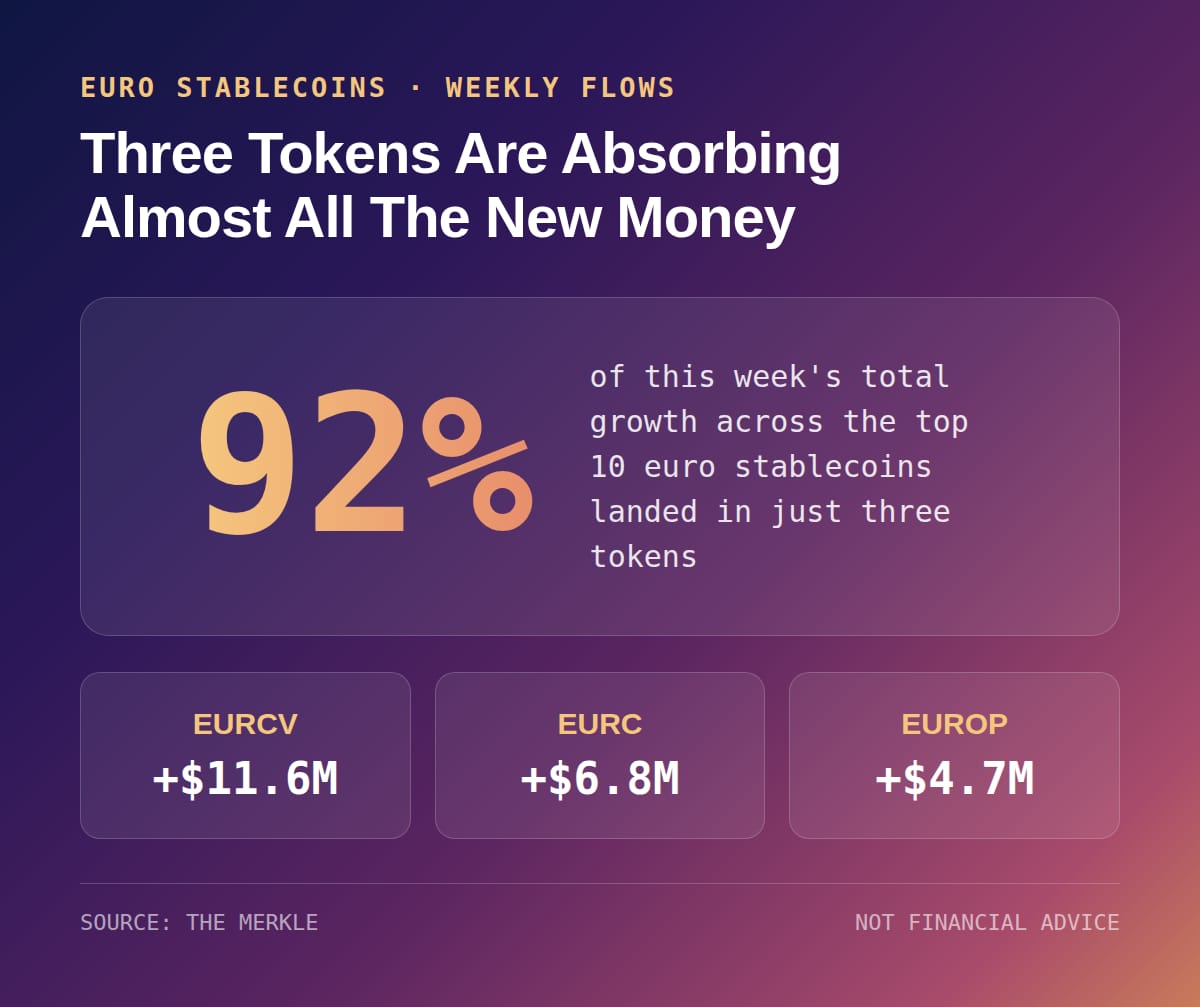
The most compelling insight from the latest market analysis is the sheer level of concentration, overshadowing mere growth for growth’s sake. Across the top ten euro stablecoins, weekly gains were almost entirely funneled into three specific assets: EURCV, EURC, and EUROP. EURCV, issued by Societe Generale’s digital asset arm, led the pack with an impressive $11.6 million increase in market capitalization. Circle’s EURC followed, adding $6.8 million, while Schuman Financial’s EUROP secured an additional $4.7 million. Cumulatively, these three tokens accounted for a remarkable 92% of the total growth observed across the leading euro stablecoins this past week.
This disproportionate share is particularly striking for a market that, on paper, lists ten competitors. In practical terms, seven of these tokens registered negligible movement, while the trio of EURCV, EURC, and EUROP performed almost all of the heavy lifting. For a sector still striving to establish its footing and demonstrate its potential alongside the multi-billion-dollar dollar-pegged stablecoin ecosystem, such a high degree of concentration offers crucial insights into the current direction of both institutional and retail demand within the European digital asset landscape. It signals a clear preference for specific offerings, driven by factors ranging from regulatory compliance and institutional backing to established infrastructure and robust liquidity.
The Foundational Role of Stablecoins in the Digital Economy
To fully appreciate the significance of these trends, it is essential to understand the fundamental role of stablecoins. Stablecoins are cryptocurrencies designed to minimize price volatility by being pegged to a stable asset, typically fiat currencies like the US dollar or the euro, or to commodities like gold. They serve as a crucial bridge between the volatile world of cryptocurrencies and traditional finance, offering a stable medium of exchange, a store of value, and a tool for efficient cross-border payments. For the European market, euro-pegged stablecoins are particularly vital, providing native euro liquidity within the blockchain ecosystem, which is essential for European businesses, investors, and consumers engaging with decentralized finance (DeFi) or other blockchain applications without exposure to dollar-denominated assets or foreign exchange risks. The overall stablecoin market capitalization reached well over $150 billion in early 2024, overwhelmingly dominated by USD-pegged tokens. The euro stablecoin market, while growing, remains a fraction of this, highlighting its nascent stage and significant potential for expansion, especially with increasing regulatory clarity.
Traditional Finance Takes the Lead: Societe Generale’s EURCV Ascent
The most significant development this week was the stellar performance of EURCV, the euro stablecoin issued by Societe Generale – Forge, the digital asset subsidiary of the venerable French banking giant, Societe Generale. EURCV’s $11.6 million market cap increase individually surpassed the combined growth of EURC and EUROP, marking a pivotal moment for a bank-issued digital asset.
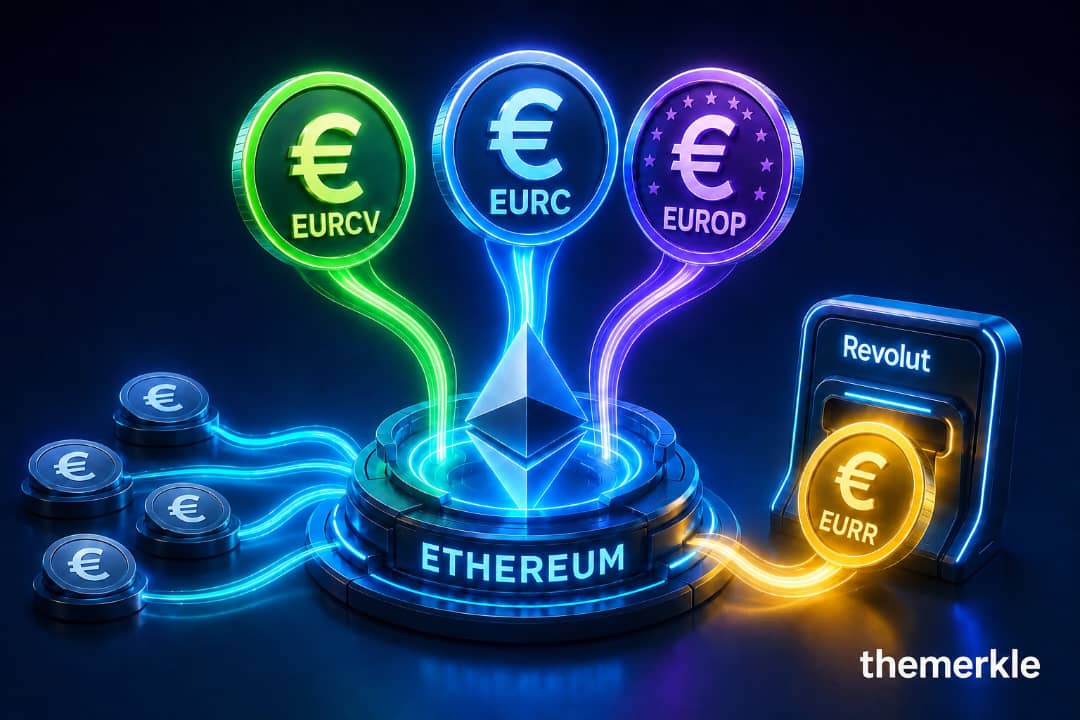
Societe Generale, one of Europe’s largest financial services groups, established Forge in 2019 to develop institutional-grade digital asset solutions, including security tokens and blockchain-native financial instruments. EURCV itself was launched with a strategic focus on providing regulated on-chain liquidity for institutional clients. Its initial deployment on Ethereum has since been expanded to a genuinely multichain footprint, a testament to Forge’s commitment to interoperability and broader market reach. This multichain strategy has involved integrations with various blockchain networks, aiming to make EURCV accessible across different decentralized ecosystems. The recent numbers strongly suggest that this extensive groundwork, which often garners headlines for new blockchain integrations, is now translating into tangible capital inflows rather than merely theoretical expansion.
From Societe Generale’s perspective, the success of EURCV validates their long-term vision for institutional digital assets. A representative from Societe Generale – Forge, speaking on their strategic objectives (as can be logically inferred from their public statements and project goals), would likely emphasize the importance of regulatory compliance, robust underlying infrastructure, and the trust inherent in a major financial institution. "Our focus with EURCV has always been to provide a secure, compliant, and highly liquid euro stablecoin for institutional use cases," an inferred statement might suggest. "The market’s response demonstrates the growing demand for digital assets issued by regulated entities, where the assurance of traditional financial backing meets the innovation of blockchain technology. Our multichain approach ensures that this trusted liquidity is available where our clients need it most." This strong performance by a traditional bank-backed stablecoin also underscores a broader industry trend: the increasing convergence of traditional finance with decentralized technologies, often facilitated by regulatory frameworks designed to bring clarity and safety to the digital asset space.
Crypto-Native Challengers: Circle’s EURC and Schuman Financial’s EUROP
While EURCV experienced an exceptionally strong week, its performance does not diminish the solid progress of its crypto-native rivals, Circle’s EURC and Schuman Financial’s EUROP. Both tokens posted meaningful weekly gains, showcasing their continued relevance and appeal within the euro stablecoin ecosystem.
Circle, a global financial technology firm, is best known for USDC, the second-largest dollar-pegged stablecoin. Leveraging its extensive infrastructure and experience with USDC, Circle launched EURC to cater to the growing demand for euro-denominated digital assets. EURC benefits significantly from Circle’s established reputation for transparency, regulatory adherence, and a broad network of integrations across various blockchain platforms and DeFi protocols. The company has been actively expanding EURC’s presence, including on emerging networks like Base, aiming to replicate the widespread adoption seen with USDC. Circle’s commitment to European markets and regulatory compliance, particularly with MiCA, positions EURC as a strong contender for institutional and retail adoption.
Schuman Financial’s EUROP also stands out due to its specific regulatory positioning. It boasts French ACPR (Autorité de Contrôle Prudentiel et de Résolution) licensing, a significant advantage in the highly regulated European financial landscape. Furthermore, EUROP emphasizes its KPMG-audited reserve structure, providing an additional layer of transparency and assurance for its users. This focus on stringent regulatory compliance and audited reserves is particularly appealing to institutional clients who prioritize legal certainty and financial transparency above all else.
Both EURC and EUROP are recognized as MiCA-compliant, fully reserve-backed euro tokens, each with its own institutional backing and strategic advantages. An inferred statement from Circle regarding EURC’s performance might highlight their "commitment to providing a robust and accessible euro stablecoin that integrates seamlessly into the global digital economy, building on the trusted infrastructure of USDC." Similarly, Schuman Financial could emphasize how EUROP’s "unwavering focus on regulatory clarity and transparent reserve management resonates strongly with institutions seeking compliant digital euro solutions within the European framework." Their continued growth, even when overshadowed by EURCV’s exceptional week, demonstrates a healthy, competitive market where diverse strategies are finding traction.
Ethereum’s Enduring Gravitational Pull in Digital Euro Flows
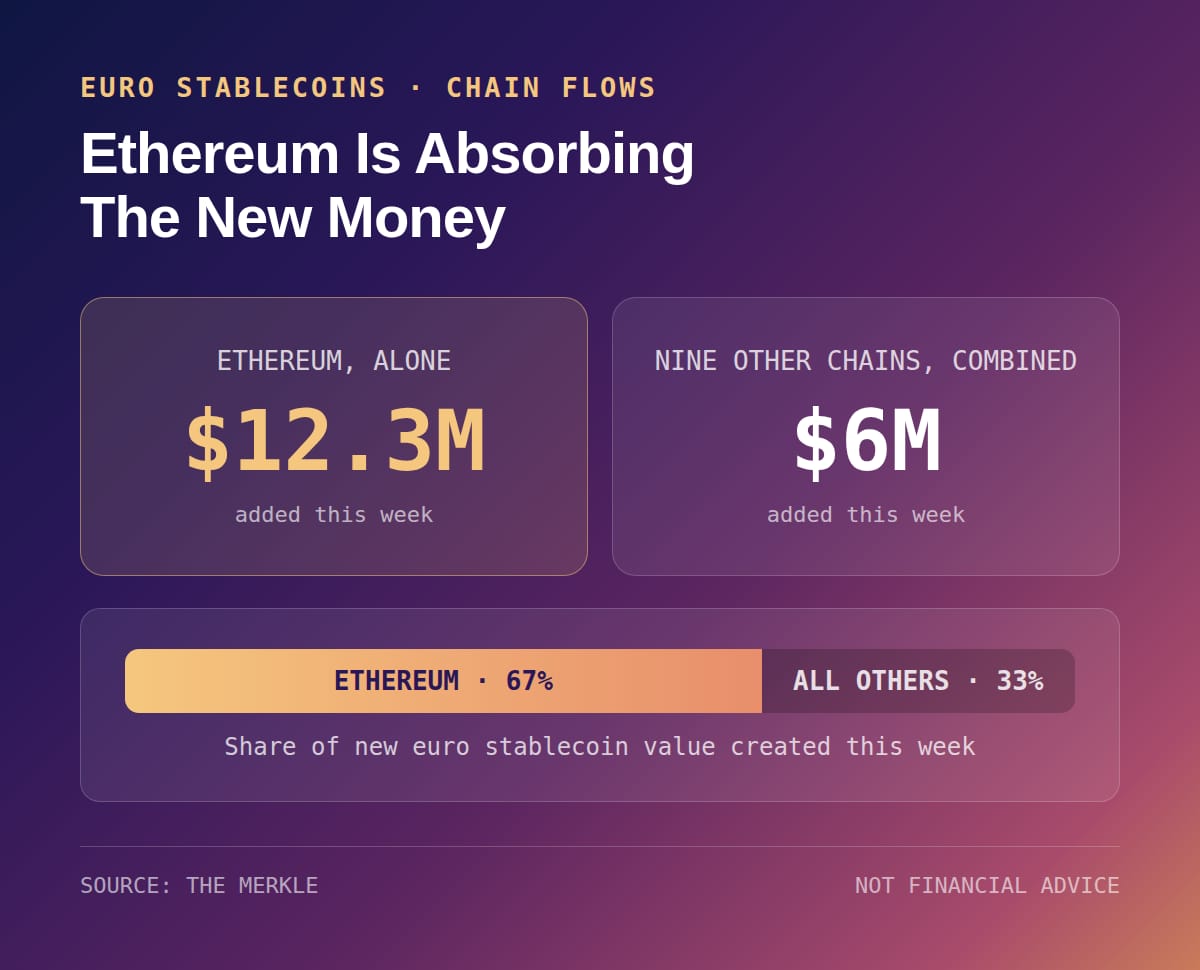
The chain-level data mirrors the token-level story of concentration, highlighting Ethereum’s enduring dominance in the stablecoin landscape. Over the past week, the market capitalization of euro stablecoins on Ethereum surged by $12.3 million. In stark contrast, the combined increase across all other nine chains where euro stablecoins are deployed amounted to a mere $6 million. This means Ethereum alone captured approximately two-thirds of all new euro stablecoin value created this week.
This pattern is particularly noteworthy given that euro stablecoins are now deployed across a wide array of networks, including Solana, Polygon, Avalanche, XRP Ledger, and Stellar, among others. The lopsided distribution of inflows underscores Ethereum’s persistent network effect, its robust DeFi ecosystem, and its perceived security, which continue to attract significant liquidity and institutional activity. The fact that EURCV, EURC, and EUROP all maintain a substantial presence on Ethereum strongly correlates with this trend; if the bulk of institutional and DeFi-driven demand landed with these tokens, it logically follows that Ethereum, as their primary hub, would register the most profound gains.
This phenomenon also serves as a crucial reminder that multichain expansion, while beneficial for improving accessibility and expanding marketing reach, does not automatically translate into balanced liquidity growth across all integrated networks. Issuers might deploy their tokens across ten different blockchains, yet witness the original, often most established, chain absorbing a disproportionately large fraction of new capital, while the other nine collectively attract only a fraction. This "multichain paradox" suggests that while broad deployment is important for reach, true liquidity and network effects remain concentrated in a few dominant ecosystems, at least for now.
The Regulatory Imperative: MiCA’s Role in Shaping the Market
The discussion around euro stablecoins is inextricably linked to the Markets in Crypto-Assets (MiCA) regulation, a landmark legislative framework introduced by the European Union. MiCA is designed to provide a comprehensive regulatory regime for crypto-assets across the EU, focusing on consumer protection, market integrity, and financial stability. Its provisions specifically address stablecoins, categorizing them into "e-money tokens" (EMTs) if they are pegged to a single fiat currency, and "asset-referenced tokens" (ARTs) if they reference other assets or a basket of currencies.
MiCA, which began to come into effect in June 2023 for stablecoin-related provisions, and will be fully applicable by December 2024, mandates strict requirements for stablecoin issuers. These include robust reserve management (e.g., holding reserves in highly liquid, low-risk assets segregated from operational funds), independent audits, capital requirements, and stringent authorization processes. Issuers must be authorized as credit institutions or e-money institutions. This regulatory clarity is a double-edged sword: it imposes significant compliance burdens but also offers a pathway to legitimacy and widespread adoption by institutional players who demand regulatory certainty.
The fact that leading tokens like EURC and EUROP explicitly highlight their MiCA compliance underscores the regulation’s profound influence on market dynamics. Institutions, in particular, are increasingly gravitating towards stablecoins that can demonstrate full adherence to these new standards, viewing it as a prerequisite for engaging with digital assets at scale. The success of a bank-issued token like EURCV, originating from an already highly regulated entity, further highlights how MiCA could inadvertently favor traditional financial institutions in the stablecoin issuance race, given their existing regulatory infrastructure and expertise. MiCA is not just a rulebook; it’s a filter, sifting out less compliant or transparent offerings and directing capital towards those that meet its rigorous standards.
Revolut’s EURR: A Glimpse into Retail Adoption and Future Potential
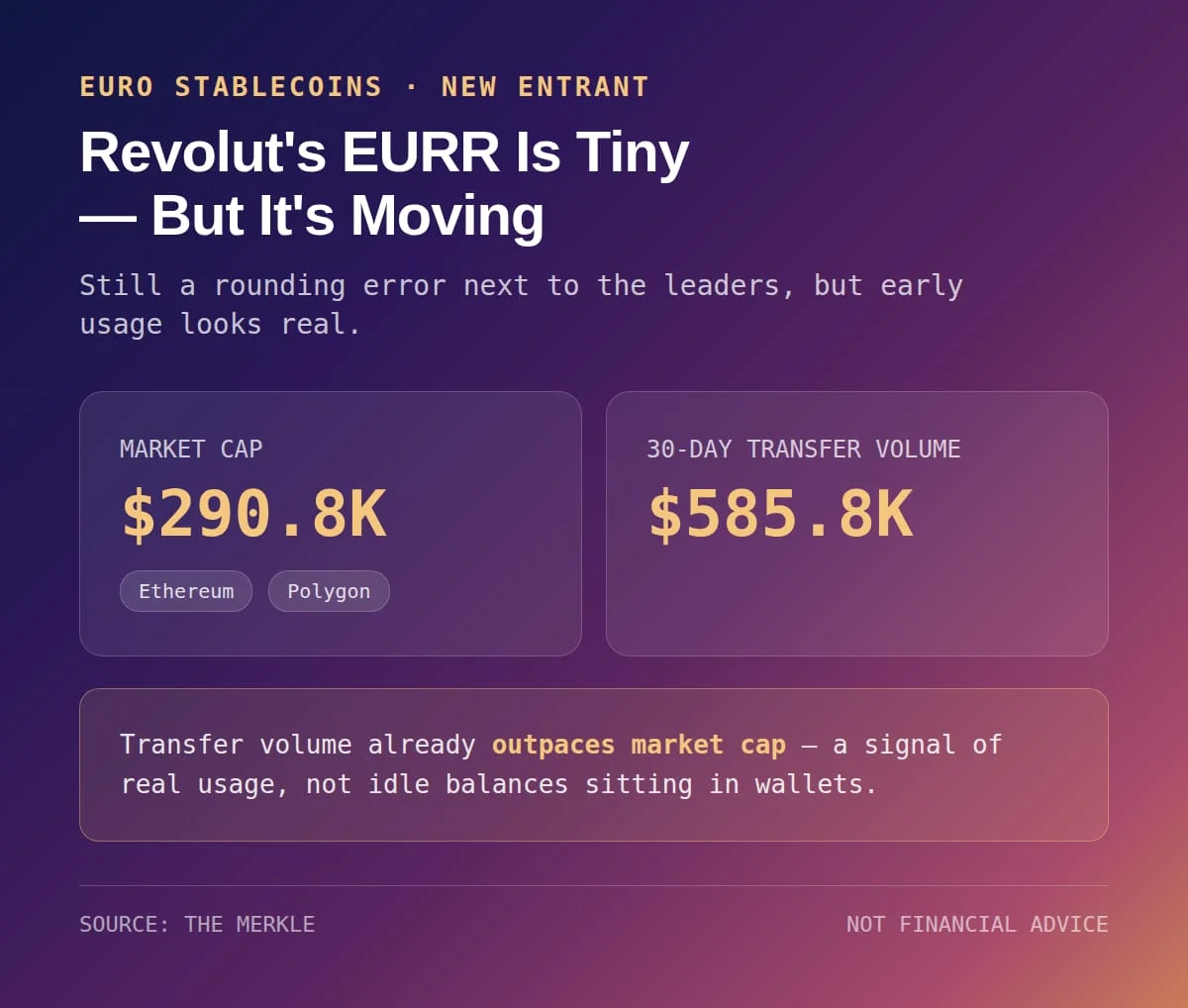
Amidst the established players and their concentrated growth, a newer entrant, Revolut’s euro stablecoin (EURR), offers a fascinating glimpse into the future of retail adoption. Revolut, a leading global fintech company and neobank with tens of millions of users across Europe and beyond, recently launched EURR. Currently, EURR’s market capitalization stands at a modest $290.8 thousand, with $585.8 thousand transferred over the past 30 days across Ethereum and Polygon. These figures are minuscule compared to the tens of millions in weekly movement seen by EURCV, EURC, and EUROP, indicating that EURR is still in its nascent stages, closer to a pilot phase than a full-scale market test. EURR only recently began its rollout to customers in a select handful of European markets.
However, what makes EURR particularly noteworthy is not its current size but the immense distribution potential it possesses. A euro stablecoin directly integrated into a widely adopted retail banking application, accessible to tens of millions of existing users, operates with a fundamentally different growth ceiling than tokens that primarily reside within crypto-native wallets or cater to a specialized institutional audience. Revolut’s ability to seamlessly onboard its vast user base into the digital asset ecosystem, potentially without them even realizing they are interacting with blockchain technology, could be a game-changer.
The fact that EURR’s transfer volume already outpaces its market capitalization is a critical indicator. It suggests genuine usage and active transactions, rather than just static balances held in a few large wallets. This metric hints at the potential for rapid scaling and widespread adoption if Revolut successfully leverages its user base and integrates EURR into its broader suite of financial services. While the "what if" remains an open question, EURR represents a significant strategic move, potentially bridging the gap between mainstream finance and digital currencies in a way that crypto-native offerings often struggle to achieve.
Broader Implications: The Evolving Landscape of European Digital Assets
Zooming out, the picture that emerges from these trends is one of a euro stablecoin market still in its formative years, actively determining its future leaders. A 92% concentration of weekly growth in just three tokens, coupled with two-thirds of new value landing on a single blockchain, is not indicative of a mature, evenly distributed sector. Instead, it signals an intense competitive race where factors like regulatory credibility, strategic blockchain presence, robust underlying infrastructure, and existing distribution networks are proving far more crucial than merely deploying a token’s logo on numerous blockchains.
This competitive dynamic carries significant implications for the future of digital assets in Europe. It suggests that traditional financial institutions, leveraging their established trust, regulatory expertise, and access to capital, may increasingly dominate the issuance of regulated stablecoins under frameworks like MiCA. This could lead to a more centralized stablecoin ecosystem in Europe compared to the more decentralized, crypto-native heavy landscape seen in the early days of dollar stablecoins.
Furthermore, the trends illuminate the ongoing debate between private stablecoins and potential Central Bank Digital Currencies (CBDCs), such as the proposed Digital Euro. Private stablecoins, particularly those from regulated entities, could serve as a valuable precursor or complement to a CBDC, providing immediate, market-driven digital euro liquidity. However, their success also raises questions about the long-term role and necessity of a state-issued digital currency if private options prove sufficiently robust and widely adopted.
Ultimately, euro stablecoins remain a relatively small fraction of the overall stablecoin market compared to their dollar-pegged counterparts. However, weeks like this one vividly illustrate where the early momentum is truly concentrating. For now, the spotlight shines brightly on Societe Generale’s EURCV, Circle’s EURC, and Schuman Financial’s EUROP, with the ambitious, app-based challenger, Revolut’s EURR, poised as a wildcard, just beginning its journey. The coming months, as MiCA fully takes hold and more institutions enter the fray, will undoubtedly bring further clarity to this dynamic and increasingly vital segment of the global digital economy. The race to define the future of the digital euro is well underway, and its outcomes will have lasting effects on finance across the continent.