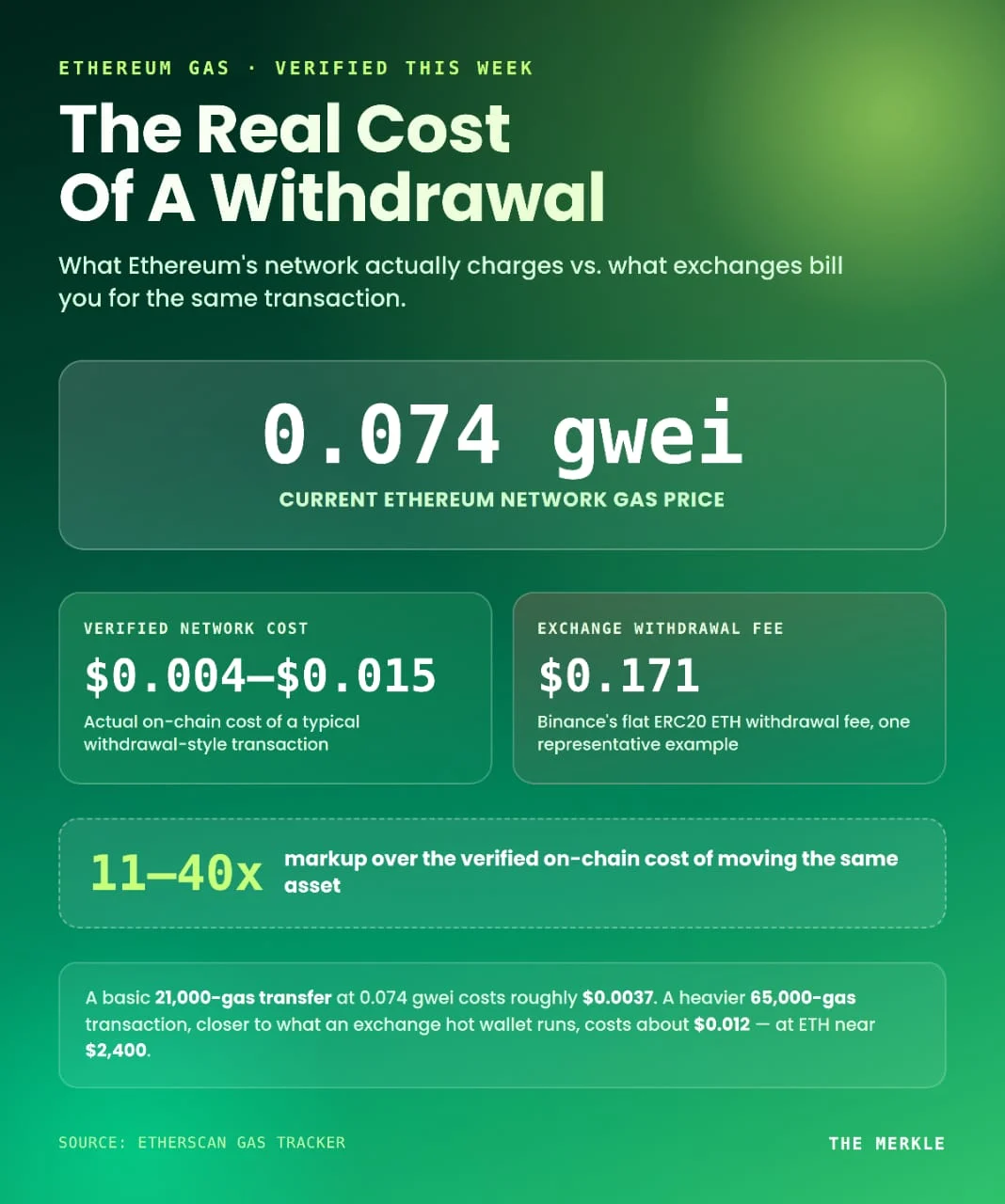
A recent examination of Ethereum’s live gas tracker revealed an almost astonishing figure: 0.074 gwei. This exceptionally low rate means that the cost of moving Ether (ETH) across the network is a mere fraction of a cent. However, a stark contrast emerges when comparing this verifiable on-chain cost with the withdrawal fees levied by major cryptocurrency exchanges for the same asset. This significant disparity, far from being an anomaly, is a systemic outcome of a pricing model largely predicated on "batching," a mechanism most users remain unaware of. The gap between what the blockchain truly charges and what users pay represents a substantial markup, prompting a deeper investigation into the economics of centralized exchange operations and their transparency.
Unpacking the Actual On-Chain Gas Costs
To establish a clear baseline, it is crucial to understand the verified ground truth of Ethereum’s network transaction costs. According to Etherscan’s authoritative live gas tracker, the network gas price for Ethereum was observed at 0.074 gwei. This was not a fleeting moment of inactivity; low, average, and high readings for the period were tightly clustered, indicating a sustained state of minimal network congestion. Independent gas tracking tools corroborated this range, with one live service pricing a standard 21,000-gas transfer at approximately $0.007. Broader industry data reinforces this trend, noting that daily average gas prices on the Ethereum mainnet have consistently remained below 1 gwei throughout much of 2026. This sustained period of affordability is a direct consequence of the network’s Pectra efficiency upgrades and the transformative blob-based scaling introduced by Ethereum Improvement Proposal (EIP) 4844, part of the Dencun upgrade.
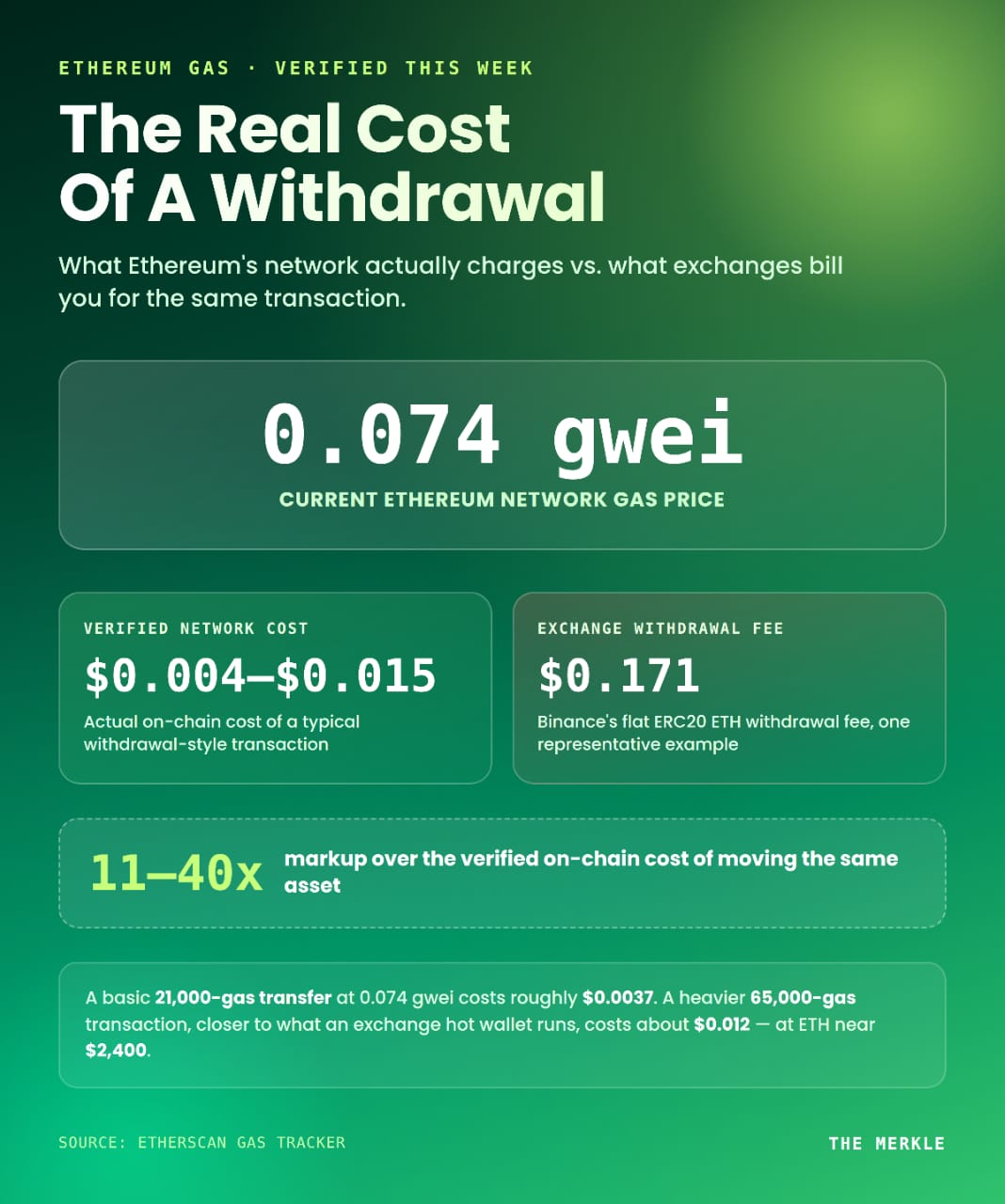
The mathematical breakdown further illuminates this point. A basic ETH transfer, consuming 21,000 gas, at a rate of 0.074 gwei, equates to approximately 0.0000015 ETH. With Ethereum currently trading at roughly $2,400, this translates to about $0.0037 – significantly less than half a cent. Even for more resource-intensive transactions, such as those that might be executed by an exchange’s sophisticated hot wallet infrastructure, involving closer to 65,000 gas, the cost remains remarkably low, around $0.012. Therefore, the verifiable range for what Ethereum’s network genuinely charges for a typical withdrawal-style transaction hovers between $0.004 and $0.015. Etherscan’s own knowledge base meticulously details this calculation process, offering full transparency for anyone wishing to independently verify these figures rather than relying solely on exchange-provided information.
The Evolution of Ethereum’s Fee Market: A Chronology of Efficiency
Understanding why Ethereum’s gas fees are currently so low requires a brief look at the network’s evolution. Historically, Ethereum’s fee market operated on a simple auction mechanism, where users bid against each other to have their transactions included in blocks. This often led to highly volatile and prohibitively expensive gas prices, especially during periods of network congestion, such as major NFT mints or DeFi liquidity events.
The first significant shift came with EIP-1559, implemented as part of the London hard fork in August 2021. This upgrade fundamentally altered Ethereum’s fee structure by introducing a "base fee" that is burned (removed from circulation) rather than paid to miners. Users could also include a "priority fee" (tip) to incentivize miners for faster inclusion. EIP-1559 aimed to make transaction fees more predictable and reduce their volatility, though periods of high demand could still push the base fee significantly upwards. While it didn’t eliminate high fees entirely, it laid the groundwork for a more stable fee market.

The more recent and impactful development for current low fees is the Dencun upgrade, implemented in March 2024. A cornerstone of Dencun was EIP-4844, also known as "Proto-Danksharding." This EIP introduced a new type of transaction data called "blobs" (Binary Large Objects), specifically designed to lower transaction costs for Layer-2 scaling solutions (like rollups). By providing a dedicated, cheaper space for L2 data on the mainnet, EIP-4844 indirectly reduced congestion and overall gas prices on the main Ethereum chain. The subsequent Pectra upgrades continued to refine network efficiency, contributing to the current environment of remarkably low transaction costs. This progression highlights a deliberate and successful effort by the Ethereum development community to scale the network and make it more accessible, a reality that the current exchange fee structures do not seem to fully reflect.
The Disparity: Exchange Withdrawal Fees Versus Network Costs
Against this backdrop of minimal on-chain costs, the fees imposed by centralized exchanges for asset withdrawals stand in stark contrast. Taking Binance as a representative example – a structure mirrored by many other major platforms – an ERC20 ETH withdrawal fee is currently listed at 0.00007 ETH. At Ethereum’s prevailing price of approximately $2,400, this translates to roughly $0.171. This figure is consistent with Binance’s publicly available official crypto fee schedule.
When juxtaposed with the verified mainnet cost range of $0.004 to $0.015, the markup applied by exchanges becomes strikingly evident. This differential ranges from approximately 11 times to an astonishing 40 times the actual network cost. This significant gap is not inherently indicative of malfeasance. Operating a cryptocurrency exchange involves substantial overheads: rigorous security audits, sophisticated cold storage management, extensive compliance teams navigating complex regulatory landscapes, and comprehensive insurance policies designed to mitigate the financial impact of the large-scale hacks that have unfortunately plagued the industry. These operational expenses legitimately require funding. Therefore, the mere existence of a markup is not the core issue; rather, it is the scale of this markup and how it compounds when considering the underlying mechanisms exchanges employ, particularly during periods of high withdrawal volume.
The Hidden Economics of Batching: A Core Profit Driver
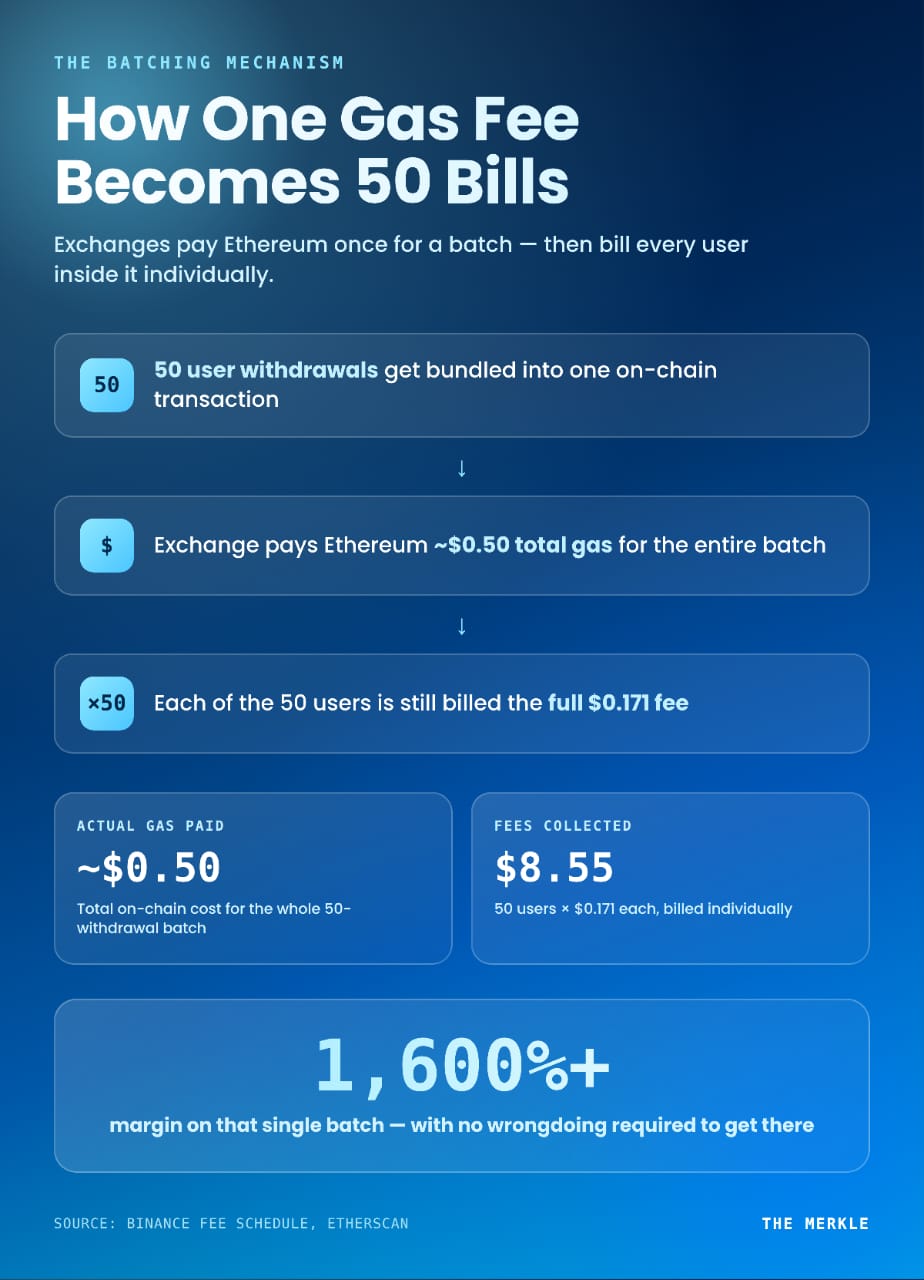
The most critical, yet often overlooked, aspect of exchange withdrawal fees is the practice of "batching." When a user initiates a crypto withdrawal from a centralized exchange, their transaction is rarely processed as a singular, isolated transfer. Instead, exchanges routinely consolidate multiple user withdrawals into a single, larger on-chain transaction. Alternatively, they route these withdrawals through optimized hot wallet infrastructure designed to minimize the total gas expenditure across a high volume of requests.
Consider the economic implications: a single batched transaction, encompassing dozens of individual user withdrawals, incurs Ethereum’s gas fee only once, or very close to it. Concurrently, every single user whose withdrawal is included in that batch is billed the full, individual withdrawal fee by the exchange. This is where the true profitability of the flat-fee model resides. If an exchange batches 50 individual withdrawals into one on-chain transaction that costs, for instance, $0.50 in total gas, and each of those 50 users is charged a flat fee of $0.171, the exchange effectively collects $8.55 in withdrawal fees. Against an actual network cost of merely $0.50, this represents a staggering margin of over 1,600% on that single batch.
This practice, while highly profitable for exchanges, does not typically involve any legal wrongdoing or overt deception. It simply highlights that the flat-fee model, which most exchanges continue to employ, was not engineered to dynamically track the real-time, fluctuating cost of the underlying blockchain transaction. Instead, it was designed for predictability, ease of communication to users, and to ensure a comfortable profit margin across a broad spectrum of network conditions, including periods when gas fees were significantly higher.
Exchange Justifications and Industry Perspectives
Centralized exchanges frequently articulate several justifications for their flat withdrawal fee structures. Foremost among these is the need to cover the aforementioned operational costs, which are extensive and critical for maintaining security, compliance, and infrastructure. They argue that these fees are necessary to sustain a secure and reliable service, providing custody and liquidity that many users still prefer over self-custody.
Furthermore, exchanges often cite the desire for simplicity and predictability for their users. A flat fee, regardless of network conditions, removes the uncertainty of fluctuating gas prices, making it easier for users to understand the total cost of their transaction upfront. This fixed pricing model also simplifies accounting and reconciliation processes for the exchanges themselves.
From an industry analyst’s perspective, these arguments hold some weight, particularly concerning the foundational operational costs. However, the sheer magnitude of the markup, especially during periods of sustained low gas prices, raises questions about transparency and fairness. Critics argue that while a reasonable margin is justifiable, the current model allows exchanges to profit excessively from a component (network fees) that is largely out of their direct control and whose actual cost to them is significantly lower. This dynamic has led to discussions about whether exchanges are adequately passing on the benefits of network efficiency upgrades, such as Dencun, to their user base.
The Alternative: Dynamic Pricing Models
Compelling evidence that flat fees are a business choice rather than a technical necessity comes from exchanges that have diverged from this model. Binance.US, for example, initiated a phased transition for its ETH and ERC-20 token withdrawal fees to a dynamic model, commencing in January 2022. This system is specifically designed to estimate fees in near real-time, factoring in Ethereum’s actual current network conditions, rather than imposing a static rate irrespective of network congestion. The exchange’s own documentation clearly articulates this shift, explaining that a withdrawal fee is distinct from, and charged in addition to, the underlying network fee itself.
This distinction is crucial. If flat withdrawal fees were solely intended to recoup legitimate infrastructure costs, there would be minimal commercial incentive for an exchange to transition to a pricing model that more accurately reflects real expenses. Such a dynamic model would inherently generate less excess margin during periods of low network congestion – precisely the environment that current gas trackers indicate. The very existence and functional implementation of dynamic pricing models demonstrate that the flat-fee approach, which remains the industry default, is a strategic business decision rather than an unavoidable engineering constraint. It underscores the potential for greater transparency and a more equitable distribution of cost savings derived from network efficiencies.
Broader Implications for Users and the Crypto Ecosystem
The implications of this fee disparity extend beyond mere transaction costs. For individual users, it means that checking a live gas tracker before initiating a withdrawal, while informative, will not alter the flat fee charged by most exchanges. However, it empowers users with the knowledge to discern how much of that fee constitutes genuine cost recovery versus built-in profit margin. This information is invaluable, whether for strategically timing withdrawals or for making informed decisions when comparing different platforms’ fee structures for the same assets.
On a macro level, this pattern represents less of a scandal and more of an "open secret" within the cryptocurrency industry – one that most users have little practical reason or means to investigate thoroughly. The practice of batching genuinely reduces aggregate gas costs for exchanges, but the flat fees they charge rarely adjust in real-time to reflect these efficiencies. Periodic fee reductions, when they occur, are often framed publicly as benevolent, customer-friendly gestures, rather than acknowledgments of the substantial margin that persists between what users are charged and what the underlying blockchain actually demands.
This lack of transparency can erode trust and potentially hinder broader crypto adoption, particularly for smaller transactions where a $0.17 fee on a $10 withdrawal represents a significant percentage. It also highlights a fundamental tension between the decentralized, transparent ethos of blockchain technology and the centralized, often opaque, business models of the intermediaries that facilitate access to it. As the crypto ecosystem matures, a greater push for fee transparency and more dynamic, cost-reflective pricing models from centralized exchanges could become a key differentiator and a significant factor in user choice and market competitiveness. Understanding this discrepancy doesn’t necessitate assuming malicious intent across the industry; it simply requires a willingness to scrutinize the numbers, which, as it turns out, is as simple as opening a gas tracker in a separate browser tab.
Disclosure: This is not trading or investment advice. Always do your research before buying any cryptocurrency or investing in any services.