
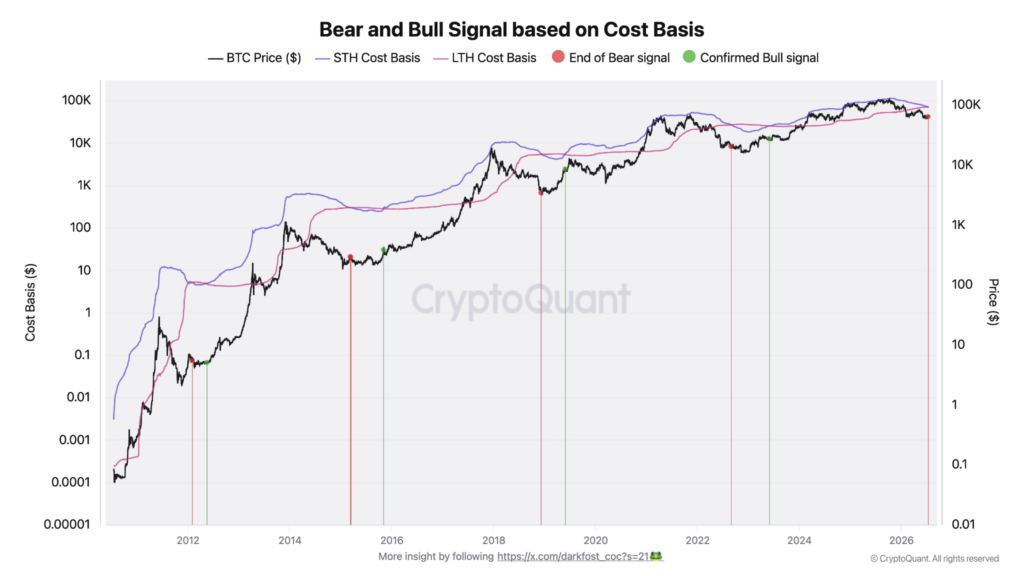
On-chain indicators are pointing towards a potential turning point in the prolonged cryptocurrency bear market, with a key metric related to Bitcoin investor behavior flashing a signal that has historically preceded market recoveries. Popular crypto analyst Darkfost recently highlighted a significant development: the downward crossover of the Short-Term Holder (STH) and Long-Term Holder (LTH) cost basis. This event, confirmed over a three-day period, suggests that the nine-month downturn that has plagued Bitcoin may be entering its final stages.
Darkfost articulated this crucial observation on social media, stating, "The end-of-bear-market signal has just flashed. This signal is defined by the downward crossover of the STH/LTH cost basis (with a 3-day confirmation window to validate the signal)." This signal, according to the analyst, indicates that the conditions are becoming ripe for a potential shift in market sentiment and price action.
To understand the significance of this crossover, it’s essential to define the terms. Short-Term Holders (STH) are investors who have held their Bitcoin for less than 155 days. Their cost basis represents the average price at which these more recent investors acquired their holdings. Long-Term Holders (LTH), conversely, are those who have held their Bitcoin for 155 days or longer. Their cost basis reflects the average price paid by more established, patient investors.
Historically, a downward crossover of the STH cost basis below the LTH cost basis has been a strong indicator of a bear market’s capitulation phase. When STH cost basis falls below LTH cost basis, it signifies that recent buyers are now holding their assets at a loss relative to the average purchase price of long-term holders. This often occurs during periods of intense selling pressure, where newer market participants are forced to sell at a loss, driving down the average acquisition cost for this group. The fact that this crossover has now occurred, and has been confirmed, suggests that a significant portion of newer investors have either exited the market or are holding at a substantial unrealized loss, potentially clearing the way for a more stable market base.
The accompanying graph shared by Darkfost visually illustrates this trend. It shows a dramatic decline in the STH cost basis, plummeting from a peak of approximately $112,500 to the current level of around $69,000. This substantial drop indicates that new entrants into the Bitcoin market over the past several months have, on average, acquired their BTC at significantly lower prices than previously. The convergence of the STH and LTH cost bases, and the potential for the STH cost basis to dip even further below the LTH cost basis in the coming months, suggests that the market may be consolidating and finding a bottom.
This development is particularly noteworthy given the duration of the current bear market. Bitcoin has experienced a prolonged period of price depreciation since its all-time highs reached in late 2021. The nine-month bear market has seen significant volatility, with sharp declines and periods of brief recovery, leaving many investors uncertain about the future trajectory of the digital asset. The STH/LTH cost basis crossover offers a glimmer of hope for a potential end to this extended downturn.

The Psychology of Short-Term and Long-Term Holders
The behavior of STHs and LTHs provides crucial insights into market sentiment and capitulation. During a bull market, new investors, often referred to as STHs, are typically drawn in by rising prices and the fear of missing out (FOMO). They tend to acquire Bitcoin at higher price levels, driving up the average STH cost basis. As the market turns bearish, these newer investors are often the first to panic sell when prices begin to fall, as they may have less conviction in the long-term viability of Bitcoin or are more sensitive to short-term losses. This selling pressure further depresses the STH cost basis.
Conversely, LTHs are typically more experienced investors who have weathered previous market cycles. They often have a higher conviction in Bitcoin’s long-term potential and are less susceptible to short-term price fluctuations. While LTHs may also experience unrealized losses during a bear market, their willingness to hold through these periods means their cost basis remains relatively stable or may even decline slowly as they potentially acquire more BTC at lower prices.
The point at which the STH cost basis falls below the LTH cost basis is a critical juncture. It signifies that the influx of new capital at higher prices has largely subsided, and the market is now dominated by the cost basis of more established holders. This can indicate that the most speculative elements of the market have been flushed out, and a more sustainable price floor is being established.
Historical Precedents and Data Analysis
Examining past Bitcoin market cycles reveals the predictive power of the STH/LTH cost basis crossover. In previous bear markets, this specific on-chain signal has often preceded significant price recoveries. For instance, during the 2018-2019 bear market, a similar crossover occurred, and was followed by a period of accumulation that eventually led to the bull run of 2020-2021. While past performance is not indicative of future results, the recurring nature of this signal across different market cycles lends it significant weight.
Further supporting data comes from the realized price of Bitcoin. The realized price is calculated by taking the price at which each Bitcoin was last moved on the blockchain. It’s essentially the total market capitalization divided by the total number of Bitcoins. The realized price acts as a sort of "average cost basis" for all Bitcoin holders. Currently, the realized price of Bitcoin is around $21,000. The STH cost basis of $69,000 is significantly above the realized price, indicating that even short-term holders, on average, are still holding at a profit relative to the absolute average cost of all Bitcoin. However, the downward trend of the STH cost basis suggests a rapid approach towards this average cost, which can act as a strong support level.
The Market Value to Realized Value (MVRV) ratio, another key on-chain metric, also provides context. The MVRV ratio compares the market capitalization of Bitcoin to its realized capitalization. When the MVRV ratio is low, it suggests that Bitcoin is undervalued relative to its historical cost basis. While the MVRV ratio has been in negative territory for an extended period during this bear market, a sustained move back into positive territory, often preceded by the STH/LTH crossover, is a bullish signal.
The Implications for Investors and Market Strategy
The current signal suggests that the "terminal phase" of the bear market is underway. This does not imply an immediate end to the downturn, but rather that the conditions are becoming favorable for a sustainable recovery. For investors, this period often presents an opportune moment to consider Dollar Cost Averaging (DCA). DCA involves investing a fixed amount of money at regular intervals, regardless of the price. This strategy can help mitigate the risk of buying at a market top and allows investors to accumulate assets at an average price that may prove favorable over the long term, especially if the market begins to recover.
The potential for Bitcoin to post a bottom in the near future and then establish a stable price range is a key implication of this on-chain data. While some market participants believe that Bitcoin has already seen its lowest point, around $58.5k, others argue that further price depreciation might be necessary before a definitive bottom can be called. The divergence of opinion highlights the inherent uncertainty that still surrounds the market.
The eventual upward crossover of the STH and LTH cost bases would serve as a strong confirmation of the onset of a bull market. This would signify that new capital is flowing back into the market at higher prices, and that short-term holders are once again acquiring Bitcoin at a premium, indicating renewed optimism and demand. However, there is no definitive timeline for this event, and it could take several months or even over a year to materialize, depending on broader market conditions and macroeconomic factors.
Broader Market Context and Bitcoin’s Maturation
Despite the ongoing volatility and the prolonged bear market, the current on-chain signals suggest that Bitcoin is continuing to mature as an asset class. The cyclical investor behavior, characterized by periods of irrational exuberance followed by capitulation and accumulation, appears to be enduring. This resilience of Bitcoin’s four-year cycle rhythms, even as some critics argue for its demise, indicates that fundamental investor psychology may still be at play.
The recent developments also occur against a backdrop of increasing institutional interest in cryptocurrencies and the ongoing evolution of regulatory frameworks globally. While these factors can introduce their own complexities and potential for volatility, they also suggest a growing mainstream acceptance of digital assets. The ability of Bitcoin to navigate these cycles, and for its on-chain metrics to provide consistent signals, points to a growing robustness in its market structure.
Looking Ahead
As the cryptocurrency market digests these on-chain signals, investors will be closely watching for further confirmation of a market bottom. The STH/LTH cost basis crossover represents a significant data point, suggesting that the most painful phase of the bear market may be behind us. However, the path to a full recovery is rarely linear, and investors should remain prepared for continued volatility. The continued development of Bitcoin’s ecosystem, coupled with evolving investor behavior, will undoubtedly shape its future trajectory. The current signals, while not a guarantee of an immediate bull run, offer a compelling case for optimism that the prolonged downturn may be approaching its conclusion. The coming months will be critical in determining whether these on-chain indicators will indeed herald the beginning of a new upward cycle for Bitcoin.