Foundry, the industry-leading digital asset infrastructure provider and operator of the world’s largest Bitcoin mining pool, Foundry USA, has officially unveiled plans to launch a dedicated Zcash (ZEC) mining pool tailored specifically for institutional participants. Scheduled for a commercial debut in April 2026, this move marks a significant expansion for the North American mining giant, signaling a strategic pivot toward privacy-preserving technologies and the diversification of institutional-grade mining services. The initiative aims to address a long-standing deficiency in the Zcash ecosystem: the lack of robust, compliant, and enterprise-ready infrastructure capable of supporting the rigorous requirements of public companies and large-scale financial institutions.
The announcement comes at a pivotal moment for the cryptocurrency mining industry, which has seen a trend toward consolidation and professionalization following the most recent Bitcoin halving. By leveraging its dominant position in the Bitcoin mining sector—where Foundry USA consistently commands the highest share of the global network hashrate—Foundry intends to bring the same level of transparency, reliability, and regulatory compliance to the Zcash network. This expansion is not merely a technical addition to Foundry’s portfolio but a calculated entry into the privacy coin market, which has faced both regulatory scrutiny and renewed interest as a fundamental component of the digital financial future.
Bridging the Institutional Gap in Privacy Technology
The core motivation behind the new Zcash pool, according to Foundry leadership, is the maturation of Zcash as an asset class. While Zcash has existed since 2016 and is widely recognized for its advanced cryptographic foundations, the infrastructure surrounding its production has historically been fragmented or geared toward retail miners. Mike Coyler, CEO of Foundry, emphasized that while Zcash has evolved into an institutional-grade asset, the mining infrastructure supporting it has failed to keep pace. This gap has created a barrier for institutional entities that require audited, US-based, and operationally transparent mining partners.
Foundry’s entry is expected to provide these entities with a "safe harbor" for participating in the Zcash network. As a US-based operator, Foundry adheres to strict regulatory standards, providing a level of comfort to public companies that are often wary of joining mining pools with opaque ownership structures or those operating in jurisdictions with weak oversight. The new pool will function similarly to Foundry USA, utilizing a collaborative model where miners combine their computational power—known as hashrate—to increase the statistical probability of solving blocks and earning rewards, which are then distributed among participants.

The Technical Foundation of Zcash and the Role of Privacy
To understand the significance of Foundry’s move, it is essential to examine the unique properties of Zcash. Originally derived from the Bitcoin codebase, Zcash shares several fundamental economic principles with the world’s largest cryptocurrency. It features a hard supply cap of 21 million tokens and utilizes a "halving" mechanism that occurs approximately every four years, reducing the rate of new token issuance to ensure long-term scarcity.
However, Zcash diverges from Bitcoin in its approach to transactional privacy. While Bitcoin is "pseudonymous"—meaning all transactions and wallet balances are visible on a public ledger—Zcash utilizes zero-knowledge proofs, specifically zk-SNARKs (Zero-Knowledge Succinct Non-Interactive Arguments of Knowledge). This technology allows users to transact without revealing the sender, receiver, or the amount involved, all while maintaining the integrity of the blockchain through cryptographic verification.
The press release issued by Foundry highlighted this dual nature, noting that Zcash demonstrates how financial privacy and compliant digital infrastructure can coexist. For institutions, this is a critical distinction. In a traditional financial setting, privacy is a legal requirement (such as bank secrecy laws), and Zcash offers a digital equivalent that allows for "shielded" transactions that can still be audited for compliance purposes through viewing keys.
A Chronology of Growth: The Zcash Hashrate Boom
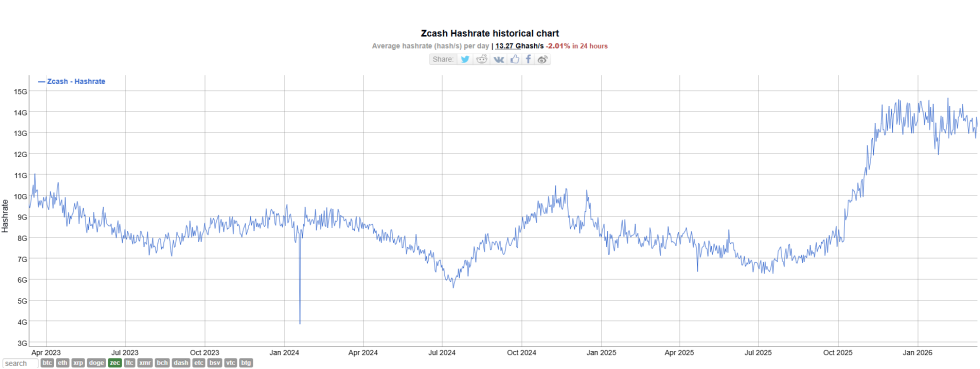
Foundry’s decision to enter the Zcash market is supported by compelling network data. Over the past several months, the Zcash network has experienced a significant surge in hashrate, indicating a renewed interest from miners and a likely influx of more efficient mining hardware.
According to data from BitInfoCharts, the computational power dedicated to securing the Zcash blockchain remained relatively stable for years but began a sharp upward trajectory in late 2025 and early 2026. In October, the ZEC hashrate was measured at approximately 8 Ghash/s. By March 2026, that figure had climbed to over 13 Ghash/s, representing a nearly 63% increase in network security and competition in just a few months.

This hashrate boom is often a leading indicator of institutional interest. As more powerful ASIC (Application-Specific Integrated Circuit) miners designed for the Equihash algorithm—the proof-of-work algorithm used by Zcash—are deployed, the network becomes more resilient against attacks. For a pool operator like Foundry, this rising tide provides the necessary liquidity of hashrate to launch a viable and competitive pool.
Collaboration with Shielded Labs and the Role of Zooko Wilcox
The launch of the institutional pool is being coordinated with key stakeholders in the Zcash ecosystem, most notably Shielded Labs. Based in Switzerland, Shielded Labs is an independent organization dedicated to supporting the development and adoption of Zcash. Zooko Wilcox, the founder of Zcash and current Chief Product Officer at Shielded Labs, expressed strong support for Foundry’s involvement.
"We at Shielded Labs are delighted that Foundry—the largest Bitcoin mining pool, and one based in North America—is launching an enterprise-grade Zcash mining pool," Wilcox stated. His endorsement underscores the importance of geographic diversity in mining. With much of the world’s mining power historically concentrated in various regions across Asia and Europe, the establishment of a major North American pool for Zcash enhances the decentralization of the network and provides a localized option for Western institutional miners.
The partnership also suggests a shared vision for the future of Zcash, focusing on the "Shielded" protocol. Shielded Labs has been instrumental in pushing for upgrades that make privacy features more accessible and efficient, ensuring that the coin remains at the forefront of the "Privacy-Enhancing Technologies" (PETs) sector.
Market Implications and the Regulatory Landscape
The timing of Foundry’s April 2026 launch date is significant within the broader context of the crypto market. Zcash is currently trading at approximately $209, a price point that reflects a recovery from previous lows but remains volatile, having seen an 11% retracement in recent weeks. For miners, the profitability of Zcash is tied to both the market price and the difficulty of the network.
From a regulatory standpoint, privacy coins have often been viewed with skepticism by global watchdogs like the Financial Action Task Force (FATF). Some exchanges have delisted privacy-focused assets to simplify their compliance burdens. However, Foundry’s approach—focusing on "institutional-grade" infrastructure—suggests a path forward where privacy and regulation are not mutually exclusive. By providing a transparent, US-based mining pool, Foundry allows institutions to earn ZEC in a manner that can be easily integrated into corporate balance sheets and tax filings.
Furthermore, the expansion of the largest Bitcoin pool operator into Zcash may trigger a "halo effect," where other infrastructure providers begin to view privacy-centric blockchains as viable sectors for investment. It validates the "Proof of Work" model for privacy coins at a time when many other networks are migrating to Proof of Stake.
Future Outlook: Toward April 2026 and Beyond
As Foundry prepares for the April 2026 rollout, the mining community will be watching closely to see how the pool integrates with existing institutional services. Foundry already offers a suite of products, including hardware procurement, financing, and advisory services. Integrating Zcash into this ecosystem allows the company to offer a "multi-asset" mining strategy to its clients, enabling them to hedge their bets across different protocols.
The broader impact on the Zcash network could be profound. A massive influx of institutional hashrate through Foundry could lead to higher network difficulty, potentially squeezing out smaller, less efficient retail miners but ultimately resulting in a more secure and stable blockchain. For Zcash, which has often lived in the shadow of Bitcoin’s massive market cap, the arrival of Foundry represents a "coming of age" moment.
In conclusion, Foundry’s planned Zcash mining pool is more than just a new service offering; it is a bridge between the world of high-finance and the frontier of cryptographic privacy. By applying the successful blueprint of its Bitcoin operations to Zcash, Foundry is positioning itself as the primary architect of the next generation of institutional mining infrastructure. As the April 2026 launch approaches, the industry will likely see a heightened focus on the intersection of privacy, compliance, and large-scale digital asset production.