


In a move that has resonated across the cryptocurrency ecosystem, Trust Wallet, a long-standing and widely utilized non-custodial crypto wallet, has publicly acknowledged a significant shortcoming in its product: its underperformance in supporting meme coin trading. This candid admission, delivered not through a quiet software update or a subtle changelog entry but via an open message from a team member, stands in stark contrast to the typical industry practice of silently rectifying issues. It signifies a pivotal moment for the nine-year-old platform and underscores the growing mainstream importance of meme trading within the broader crypto market.
The Unveiling of a "Weak Spot": Trust Wallet’s Candid Confession
For nearly a decade, Trust Wallet has cultivated a reputation as a robust and secure gateway to the decentralized world, enabling millions of users to manage a vast array of cryptocurrencies across numerous blockchains. Its genesis in 2017, predating much of the recent meme coin frenzy, established it as a reliable tool for long-term holding and general crypto transactions. However, the rapidly evolving landscape, particularly the meteoric rise of meme coins, has exposed areas where even established players can fall behind.
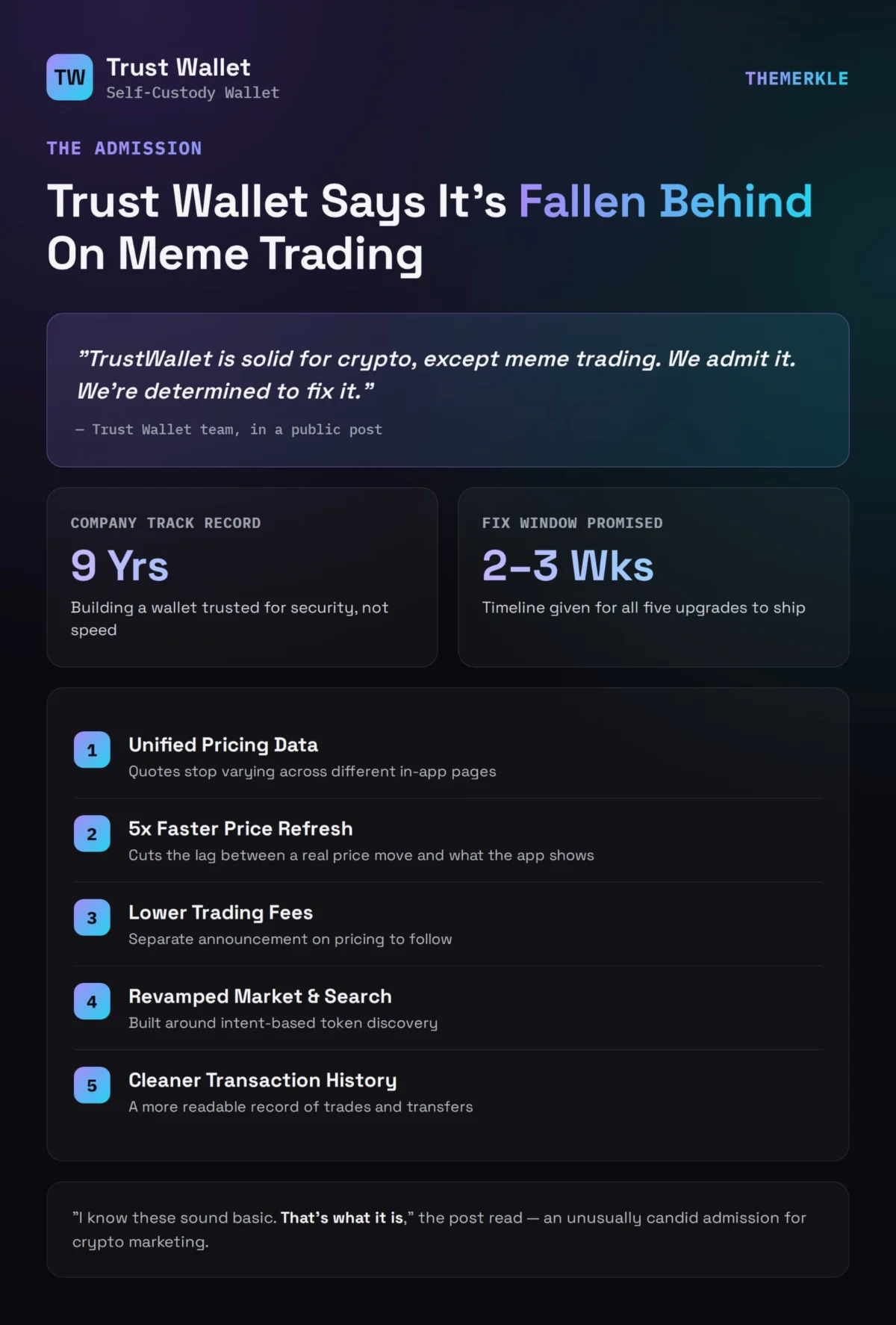
In its recent public statement, Trust Wallet articulated its Achilles’ heel with unusual directness: "TrustWallet is solid for crypto, except meme trading. We admit it. We’re determined to fix it." This straightforward declaration immediately set a different tone from the often-guarded language of corporate communications in the tech sector, especially within the highly competitive crypto space. The company did not merely confess; it also outlined a concrete roadmap for improvement, promising five specific upgrades slated for implementation within the next two to three weeks.
These upcoming enhancements are designed to address core pain points experienced by meme traders:
- Unified Pricing Data: Eliminating discrepancies in asset quotes across different pages within the application.
- 5x Faster Price Refresh Rate: Providing near real-time market data essential for volatile assets.
- Lower Trading Fees: A direct reduction in transaction costs, with a detailed announcement forthcoming.
- Revamped Market and Search Experience: Introducing a more intuitive, intent-based discovery mechanism for new and trending tokens.
- Cleaner, More Readable Transaction History: Improving clarity and ease of tracking past trades.
The unglamorous nature of these promised fixes is notable. They are not flashy, groundbreaking features but rather fundamental improvements to existing functionalities that, as the company itself acknowledged, "sound basic. That’s what it is." This candor suggests a deep understanding of user frustration and a commitment to addressing core usability issues rather than pursuing superficial marketing wins. In an industry often criticized for hype cycles and exaggerated claims, Trust Wallet’s grounded approach offers a refreshing change.

Understanding the Demands of Meme Trading: Why Speed and Accuracy Reign Supreme
To fully appreciate the significance of Trust Wallet’s planned upgrades, one must understand the unique demands of meme coin trading, which diverge sharply from traditional cryptocurrency investment or long-term holding. Meme tokens are characterized by extreme volatility, often experiencing price swings of 30%, 50%, or even hundreds of percent within minutes of launch or significant social media traction. In this high-stakes environment, the difference between profit and loss frequently hinges on speed and accuracy.
Consider the scenario of a trader attempting to capitalize on a rapidly trending meme coin. A wallet that displays inconsistent prices across different screens is not merely an inconvenience; it can lead to misinformed decisions, causing a trader to enter or exit a position at a sub-optimal, or even detrimental, price. Similarly, a slow price refresh rate, where an application might show a price that is five or ten seconds old, can be catastrophic. In the world of meme coins, five seconds can mean the difference between catching a token at its nascent stage and buying into an already inflated asset, missing the primary profit window.
Beyond execution, discovery is equally paramount. Meme trading is inherently a game of identifying the next viral token before the broader market catches on. A "Market" tab that intelligently surfaces genuinely relevant, intent-based results – perhaps by tracking real-time social sentiment, trading volume spikes, or new listings – offers immense value to an active trader. Conversely, a cluttered or poorly designed discovery interface can leave users feeling blind to emerging opportunities, forcing them to seek external tools or alternative wallets. The combination of rapid price changes, tight trading windows, and the imperative for early discovery makes meme trading a punishing environment for any wallet not optimized for speed, precision, and intuitive navigation.
A Retrospective: Trust Wallet’s Journey and Market Position
Founded in 2017 and later acquired by Binance in 2018, Trust Wallet quickly established itself as a leading non-custodial wallet solution. Its appeal lay in its multi-chain support, user-friendly interface, and a strong emphasis on security, empowering users with full control over their private keys. Over its nine-year tenure, it amassed a genuinely enormous user base, becoming a default choice for many everyday crypto holders globally. This long-standing trust and widespread adoption were built on its reliability for storing, sending, and receiving a diverse range of digital assets, as well as its basic integration with decentralized applications (dApps).
However, the crypto market is dynamic. While Trust Wallet excelled at being a secure vault and a general-purpose access point to Web3, the explosion of DeFi, NFTs, and most recently, the meme coin phenomenon, introduced new user behaviors and expectations. As meme trading surged in popularity, driven by cultural trends, social media virality, and the allure of rapid gains, users began to demand more than just secure storage. They sought integrated tools that could keep pace with the hyper-fast, speculative nature of these assets. Trust Wallet, by its own admission, found itself trailing in this specific, yet increasingly significant, niche.

The Competitive Landscape: How Rivals Capitalized on Meme Trading Demands
Trust Wallet’s public admission highlights a crucial trend: while it built its foundation on security and broad utility, other wallets have strategically carved out market share by hyper-focusing on specific user needs, particularly those of active traders.
Phantom’s Meme-Centric Approach:
Perhaps the most direct competitor in the realm of meme trading optimization is Phantom Wallet, particularly dominant within the Solana ecosystem. Phantom effectively built its reputation by understanding and catering to the precise demands of meme traders. Its "Explore" tab, for instance, is not just a general dApp browser but a dynamic dashboard that surfaces trending tokens in real-time, allowing users to see what other Phantom traders are actively buying without ever leaving the application. This intent-based discovery mechanism provides a powerful advantage, giving users an edge in identifying nascent trends.
Furthermore, Phantom’s swap feature is designed for predictability and efficiency, often applying a flat, transparent fee (typically around 0.85% regardless of trade size). This clarity allows traders to easily calculate costs mid-trade, a critical factor when dealing with rapid price movements. Beyond these core features, Phantom has actively integrated deeper trading infrastructure, launching "Phantom Perps" through a Hyperliquid integration for perpetual futures trading and developing "Phantom Terminal," a more advanced desktop trading interface complete with professional-grade charting tools for high-frequency traders. For Solana-native meme trading, Phantom has evolved beyond a mere wallet; it functions more like a dedicated trading terminal that also securely manages users’ private keys.
MetaMask’s Broad Utility vs. Niche Focus:
MetaMask, another titan in the crypto wallet space, presents a slightly different competitive narrative. While it boasts unparalleled breadth, supporting the Ethereum ecosystem and numerous EVM-compatible chains, its approach to meme trading has been more about general utility than specialized tools. Its built-in swap feature aggregates quotes across multiple decentralized exchanges (DEXs) and market makers, aiming to find competitive routes while charging a service fee of approximately 0.875%. A standout feature for active traders is its "Gas Station," which allows users to pay network fees using the token they are swapping into, eliminating the need to constantly ensure a separate ETH balance for gas – a genuine convenience for those frequently rotating capital between different meme tokens.
However, MetaMask’s "Discover" tab has historically leaned more toward general dApp browsing and NFT exploration rather than dedicated, real-time meme coin trending. As a result, heavier or more sophisticated meme traders often bypass MetaMask’s in-app swap for larger or more complex trades, opting instead to route directly through a DEX for potentially better rates or more advanced order types. MetaMask’s strength lies in its universal compatibility and foundational role in Web3, but its meme trading experience, while competent, hasn’t been its primary differentiator.
The Multi-Chain Advantage: Bitget Wallet and Others:
Multi-chain competitors like Bitget Wallet have carved out their niche by addressing the fragmented nature of the meme coin market, which spans across Solana, Base, Ethereum, Avalanche, and other networks. Bitget Wallet, for example, has developed a dedicated in-app "Meme" section that actively tracks trending tokens across its more than 100 supported networks. Crucially, it aggregates swap pricing automatically to find the best available rate, regardless of whether a trader is rotating capital between different blockchain ecosystems. This built-in, cross-chain meme discovery and optimized execution represent a significant competitive edge, one that Trust Wallet’s revamped Market and Search tabs will need to genuinely contend with upon their release.

The Paradigm Shift: Meme Trading as a Mainstream Imperative
This unfolding narrative is not merely about a feature race between competing crypto wallets; it’s a powerful signal about the maturation and diversification of the cryptocurrency market. Meme trading, once considered a fringe activity by a niche group of speculative investors, has evolved into a mainstream phenomenon. The sheer volume of daily transactions, the enormous market capitalization of top meme coins (e.g., Dogecoin and Shiba Inu, which have collectively commanded tens of billions of dollars), and their pervasive influence on crypto culture underscore their undeniable significance.
When a wallet of Trust Wallet’s stature – a nine-year-old platform with a genuinely enormous global user base – openly admits that its meme trading experience has lagged, it’s more than a product roadmap update. It’s an acknowledgment of where user expectations have truly landed. The modern crypto user, particularly those drawn to the fast-paced world of meme coins, demands tools that are not just secure but also hyper-responsive, efficient, and intuitive for rapid asset discovery and execution. The traditional strengths of a wallet, such as robust security and broad asset support, while still critical, are no longer sufficient to guarantee user loyalty if the actual trading experience falls short in a key, high-engagement area.
Trust Wallet’s tone in its admission is particularly telling: "I’m still amazed by how many users and supporters stick with Trust Wallet even though we know it’s not perfect across every feature." This level of honesty from a company speaks volumes. It suggests that Trust Wallet understands that loyalty, however deep-rooted in trust and security, can only sustain a product for so long if users are consistently forced to seek alternative platforms for the activities they increasingly prioritize. The company recognizes that while its foundational strengths have retained a user base, the evolving landscape necessitates adapting to new user behaviors to prevent further attrition.
Implications of Trust Wallet’s Strategy: Transparency and Trust
Trust Wallet’s decision to be transparent about its weaknesses carries several significant implications. Firstly, it could serve to strengthen user trust. In an industry often plagued by opacity and exaggerated marketing, genuine candor can be a powerful differentiator. By openly acknowledging shortcomings and committing to swift rectification, Trust Wallet signals respect for its user base and a willingness to listen to feedback, potentially fostering deeper loyalty among existing users and attracting new ones who value honesty.
Secondly, this move could intensify competition within the crypto wallet sector. By explicitly targeting features that competitors like Phantom and Bitget Wallet have mastered, Trust Wallet is directly challenging their market positioning. This heightened competition is ultimately beneficial for users, as it drives innovation and forces all players to continually refine their products, leading to better user experiences across the board.

However, the strategy is not without its risks. The public declaration sets high expectations. If Trust Wallet fails to deliver on its promised upgrades within the stated two-to-three-week window, or if the improvements do not meet user expectations for quality and performance, the candor could backfire, eroding the very trust it sought to build. The challenge of delivering "faster" and "unified" experiences evenly across a global user base, operating on wildly different devices and network conditions, is considerable.
The Road Ahead: Execution and User Experience
The next few weeks will be critical for Trust Wallet. If it successfully implements all five promised upgrades – unified pricing, a 5x faster refresh rate, lower trading fees, enhanced discovery, and a cleaner transaction history – it could meaningfully narrow the gap with specialized meme trading wallets like Phantom and multi-chain aggregators like Bitget Wallet. Crucially, it would achieve this without sacrificing the broader multi-chain support and the long-standing reputation for security and reliability it has meticulously built over nearly a decade.
The true test will lie in the execution. "Faster" and "unified" are claims that are relatively easy to announce but considerably harder to deliver flawlessly at scale. The crypto community will be watching closely to see if Trust Wallet can translate its candid admission into a tangible, improved user experience that genuinely addresses the demands of the modern meme trader.
For now, what stands out most is not just the roadmap itself, but the fact that a wallet of this establishment felt compelled to vocalize its deficiencies. In a market where meme trading increasingly drives daily engagement, trading volumes, and cultural relevance, admitting a lag in this area is no longer a sign of weakness. Instead, it is a pragmatic acknowledgment of where the battle for user attention and loyalty has decisively shifted, signaling a potential new standard of transparency and responsiveness in the ever-evolving world of crypto wallets.
Disclosure: This is not trading or investment advice. Always do your research before buying any cryptocurrency or investing in any services.














