Bitcoin, once heralded as the digital gold of the 21st century, is increasingly exhibiting characteristics akin to a high-risk stock market proxy, according to a recent analysis by Mike McGlone, a senior macro strategist at Bloomberg Intelligence. This evolving correlation with traditional equity markets, particularly U.S. equities, coupled with tightening monetary policy from the Federal Reserve, suggests a potentially turbulent period ahead for the leading cryptocurrency, with some analysts forecasting a significant downturn.
The narrative surrounding Bitcoin’s intrinsic value and its role as a hedge against inflation has been challenged by its recent price action. Instead of acting as an independent asset, Bitcoin’s movements have become more synchronized with the broader risk-on sentiment that often dictates the performance of stocks. This shift in behavior has led to heightened volatility and increased susceptibility to macroeconomic headwinds, raising concerns among investors and analysts alike.
The Shifting Paradigm: Bitcoin’s Correlation with Equities
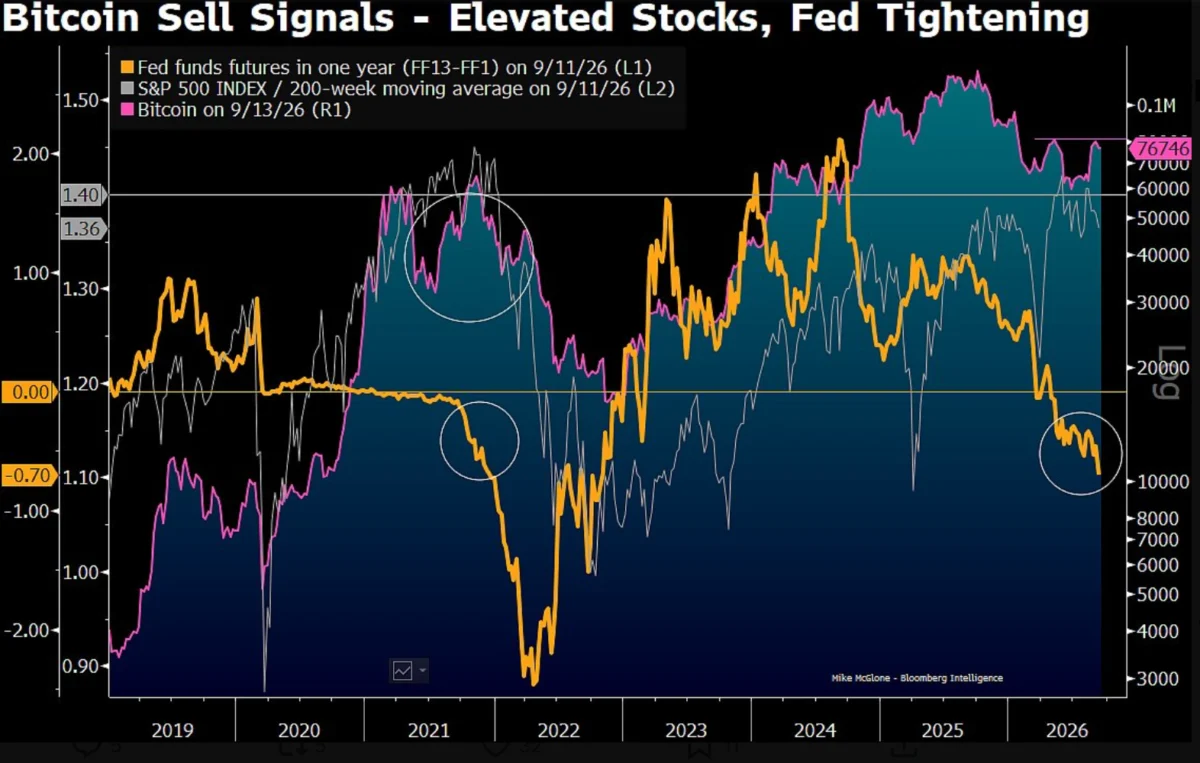
A pivotal observation from McGlone’s analysis centers on Bitcoin’s burgeoning correlation with the S&P 500, the benchmark index for U.S. equities. Over the past five years, the performance trajectory of Bitcoin has, in many instances, mirrored that of the S&P 500. While this synchronization might suggest a broader market trend influencing all asset classes, it comes with a critical caveat: Bitcoin has historically exhibited nearly three times the volatility of the S&P 500.
From a portfolio management and risk assessment standpoint, this combination presents a precarious proposition. Investors who seek to diversify their portfolios or gain exposure to a potentially uncorrelated asset might find Bitcoin’s current behavior counterintuitive. The prospect of receiving stock-like returns while shouldering significantly greater risk inherently diminishes its appeal as a stable, long-term investment.
McGlone posits that Bitcoin has effectively become the "beta" of the cryptocurrency market. In financial parlance, beta measures a stock’s volatility in relation to the overall market. In this context, Bitcoin’s price movements are heavily influenced by the collective sentiment and performance of other digital assets, which themselves are often speculative. With millions of other cryptocurrencies vying for investor capital, Bitcoin’s position as the market leader makes it particularly vulnerable to shifts in risk appetite within the broader crypto ecosystem. If investors begin to de-risk, reducing their exposure to speculative assets, Bitcoin, as the most prominent and liquid cryptocurrency, could experience an amplified downside.
Economic Headwinds and the Federal Reserve’s Influence
Beyond its correlation with equities, external economic factors are also contributing to the bearish outlook for Bitcoin. McGlone points to the current state of U.S. equities, suggesting they may be overextended relative to their long-term trend. A key indicator he highlights is the S&P 500’s distance from its 200-week moving average, a widely watched technical metric. A significant divergence from this long-term trend can often signal an impending market correction. Given Bitcoin’s increasing entanglement with equity market dynamics, a sustained decline in stocks could have a disproportionately negative impact on BTC’s price.
The U.S. Federal Reserve’s monetary policy stance represents another significant factor exerting pressure on Bitcoin and other risk assets. Market participants are closely monitoring signals from the Fed regarding potential interest rate hikes. Fed funds futures, which reflect market expectations, currently indicate a strong likelihood of roughly 70 basis points of rate increases over the next year. This tightening of monetary policy, characterized by higher interest rates, typically makes borrowing more expensive and can lead investors to shift away from riskier assets in favor of more conservative, yield-generating investments. For assets like Bitcoin, which have historically benefited from periods of low interest rates and ample liquidity, a sustained period of Fed tightening could create a more challenging environment, potentially leading to capital outflows and price depreciation.
Historical Precedents and Potential Price Targets
McGlone’s analysis is not the first time a prominent figure has issued a dire warning about Bitcoin’s future. However, his current outlook, which suggests a potential drop to $10,000, has garnered significant attention due to his track record and the specific reasoning provided.
A key element of his bearish thesis revolves around historical relationships between Bitcoin and broader risk assets. He suggests that a persistent decline of 20% or more in the S&P 500 could trigger a much more profound sell-off in Bitcoin. This assertion is based on observing past market cycles where significant downturns in traditional markets have led to amplified losses in the cryptocurrency space.
The strategist has presented a chart indicating Bitcoin’s recent rebound towards the $80,000 resistance area as a potential warning sign rather than a confirmation of a renewed bull market. He interprets this move as a possible temporary bounce before another downward leg. This perspective challenges the optimistic sentiment that often accompanies such price recoveries, suggesting that underlying systemic weaknesses might still be in play.
In his most bearish scenario, McGlone envisions Bitcoin heading towards its long-standing pivot point around $10,000. For context, with Bitcoin trading around $77,300 on Sunday, reaching $10,000 would necessitate a price plummet of approximately 87%, according to data from CoinGecko. At such a valuation, Bitcoin’s market capitalization would shrink to roughly $200 billion, a stark contrast to its current valuation of approximately $1.55 trillion. It’s worth noting that Bitcoin had previously reached an all-time high of $126,080 in October, and since then, it had already experienced a decline of roughly 38.6% prior to the period of this analysis.
New York Mayor’s Bitcoin Paycheck: A Symbol of Shifting Attitudes?
The timing of McGlone’s analysis, which suggests a potential downturn, coincided with a notable event in the world of cryptocurrency adoption: New York City Mayor Eric Adams receiving his first paycheck in Bitcoin. In November 2021, Mayor Adams announced his intention to convert his initial mayoral salary into Bitcoin and Ether, a move that was widely publicized as a bold embrace of digital assets by a major political figure.
While the direct causal link between Mayor Adams’ paycheck and Bitcoin’s price movements is unlikely and speculative, the event itself is symbolic. It represents a growing acceptance and integration of cryptocurrencies into mainstream financial and political discourse. The mayor’s decision, alongside other initiatives like Miami Mayor Francis Suarez’s embrace of Bitcoin, signals a potential shift in how public figures and institutions view and interact with digital currencies.

However, the volatility inherent in Bitcoin means that such adoption, especially when tied to salaries or income, carries significant risk for the recipient. If Bitcoin’s price were to experience a sharp decline, the fiat value of the mayor’s converted paycheck would diminish accordingly. This inherent risk underscores the speculative nature of Bitcoin and the potential for substantial fluctuations in its purchasing power.
Despite any potential price dips that may have occurred around the time of his salary conversion, Mayor Adams has publicly expressed no regrets. He has consistently advocated for New York City to become a hub for cryptocurrency innovation and investment, emphasizing the long-term potential of these technologies. His stance suggests a belief in the underlying value and future growth of Bitcoin, even in the face of short-term market volatility. This confidence, from a prominent city leader, can serve as a powerful endorsement for the burgeoning digital asset space, encouraging further exploration and adoption.
Broader Implications and the Future of Bitcoin
The ongoing debate surrounding Bitcoin’s intrinsic value, its correlation with traditional markets, and the influence of macroeconomic factors highlights the complex and evolving landscape of digital assets. While proponents continue to champion Bitcoin as a revolutionary technology with the potential to disrupt traditional finance and serve as a store of value, critics point to its volatility and speculative nature as significant drawbacks.
McGlone’s analysis, while bearish, contributes to a broader conversation about Bitcoin’s role in the global financial system. If Bitcoin indeed continues to behave as a high-risk equity proxy, its utility as a safe-haven asset or an inflation hedge may be further questioned. This would necessitate a re-evaluation of its investment thesis by many market participants.
The implications of a significant Bitcoin downturn, as predicted by some analysts, could extend beyond individual investors. It could impact the broader cryptocurrency market, potentially leading to a deleveraging event and a period of consolidation. Furthermore, the regulatory response to such a downturn could also intensify, as governments and financial watchdogs grapple with the implications of a volatile and interconnected digital asset market.
Conversely, proponents argue that Bitcoin’s resilience and its ability to recover from significant drawdowns underscore its long-term potential. They believe that as the digital asset space matures, Bitcoin will eventually decouple from traditional markets and establish itself as a distinct asset class with unique properties.
Ultimately, the trajectory of Bitcoin will be shaped by a confluence of factors, including technological advancements, regulatory developments, macroeconomic conditions, and evolving investor sentiment. While short-term price predictions remain inherently uncertain, the ongoing discourse and analyses, such as those from Bloomberg Intelligence, provide valuable insights into the forces shaping the future of this pioneering cryptocurrency. The embrace by figures like Mayor Adams signifies a tangible step towards mainstream integration, even as the inherent risks of volatility remain a significant consideration for all involved.