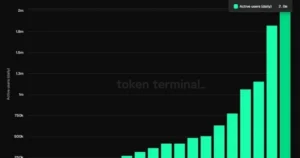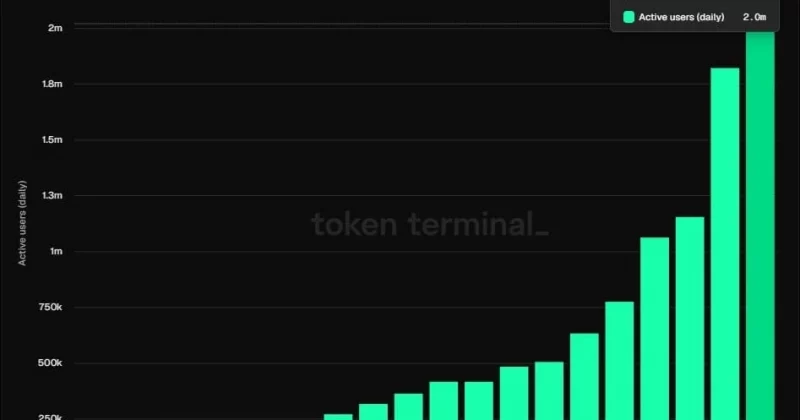
Tron has achieved a significant milestone, crossing the 4 million daily active user (DAU) threshold and surpassing Solana to claim the top position among major blockchain networks. This remarkable surge in user activity is not attributed to the speculative frenzy surrounding Decentralized Finance (DeFi) or the hype of Non-Fungible Tokens (NFTs), but rather to the consistent and high-volume utilization of stablecoins, particularly Tether (USDT). This shift underscores a fundamental driver of blockchain adoption that prioritizes utility and accessibility over speculative trading.
The Stablecoin Engine Powers Tron’s Ascent
The data reveals a dramatic upward trajectory for Tron’s user base. In the fourth quarter of 2025, the network averaged approximately 2.8 million DAU, placing it just behind Solana’s 2.9 million. By February 2026, this figure had climbed to an impressive 3.2 million. The most recent data confirms that Tron has now cleared the 4 million DAU mark, a testament to its rapidly expanding ecosystem.
This substantial growth is intrinsically linked to the robust activity of USDT on the Tron network. USDT transfer volumes on Tron frequently surpass $20 billion on a daily basis, indicating a massive flow of capital and transactions facilitated by the stablecoin. As of May 2025, the circulating supply of USDT on Tron had already exceeded $75 billion, representing more than half of Tether’s total global supply. This concentration highlights Tron’s pivotal role in the stablecoin economy.
Furthermore, Tron’s infrastructure is demonstrably capable of handling this increased load. The network processes over 8 million daily transactions, a figure that dwarfs many of its competitors and showcases its scalability. This transactional capacity has contributed to the accumulation of over 306 million total user accounts, suggesting a broad and diverse user base engaging with the network.
Why Stablecoins Outperform Speculation in Driving User Growth
The foundational architecture of Tron, established by founder Justin Sun in 2017 with its mainnet launch in 2018, was designed with specific goals in mind: high throughput and low transaction fees. These core principles have proven to be a critical enabler for stablecoin adoption. Unlike the volatile nature of cryptocurrencies that attract traders seeking quick gains, stablecoins offer a predictable store of value pegged to traditional fiat currencies. This stability makes them ideal for everyday transactions, remittances, and cross-border commerce, activities that require reliability and cost-effectiveness.
The low fees on the Tron network make it an attractive platform for individuals and businesses looking to move value efficiently. For users in regions with less developed financial infrastructure, stablecoins like USDT on Tron offer a accessible gateway to digital finance, enabling participation in global markets and facilitating cross-border payments without the prohibitive costs and complexities associated with traditional banking systems. This utility-driven adoption, fueled by stablecoins, presents a more sustainable and organic growth model compared to ecosystems heavily reliant on speculative trading.
The contrast with networks primarily driven by DeFi speculation or NFT trading is stark. While these sectors can generate periods of intense activity and high user engagement, they are often susceptible to market fluctuations and can experience rapid user churn when sentiment shifts. Tron’s growth, anchored by the steady demand for stablecoin utility, suggests a more resilient and foundational user base.
Implications for Investors and the Broader Blockchain Landscape
The sustained high transaction volume on Tron is not merely a statistical anomaly; it is structurally tied to global remittance flows and cross-border commerce. This indicates that Tron is becoming an integral part of the digital economy, facilitating real-world financial activities. The native token, TRX, plays a crucial role in this ecosystem, as it is required to pay transaction fees and participate in the network’s governance. This creates a direct demand for TRX, as its utility is intrinsically linked to the network’s operational activity.
However, this reliance on a single asset, USDT, also presents a significant risk of concentration. The network’s user numbers and transaction volumes are overwhelmingly dependent on the stability and continued dominance of Tether. Any disruption to Tether’s operations, whether through regulatory action, technological issues, or a significant loss of confidence, could pose an existential threat to Tron’s user base and activity levels. For instance, if Tether were to face severe regulatory scrutiny in major jurisdictions or if a competing stablecoin like USD Coin (USDC) were to gain substantial traction on the Tron network, the current user numbers could experience a sharp reversal. This highlights the delicate balance between leveraging a dominant asset for growth and mitigating the risks associated with such concentration.
The success of Tron in attracting a vast user base through stablecoin utility offers a compelling case study for other blockchain networks. It suggests that focusing on practical applications and providing cost-effective solutions for everyday financial needs can be a more potent driver of long-term growth than solely catering to speculative markets. As the digital economy matures, the demand for reliable and accessible financial tools will likely increase, positioning networks that can effectively facilitate these transactions for sustained success.
A Look at the Chronology of Tron’s Growth
- 2017: Tron is founded by Justin Sun.
- 2018: Tron’s mainnet is launched, emphasizing high throughput and low fees.
- Q4 2025: Tron averages approximately 2.8 million daily active users, trailing Solana.
- February 2026: Tron’s DAU climbs to approximately 3.2 million.
- Recent Data: Tron surpasses 4 million daily active users, becoming the leading major blockchain network by this metric.
- May 2025: USDT circulating supply on Tron exceeds $75 billion, representing over half of Tether’s total supply.
Supporting Data and Network Metrics
- Daily Active Users (DAU): Over 4 million.
- Daily Transactions: Over 8 million.
- Total User Accounts: Over 306 million.
- USDT Transfer Volume (Daily): Frequently exceeds $20 billion.
- USDT Circulating Supply on Tron (May 2025): Over $75 billion.
Broader Impact and Future Considerations
Tron’s achievement is more than just a statistic; it signifies a potential shift in how blockchain networks achieve mass adoption. The dominance of stablecoins in driving user activity suggests that the "killer app" for blockchain might not be a complex DeFi protocol or a groundbreaking NFT collection, but rather a fundamental financial utility that addresses real-world needs. This is particularly relevant in emerging markets where access to traditional financial services is limited.
The concentration risk remains a critical point of analysis. While USDT’s prevalence on Tron has been a powerful growth engine, the network’s future success will likely depend on its ability to diversify its use cases and attract a broader range of applications beyond stablecoin transfers. This could involve fostering innovation in areas like decentralized applications (dApps), gaming, or supply chain management, thereby reducing its over-reliance on a single asset.
For investors, the implications are multifaceted. The strong utility-driven demand for TRX, tied to transaction fees and governance, could provide a stable foundation for its value. However, the inherent risk associated with Tether’s market position cannot be ignored. Diversification of network activity and a robust ecosystem of dApps would be crucial for Tron to solidify its position as a leading blockchain network in the long term, mitigating the risks associated with its current stablecoin-centric growth model. The continued evolution of regulatory landscapes for stablecoins globally will also be a significant factor influencing Tron’s trajectory.
The path forward for Tron will likely involve a strategic balance between capitalizing on its existing strengths in stablecoin facilitation and actively cultivating new avenues for growth and utility. Its ability to navigate these challenges will determine whether its current leadership position is a fleeting moment or a lasting testament to the power of accessible and utility-driven blockchain solutions.
Disclosure: This article was edited by the Editorial Team. For more information on how we create and review content, see our Editorial Policy.