The native token of the Binance ecosystem, BNB, has solidified its position at the forefront of the digital asset market, reclaiming its status as the world’s fourth-largest cryptocurrency by market capitalization after a decisive move ahead of XRP. This resurgence has reignited a fierce debate among analysts and investors regarding the long-term price ceiling of the asset. While optimistic projections of BNB reaching $10,000 or even $20,000 frequently circulate within retail trading circles, a rigorous mathematical analysis suggests that such valuations would require a fundamental shift in the entire global financial landscape and a massive expansion of the total cryptocurrency market capitalization.
The Current Market Position and the XRP Reversal
In May 2024, BNB successfully overtook XRP in market capitalization rankings, a milestone that reflected both the recovery of the Binance exchange following its regulatory settlements in the United States and the continued expansion of the BNB Chain ecosystem. As of mid-2024, BNB maintains a market capitalization of approximately $80.6 billion. This valuation places it in an elite bracket, trailing only Bitcoin (BTC), Ethereum (ETH), and the stablecoin USDT.
The rivalry between BNB and XRP has historically been a barometer for sentiment regarding centralized exchange utility versus cross-border payment utility. However, the gap between the two has widened significantly. For BNB to maintain this lead and begin closing the distance with Ethereum, it must navigate a complex path of institutional adoption and ecosystem diversification. Currently, Ethereum’s market capitalization sits comfortably above $200 billion, meaning BNB would need to more than double its current value—reaching a price of approximately $1,500—just to match Ethereum’s current size, assuming Ethereum’s price remains stagnant.
The Mathematical Reality of Five-Figure Price Targets
Crypto Patel, a prominent market analyst, recently published a breakdown of the structural and mathematical hurdles facing BNB’s ascent to the $10,000 mark. The core of the analysis rests on the relationship between token supply and market capitalization. BNB operates on a "burn" trajectory, with the ultimate goal of reducing the total supply to 100 million tokens.

Under the assumption that this 100-million-token supply target is eventually reached, the implications of a $10,000 price point are staggering:
- At $10,000 per token: BNB would command a market capitalization of $1 trillion. To put this in perspective, $1 trillion is roughly the valuation Bitcoin held during major portions of the 2021 and 2024 bull cycles.
- At $20,000 per token: BNB would reach a $2 trillion valuation. This figure exceeds the total combined market capitalization of the entire cryptocurrency market during several periods of its history.
The analyst noted that while a move toward $2,000 or $3,000 is within the realm of technical possibility during a strong bull market, targets of $20,000 in the near term are mathematically improbable. For a single altcoin to reach a $2 trillion valuation, the total crypto market would likely need to expand to $10 trillion or $15 trillion, a scenario that requires massive influxes of institutional capital and global regulatory clarity.
The Evolution of BNB: A Chronological Context
To understand BNB’s potential for future growth, one must examine its evolution from a simple discount token to a cornerstone of decentralized finance (DeFi).
- 2017 – The Genesis: BNB was launched via an Initial Coin Offering (ICO) to fund the creation of the Binance exchange. Its primary utility was providing users with a 50% discount on trading fees.
- 2019 – Binance Chain Launch: The asset migrated from the Ethereum network to its own proprietary blockchain, Binance Chain, focusing on high-speed decentralized trading.
- 2020 – The DeFi Explosion: Binance Smart Chain (now BNB Chain) was launched, introducing smart contract compatibility. This allowed BNB to become the "gas" for a massive ecosystem of decentralized applications (dApps), rivaling Ethereum’s dominance during the "DeFi Summer."
- 2021-2022 – Regulatory Scrutiny: BNB faced significant headwinds as global regulators targeted Binance. Despite this, the token showed resilience, holding much of its value compared to other "Ethereum killers" like Solana or Cardano during the 2022 bear market.
- 2023-2024 – Settlement and Stability: Following a $4.3 billion settlement with U.S. authorities and a change in leadership from Changpeng "CZ" Zhao to Richard Teng, the ecosystem entered a "compliance-first" era. This stability allowed the price to recover and eventually challenge previous all-time highs.
The Concentration Risk and the Binance Dependency
A critical factor identified by market observers is the "Binance concentration risk." Unlike Ethereum, which is supported by a vast, decentralized array of developers, foundations, and independent entities, the value of BNB is inextricably linked to the health and success of the Binance exchange.
The majority of BNB’s value drivers are managed by or adjacent to Binance:

- The Auto-Burn Mechanism: A quarterly process where Binance uses a portion of its profits to buy back and destroy BNB, reducing supply.
- Launchpool Utility: Users must hold or stake BNB to participate in new token launches on the Binance platform.
- On-Chain Activity: While BNB Chain is technically decentralized, a significant portion of its liquidity and user base originates from the Binance exchange.
Analysts argue that any serious legal or operational setback for the Binance exchange would immediately translate into a price correction for BNB. For the token to reach the $2,000–$3,000 range, Binance must not only maintain its market-leading position but also successfully navigate the transition into a fully regulated global financial entity.
Institutional Integration and the ETF Narrative
A burgeoning catalyst for BNB’s long-term growth is the potential for institutional investment products. Following the approval of Bitcoin and Ethereum Spot ETFs in the United States, attention has turned to which assets might be next. Recent amendments by major asset managers like Grayscale and VanEck regarding altcoin-based investment vehicles have fueled speculation that a BNB ETF could be a possibility in the distant future.
However, the path to a BNB ETF is fraught with hurdles. The U.S. Securities and Exchange Commission (SEC) has previously categorized BNB as a security in its lawsuits against Binance. Until the legal status of the token is clarified through court rulings or federal legislation, institutional "wrapper" products like ETFs remain a long-term prospect rather than a near-term reality. If a BNB ETF were eventually approved, it would provide the "wall of money" necessary to push the market cap toward the $500 billion mark.
Technical Trajectory and the 2029 Projection
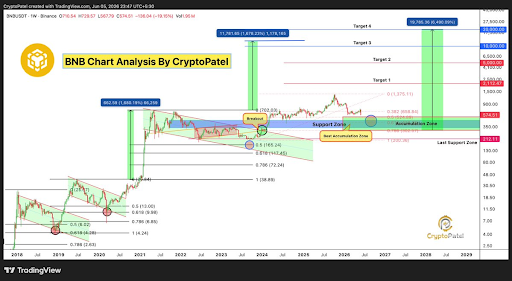
In the technical analysis provided by Crypto Patel, the projected path for BNB suggests a multi-year consolidation followed by a series of "step-ups." The "believable bull case" involves the asset reclaiming its previous all-time high and establishing a new support floor near $1,000. From there, a push toward $3,000 is viewed as the peak of the current market cycle.
The more extreme targets of $10,000 to $20,000 are plotted on a much longer time horizon. The analyst’s chart suggests that such levels would likely not be reached until at least 2029, coinciding with several more "Halving cycles" for Bitcoin and the continued maturation of the digital asset class. This timeline allows for the total crypto market cap to grow into a size that could realistically support a trillion-dollar altcoin.
Implications for the Broader Market
The trajectory of BNB serves as a bellwether for the "Exchange Token" sector and the broader Layer 1 (L1) competition. If BNB can successfully decouple from the specific news cycles of the Binance exchange and prove its independent utility through the BNB Chain’s Real-World Asset (RWA) tokenization and stablecoin dominance, it may redefine how investors value platform-linked assets.
Currently, the BNB Chain is a leader in global stablecoin transactions, often processing higher volumes of smaller retail transactions than Ethereum due to its lower fee structure. This utility provides a "fundamental floor" for the price. However, the rise of high-performance competitors like Solana and the scaling of Ethereum via Layer 2 (L2) solutions mean that BNB cannot rely on its historical momentum alone.
Conclusion: A Realistic Path Forward
While the allure of a $20,000 BNB is strong for those seeking life-changing returns, the sober reality of market mathematics suggests a more measured outlook. BNB’s journey to becoming a trillion-dollar asset depends on more than just the success of Binance; it requires the entire cryptocurrency industry to become a primary pillar of the global financial system.
For the immediate future, investors are focused on the $1,500 to $2,000 range. Reaching these levels would confirm BNB’s dominance among altcoins and potentially set the stage for a "flippening" with Ethereum. However, as the analysis by Crypto Patel highlights, any claims of a near-term $10,000 price point should be viewed with skepticism, as they ignore the fundamental constraints of global liquidity and market capitalization. The path forward for BNB is one of gradual supply reduction and steady ecosystem expansion, rather than an overnight leap into the multi-trillion-dollar stratosphere.